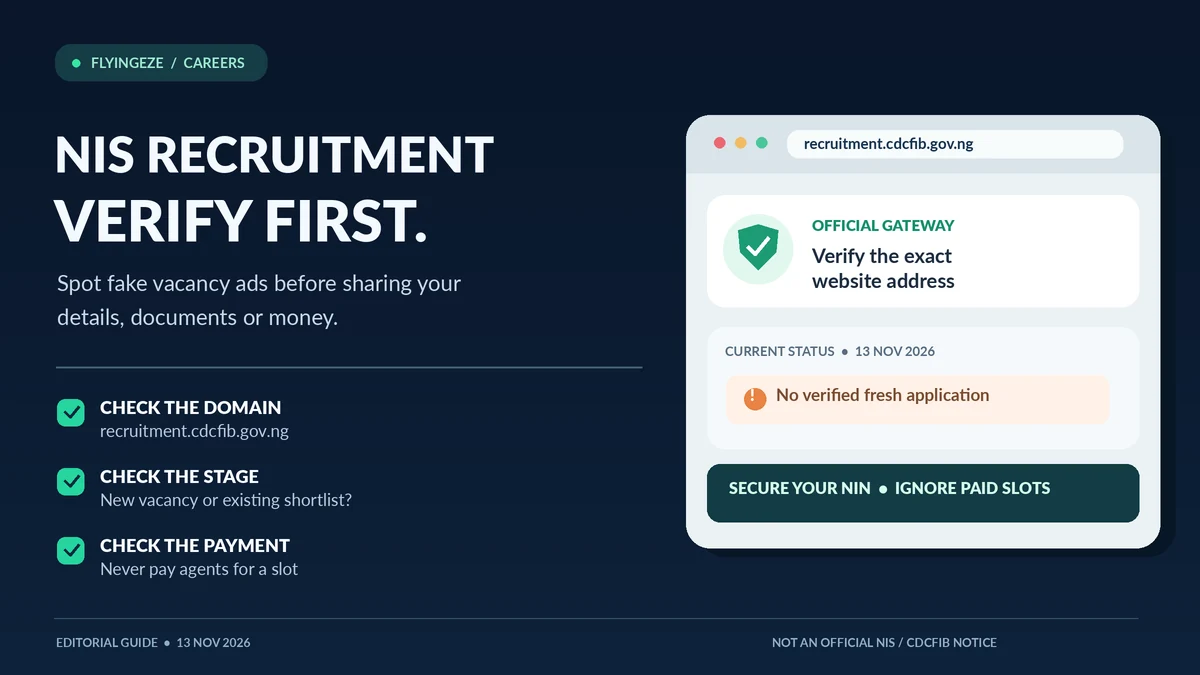
To verify a Nigeria Immigration Service (NIS) vacancy, begin with the official CDCFIB recruitment gateway at recruitment.cdcfib.gov.ng , then independently confirm the advert's date, agency, vacancy, application stage and instructions. Do not pay an agent or enter your NIN or screening details on a link received only through WhatsApp, an advert, a PDF or a social-media post.
The Nigeria Immigration Service has repeatedly warned about people impersonating it to publish fake job openings. For applicants searching immigration portal for recruitment, the danger is not just a completely invented website. Criminals can copy a real notice, use official-looking graphics, exploit an older shortlist, or add a fraudulent payment or identity-collection link to an otherwise familiar recruitment story.
Status checked 13 November 2026: no new first-time NIS application intake was verified open. CDCFIB's October–November 2026 portal activity concerns eligible candidates who progressed through the 2024/2025 exercise. The later 28 October Board notice described a window through 14 November 2026 for final-stage actions; an earlier announcement had named 13 November. Neither notice authorised a fresh recruitment form.
This guide provides a practical verification checklist, explains documented 2026 fraud incidents, and sets out safe next steps if you have already clicked a suspicious link, paid money or supplied personal documents. Because this is a fast-changing recruitment topic, all status statements are dated, and readers should recheck the official portal before acting.
Quick checklist: is an NIS recruitment advert genuine?
| Check | Genuine evidence to look for | Warning sign |
|---|---|---|
| Recruitment gateway | recruitment.cdcfib.gov.ng and authorised Board instructions | A different or disguised domain claiming to be the official form |
| Recruitment year and stage | A dated notice stating new applications or a specific existing-candidate step | Final-stage access presented as a new vacancy for everyone |
| Issuing authority | NIS, CDCFIB or a relevant government channel that can be independently checked | A WhatsApp-only agent or copied letterhead without corroboration |
| Vacancy details | Clearly named service, cadre, eligibility and actual deadline | Vague “all Nigerians eligible” offer and guaranteed placement |
| Fees | Published official instructions; the recent joint application was free | Money requested to buy an application, shortlist or appointment |
| NDLEA drug screening | Official link supplied through the relevant candidate portal | Payment for the October–November 2026 drug integrity test |
| Personal information | Details requested only inside a verified and applicable government workflow | NIN, OTP or document upload demanded by an unrelated form |
| Contact and escalation | Details independently obtained from NIS's official contact page | Unverifiable phone number offering private “processing” |
1. Start from the real NIS recruitment gateway
The CDCFIB—Civil Defence, Correctional, Fire and Immigration Services Board—administers the joint recruitment process involving NIS, the Nigeria Security and Civil Defence Corps, the Nigerian Correctional Service and the Federal Fire Service. The verified starting address used for this recruitment is https://recruitment.cdcfib.gov.ng/ .
The gateway leads to the CDCFIB applicant portal . The applicant interface requires JavaScript in a modern browser. A login or status-check page existing on a genuine government domain does not mean people who never applied can register today.
Use immigration.gov.ng for the Immigration Service's institutional information and official statements. Its passport, visa, residence and other travel-document systems are not employment application forms. Similarly, the main Board site, cdcfib.gov.ng , was displaying a scheduled-maintenance notice during the research check. That does not make a privately advertised “backup recruitment portal” legitimate.
In February 2026, NIS specifically warned that it was not running an independent recruitment exercise and directed the public to CDCFIB's recruitment system for the joint process. The warning was reported by the News Agency of Nigeria and BusinessDay . Always prefer a fresh authenticated update if the Board later announces a different procedure.
2. Inspect the complete website domain—not just the NIS name
A copied crest, green government-style colour scheme and HTTPS padlock cannot prove that a website is operated by NIS or CDCFIB. Criminals can obtain valid encryption certificates for websites they control. What matters is the complete hostname and whether the agency independently identifies that address as authorised.
For the current verified process, the hostname is recruitment.cdcfib.gov.ng. A fictional example such as recruitment.cdcfib.gov.ng.example.invalid is not part of the Board's domain: it ends in example.invalid. That example is illustrative and is not a real recruitment website. The same caution applies to links containing “immigration recruitment” in a path on an unrelated domain.
Do not assume a shortened URL or QR code points to the right destination. If a message claims an urgent vacancy, leave that message, type the government address yourself, and look for the actual notice. Never paste a screening ID, NIN or password into a website merely to test whether it is genuine.
When the Board's website is unavailable, wait for independently verified government instructions rather than moving to a mirror supplied by an unknown user. A genuine website error is inconvenient, but an impostor site can turn that inconvenience into identity theft.
3. Verify whether the advert describes a new vacancy or an old recruitment stage
The phrase “CDCFIB portal reopened” is not synonymous with “NIS is accepting first-time applications.” An important example is the 2026 continuation of the 2024/2025 joint recruitment exercise. The Board's October announcement concerned candidates who had already progressed through stages such as medical screening and oral interviews.
An October 22 report described portal access from 28 October to 13 November 2026 for eligible existing candidates. A later October 28 Board notice set out a window through 14 November for final-stage document verification, screening-location selection and registration for drug screening.
These details are specific to an ongoing exercise. If you did not submit an application in that earlier process, the existence of a status checker does not create a new opportunity to apply. A scammer may deliberately replace “existing shortlisted applicants” with “everyone can apply now” to attract people who missed the original intake.
Before clicking anything, record the advertised recruitment year, publication date, intended applicants and application stage. Compare those details with a dated official notice. A valid 2025 vacancy announcement may remain visible on a website but does not become a 2026 vacancy just because somebody shares it again.
4. Confirm the issuing authority and the exact job being advertised
A reliable vacancy notice should identify the responsible agency, the cadre or role being filled, eligibility conditions, application dates and instructions. During a joint CDCFIB exercise, an advert may mention multiple services, but candidates must still identify the specific NIS position and its requirements.
Do not assume that an advertisement for a fire-service technical role automatically makes the same qualification eligible for Immigration. In the previous joint recruitment, categories included superintendent, inspectorate and assistant posts with different education and professional requirements. A forthcoming exercise can change those requirements, so older age, height and qualification tables are only historical references.
FlyingEze's CDCFIB recruitment, agencies and eligibility explainer provides the broader joint-service context. This article instead focuses on authenticating an alleged vacancy before applying or sharing information.
A notice promising an officer position to every applicant irrespective of documents, fitness or assessment should trigger further scrutiny. So should a claim that a civil servant, politician or private recruiter can guarantee selection through a special slot.
5. Recognise fake PDF circulars and forged government announcements
A professional-looking PDF can still be fabricated. Names, letterheads, seals and scanned signatures can be copied; the presence of an official title is not evidence that the named person issued the document.
On 13 August 2026, the Federal Ministry of Information and National Orientation rejected a forged statement claiming that CDCFIB recruitment would be postponed until after Nigeria's 2027 general election. The Ministry said the document did not originate from the Minister of Interior, his office or CDCFIB.
Another documented case involved a fake notice saying that a recruitment-status portal would open on 3 August 2026. According to The Punch's August 2 report , CDCFIB disowned the notice despite its formal presentation and attributed signature.
The lesson is not to ignore all PDF notices. It is to verify any PDF independently: search for the same dated announcement on a government channel, confirm the named recruitment stage, and avoid following payment or login links contained only in the document. Do not circulate a suspicious PDF in jobseeker groups as confirmed news.
6. Do not trust a recruitment page because it has followers or a badge
NIS warned again in March 2026 about unauthorised recruitment posts circulating on social media. The Punch reported that the Service's statement addressed an impersonating Facebook page that had attracted more than 46,000 followers. Popularity did not establish that the page was an official recruitment authority.
Fraudulent posts may copy uniformed photographs, use the name of a government officer or ask people to comment with their phone numbers before moving the conversation into WhatsApp. Some offer to add candidates to a “shortlist group,” supply a leaked examination result or secure an appointment.
A safer process is to find social handles through the NIS website and compare the actual statement with CDCFIB notices. A forwarded post can alert you that something may have happened; it should not be the only evidence you use to pay, travel, upload documents or share personal identifiers.
7. Treat paid application slots, shortlists and appointments as red flags
The previous CDCFIB application exercise was publicly described as free, and NIS has stated that genuine recruitment should not be arranged through unofficial third-party payments. Be wary of “portal activation,” “shortlist confirmation,” “appointment allocation,” “medical clearance,” “VIP slot,” or “manual upload” fees requested by individuals.
An agency may ask candidates to bear ordinary personal costs of obtaining their own documents or travelling to a genuine screening location. That does not authorise a broker to collect money in exchange for a recruitment decision. Do not make a transfer just because the recipient account name sounds official.
A particularly clear example concerns the recent NDLEA Drug Integrity Test. In its 30 October 2026 statement , the National Drug Law Enforcement Agency said candidates from the four Ministry of Interior services should not pay for the mandatory test because the Ministry had already made arrangements for its cost. The appropriate access link was to be provided through the candidates' authenticated institutional portals.
Therefore a person seeking money for an October–November 2026 NDLEA screening code, faster appointment or guaranteed pass is not following those instructions. Passing a test also does not, by itself, amount to a final appointment letter.
8. Protect NIN, screening IDs, passwords and supporting documents
Some legitimate recruitment workflows request identity verification, including a National Identification Number, or an applicant's prior screening reference. The presence of an NIN field is not itself evidence of fraud. What matters is whether you reached that field through the authenticated government portal and whether it relates to your actual application stage.
Never publish your NIN, date of birth, original certificates, bank details, screening ID or application confirmation in a Facebook comment asking someone to check a shortlist. Fraudsters can copy these details, impersonate you or use them to make subsequent messages more convincing.
Be especially cautious if a supposed recruitment officer asks for a banking OTP, debit-card PIN, email password or remote access to your phone. Those are not normal proofs of eligibility for a government vacancy. Nigeria's Computer Emergency Response Team warns that fake forms distributed through SMS, email, WhatsApp and social media can be used to steal personal and financial information.
Keep genuine records in a secure folder and submit only what the authorised application or screening instructions require. If a link arrives unexpectedly, check the domain before typing any personal data.
How to check an NIS shortlist or candidate invitation safely
If you are an existing applicant, start at the CDCFIB recruitment gateway , follow its own applicant-portal link , and follow the options actually presented for your recruitment stage. The interface requires JavaScript; avoid unofficial pages that offer to “check your status” on your behalf.
For eligible finalists during the 2026 continuation, the Board's published instructions described document review, screening-location selection and mandatory drug-test registration. Those are not general steps that every member of the public must complete.
A genuine-looking invitation should be checked for the right applicant, prior application stage, date, authorised venue and required documents. If a message directs you to a new website, verify that destination independently through the Board's official gateway before signing in.
FlyingEze's dated report on CDCFIB's physical-screening shortlist is useful historical context. It should not be mistaken for a fresh invitation today. Likewise, a screenshot saying “selected” is not reliable proof that a different candidate has been appointed.
Why a maintenance notice does not justify using a mirror portal
At the research check, the official CDCFIB website displayed scheduled maintenance, while the recruitment gateway linked to an applicant interface. A page loading slowly or showing an error is not evidence that the government has moved applications to a private .com, .org or shortened URL.
Use an updated browser, verify the address, enable JavaScript where the genuine portal requires it, and follow the Board's authenticated service announcements. If an important deadline is approaching, keep a private screenshot of the technical error with the date and time, then request clarification through independently sourced government contact details.
Do not assume an outage extends a closing date. Similarly, do not allow a third party to install an unknown “recruitment fix” application or take control of your device to resolve a website problem.
What if you already clicked a suspicious NIS recruitment link?
Your response depends on the information or access the website obtained. Avoid panic-driven decisions: focus on securing the accounts and evidence that could actually be affected.
If you opened the page but entered nothing
Close it, avoid downloads or unexpected permission prompts, and do not revisit it through the same message. If a file was downloaded, do not execute it. Review device warnings or security settings if the page requested installation or unusual permissions.
If you submitted your NIN, identity card or certificates
Preserve the exact URL, date and any confirmation message. Do not send more documents or “verification charges.” Watch for follow-up impersonation attempts using information you disclosed, and contact the relevant identity issuer or account provider if misuse becomes apparent. Do not publish the leaked information while asking strangers for advice.
If you shared a password or OTP
Change the affected password through the genuine service from a trusted device. Secure the linked email and other accounts where a password was reused. If banking credentials, OTPs or card details were exposed, contact your bank immediately through its published fraud channel.
If you transferred money to a supposed agent
Stop further payments, especially requests for a refund-processing fee. Save the transfer receipt, recipient account, messages and advertised vacancy. Contact the bank or payment provider promptly to request a fraud review; recovery is not guaranteed.
How and where to report a fake NIS recruitment website
First, preserve evidence: the exact website address, sender's profile, the message or PDF, screenshots, date, payment details and the action requested. Make sure screenshots do not unnecessarily expose your NIN or other private records when sharing them.
For government verification, use NIS's official contact page rather than a number printed on the suspicious advert. CDCFIB's main site also displays a Board contact at its authenticated government address. Clearly distinguish a request to verify an announcement from a claim that the government will reverse a fraudulent transfer.
For a suspected cybercrime or identity-theft attempt, the Nigeria Police Force National Cybercrime Centre (NPF-NCCC) operates an official e-reporting portal. Nigeria's ngCERT phishing advisory also advises reporting suspicious websites and messages. Where money was sent, contact the financial institution promptly, then use the appropriate law-enforcement route.
Do not publicly accuse an unrelated person merely because their name resembles a scammer's display name. Provide evidence and allow the relevant investigators to assess it.
How to prepare for a future genuine NIS vacancy without using an agent
There was no verified new NIS first-time application intake on 13 November 2026. Until an authentic vacancy is announced, keep your identity documents consistent, organise educational records, maintain control of your own email and phone number, and review the official requirements when published.
Do not treat old age, height or academic qualification requirements as confirmed rules for a future exercise. You can use past notices to prepare questions, but only the actual new advert determines eligibility, application dates, the applicable cadre and documentation instructions.
Check the official recruitment gateway periodically rather than paying to join a “priority list.” The legitimate goal is to be ready to apply on time, with accurate information, when an eligible vacancy really exists. FlyingEze's earlier report on fake CDCFIB recruitment portals provides further historical background on this recurring problem.
Frequently asked questions about fake NIS recruitment portals
What is the genuine immigration portal for recruitment?
The official gateway used for the verified joint CDCFIB process is recruitment.cdcfib.gov.ng . Existing candidates should follow its own applicant-portal link and current Board instructions.
Is NIS accepting fresh job applications on 13 November 2026?
No fresh first-time application round was verified on that date. The October–November portal access was for eligible applicants already in the 2024/2025 recruitment process, not a new intake.
Is immigration.gov.ng a recruitment form?
No. It is the official Nigeria Immigration Service institutional website. Its passport, visa and travel-document services should not be confused with an employment application form.
Can I trust a PDF with a government seal and signature?
Not without independent confirmation. The Ministry of Information and CDCFIB disowned forged recruitment notices during 2026, including documents designed to resemble official announcements.
Does a social-media page with thousands of followers prove a vacancy is real?
No. NIS specifically warned about an impersonating social-media recruitment page in March 2026. Confirm claims from authenticated government channels instead of relying on popularity or a badge.
Should I pay to obtain an NIS shortlist or appointment letter?
No. Do not pay a private agent for recruitment access, selection or a reserved position. The recent joint application was free, and the October–November 2026 NDLEA drug test was officially free to candidates.
Is it safe to enter my NIN on the applicant portal?
A genuine and relevant government candidate workflow may require identity verification. Verify that you are on the Board-linked portal and that the request applies to your stage; never enter NIN details into an unrelated “status checker” or social-media form.
Where should I report an impersonating recruitment website?
Preserve the link and evidence, use independently obtained NIS or CDCFIB contacts for verification, and report suspected cybercrime to the NPF National Cybercrime Centre through its official reporting portal. If you paid money, contact your bank promptly as well.
Final verification checklist: five questions before you act
- Source: Does the announcement trace back to the genuine CDCFIB or NIS government channel?
- Stage: Is it a new application or an instruction for already shortlisted candidates?
- Details: Are the date, agency, vacancy, eligibility and deadline consistent with an authenticated notice?
- Safety: Is anyone requesting an unofficial payment, OTP, NIN upload or website login?
- Evidence: Can you independently corroborate the claim before applying, travelling or sharing it?
The bottom line: anyone searching for an immigration portal for recruitment should verify more than a web address. Start at the official CDCFIB gateway, check whether the claimed vacancy is genuinely open, and compare dates, stages and instructions against authenticated government notices. Do not let urgent language, an impressive letterhead or a promised appointment override those checks. The safest recruitment application is one made through the correct process—not through a person claiming to offer a shortcut.