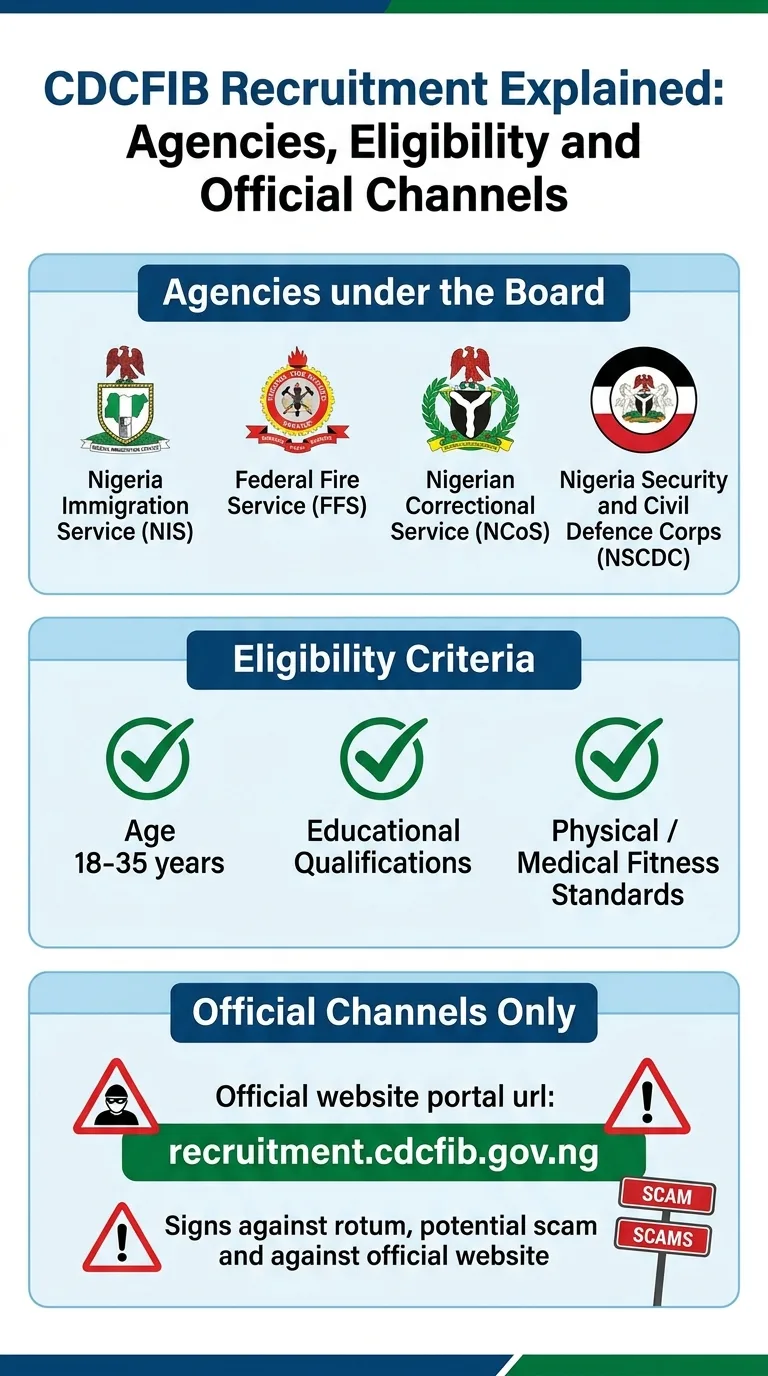
CDCFIB recruitment is the process used by Nigeria's Civil Defence, Correctional, Fire and Immigration Services Board to select eligible applicants for four federal paramilitary services. Those services are the Nigeria Security and Civil Defence Corps (NSCDC), Nigeria Immigration Service (NIS), Nigerian Correctional Service (NCoS) and Federal Fire Service (FFS). Although the agencies have different duties, their joint recruitment exercises can use the same Board-managed application and screening system.
Recruitment status as of 9 November 2026: There is no verified new application round for first-time applicants. The official CDCFIB recruitment notice currently describes the 2024/2025 exercise as concluded. Separately, a Board announcement reported on 28 October 2026 gave candidates already at the final stage until 14 November 2026 to complete specified document and screening steps. That was not a fresh invitation to submit applications. Existing candidates should follow the instructions in their own official applicant dashboard.
This guide explains the participating agencies, eligibility rules from the last advertised exercise, qualifications by role, recruitment stages and how to distinguish authentic notices from scams. The correct official recruitment starting point is recruitment.cdcfib.gov.ng . Do not send your National Identification Number (NIN), login details or money to an unofficial “shortlist checker”. Last fact-checked: 9 November 2026.
What does CDCFIB stand for?
CDCFIB means the Civil Defence, Correctional, Fire and Immigration Services Board. It is the Board involved in appointments and recruitment administration across four services under Nigeria's Ministry of Interior. CDCFIB is not a fifth service into which a person applies in place of choosing a specific agency.
It is also different from the Nigeria Police Force, Nigerian Army, Nigeria Customs Service and other federal organisations with separate recruitment procedures. A page that combines a supposed CDCFIB application with unrelated agencies or promises automatic transfer to another organisation should be verified before anyone acts on it.
The four agencies included in CDCFIB recruitment
| Agency | Full name | Main areas of work |
|---|---|---|
| NSCDC | Nigeria Security and Civil Defence Corps | Protecting critical infrastructure, civil protection, disaster response and related security duties |
| NIS | Nigeria Immigration Service | Border management, entry and exit controls, passports and migration administration |
| NCoS | Nigerian Correctional Service | Custodial and non-custodial services, rehabilitation and reintegration |
| FFS | Federal Fire Service | Fire prevention, firefighting, rescue, inspection and fire-safety education |
1. Nigeria Security and Civil Defence Corps (NSCDC)
The NSCDC supports Nigeria's internal security system. Its official mandate includes the protection of critical national assets such as energy facilities and telecommunications infrastructure, disaster support, the regulation of private guard companies and other civil-protection responsibilities. Some roles may be operational; others may involve administration, technology or specialist skills when advertised.
2. Nigeria Immigration Service (NIS)
The NIS manages key immigration and border functions. According to the service's own description , these include controlling entry into and exit from Nigeria, issuing travel documents and residence permits, border surveillance and enforcing relevant immigration laws. Applicants should not assume that every immigration role is a passport-desk position: specific vacancies determine duties and qualifications.
3. Nigerian Correctional Service (NCoS)
The NCoS manages custodial and non-custodial correctional services. Its service charter covers secure and humane custody, rehabilitation, vocational programmes, reintegration and lawful non-custodial measures. Recruitment may therefore involve a range of operational and professional roles when those vacancies are authorised.
4. Federal Fire Service (FFS)
The FFS focuses on fire prevention and response. Its official mandate includes firefighting and rescue, fire-safety regulation, public education, risk assessment and specialist training. Some positions can require particular technical, health or fitness qualifications, so applicants must read the actual role description.
Is CDCFIB recruitment open now in November 2026?
Not for a verified new round of applications, as at 9 November 2026. Readers should distinguish three things that are sometimes all described as “recruitment opening”: an invitation to apply for the first time, temporary access for applicants already shortlisted, and a website displaying historical information.
The Board's public notice states that the 2024/2025 recruitment exercise has concluded and asks visitors to watch for further information. However, the Board's 28 October 2026 statement announced an access window through 14 November specifically for successful candidates continuing document confirmation, location selection and drug-screening arrangements. These messages concern different presentations or stages of the same exercise; they do not establish a new 2026/27 recruitment application round.
An earlier report following the Board's 22 October meeting mentioned 13 November as the closing date. The later dated 28 October notice reported 14 November. This date discrepancy is a good reason for affected candidates to prioritise the current instruction shown in their official applicant portal, not an old post, screenshot or third-party countdown.
People who did not previously apply should not attempt to register through the final-stage process or pay anyone claiming a special form is available. This article will need a status update if the Board officially announces another intake.
CDCFIB eligibility requirements: what the previous recruitment notice said
The official Nigerian Correctional Service notice for the 2025 exercise identifies general requirements for applicants across the four services. These provide a useful guide to preparing for a future advertisement, but they must not be treated as guaranteed eligibility rules for an unannounced recruitment round.
| Requirement | Advertised for the previous exercise | What to verify next time |
|---|---|---|
| Citizenship | Nigerian citizen by birth | The citizenship conditions and proof required by the new notice |
| Age | Generally 18–35 years | The exact date for calculating age and any role-specific rule |
| Height | At least 1.65m for male applicants; 1.60m for female applicants | The applicable physical standard for the new vacancy |
| Health | Physically and mentally fit | Approved medical evidence and screening process |
| Character | Good character and no disqualifying criminal record | Required declarations and verification |
| Education | Relevant qualifications for the specific post | Exact certificate, subjects, grade and professional requirements |
| Agency selection | One application to one of the four agencies | Any fresh instruction on duplicate applications |
Do not assume that a particular height, qualification or age exception can be waived by an agent. Also do not assume that being within the age limit ensures selection: applicants must satisfy the requirements of the specific position and the subsequent assessment process.
Educational qualifications and recruitment cadres
Vacancies in the previous exercises have been described under superintendent, inspectorate and assistant cadres, with different requirements for each. For a future recruitment, the published vacancy advert—not a general social-media chart—must be the authority.
Superintendent-level roles
Such positions have included degree- or Higher National Diploma-level routes, with professional qualifications necessary for specialist vacancies. A person with a general degree should not automatically assume eligibility for a medical, engineering, legal or other regulated professional role.
Inspectorate-level roles
Previous advertisements have included qualifications such as the National Diploma (ND/OND), Nigeria Certificate in Education (NCE), and specialist nursing or other credentials for appropriate positions. Applicants should check whether a professional registration, licence or particular field of study is mandatory.
Assistant and technical roles
Some posts accepted recognised secondary-school qualifications such as WAEC, NECO or other accepted O-level results, while artisans and drivers could need trade tests or relevant licences. Earlier notices described four or five relevant credit passes for certain roles, including English and Mathematics, but the precise threshold varied by position. There is no single universal “four credits guarantee entry” rule.
For any new vacancy, read the actual job title and eligibility section before selecting a cadre. Having a higher qualification does not necessarily allow a candidate to ignore a role's specific licensing, physical or academic requirements.
How the CDCFIB application process works when a new round is announced
The following is a preparation guide based on the previous process, not an instruction to register now. The workflow or interface could change in a future exercise.
- Confirm an actual opening. Read the announcement on the official recruitment portal and check its date, available positions, deadline and approved agencies.
- Select one service and a suitable vacancy. Read its educational, physical, age and professional requirements first.
- Prepare accurate information. Have the identifying information and documents expressly requested by the portal, including a valid NIN where required, available before beginning.
- Complete the official form once. Follow the current on-screen instructions and review spellings, dates, qualifications and contact information before submission.
- Keep the official acknowledgement. Save any application number or receipt provided by the government portal, without publishing personal details.
- Follow later notices. Any CBT, physical verification, interviews or other assessments should be confirmed on the official portal for that exercise.
In the 2025 exercise, applying to more than one service was explicitly disallowed and could result in disqualification. Do not create extra applications because a third party says it will improve your chances. Recruitment does not require paying a broker, WhatsApp administrator or unofficial “registration centre” to secure a slot.
What happens after an application is submitted?
CDCFIB recruitment can involve more than an online form. The previous 2024/2025 exercise proceeded through stages that included application review, computer-based testing, physical and document verification, medical assessment and interviews or other screening, depending on the category and stage.
For example, the Board issued official instructions for physical screening in its previous exercise . That FlyingEze report is historical information: it is not a current invitation to attend a screening centre.
A candidate moving past one stage is not automatically appointed. Similarly, a shortlist for an interview is not the same as the final list of successful recruits. Assessment dates, venues and document requirements should always be read from the candidate's own current portal instructions rather than generalised from someone else's message.
How existing applicants should check their CDCFIB status safely
- Type https://recruitment.cdcfib.gov.ng/ directly into a browser, or use a trusted bookmark.
- Follow the site's link to the official applicant portal .
- Use the login or identification fields currently displayed. They may change; avoid guides claiming that one particular password or login format always works.
- Read your individual application status and any official notices or downloadable instructions associated with it.
- Keep sensitive identifiers private and save relevant instructions securely for personal reference.
Where the site requires JavaScript, enable it only in a trusted, updated browser. If the Board website is temporarily unavailable or under maintenance, return later rather than entering credentials into an alternative address promoted by a stranger. The main CDCFIB website was displaying a maintenance notice when this article was checked; that does not authorise a different organisation to collect applications.
The Board has previously warned applicants against relying on emails and unofficial channels for recruitment stages. A purported shortlist forwarded on WhatsApp or contained in a paid downloadable PDF should not override the official dashboard.
What is the NDLEA drug test in the final recruitment stage?
In the late-2026 final-stage process, some candidates who had already passed earlier assessments were directed to complete a Drug Integrity Test (DIT) with the National Drug Law Enforcement Agency (NDLEA). This was a step for eligible candidates within the existing recruitment, not a separate opportunity for new applications.
On 30 October 2026, the NDLEA explicitly confirmed that candidates should pay nothing for that test because the Ministry of Interior had arranged bulk payment. NDLEA said applicants should access the Drug Integrity Test system through the designated link provided on their respective institutional portals, then follow the registration and testing instructions.
Therefore, do not follow an unknown “NDLEA CDCFIB test payment” link, pay a testing-centre official or purchase a supposed screening code. Confirm eligibility and the next step from your own official application record. The precise screening timetable and any appointment instructions should be checked against the current official notice.
How to recognise CDCFIB recruitment scams and fake portals
Recruitment fraud often exploits urgency: someone claims that only a few places remain, that a candidate has been privately selected or that an agent can fix a portal problem for a fee. The following warning signs deserve attention:
- A lookalike domain: an unfamiliar address with extra words, different endings or a misspelt government name.
- A payment demand: fees for an application form, shortlist access, interview venue, drug test or appointment letter.
- An unexpected message: a WhatsApp, Telegram, email or SMS instructing you to submit your NIN, password, OTP or bank details on a separate site.
- A guaranteed job offer: someone promises appointment in exchange for money, a referral or a “special connection”.
- An outdated advert disguised as a new one: a previous screening date is recirculated under a 2026/27 headline without a fresh Board announcement.
- An unverified list: a downloadable “final shortlist” or image with no matching announcement on the official portal.
FlyingEze previously reported the Board's warning about fake recruitment portals . It also covered the government's denial of a misleading postponement notice . Both illustrate why independent verification matters; they should be read as reports about events at the time, not as substitutes for the current official notice.
Be especially careful with the NIN: it is personal identifying information, not a harmless keyword to enter into multiple “checker” websites. An official-looking coat of arms, HTTPS padlock or screenshot alone does not prove a website is operated by the Board. Always verify the full address and context before sharing details.
Documents applicants can prepare before the next recruitment
Preparation can save time once a real application window opens. Keep originals and safe copies of documents you may be asked to provide, but do not upload them anywhere until the Board has formally opened an appropriate process.
- Accurate personal details that match official records, including your NIN where required.
- Valid phone number and access to the contact details used for an existing application.
- Relevant educational certificates, O-level results and transcripts where applicable.
- Professional registration, trade-test certificates or licences for specialist roles.
- Citizenship or state/local government documentation if the official notice requires it.
- Any medical, photograph or identity documents specifically requested by the new vacancy or screening notice.
Check that your names, date of birth and qualifications are consistent across documents. If a record contains an error, resolve it through the responsible institution rather than paying someone to create altered paperwork. Fraudulent certificates may result in disqualification and possible legal consequences.
Common CDCFIB recruitment mistakes to avoid
One mistake is assuming a reopened portal means new jobs are available. In October 2026, the Board's final-stage access window was for candidates already in the process. Another is applying for an agency solely because a friend selected it, without checking its mandate or the advertised role.
Other mistakes include submitting inconsistent identifying information, applying twice in violation of recruitment instructions, trusting old screening requirements as permanent rules, following unverified result links and believing that payment can replace the Board's selection stages.
For someone considering the four services, the better approach is to understand the duties, compare a future vacancy with your qualifications and use official instructions at every stage. No legitimate guide can guarantee selection.
Frequently asked questions about CDCFIB recruitment
What is the full meaning of CDCFIB?
CDCFIB stands for the Civil Defence, Correctional, Fire and Immigration Services Board, which handles recruitment administration for four participating Nigerian paramilitary services.
Which agencies participate in CDCFIB recruitment?
The Nigeria Security and Civil Defence Corps, Nigeria Immigration Service, Nigerian Correctional Service and Federal Fire Service.
Is CDCFIB recruiting new applicants in November 2026?
No fresh application round was verified as open on 9 November 2026. The official recruitment notice describes the 2024/2025 exercise as concluded, while an October notice provided a limited final-stage window for existing eligible candidates. Check the Board's official portal for changes.
What is the official CDCFIB recruitment portal?
Use https://recruitment.cdcfib.gov.ng/ and follow its own applicant-portal link. Do not enter personal details on an unrelated “results checker” site.
What age and height limits applied to the previous exercise?
The 2025 recruitment notice listed 18–35 years and minimum heights of 1.65 metres for men and 1.60 metres for women. A future advertisement must be checked for the exact rules and qualifying dates for that round.
Can I apply for NSCDC and Immigration at the same time?
During the last joint recruitment, applicants were instructed to choose only one of the four services; multiple applications could lead to disqualification. Follow the same precaution unless an officially announced future recruitment expressly provides otherwise.
Do I need a university degree to apply?
Not for every role. Previous exercises included positions under different cadres, with some requiring O-level or trade qualifications and others demanding diplomas, degrees or specialist credentials. Eligibility depends on the specific vacancy.
Is CDCFIB recruitment free?
Yes, the official process has been described as free. In particular, NDLEA confirmed on 30 October 2026 that eligible CDCFIB candidates must not pay for the mandatory Drug Integrity Test in the ongoing final-stage process.
How do I know if I am shortlisted?
Access your own status through the official applicant portal and follow its instructions. A forwarded screenshot, commercial “shortlist PDF” or private message is not reliable confirmation.
When will the next CDCFIB recruitment start?
As of 9 November 2026, an official new application date had not been verified. Any later announcement should be checked directly on the Board's recruitment portal. This guide will need updating if a new intake is formally announced.
Conclusion: follow the Board, not the rumours
CDCFIB recruitment brings together four Nigerian federal paramilitary services, each with its own mandate and vacancy requirements. The last advertised exercise used general eligibility rules covering citizenship, age, fitness, character, qualifications and a one-service application limit. Those historical requirements can guide preparation, but they do not replace a future official vacancy notice.
The most important practical point for November 2026 is that the final-stage process for existing applicants is not a new recruitment exercise. First-time applicants should monitor the official CDCFIB recruitment website rather than register through imitation portals. Existing candidates should review their own dashboard, respect valid deadlines and avoid all unofficial payments—especially for NDLEA drug testing, which the agency says is covered by the government.
Editorial note: Information checked on 9 November 2026. Recruitment announcements, dates, access conditions and eligibility may change. FlyingEze is an independent publication, not a recruitment agent or official CDCFIB representative. Never send personal credentials to this publication or pay anyone for a recruitment slot.