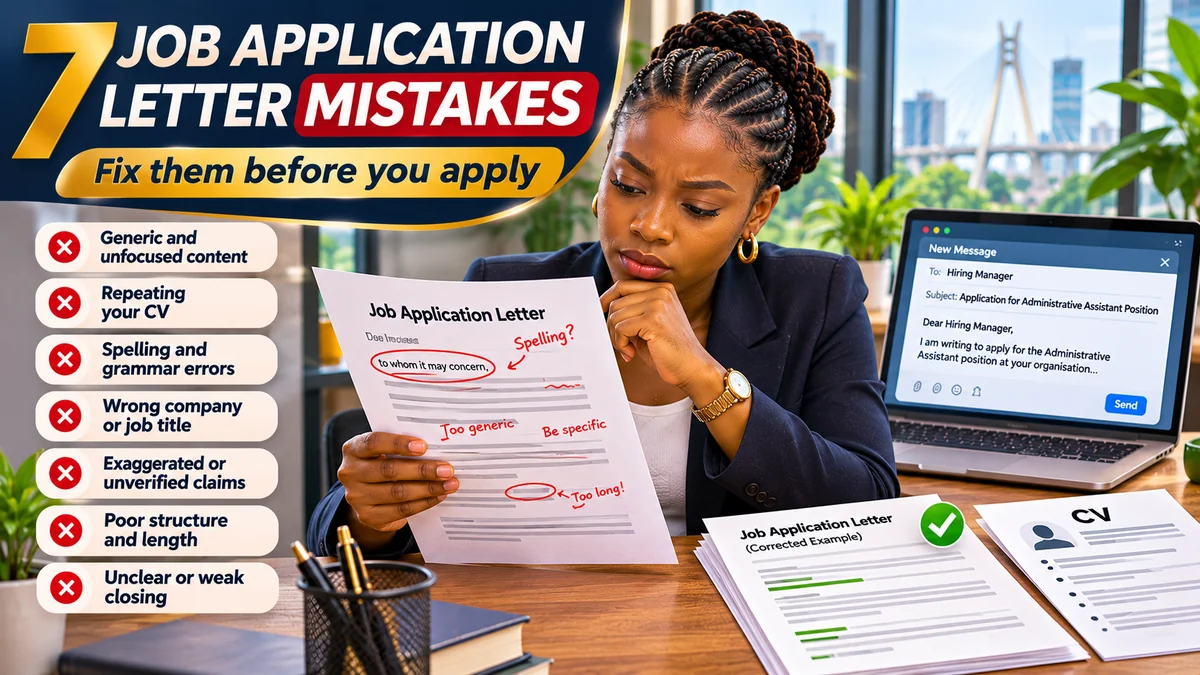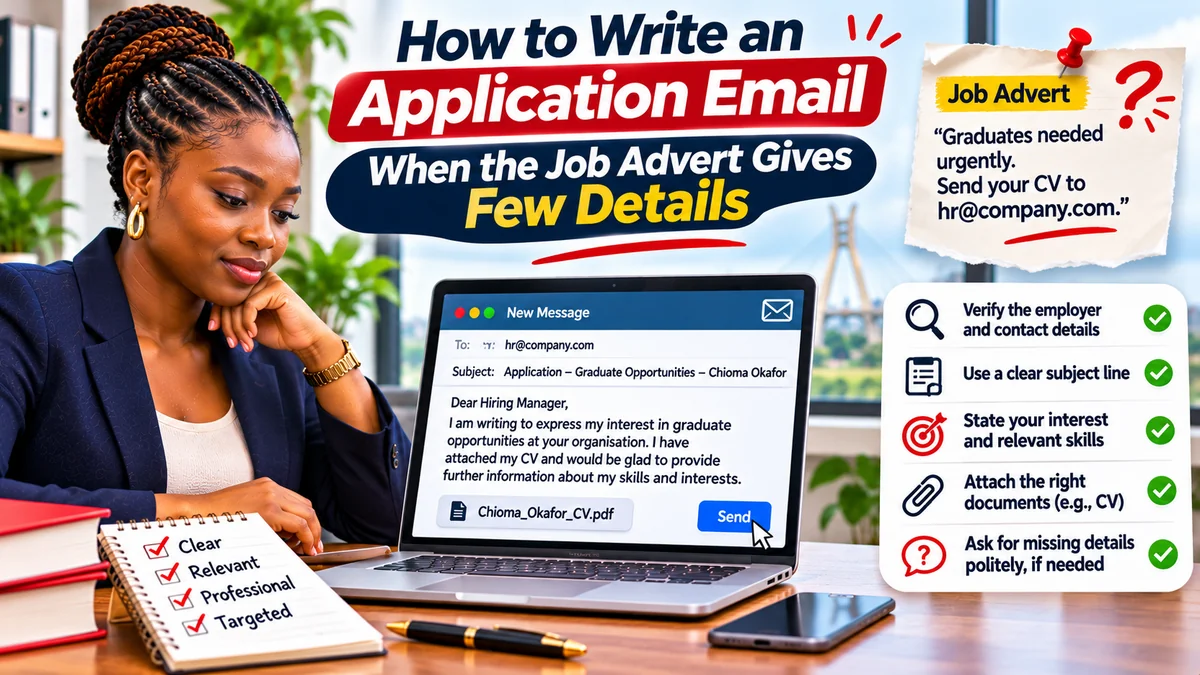
When a job advert gives few details, write a short, targeted application email only after confirming that the employer and recruitment channel are genuine. State the role you believe you are applying for, highlight one or two relevant skills with truthful evidence, and attach only the documents requested. If the advert does not identify a role, the employer or a trustworthy application process, ask a focused question first—or do not send personal information.
Searching for an application letter for job application often leads to full formal-letter templates. Yet some Nigerian vacancies simply say “Send CV to this email,” “Staff needed urgently,” or “Interested candidates should contact HR.” Others give a job title but omit the duties, employment type, location or deadline. The difficult part is knowing how much to write when you do not have enough information to tailor a traditional cover letter.
This guide explains how to respond professionally without inventing facts about the vacancy. It includes a decision table, a practical email structure, four original sample messages, questions to ask recruiters, attachment and follow-up advice, and current precautions against recruitment fraud. All samples are illustrative; edit them using your genuine experience and the real, independently verified employer details. Research checked: 16 November 2026.
Quick answer: what should you write when the advert is vague?
If a real employer has advertised a specific role but provided few duties, use an email with five elements:
- Subject: “Application – [Exact advertised role] – [Your name]” and any reference supplied.
- Greeting: A verified contact's name or “Dear Hiring Manager”.
- Opening: Identify the vacancy and where you saw the official advert.
- Fit: Give one or two accurate, relevant examples of what you can do; do not guess hidden requirements.
- Closing: Mention your CV or required attachment, thank the reader and offer to provide further information.
Short illustrative email: “Dear Hiring Manager, I am applying for the Administrative Assistant vacancy posted on your verified careers page. Through my supervised placement, I developed experience maintaining spreadsheets, organising records and meeting deadlines. I have attached my CV and would welcome further details about the role's day-to-day responsibilities. Thank you for your consideration. Kind regards, [Full name].”
This example assumes there is a verified company and a clearly named position. If there is no identifiable employer or authorised application address, do not treat that message as safe to send with your CV.
First decide whether you should apply, ask or stop
Not every short advertisement is fraudulent. A small local business may genuinely use a brief notice, and some recruiters provide fuller details later. However, missing essentials create uncertainty. The Penn State Behrend career service specifically recommends contacting an employer when a vacancy lacks enough detail and asking for a more complete description or clarification of the application method.
| What the advert tells you | Best initial action | What not to assume |
|---|---|---|
| Verified employer, exact role, official email, few duties | Send a short tailored email if application instructions are clear; ask targeted questions if essential details are missing | Do not invent responsibilities or experience requirements |
| Verified employer, “graduates needed”, no job title | Ask which positions are available, or clearly state your relevant functional interest | Do not call yourself an applicant for a role that was never announced |
| Official organisation, no advertised vacancy | Send a clearly labelled speculative enquiry only if the organisation accepts such contact | Do not imply that a vacancy is open |
| Anonymous poster, unofficial link, payment request or identity demands | Pause, verify independently and avoid sending sensitive documents | Do not treat a logo, forwarded message or urgent deadline as proof of legitimacy |
| Advert directs you to a verified application portal | Follow the portal instructions, not an unrelated email address | Do not bypass a required form with an unsolicited attachment |
This distinction is especially important for government roles. In an August 2026 public warning , Nigeria's Federal Civil Service Commission advised applicants not to rely on recruitment links and purported announcements that cannot be traced to official FCSC channels. A social-media post using a government emblem does not establish an authorised vacancy.
Step 1: verify what the advertisement actually says
Read the original listing, not just a screenshot cropped for WhatsApp or Telegram. Record its exact wording, the date of publication, the stated company name, location, role title, application channel, deadline and any reference number. Check the organisation's official website and careers page where available, or contact a verified public office number.
If you discover the vacancy on a reputable job board, open the original posting and check whether the same company and job are identifiable through independently confirmed channels. A company name appearing in a listing is helpful but not, by itself, proof that the person sending the message is authorised to recruit for it.
A registered business is not necessarily the source of a particular vacancy, either. Be cautious with supposed hiring staff who ask you to move immediately to private messaging, pay a processing fee, provide bank information or share an OTP. These are reasons for more verification, not reasons to accelerate your application.
For a broader checklist, FlyingEze's guide to recognising fake remote job offers in Nigeria covers recruitment impersonation and document-safety concerns.
Step 2: decide what information is essential, and what can wait
Recruiters do not always publish every task, reporting relationship or workplace policy. You may still apply when the company, role and official submission method are clear. But some missing details determine whether you can make an informed decision or whether your credentials are relevant.
Prioritise clarification about the position itself, the work location or remote arrangement, the type of employment, required qualifications and the submission deadline. Salary, working hours and benefits may also be important to you, but there is no universal rule that all questions must be answered in the first email.
If you need clarification, choose at most two or three focused questions instead of sending a long questionnaire. Penn State's guidance suggests asking for a full job description or a preferred application format; that is a sound model for a brief initial enquiry.
Useful wording: “Could you confirm the role title and primary responsibilities?” “Is the position based in Enugu, Lagos or available remotely?” “Should applicants submit a CV by email or through an official portal?”
Avoid presenting an unanswered question as a fact. For example, if an advert only says “graduate opportunities”, do not write, “I am applying for the confirmed Finance Officer role with your Abuja branch.” Nothing in the notice establishes that such a position exists.
Step 3: choose a subject line that makes your purpose unmistakable
The subject line helps a hiring team identify and route the email. Jobberman Nigeria , the British Council and George Brown College Career Services all recommend a clear subject containing the job or application purpose.
| Situation | Suitable subject |
|---|---|
| Specific position stated | Application – Customer Support Assistant – [Full name] |
| Advert includes a reference | Application – Accounts Assistant – Ref [Reference] – [Name] |
| Verified advert with no position | Enquiry About Graduate Vacancies – [Full name] |
| Application method unclear | Clarification Request – [Advert title or date] |
| No advertised opening | Expression of Interest – Operations Opportunities – [Full name] |
Do not invent a job code. Avoid vague subjects such as “Please help”, “JOB!!!” or “My CV”. The exact subject supplied in a genuine advert takes priority over these examples.
Step 4: write a short email instead of a speculative essay
For a basic application email, two or three short paragraphs often work well. That is practical guidance rather than a compulsory Nigerian word limit. George Brown College recommends a short professional message, named subject, appropriate signature and clearly identified attachments. The University of Reading explains that the covering letter can appear in the email body or as an attachment, depending on employer instructions.
Paragraph 1: State why you are writing and what verified notice prompted the message. Paragraph 2: Describe one strong example from work, NYSC, education or volunteering that relates to the advertised function. Paragraph 3: Refer to the CV, ask a necessary question if appropriate and finish politely.
A rough starting range of 100–180 words can keep a short application readable, but follow the job's specific requirements. An employer may request a longer statement or answers to selection criteria, in which case an ultra-short email will not substitute for them.
Write “I maintained records for my NYSC supervisor” only if that is true. Do not ask an AI tool to invent duties or employers to fill gaps in the advert. An honest, adaptable email is more credible than a highly specific story that cannot be verified.
Example 1: application email when the role is named but duties are unclear
Scenario: A verified fictional employer advertises an Administrative Assistant position but gives no detailed responsibilities. The applicant has relevant documentation experience. Replace every bracketed field and claim before use.
Subject: Application – Administrative Assistant – [Full name]
Dear Hiring Manager,
I am applying for the Administrative Assistant position advertised on [verified company page or job board] on [date]. My background includes experience with document organisation, spreadsheet updates and coordinating routine tasks.
During [real placement or project], I maintained [specific records] and followed up on missing information before it was submitted. This helped me develop accuracy, communication and time-management skills relevant to administrative support.
I have attached my CV for your review. I would appreciate any further information you can share about the position's main responsibilities and reporting arrangements.
Thank you for your consideration.
Kind regards,
[Full name]
[Phone number]
This is an example, not an actual applicant's history. The writer does not claim knowledge of undisclosed duties or demand that the employer provide an extensive description before acknowledging the application.
Example 2: a vague “graduates needed” advert from a verified employer
Scenario: A real organisation posts a verified vacancy notice mentioning graduate opportunities, but does not identify the departments or job titles. Because there is no exact advertised role, use an enquiry or expression of interest rather than inventing one.
Subject: Enquiry About Graduate Opportunities – [Full name]
Dear Recruitment Team,
I saw your graduate-opportunities notice on [verified channel] and would like to learn which positions are currently accepting applications.
I am a graduate of [true discipline] with experience in [real project, training or previous work]. My interests are mainly in [specific field, such as customer operations or finance support], where I have developed skills in [two relevant capabilities].
Could you confirm the available role titles and the official application process? I would be happy to provide a CV through the channel your team recommends.
Thank you for your guidance.
Kind regards,
[Full name]
[Phone number]
Notice the difference: this example does not attach a full set of personal records before the vacancies and recipient are understood. If a verified employer's official advert clearly instructs graduates to attach a CV immediately, comply with that requirement rather than using the sample unchanged.
Example 3: ask for details before applying
Scenario: The company and contact address are verified, but important eligibility information is absent. A short clarification can save effort and reduce misunderstanding.
Subject: Clarification on Customer Service Vacancy – [Advert date]
Dear Hiring Manager,
I am interested in the Customer Service vacancy listed on your official page on [date]. Before submitting my application, could you please clarify whether the role is based on-site or remote and whether previous paid customer-service experience is required?
I have relevant experience from [real project or placement] and would like to ensure my application follows your requirements.
Thank you for your time.
Kind regards,
[Full name]
This is a clarification request, not a submitted application. Do not count it as an application in your job-search record unless the organisation subsequently accepts an application from you.
Example 4: a speculative email when no job has been advertised
A speculative application is different from responding to a vague advert. It is an enquiry about potential opportunities when there is no confirmed opening. Prospects' career guidance advises clearly identifying the kind of work sought, relevant evidence and the reason for contacting that organisation.
Subject: Expression of Interest – Junior Data Support Opportunities – [Full name]
Dear Recruitment Team,
I am writing to enquire whether your organisation considers applications for junior data-support opportunities. I have reviewed [genuine public information about the organisation] and am interested in work involving accurate records and reporting.
Through [true coursework, independent project or placement], I developed skills in spreadsheet validation and presenting basic findings. I would be pleased to discuss how these skills might support an appropriate future opening.
If your team accepts expressions of interest, please let me know the preferred application process. I can provide a CV or a link to non-confidential work samples.
Thank you for your consideration.
Kind regards,
[Full name]
[Phone number]
Do not suggest you were invited to apply when you were not. A speculative email may receive no reply, and an employer may prefer candidates to use its careers portal instead. Check the organisation's public recruitment preferences before reaching out.
What can a fresh graduate write without knowing the job requirements?
If you have recently graduated or completed NYSC, focus on transferable skills you can demonstrate. Examples include organising a school project, recording attendance, assisting customers during a genuine volunteer activity, preparing reports or working with a team to meet a deadline. These are relevant only if the real position calls for similar abilities.
Use a short evidence sentence such as: “During my final-year project, I cleaned a dataset, documented missing entries and explained the results to my team.” That tells a reader more than “I am a hardworking and computer-literate graduate.” But if you did not conduct that project, do not copy the sentence as a personal achievement.
You can adapt the evidence to an industry once the actual requirements become known. For example, a records project may be relevant to administrative work; a community outreach activity might demonstrate public communication. If the opening is technical or regulated, do not assume general enthusiasm replaces necessary qualifications or licensing.
FlyingEze's entry-level remote-job guide discusses positions where graduates can demonstrate useful capabilities without inventing a long employment history. The separate CV-writing guide helps organise those genuine experiences in the accompanying document.
Should the application letter be in the email or attached as a PDF?
The employer's instructions decide. If the advert says “send your CV and cover letter as attachments”, write a brief introductory email and include both documents in the requested format. If it says “email your application and CV” without requiring a separate cover letter, an appropriately written email body may serve as the letter, with the CV attached. If the advert requires a portal form, do not substitute email unless that alternative is authorised.
| Advert instruction | Practical response |
|---|---|
| “Send your CV only” | Write a short introduction; attach only the CV requested |
| “Send CV and cover letter in PDF” | Attach two PDF files and mention them briefly in the email body |
| “Email your application” | Use a concise role-specific email body, plus any requested files |
| “Apply through this official portal” | Complete the verified portal workflow; attach files only when requested |
| “We are hiring” without a verified role or channel | Verify, then ask what roles and submission methods are authorised |
The University of Reading explicitly recognises the choice between emailing with attached letter and CV or using the letter as the message itself. George Brown College recommends clear filenames and an attachment check before sending.
Useful filenames include FullName_CV.pdf and FullName_CoverLetter_AdministrativeAssistant.pdf. A searchable, readable PDF can preserve layout, but use DOCX when the employer specifically requests Word. Avoid unrequested bundles of identity documents, certificates and personal photographs.
What if the employer name or contact email is hidden?
Some recruitment agencies advertise confidential client vacancies without revealing the final employer. That arrangement is not automatically fraudulent. However, you still need a legitimate, independently verifiable agency and an authorised contact route, as well as enough information to assess your suitability.
Check the agency's official website, publicly listed office and recruitment procedures. If you cannot verify the sender or its connection to a legitimate organisation, do not hand over copies of your NIN, BVN, identity card, bank details or account credentials. Even an ordinary CV can contain personal information, so share it thoughtfully.
In August 2026 the Federal Civil Service Commission warned against unauthorised government recruitment messages, unofficial forms and payment requests. On 2 November 2026, ngCERT issued an advisory about fraudulent opportunities promoted on social media and through referrals, including cases linked to trafficking and extortion. These are stronger reasons to verify the source of a vague advert, not proof that every brief vacancy is fake.
Seven red flags that call for verification before you reply
- The advert gives no identifiable employer or authorised recruitment agency, and the sender refuses to provide one.
- You are asked to pay a registration, shortlist, training, travel or placement fee before the position can be verified.
- The contact demands an OTP, banking password, PIN or full financial information to “activate” an application.
- The job promises unrealistic earnings without describing the work, location, contract or employer.
- The contact urges immediate travel or movement to an unfamiliar location without independently verified arrangements.
- An official-looking logo appears on a forwarded message but no corresponding vacancy exists on the organisation's authorised channels.
- The recipient repeatedly redirects you to new unofficial accounts, suspicious forms or unexplained file downloads.
Legitimate roles can have unusual requirements, and a single issue may have an innocent explanation. Still, you should resolve material questions before submitting sensitive documents or travelling. Nigeria's 2026 government and cybersecurity notices support verification through authorised channels, rather than relying on the urgency or visual branding of a forwarded post.
Should you follow up if no one replies?
Keep a private record of the vacancy, original link, verified contact, date, documents sent and any response. Where the employer gives a decision or contact timeline, respect it. If none exists, a polite follow-up after around one to two weeks is a reasonable editorial rule of thumb, not a universal expectation. Prospects suggests a similar interval for speculative applications.
A concise message could say: “I am following up on my email of [date] regarding the [role or enquiry]. I remain interested and would appreciate any guidance on the next step when convenient. Thank you.” Avoid sending daily reminders, demanding feedback or repeatedly contacting employees who are not involved in recruitment.
If you only asked a clarification question, keep the next message about the missing information. Do not claim that you submitted a full application unless you actually did so through the accepted process.
A practical checklist before you press Send
| Check | Question |
|---|---|
| Employer | Can I independently verify the company or recruiting agency? |
| Vacancy | Is there a confirmed role, or am I making an enquiry? |
| Contact | Is this email or portal officially authorised for recruitment? |
| Subject | Does it state the correct role or enquiry purpose? |
| Evidence | Have I included a truthful example relevant to the information available? |
| Uncertainty | Have I avoided inventing duties, qualifications or a salary? |
| Attachments | Am I sending only the requested documents and approved work samples? |
| Privacy | Have I removed unnecessary identity and financial information? |
| Proofreading | Are the recipient, date, names, phone number and filenames correct? |
| Recordkeeping | Can I retain the sent message and source advert for future reference? |
For more general application pitfalls, FlyingEze also covers legitimate job-search platforms and application tips . Apply the same verification principles whether the opportunity is remote or on-site.
Frequently asked questions
How do I write an application email when a job advert has no description?
When the employer and exact role are verified, state that role, provide one or two relevant genuine examples and mention your CV. Ask a focused question if essential duties or requirements are unclear. If the employer or recipient cannot be verified, investigate before attaching documents.
What subject should I use if the advert only says “graduates needed”?
Use a truthful subject such as “Enquiry About Graduate Opportunities – [Name]”. Do not invent a job title or vacancy reference. If the verified employer instructs applicants to use a particular subject, follow it.
Can I send my CV when the employer has not given a job title?
You may do so when the recruiter is verified and the official advert explicitly requests a CV for general opportunities. Otherwise, an enquiry about available positions and the application channel may be safer.
Should I ask about salary in my first email?
Salary can be an important factor, particularly when deciding whether to travel, relocate or accept an interview. Prioritise the essential missing details first and ask about compensation professionally when needed. There is no rule that forbids a salary question, but the advert or recruitment process may already specify when it will be discussed.
Is “Dear Sir/Madam” appropriate if no hiring manager is named?
A verified name is useful, but “Dear Hiring Manager” or “Dear Recruitment Team” is acceptable when the person is not identified. Do not guess a name, title or gender.
Can I apply by email if the job advert provides only a phone number?
Only send an email after you have independently established an authorised recruitment address. A phone or messaging number by itself does not prove that the recipient can receive official applications.
Should I attach both an application letter and a CV?
Follow the advert. If both are requested, attach both in the required format; if the employer asks for only a CV or a portal form, do not disregard that instruction. An email body can act as a brief cover letter where appropriate.
How long should a job application email be?
For a simple email application, a few short paragraphs are often sufficient. This article suggests about 100–180 words as a starting point, but it is not an official requirement. Detailed selection questions or specialist applications may need more information.
What if there is no response to a clarification email?
Consider one polite follow-up after a suitable interval, based on the employer's stated timeline. If the essential information remains missing or the opportunity cannot be verified, do not feel obliged to keep sending documents or messages.
Can AI write an application email for me?
AI can help organise and proofread your real facts. It should not invent qualifications, employers, job duties, achievements or information absent from the advert. Review every sentence and respect any recruitment rule about automated assistance.
Conclusion: be specific about what you know—and careful about what you do not
A vague job advert does not require you to guess an employer's hidden expectations. A good email can be short and useful: identify the verified position or make an honest enquiry, offer a credible example of your skills, follow the advertised submission method and request only the clarification you genuinely need.
The most important first step is not an elegant salutation; it is making sure the opportunity and recipient are real. When the source is trustworthy, write clearly and use evidence. When key facts are missing, ask. When the employer or process cannot be verified, protect your information and stop.