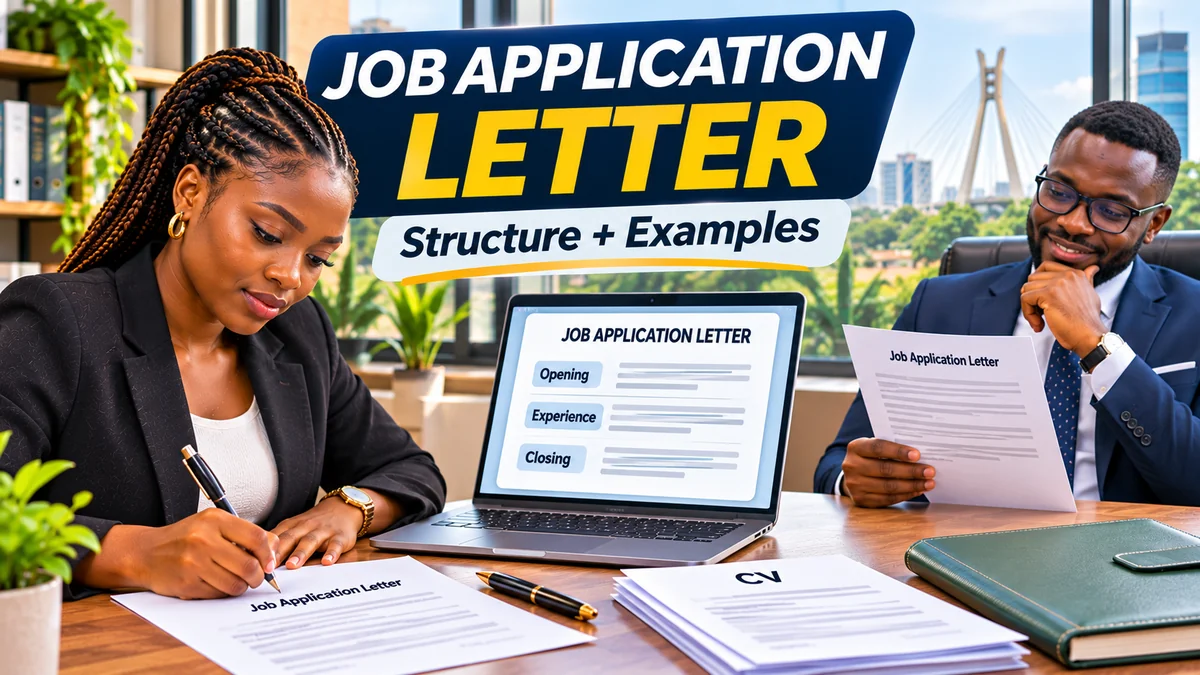
An application letter and a cover letter often serve the same purpose: explaining why an employer should consider you for a job. In some recruitment processes, however, an application letter for job application is a more self-contained account of your qualifications, while a cover letter briefly introduces the CV attached alongside it. There is no universal rule that forces employers to use the two names differently.
For Nigerian jobseekers, the most dependable answer is practical: read the vacancy instructions first. If an employer asks for “application letter and CV”, send a tailored letter and CV. If the advert requests only a CV, do not assume extra files are welcome. If it asks for a standalone application letter, make the letter sufficiently informative without turning it into a three-page autobiography.
This guide explains what hiring managers actually need, where the labels overlap, how to choose the right format for email and online applications, and how to write strong examples as a graduate or experienced professional. Three fictional templates and a final checklist make the advice actionable. Research updated on 16 November 2026.
Application letter vs cover letter: what is the difference?
Two reputable career resources illustrate the terminology problem. An Indeed comparison updated in June 2026 describes an application letter as potentially standalone and more detailed, whereas a cover letter usually accompanies a CV or résumé. Yet another Indeed guide updated in November 2026 explicitly describes an application letter as sometimes being called a cover letter.
Both approaches exist in practice. A university career service may call any letter accompanying a résumé a cover letter; a Nigerian vacancy might request an “application letter” but still expect a CV. Treat the distinction as a useful writing convention, not a legal or universally standardised classification.
| Question | Application letter | Cover letter |
|---|---|---|
| Typical purpose | Apply for a position or express interest in employment | Introduce and support a CV for a position |
| Often attached to CV? | Sometimes; many employers ask for both | Usually, by definition |
| Content | May be self-contained if no CV is requested | Selects one or two highlights rather than restating the whole CV |
| Typical length | Often one page; extra detail only if specifically requested | Usually no more than one page |
| Focus | Role, motivation, qualifications and relevant proof | Role, employer fit and persuasive proof linked to CV |
| Best rule | Follow the exact advert or submission instructions | Follow the exact advert or submission instructions |
The overlap is greater than the differences: a well-written version of either should state the opportunity, demonstrate relevant skills, explain why the organisation interests you and end professionally. Harvard's career service describes a cover letter as a narrative introduction accompanying a résumé, designed to show your qualifications and interest in the employer.
What employers actually expect from either letter
An employer generally wants relevance, credibility, clarity and compliance with instructions, not a particular decorative heading. A strong letter answers four questions:
- Which role do you want? Give the exact advertised job title and vacancy reference if supplied.
- Why can you do it? Connect two or three requirements to evidence from work, NYSC, SIWES, education, projects or volunteering.
- Why this employer? Show a genuine connection with the organisation's work, services or stated needs rather than generic praise.
- What happens next? Indicate the correct attached documents or portal submission and thank the reader, without demanding an interview.
Harvard's résumé and cover-letter guidance advises writers to be brief, factual, specific and focused on the role. Its August 2026 guide recommends approximately three to four concise paragraphs, with examples of actual results. These are sound editorial principles, not evidence that every employer reads every cover letter.
Indeed's application support guidance says some employers require a cover letter while others make it optional. The practical lesson is to write a good letter when it is requested, and to avoid treating an extra attachment as mandatory when the employer's portal does not support it.
Which one should you send? Five common application situations
| Vacancy instruction | Recommended action |
|---|---|
| “Submit an application letter and CV” | Send a tailored one-page application/cover letter plus the specified CV; don't send two letters |
| “Submit a cover letter and résumé” | Send a concise tailored cover letter and résumé |
| “Application letter only” | Provide a sufficiently informative standalone letter; include other files only if permitted |
| “Complete the online form; no additional documents” | Answer the form accurately; do not invent an upload slot or send unsolicited files |
| “CV required, cover letter optional” | Consider a short tailored cover letter if you have relevant evidence to add and the system accepts it |
Many Nigerian private-sector, NGO, education and public-sector employers use their own terminology. A school may ask for a formal “letter of application”; a technology company may simply ask for a “cover letter”; an international employer may use a text box rather than accept a separate document. Do not invent a Nigeria-wide legal rule that one name is required for one industry. If instructions are genuinely unclear, use a single professional letter with the exact role title and ask the employer through its verified contact channel if further clarification is essential.
How to write an application letter for a job, step by step
1. Read and annotate the job advertisement
Identify the required qualification, technical skills, location, working arrangements and deadline. Separate mandatory requirements from preferred ones. Note any instructions about references, certificates, salary expectations, subject lines, file size or application portal. Do not claim a qualification you lack just to mirror the advertisement.
2. Use a straightforward professional heading
For an attached formal letter, include your name, phone or email, date and the organisation or hiring manager if known. A complete residential address is usually unnecessary unless requested; city and state may be sufficient for ordinary digital applications. When you are typing into a portal text box or the body of an email, a full postal-letter heading may be redundant.
3. Address the right person if possible
Use “Dear Ms Okeke” or “Dear Hiring Manager” where appropriate, provided the name and title are accurate. If no individual is identified, “Dear Hiring Manager” is a safe professional choice. “Dear Sir/Madam” remains familiar in formal correspondence, but it is not obligatory. Never guess a person's name or gender.
4. Name the role in your opening paragraph
Begin with the precise position and a relevant reason for applying. For example: “I am applying for the Customer Service Officer vacancy advertised on your careers page. My experience handling service enquiries and maintaining records aligns with the position's customer-support responsibilities.” This is more informative than opening with several lines about being obedient, hardworking and in desperate need of employment.
5. Show proof, not a long list of adjectives
Choose two strong examples. If you organised weekly office records during NYSC, specify what was prepared and how it was used. If you built a working software prototype, describe the purpose and your contribution. Quantify work only when the measurement is real and explainable. For candidates without paid experience, academic projects, SIWES and volunteering can be relevant evidence.
6. Explain genuine interest in that employer
Research its verified services, projects or mission and connect one detail to your background. Generic statements such as “your organisation is the leading company in Africa” can be counterproductive if unsupported. It is enough to demonstrate that you understand the work and how you might contribute.
7. Close with a practical next step
Thank the employer, express willingness to discuss your fit and accurately mention any enclosed CV or documents. You may end “Yours sincerely” or “Kind regards” as appropriate to the format and audience. The substance of the letter matters more than a rigid dispute about sign-offs.
Sample application letter for a job in Nigeria: standalone version
The following example uses a fictional applicant and fictional employer. The role, qualifications and experience are illustrative. Replace every detail with your true information before submitting.
Amaka Nwosu
Enugu, Nigeria
amaka.example@example.com | +234 800 000 000016 November 2026
The Recruitment Manager
Example Hospitality Services Ltd
Enugu, NigeriaSubject: Application for Front Desk Officer Position
Dear Hiring Manager,
I am applying for the Front Desk Officer position at Example Hospitality Services Ltd. I hold an HND in Business Administration and have completed an NYSC assignment that involved reception support, visitor records and office communication.
During my service year, I maintained a daily visitor register, responded to routine enquiries under supervision and prepared weekly summaries for the administrative team. These responsibilities strengthened my attention to detail, record keeping and ability to communicate respectfully with people who needed clear information.
I am especially interested in a front desk role because it combines accurate administration with customer care. I can use spreadsheets for basic tracking, work collaboratively with colleagues and follow established procedures for handling guest information and requests. I would welcome the opportunity to learn your booking systems while contributing to organised service at the reception desk.
Thank you for considering my application. I would be pleased to discuss how my experience fits the role and can provide additional supporting documents through your approved recruitment process.
Yours sincerely,
Amaka Nwosu
This is a standalone letter: it identifies education and work evidence directly, even without requiring a CV to explain the basic qualification. If the vacancy also requests a CV, attach it, and tighten the letter to avoid reproducing the entire employment history.
Sample cover letter: when the employer asks for a CV and covering letter
This second fictional model deliberately places greater emphasis on why two selected experiences suit a particular role, leaving full dates, qualifications and other career details to the accompanying CV.
Chidi Ezeonu
Abuja, Nigeria
chidi.example@example.com | +234 800 000 000116 November 2026
Hiring Manager
Example Analytics CompanySubject: Application for Junior Data Analyst
Dear Hiring Manager,
I am applying for the Junior Data Analyst role advertised on your careers website. Your team's focus on making operational information easier to use matches the type of practical analysis I have developed through academic work and project-based training.
For my final-year project, I cleaned questionnaire responses, built summary tables in Excel and presented key findings to a supervisor. More recently, I created a sample sales dashboard using anonymised practice data, documenting the assumptions and checks needed to interpret the results. These projects strengthened my ability to organise data, explain findings and seek feedback when an analysis needs improvement.
I would welcome the opportunity to bring those skills to your team and continue developing reporting and problem-solving abilities. My attached CV outlines my qualifications and project work in more detail, and I can provide a portfolio link if requested.
Thank you for considering my application.
Kind regards,
Chidi Ezeonu
This letter gives an employer reasons to inspect the CV without copying each CV bullet. Neither fictional candidate should claim credentials, projects or results unless their own history supports them.
What should you write in the email body?
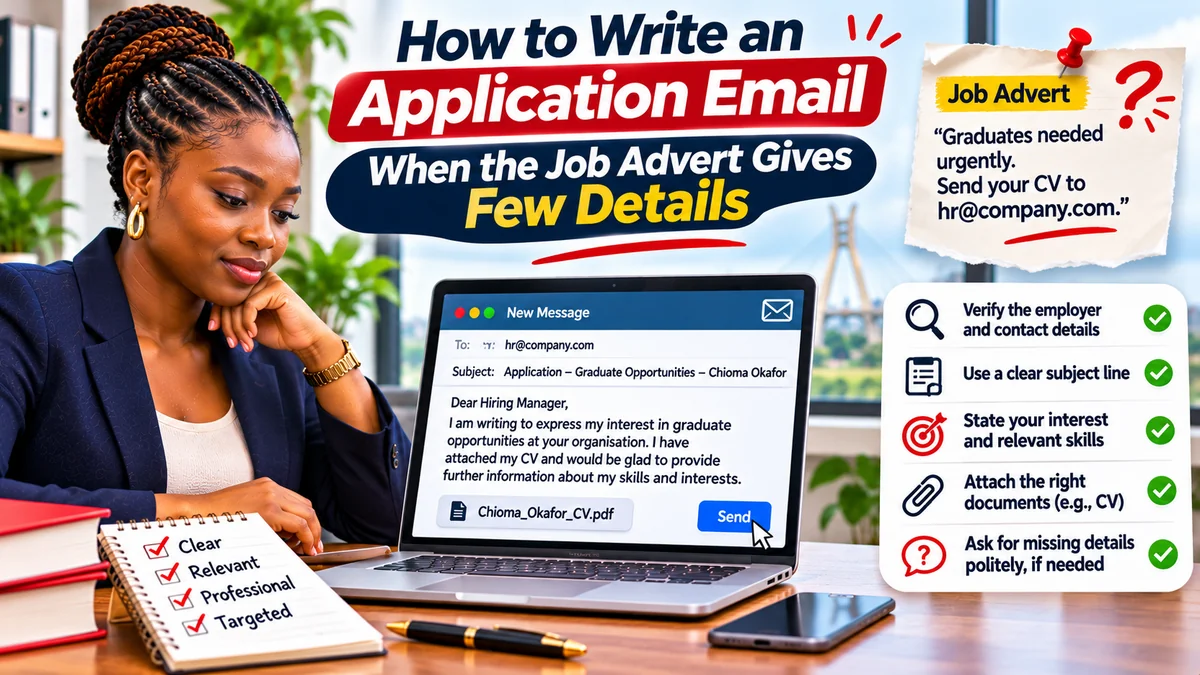
When a legitimate job advertisement says to email a CV and application letter, use a clear subject line and a short message. If a separate letter is attached, the email body need not contain another full letter. A practical model is:
Subject: Application for Administrative Assistant — Amaka Nwosu
Dear Hiring Manager,
Please find attached my application letter and CV for the Administrative Assistant position advertised on your organisation's careers page. My experience in record management and customer-facing administrative support is relevant to the role.
Thank you for reviewing my application. I would welcome the opportunity to discuss my qualifications.
Kind regards,
Amaka Nwosu
+234 800 000 0000
If the employer asks you to put the application letter in the email body, use the longer substantive letter as the email text rather than attaching a separate file. Always follow the advertised subject line exactly when one is specified; some recruitment systems rely on consistent reference codes or titles.
Should you attach both an application letter and a cover letter?
Usually no. Most advertised jobs asking for an “application letter and CV” mean one introductory letter plus a CV, not two nearly identical introductory letters. Sending both may waste the recruiter's time, introduce contradictions and suggest that instructions were misunderstood.
Only submit two distinct written statements when the employer specifically requests both and explains their separate purposes—for example, a covering note plus a supporting statement addressing selection criteria. If a portal names multiple fields, read each prompt before filling them: “Why do you want this role?” is not always an instruction to paste an entire formal letter.
The Prospects job-application guide distinguishes the different documents and online application responses employers may request. The appropriate submission is the set of materials the process asks for, not every job-search document you have ever prepared.
How to write without paid work experience or after NYSC
Recent graduates in Nigeria often have experience that is easy to overlook because it was not a permanent paid job. An NYSC place of primary assignment, a final-year research project, industrial training (SIWES), a software portfolio, a small business project or verifiable community work can show relevant skills.
For a fresh graduate, the structure might be: qualification → one substantial project or service responsibility → skills demonstrated → relevance to the vacancy. For example, a business-administration graduate applying for an operations role can discuss an Excel tracking system built during NYSC rather than writing “I have no experience but am ready to learn”.
If the job asks for two years of professional experience and you have none, do not change internship dates or call a student task a two-year employment record. Apply only when you can reasonably meet or explain the actual criteria. You can also consider appropriately advertised entry-level roles. FlyingEze's entry-level remote jobs guide discusses roles that may be accessible to applicants with demonstrable skills but limited formal experience.
For CV-specific guidance, read FlyingEze's guide to writing a CV for international remote employers . The CV documents the full relevant background; the application or cover letter should explain why a selected part of that background fits the particular job.
How experienced applicants can make the letter stronger
A mid-career applicant should avoid using the space simply to repeat a job history. Identify the employer's main problem and present one or two verified achievements related to it. A project manager might explain how they coordinated a delivery across teams. A customer-service professional might describe a documented process that improved response consistency.
Use numbers only when they are real, attributable and not confidential. For example, “reduced average processing time from five working days to three” is stronger than “improved productivity greatly” only if you actually measured it and can explain the method. If no reliable metric exists, describe a specific accepted deliverable or responsibility instead.
Employers can also value why you want that specific role at this stage. A deliberate move from front-desk operations into customer-success management, for instance, is easier to understand when the letter connects transferable experience to the target position.
What if the company has not advertised a vacancy?
A speculative application asks an organisation to consider you for suitable current or future opportunities even without a publicly listed position. It may be framed as a letter of interest or an application letter, typically accompanied by a tailored CV.
Prospects' speculative-application guidance recommends researching the organisation, specifying the type of work you are seeking and explaining how you could contribute. Do not falsely write that you are responding to an advertised vacancy. A concise opening could be: “I am reaching out to enquire about possible junior administrative opportunities with your organisation because my records-management and service experience aligns with your customer operations.”
Use only a verified contact route; avoid bulk unsolicited messages to employee personal addresses. A speculative letter may go unanswered even when it is professionally written. Keep applying to real vacancies instead of interpreting silence as a commitment to consider you.
Formatting, file names and applicant tracking systems
For a conventional attached letter, aim for one readable A4 page with three to five concise paragraphs, a normal font and consistent margins. Harvard and Prospects both recommend brevity and tailoring. Use a name such as Chidi_Ezeonu_Cover_Letter_Junior_Analyst.pdf, rather than document_final_final.pdf.
Use PDF when it preserves text and the application permits it; use DOCX or a portal text box when the employer requires those formats. A scanned picture of a page is less accessible and may not be processed like ordinary selectable text. Before sending, open the file on a mobile device and verify the text, spacing, email address and attachments.
Some employers use applicant tracking systems (ATS), but there is no reliable universal ATS score that guarantees selection. Use relevant language from the job advert accurately, not repeated keyword stuffing. Harvard's guidance on AI and application documents emphasises writing that genuinely represents the applicant's experience. A readable letter helps human reviewers too, regardless of whether software performs initial checks.
Can AI help write an application letter?
AI can be useful for making an outline, improving clarity, checking grammar or finding gaps between a job description and your documented experience. It should not invent a degree, company, performance figure, reference or project. Do not copy private documents or sensitive employment information into a tool without considering confidentiality and the service's data rules.
One safe workflow is to write your own real examples first; ask an AI tool to shorten or reorganise the text; then verify every sentence against the CV and vacancy. The employer should hear your actual voice and be able to question you about anything in the letter. A polished fiction is more damaging than a modest, truthful application.
Harvard's AI-for-resumes-and-cover-letters advice supports using generative tools as an editing aid rather than a substitute for an authentic, applicant-owned account of experience.
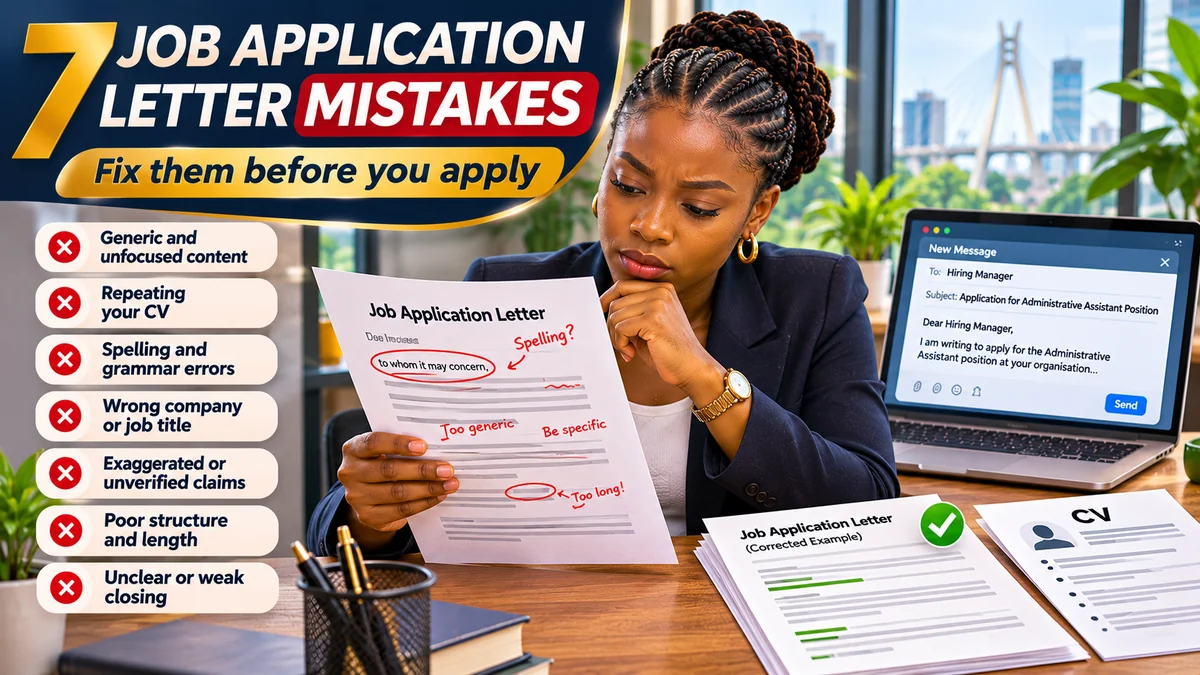
Ten mistakes that weaken job application letters
- Using the wrong job title: the recruiter may think the letter was copied from another application.
- Opening with unrelated personal history: explain what position you want before detailing your life story.
- Writing “I am hardworking” without evidence: replace vague claims with a specific task or achievement.
- Repeating the entire CV: select two relevant experiences and explain their significance.
- Inventing qualifications or metrics: claims should be accurate and defensible at interview.
- Sending both letters when only one is requested: follow the application instructions rather than duplicating files.
- Ignoring specified file formats or subject lines: administrative mistakes can prevent proper processing.
- Using elaborate graphics that obscure text: clarity matters more than decoration for most roles.
- Adding NIN, BVN, banking details or irrelevant personal information: disclose sensitive data only through legitimate, necessary recruitment steps.
- Assuming AI-written text is ready to send: proofread, personalise and verify every statement.
Practical checklist before submitting a job application letter
- The employer and vacancy are legitimate, and I know where I found the advertisement.
- The position title and any reference code are exact.
- The submission type matches the employer's instructions: letter, CV, form or email body.
- The opening clearly identifies the job and the reason for applying.
- I selected one or two strong examples tied to the stated requirements.
- All education, NYSC, experience and achievement claims are truthful.
- The employer-specific explanation is genuine rather than generic praise.
- The letter is concise, readable and free of typographical errors.
- The file format, filename and email subject are correct.
- Only the requested documents are attached; no private passwords, OTPs, BVN or NIN are included unnecessarily.
- The phone number and professional email are correct.
- I have kept a copy of the letter and a record of the application.
For applicants searching outside their city or applying to foreign companies, FlyingEze's guide to legitimate remote-job platforms and applications explains why verifying the employer and job posting matters before sending personal information.
Frequently asked questions
Is an application letter the same as a cover letter?
They are often used interchangeably. Some career guides distinguish a self-contained application letter from a shorter cover letter accompanying a CV, but not every employer uses that distinction. Always follow the wording and instructions in the advertisement.
Can I use a cover letter as an application letter?
Usually yes if it contains the information requested. When no CV is permitted, add enough accurate education and experience detail for the letter to stand on its own. When a CV is required, keep the letter complementary rather than duplicating it.
How long should an application letter for a job be?
For most roles, aim for one page with clear, short paragraphs. A longer statement may be justified if the employer explicitly requests detailed evidence against selection criteria or a specified word count. Do not exceed a stated limit.
Should I write “Application Letter” at the top?
Not necessarily. A professional subject such as “Application for Customer Service Officer” is usually more informative. The label matters less than the role, relevant evidence and correct submission format.
Do employers read cover letters?
Practices vary by employer, recruiter and stage of screening. UC Berkeley's career guidance notes that some readers consider cover letters while others initially focus on the résumé. Write a good one when required, but do not promise that it will be read or result in an interview.
Should I attach a CV if an employer only requests an application letter?
Follow the instructions. If the letter must be standalone and no additional documents are accepted, do not attach an unsolicited CV. If the employer invites supporting material, send only what it permits. Ask the legitimate recruitment contact when requirements are unclear.
Can an NYSC corps member use service experience?
Yes. Describe real responsibilities, skills and achievements from the place of primary assignment or community projects. Label the status and dates accurately; do not present a continuing NYSC assignment as completed service.
What should I write if I have no job experience?
Use a relevant academic project, SIWES attachment, volunteer contribution, practical training or independently built project. Explain what you did and learned, then connect it to the employer's requirements. Avoid pretending a student project was a paid job.
Is a cover letter compulsory for every online job application?
No. Some portals require a letter, some make it optional and others offer no upload field. The employer's current application process determines what must be submitted. Do not try to bypass a portal simply to send a letter it does not accept.
What is the best email subject for a job application?
Use the exact subject requested in the advertisement. If no format is specified, something such as “Application for Accounts Assistant — Ada Okafor” clearly identifies the position and applicant. Avoid vague subjects like “CV attached” or “Please help me”.
Should I put salary expectations in the letter?
Generally not unless the employer asks for them. If requested, provide an honest, appropriately framed answer in the required field or document rather than guessing a figure to impress a recruiter.
Final verdict: employers care more about relevance than the label
The distinction between an application letter and a cover letter is useful, but it is not a test that applicants must solve with a rigid universal definition. If the employer asks for an application letter, write a clear letter proving your suitability. If it asks for a cover letter, write a concise introduction that complements the CV. If it specifies an online form, complete the form and supply only the requested documents.
The strongest letter names the role, makes an honest case for your skills, shows a relevant reason for choosing the employer and respects the recruitment process. For Nigerian graduates, NYSC, SIWES, voluntary service and real projects can provide useful evidence even without years of paid work.
Editorial note: Researched on 16 November 2026 using university career services, Prospects and Indeed guidance. All example applicants, employers, qualifications and outcomes are fictional illustrations, not real vacancies or recommended credentials. No letter template guarantees a job interview or offer.