A good application letter for a job application does not require years of paid work experience. For a recent Nigerian graduate, the stronger approach is to explain which role you want, choose one or two relevant examples from university, SIWES, NYSC, volunteering or personal projects, and show how those experiences relate to the employer's work.
That is especially important when applying for your first administrative, customer-support, technology, finance or graduate-trainee role. Many applicants rely on statements such as “I am hardworking and ready to learn.” Employers get more useful information when you show what you worked on, how you approached it and what you produced.
This guide provides a complete fictional entry-level job application letter, explains each paragraph, offers versions for graduates with different backgrounds, and covers email submissions, formatting, responsible use of AI and a final application checklist. It is tailored to the Nigerian context but the principles apply widely. Researched on 16 November 2026.
Quick answer: how to write an application letter as a new graduate
- Read the actual vacancy and identify the position title, required skills and submission method.
- Use a professional heading and greeting, unless the employer provides a portal text box.
- Open by stating the exact role and one genuine reason your background fits.
- Explain two relevant pieces of evidence: a project, SIWES attachment, NYSC duty, volunteering or verified part-time work.
- Connect those experiences to the employer's responsibilities rather than restating your entire CV.
- End politely, mention the requested attachment if applicable, and check every claim and contact detail before sending.
The University of Pennsylvania's career service advises applicants to explain both why this employer and why you, generally keeping non-academic cover letters to one page. Prospects' guide for jobseekers without experience recommends explaining transferable skills from education and other activities rather than focusing on what you lack.
Complete entry-level job application letter example for a Nigerian graduate
Below is a fictional, copy-and-adapt example for an entry-level Administrative Assistant role. The employer, applicant, university, experiences and dates are illustrative. They are not a real vacancy or real applicant credentials. Replace them with your own facts and follow the actual job advert.
Amara Okafor
Enugu, Nigeria
amara.example@example.com | +234 800 000 000016 November 2026
The Hiring Manager
Example Community Services Ltd
Enugu, NigeriaSubject: Application for Entry-Level Administrative Assistant
Dear Hiring Manager,
I am applying for the Entry-Level Administrative Assistant position advertised on your careers page. I recently completed a B.Sc. in Business Administration and am interested in supporting a team that relies on accurate records, clear communication and organised daily operations.
For my final-year project, I gathered and organised survey responses, built an Excel workbook to categorise the results, and prepared a short report for my supervisor. During my NYSC assignment, I also supported office correspondence and maintained a weekly register of requests under supervision. These experiences helped me develop careful record-keeping, time management and the ability to communicate progress clearly.
Your organisation's emphasis on dependable service appeals to me because I enjoy solving practical administrative problems and helping colleagues find reliable information. I would welcome the opportunity to contribute to scheduling, document management and customer enquiries while learning your approved internal systems and procedures.
My CV is attached as requested. Thank you for considering my application. I would appreciate the opportunity to discuss how my skills and willingness to learn could support your team.
Yours sincerely,
Amara Okafor
How to use the example: update the job title, organisation, degree, graduation or NYSC status and all achievements. If you did not complete NYSC, remove that sentence and replace it with an actual academic or volunteer project. If the advert asks for a standalone letter with no CV, remove the sentence claiming a CV is attached and include any essential qualification details the employer requests.
Why this sample letter works: a paragraph-by-paragraph breakdown
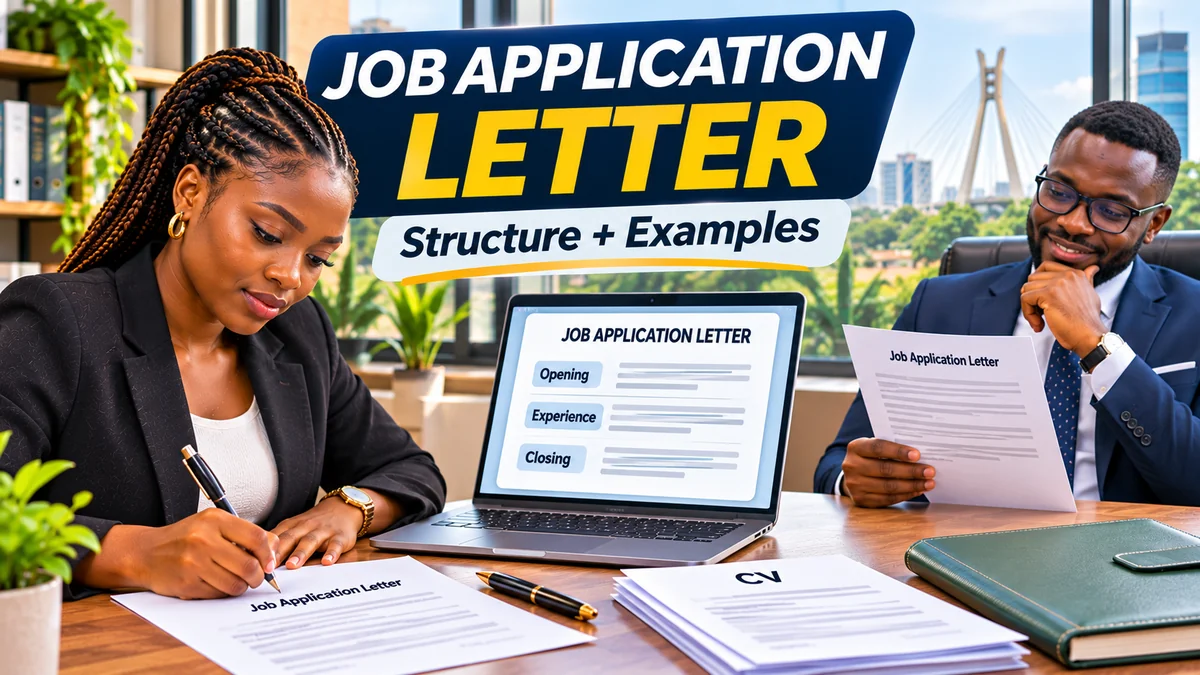
| Section | What it does | How to personalise it |
|---|---|---|
| Contact details and subject | Shows who is applying and for which role | Use current phone/email and the exact vacancy title or reference |
| Opening paragraph | States interest and relevant educational background | Replace the generic qualification with yours and name a genuine employer need |
| Evidence paragraph | Shows two practical examples instead of unsupported adjectives | Choose actual coursework, SIWES, NYSC, paid work or project evidence |
| Employer-fit paragraph | Explains motivation and potential contribution | Reference a verified service, requirement or work area—not invented company claims |
| Closing paragraph | Signals what was attached and invites consideration | Match the application channel and requested documents |
The Harvard FAS career service's August 2026 guidance recommends choosing one or two relevant experiences and explaining what you did, how you did it and what resulted. It specifically recognises academic projects, volunteering and campus activities as evidence for early-career applicants. That is a helpful test for the sample: every substantive sentence either identifies the role, shows real skills or explains the applicant's motivation.
What to include before writing: turn the vacancy into an evidence checklist
Start with the job description, not a downloaded template. Highlight the three or four requirements most important to the actual role. Then match each to something you have genuinely done. For an entry-level administrative vacancy, a simple planning grid might look like this:
| Employer requirement | Potential graduate evidence | What you could write—only if true |
|---|---|---|
| Accurate data entry | Final-year questionnaire dataset | Organised survey data in Excel and checked entries before preparing a report |
| Communication | Student association or NYSC work | Prepared meeting updates and tracked actions for a team |
| Customer support | Volunteer help desk or retail part-time role | Answered enquiries and referred unresolved requests to the responsible person |
| Time management | Research project with a deadline | Coordinated assigned tasks and delivered the report by its agreed date |
| Technical tools | Practice spreadsheet or software project | Built a sample dashboard or used spreadsheet functions to summarise results |
These are illustrative descriptions, not claims you should copy without evidence. Include numbers only when you have documentation or can explain how you measured them. A small but clearly described project is more convincing than a dramatic improvement percentage that never happened.
How to write each part of your job application letter
1. Put the right information at the top
For a formal attachment, add your name, a working phone number, professional email, location if relevant, date, recipient and a subject such as “Application for Graduate Trainee — Operations”. You usually do not need your full home address, date of birth, marital status or NIN in a general covering letter. If an employer provides specific instructions, follow the authorised form.
2. Open with the job title and a genuine fit
A weak introduction says: “I humbly write to seek for any job in your reputable establishment.” It does not tell the employer which job you want or why you could do it.
A stronger version says: “I am applying for the Junior Operations Assistant position. My final-year research and volunteer administrative work developed the record-keeping and communication skills listed in your vacancy.” The second is still concise but gives a reason to read further.
3. Use one or two clear examples
For each example, use the formula task → action or tools → evidence of the result → connection to the job. If the role requires customer communication, explain a specific time you handled an enquiry or presented information clearly. If the role requires technical skills, describe a prototype, code project, laboratory task or documented analysis.
The University of Pennsylvania career service explicitly recommends transferable skills when an applicant lacks directly related employment. There is no need to label yourself “inexperienced” in the opening paragraph; the application can show relevant potential without pretending you held a professional role.
4. Explain why the specific company interests you
Visit the verified employer website and understand its products, customers or public mission. Write one meaningful sentence connecting that work to your motivation. Avoid grand statements such as “the number-one employer in Africa” without evidence. If the vacancy is for a school, you might discuss educational support; if for a logistics business, accurate tracking and coordination may be relevant.
5. Close confidently but politely
End with a brief statement of interest, an accurate reference to the CV or other requested material, and thanks. “I would welcome the opportunity to discuss my fit for the role” is enough. Avoid guaranteeing that the employer will hire you or demanding a meeting. An application letter expresses interest; it does not create an employment offer.
No paid experience? Use these five credible sources of evidence
- Final-year project: explain the question, your contribution, tools, output and feedback. For example, a research summary or working prototype.
- SIWES or industrial attachment: identify the organisation, dates, tasks you were authorised to perform and skills practised. Do not claim to have held a full-time job if it was a student attachment.
- NYSC place of primary assignment: describe real teaching, office, field or community responsibilities and distinguish ongoing service from completed service.
- Campus clubs or volunteering: show how you organised an event, documented a budget, communicated with participants or solved a small problem.
- Independent training and projects: cite a finished portfolio, public GitHub repository, design case study or other honest demonstration. A course registration alone is not proof that you mastered the skill.
Prospects emphasises that abilities developed in coursework, part-time activities and societies can be transferable to employment. Indeed's May 2026 guide for applicants without work experience likewise recommends matching skills from education, volunteering and other activities to the job requirements.
For graduates seeking practical experience rather than immediate full-time work, FlyingEze's guide to entry-level remote jobs in Nigeria discusses role types and application considerations for candidates with limited formal employment history.
How to adapt the letter for four entry-level roles
Do not send the administrative example unchanged when applying to an unrelated vacancy. Use the actual employer's requirements and one appropriate example from your own experience. The wording below is illustrative, not a claim about a real applicant.
Entry-level software or IT support
Possible opening: “I am applying for the Junior IT Support position. During my computer science training, I documented a small troubleshooting project and helped colleagues resolve basic software setup problems under supervision.”
Evidence to discuss: GitHub projects, help-desk practice, testing, networking labs, a small website, documented fixes or security-awareness work. Do not claim access to production systems you never operated. Show what you personally built or tested, not a generic list of programming languages.
Customer service or front desk
Possible opening: “I am applying for the Customer Service Assistant position. Through a volunteer information desk and group assignments, I practised giving clear responses, documenting requests and escalating questions I could not resolve independently.”
Evidence to discuss: accurately tracked enquiries, communication, confidentiality and attention to customer needs. Avoid unverified customer-satisfaction percentages.
Junior finance or accounts assistant
Possible opening: “I am applying for the Junior Accounts Assistant position. My accounting coursework and supervised spreadsheet project helped me practise transaction categorisation, basic reconciliation and accurate reporting.”
Evidence to discuss: a budget model, relevant accounting coursework, verified SIWES support or a training ledger. Do not present practice work as regulated professional financial responsibility or claim to be certified if you are not.
Teaching assistant or school administration
Possible opening: “I am applying for the Teaching Assistant vacancy. During teaching practice, I prepared supervised lesson materials, supported classroom activities and documented feedback on learner exercises.”
Evidence to discuss: supervised teaching, lesson planning, assessment support and safeguarding awareness. Respect learners' privacy; do not include pupils' names, grades or photos in an application without authorisation.
How should you describe NYSC in a graduate application?
Use the true name of your place of primary assignment, dates, position and actual responsibilities. If you have passed out, you can say you completed NYSC. If you are currently serving, describe it as an ongoing NYSC assignment and do not claim a discharge certificate you have not received. If you have a valid exemption certificate, do not fabricate an NYSC job history.
An example of an accurate-sounding statement, where supported by the applicant's real experience, is: “During my NYSC assignment at a secondary school, I prepared lesson plans and maintained weekly assessment records under the subject teacher's supervision.”
NYSC, internships and projects may all provide relevant work evidence, but they are not interchangeable certificates or employment contracts. Include only experience you can explain in an interview and substantiate with appropriate records where requested.
Short email application example for a first job
When a vacancy requests an application letter and CV by email, the email body should be clear but does not need to repeat the entire attached letter.
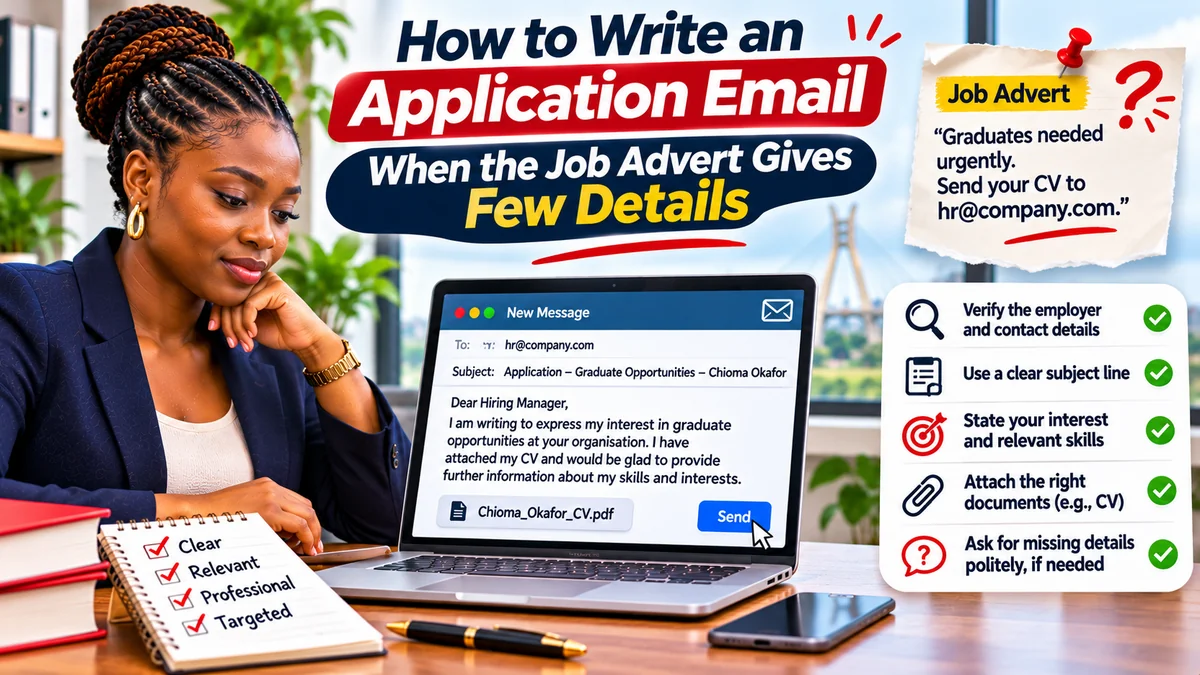
Subject: Application for Junior Administrative Assistant — Amara Okafor
Dear Hiring Manager,
Please find attached my application letter and CV for the Junior Administrative Assistant position. My academic project and supervised administrative experience have helped me develop skills in record-keeping, spreadsheets and clear communication that are relevant to the role.
Thank you for considering my application. I would welcome an opportunity to discuss my qualifications.
Kind regards,
Amara Okafor
+234 800 000 0000
If the employer specifically requests that the letter be pasted into the email body, put the full tailored letter there rather than attaching a duplicate. Follow its exact subject-line, reference-number and file instructions. If the employer uses a portal form, complete the required fields rather than emailing documents to an unrelated address.
Application letter vs CV: what belongs in each?
| Information | Application letter | CV |
|---|---|---|
| Job and employer fit | Explain the direct connection | Usually not the main focus |
| Education | Mention the qualification if relevant | Provide institution, qualification and dates |
| Projects | Explain one or two most relevant examples | List multiple projects, roles, tools and achievements |
| NYSC and experience | Explain the duties that matter for this vacancy | List accurate organisation names, dates and responsibilities |
| Motivation | Describe why this employer and role interest you | Limited or not applicable |
For more extensive guidance on describing transferable skills in a CV, FlyingEze has a CV-writing guide for international remote employers . A letter and a CV should support the same truthful story, not repeat each other word for word.
Some adverts use “application letter” and “cover letter” interchangeably. The critical requirement is to send one appropriate introductory letter when requested and attach the correct supporting materials. A separate comparison of those labels is covered by FlyingEze's planned article, Application Letter vs Cover Letter: What Employers Actually Expect, scheduled for publication in December 2026.
How long should an entry-level application letter be?
For most ordinary entry-level vacancies, one A4 page is a sensible default. The University of Pennsylvania recommends a one-page non-academic cover letter with readable typography and standard margins. Short paragraphs also make it easier to review on a phone or recruitment portal.
Use a plain, accessible font, normal margins and a consistent document structure. Do not add decorative photos, elaborate tables or unrelated personal details unless the employer requests a particular format. When the application has a text-box word limit, follow that instead of forcing a full printed letter into the field.
Submit a text-based PDF when permitted and layout preservation matters; use DOCX or the portal's own format if required. Do not assume every employer accepts PDFs. Name the file clearly—for example, Amara_Okafor_Application_Letter_Admin_Assistant.pdf—and open the attachment before sending to verify that it is readable.
Can applicant tracking software affect the letter?
Some employers use application-management or applicant-tracking systems (ATS), but there is no universal keyword count or “ATS score” that guarantees an interview. Use the actual job title and relevant skills accurately. A plain-text, well-structured letter is generally easier to read and copy than an image of a scanned page.
Avoid listing every buzzword in the vacancy without supporting evidence. A statement such as “proficient in Excel, accounting, project management, customer care, cloud engineering and logistics” raises questions if the applicant cannot show how any of those skills were used. Two strong, true examples are more persuasive than an exaggerated collection of keywords.
Should you use AI to write your first job application?
AI can help you produce an outline, correct grammar and improve the structure of an application letter. It can also compare a job description with the genuine projects and experience you choose to share. However, you remain responsible for every claim.
A useful workflow is to list the actual job requirements and your real examples, draft the letter in your own words, use an editing tool to shorten awkward sentences, then check that all claims are supported by your CV or portfolio. Do not invent a degree grade, paid role, organisation, metric or professional certificate. Never paste confidential client information or private identity documents into a writing tool unnecessarily.
Harvard's 2026 cover-letter guidance supports specific, personal evidence over generic language. A polished but fictional letter can create serious credibility problems when an employer asks follow-up questions.
How to avoid fake entry-level vacancies and application scams
New graduates may be targeted by recruiters who promise immediate employment without proper screening, demand payment for “application processing”, or ask for banking details before an actual interview. In an April 2026 warning , the US Federal Trade Commission described unsolicited job messages that evolve into requests for money; its 2025 guidance also warns about fake recruiters requesting sensitive financial information.
Although these alerts come from a US consumer agency, the underlying warning signs apply to online job scams more broadly. Verify the employer and actual vacancy through a separately found website or known official contact. Do not pay to secure an interview or job offer, and do not share an OTP, bank PIN, BVN, NIN scan or account password with an unknown recruiter. If sensitive documents are legitimately needed at a later stage, use the employer's authenticated, necessary process.
FlyingEze's guide to legitimate remote-job platforms provides further practical checks for applicants using job boards and remote-work listings.
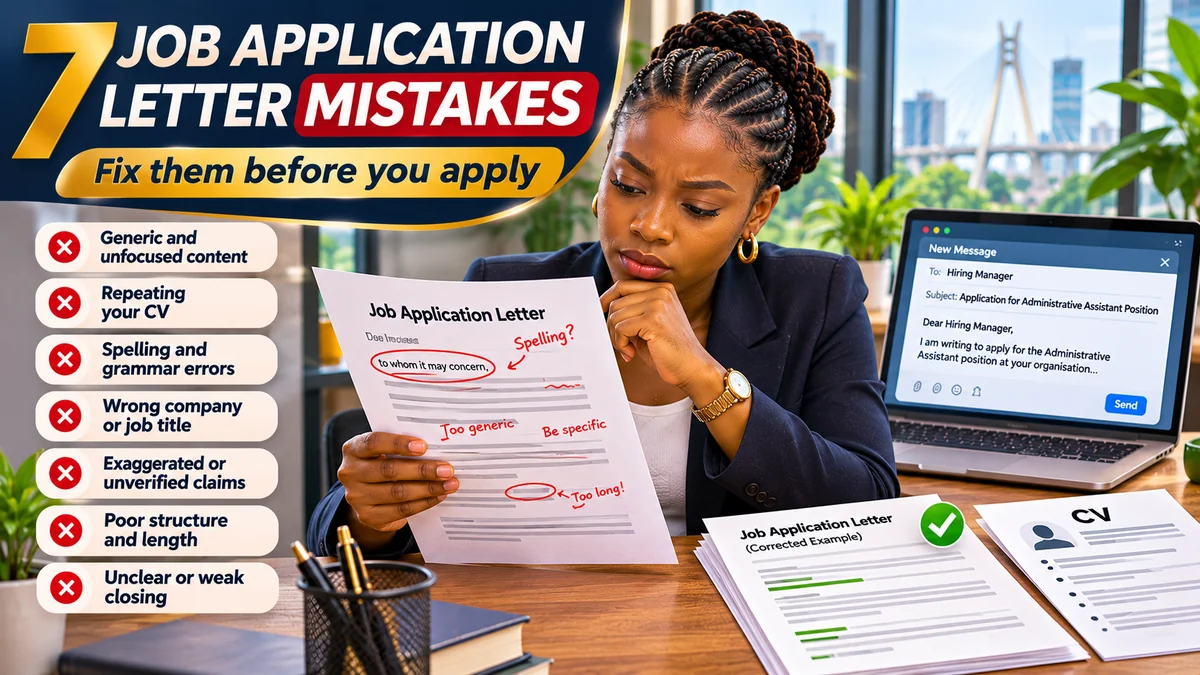
Common mistakes in a new graduate's application letter
- Beginning with an apology: “I have no experience, but…” shifts attention away from useful skills. Start with your fit and evidence.
- Sending an unchanged template: replace fictional names and projects, and tailor the role and company details.
- Writing several paragraphs of generic praise: a verified reason for wanting the role is stronger than “world-class prestigious company”.
- Repeating the entire CV: explain why one or two experiences matter rather than listing everything twice.
- Inventing metrics: a true completed task beats a fabricated 80% improvement claim.
- Confusing NYSC status: distinguish an ongoing assignment, completed service and exemption.
- Ignoring application instructions: check the required subject, reference code, file format and closing date.
- Using an inappropriate email address: choose a simple professional account you can access.
- Including sensitive personal data: a typical application letter does not need your bank account details or NIN.
- Missing the final proofreading step: check employer name, job title, spelling, attached files and working links.
Final checklist: before you send an entry-level job application
- I verified that the vacancy and employer are legitimate.
- I know the correct job title and any vacancy reference number.
- My letter matches the required email, attachment or portal format.
- My opening gives a clear reason I fit the role.
- My examples come from real education, work, NYSC, SIWES, volunteering or projects.
- I can explain each tool, task and result honestly.
- I mention the actual organisation rather than generic flattery.
- My CV supports the same facts and dates.
- I removed irrelevant or highly sensitive personal information.
- I checked the file name, phone, email, grammar and any requested attachments.
- I saved a copy of the final application and noted where and when I submitted it.
Frequently asked questions
How do I start an application letter for my first job?
State the exact job title and connect one genuine academic, project or service experience to the role. For example: “I am applying for the Graduate Operations Assistant position. My coursework and final-year research helped me develop spreadsheet and reporting skills relevant to this vacancy.” Adapt the words to your actual background.
Can a graduate get a job without experience?
Some entry-level roles accept applicants with limited paid employment experience, although every vacancy has its own requirements. Emphasise demonstrable skills, academic work, projects and relevant volunteering. Do not assume “entry-level” means that every qualification requirement is optional.
Should I include my degree classification?
Include it when the role asks for a particular grade or when it is relevant and truthful. Otherwise you can mention your degree and leave the full qualification details to the CV. Never increase or invent your result.
What if I am still doing NYSC?
Describe your actual current assignment and dates. Do not say you have completed service if you have not. Confirm that the proposed job arrangements are compatible with your current obligations and the employer's eligibility requirements.
Is a one-page application letter enough?
Usually, yes, for a conventional entry-level job. University career guidance generally recommends brevity and relevance. Follow a different word limit or supporting-statement requirement if the employer specifies one.
Should the letter include a passport photograph, NIN or BVN?
Not normally. Ordinary letters can include your name, professional email, phone number and location when useful. Sensitive identity or financial details should be provided only when legitimately necessary through secure, verified recruitment processes.
Can I use a free template?
Yes, as a structure, but replace all sample details and tailor the evidence and employer-specific lines. The fictional letter above should never be sent with its invented work history, employer or email address.
Is an application letter different from a cover letter?
The terms frequently overlap. Some employers use “application letter” for a self-contained statement and “cover letter” for a letter accompanying a CV. Follow the actual vacancy instructions; usually one tailored introductory letter is enough.
Can I send the letter as an email instead of a PDF?
Yes, if that is what the employer requests or permits. If the advert says to attach a letter, attach it in the specified format and keep the email message short. If it asks for the letter in the body, paste the substantive letter into the email.
Will a professional letter guarantee an interview?
No. It can help communicate your relevance and writing ability, but interviews depend on the employer's criteria, the applicant pool, genuine vacancies and other selection decisions. No template or AI tool guarantees recruitment.
Conclusion: use evidence, not excuses, to make your first application count
The best entry-level job application letter for a new graduate is short enough to read easily, specific enough to be credible and honest enough to defend in an interview. Begin with the vacancy, select real academic or practical evidence, explain how it supports the employer's needs and close professionally.
Even without a paid job history, you may have useful experience through research, SIWES, NYSC, volunteering and independently completed projects. Present that work accurately, tailor it to the role and follow the exact application instructions. Use the sample above as a guide—not as a biography to copy.
Editorial note: This article provides general job-search guidance based on university career services, Prospects, Indeed and FTC consumer advice reviewed on 16 November 2026. The sample applicant, employer and achievements are fictional. No letter format guarantees employment.