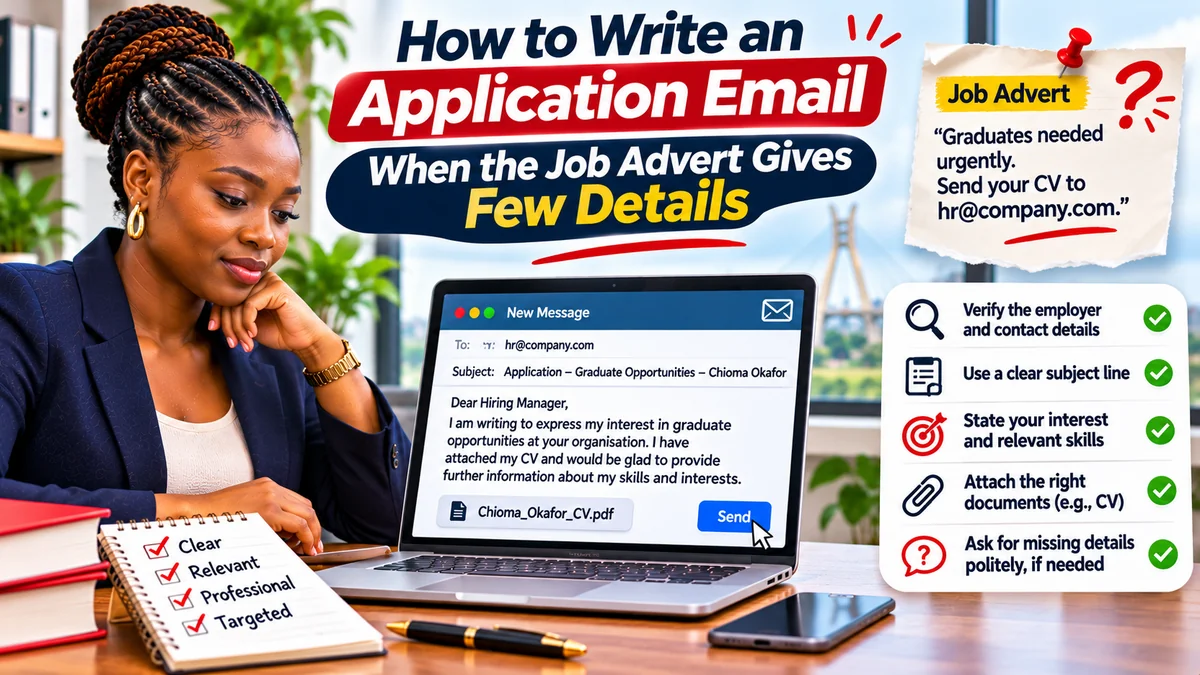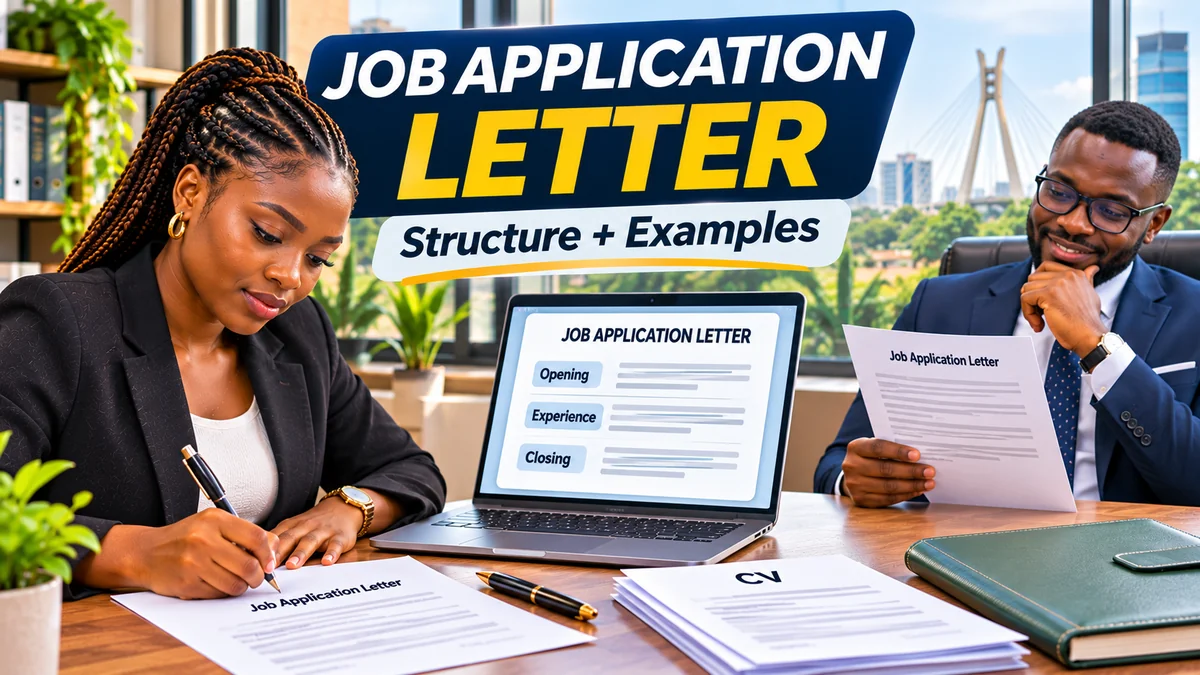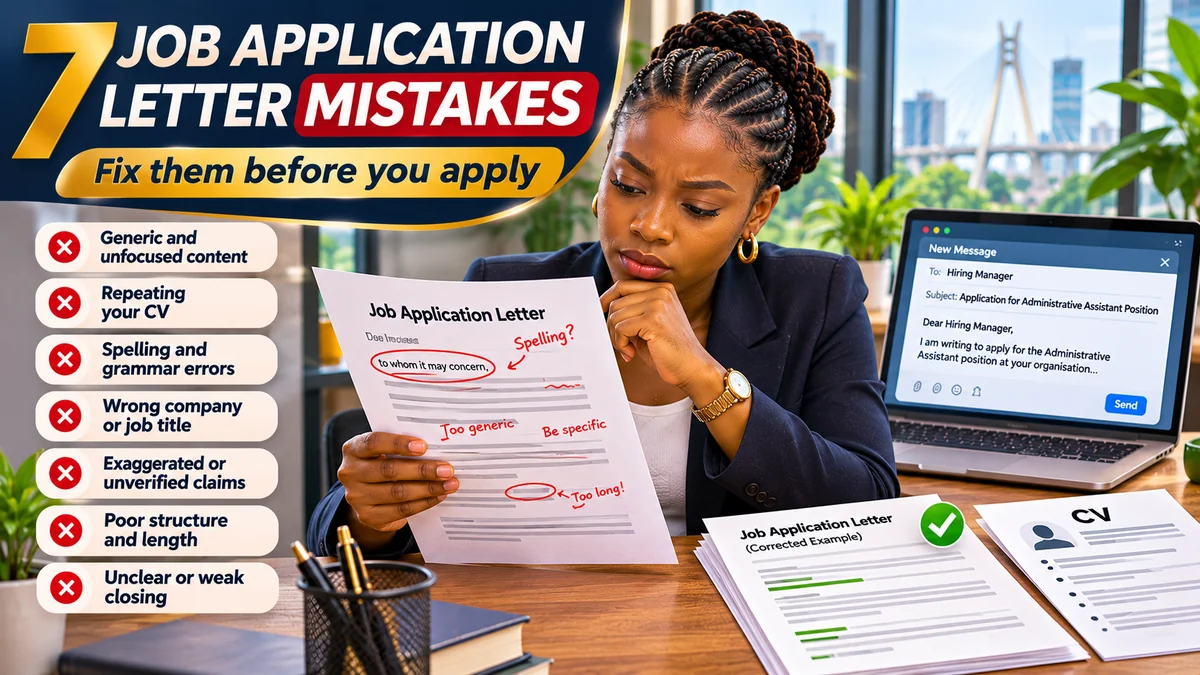
Seven job application letter mistakes can weaken an otherwise promising application: using a generic message, repeating the CV, making vague or exaggerated claims, naming the wrong employer or role, ignoring submission instructions, presenting a difficult-to-read letter, and ending without a clear professional purpose. None automatically guarantees rejection, but each can make it harder for a recruiter to recognise your suitability.
If you are preparing an application letter for job application in Nigeria, the goal is not to sound as formal as possible. It is to show the employer that you understand the advertised role and can offer relevant skills backed by real evidence. A concise, accurate letter also helps demonstrate the communication and attention to detail many jobs require.
This guide breaks down seven avoidable mistakes, shows how to correct each with original before-and-after examples, and includes a practical checking routine for graduates, NYSC members, teachers, administrative applicants and experienced professionals. The sample statements are fictional and must be replaced with your own achievements. Research checked on 16 November 2026.
Why application letter mistakes matter
A cover letter or job application letter helps an employer understand why an applicant's experience fits a specific vacancy. It is not a second CV, a formal plea for employment or a guarantee of an interview. Jobberman Nigeria's guidance on cover-letter errors identifies ignored instructions, copied messages, CV repetition and weak proofreading as common pitfalls. The University of Pennsylvania Career Services similarly recommends tailoring a generally one-page letter with concrete examples and a clear explanation of fit.
Hiring practices vary. Some organisations ask candidates to upload a letter, some request an email introduction, and others do not require a cover letter at all. Recruiters may consider multiple factors, including essential qualifications, experience, assessments and business needs. A flawed letter may create an avoidable obstacle, but no researcher can promise that correcting seven items alone will secure an interview.
| Mistake | What goes wrong | Best correction |
|---|---|---|
| 1. Generic letter | The employer cannot see why you chose that vacancy | Match the role and organisation with relevant evidence |
| 2. CV repetition | Valuable space adds little new information | Explain one or two achievements in context |
| 3. Unsupported claims | Skills or results cannot be verified | Use genuine examples and accurate scope |
| 4. Wrong details | The wrong name or job title undermines credibility | Check the recipient, title and reference |
| 5. Ignored instructions | The application may be incomplete or sent to the wrong channel | Follow the advert's exact submission rules |
| 6. Poor presentation | The message becomes hard to scan | Use concise paragraphs and readable formatting |
| 7. Weak closing | No clear interest or professional next step is conveyed | Thank the employer and reference the attached application |
Mistake 1: sending the same generic letter to every employer
A generic opening such as “I hereby apply for any available position in your esteemed establishment” tells a hiring manager almost nothing. It does not identify the advertised job, its requirements or the reason your experience is relevant. If the company hires receptionists, accountants, drivers and support agents, the recruiter should not have to guess which role you mean.
Weak example: “Dear Sir, I wish to work in your prestigious company. I am hardworking, obedient and will do any job you give me.”
Better example: “I am applying for the Customer Support Assistant position advertised on your official careers page. My experience responding to community enquiries and recording follow-up requests has prepared me for the role's customer-contact and documentation duties.”
The second version is an illustrative rewrite, not a claim about a real applicant. It works because it identifies a job and connects two responsibilities to a plausible source of experience. If you did not actually perform those tasks, use a different truthful example.
How to fix it: Read the vacancy and highlight two requirements that matter. Research the organisation through its verified site. Rewrite the opening and one evidence paragraph around the actual role. You may reuse the structural outline of a letter; the employer, title and evidence emphasis should be individually checked.
The London School of Economics careers guidance suggests a useful test: if changing only the company name leaves the letter equally suitable for an unrelated employer, it probably needs more targeting. Do not add invented praise about an organisation just to make the letter seem personalised.
Mistake 2: repeating the CV instead of explaining your strongest evidence
A CV gives an overview of education, work history, projects and capabilities. A letter should interpret the most relevant details. When it simply repeats a chronological list—secondary school, university, NYSC, every course and every duty—the employer must still work out how any of that experience addresses the vacancy.
Weak example: “I attended secondary school in 2018, graduated in 2024, completed NYSC, know Word and Excel, and can work with a team.”
Better example: “During a supervised placement, I updated a weekly attendance spreadsheet and flagged missing entries to my supervisor before reports were submitted. That experience would help me handle the accurate records required for your Administrative Assistant role.”
The stronger version takes one detail that could already appear on the CV and explains what the person did and why it matters. It also allows a recruiter to ask a meaningful follow-up question. Use the actual project or work placement where you gained that experience.
How to fix it: Select one or two examples that match the advertised tasks. State the situation briefly, name your personal action, and explain the verified output or learning. You do not need to restate every qualification. FlyingEze's guide to writing a CV for international remote employers covers the complementary role of the CV.
The University of Oxford Careers Service and Prospects both advise applicants to avoid simply copying the CV into the cover letter. The letter is most useful when it adds relevant context.
Mistake 3: relying on clichés, unsupported achievements or invented experience
Statements such as “I am the best candidate”, “I am very innovative” or “I am 100% computer literate” are hard for an employer to assess. Words like hardworking and passionate are not forbidden, but without an example they reveal little about how a candidate might perform.
A more serious problem is exaggeration: claiming you managed staff when you only observed the supervisor, stating that you increased sales by 80% without reliable records, or inventing a company, qualification, certificate or recommendation. AI writing tools may also introduce impressive-sounding details you never supplied.
Weak example: “I am a world-class data analyst who improved productivity by 200% during NYSC.”
Better example: “During my NYSC placement, I organised a spreadsheet used to track weekly submissions and checked it for incomplete entries. I would bring the same attention to detail to your reporting process.”
The better example makes a modest, testable claim. If the project never happened, do not use it. If you have genuine approved numbers showing an improvement, state the period, measure and your actual contribution rather than attributing the entire team's performance to yourself.
How to fix it: Replace every adjective with evidence where possible. Ask: “Could I explain exactly when I did this? Is the outcome correct? Can I discuss it without breaching confidentiality?” If the answer is no, rewrite the statement.
Applicants without paid work experience can draw from genuine final-year projects, teaching practice, NYSC, volunteering, student societies or independent demonstrations. The Harvard FAS Career Services' 2026 advice explicitly recognises these early-career sources of evidence. An honest example is better than a fabricated professional history.
Mistake 4: leaving the wrong company, recipient or job title in your letter
Imagine applying to a Lagos accounting firm while the subject line reads Application for Marketing Executive at [another company]. This happens when candidates copy an old draft and change only part of it. A wrong title can make an application look careless or ambiguous, especially where several roles are open.
Other easily missed errors include using an outdated vacancy reference, misspelling the company's name, addressing the wrong individual, using the wrong date or attaching a letter meant for a different organisation.
Weak example: “The HR Manager, [Old Company]. RE: Application for Storekeeper,” sent in response to a Finance Assistant advert at a different employer.
Better approach: Use the exact verified organisation name and APPLICATION FOR THE POSITION OF FINANCE ASSISTANT — REF [if supplied]. Address a named person only if the identity and role are known; otherwise, “Dear Hiring Manager” or an appropriate department is acceptable.
How to fix it: Before sending, compare the advert and final document side by side. Check the company name in the header, opening, middle and filenames. Check the job title and reference in the email subject and attachments. Make sure the contact details are yours and match your CV.
This is also a proofreading issue, but it deserves its own check because an ordinary spellchecker will not identify a correctly spelled wrong company name. Jobberman specifically calls out company-name and position-title errors.
Mistake 5: ignoring submission instructions, required documents or deadlines
A good letter can still arrive as an incomplete application. A job advert may specify a reference in the email subject, ask for a PDF, require answers to selection criteria, prohibit direct email, demand use of an application portal or identify a deadline. Ignoring those directions may prevent the employer from processing the application correctly.
Weak example: A vacancy asks candidates to submit a CV and letter in PDF format through its careers portal, but the applicant sends only a WhatsApp message to an unofficial number.
Better approach: Verify the careers portal, complete the required form, attach the two readable PDFs, include the advertised reference and submit before the stated closing date. Check the portal's success message or the legitimate acknowledgement email if one is supplied.
How to fix it: Build a brief requirements checklist: job title, reference, eligibility, document types, word limits, filenames, portal or email address, deadline and time zone. Do not invent attachments merely to satisfy a list. If a document is missing or your eligibility is unclear, follow the employer's published enquiry procedure.
The University of Texas at Austin Career Services recommends following posting instructions, including email subject conventions and any specially requested information. Jobberman's Nigeria guidance makes a similar point. Do not assume every Nigerian employer requires a handwritten letter, passport photograph or home address; requirements differ.
A related safety issue is applying through a fake recruitment page. In November 2026, Nigeria's computer emergency response team (ngCERT) warned about fraudulent employment and opportunity adverts on social media. Independently verify employers before sending identity documents, money or login credentials.
Mistake 6: writing a long, cluttered or unprofessional letter
A recruiter should be able to see the position, relevant strengths and next step without searching through unnecessary paragraphs. Long introductions, repeated compliments, block capitals, decorative fonts, unrelated personal history and poor spacing can make a letter difficult to read.
Weak example: A three-page letter begins with several paragraphs praising the organisation, lists every school attended, repeats the whole CV and ends without explaining which job the person wants.
Better approach: Present three or four short paragraphs: opening and role, strongest relevant evidence, motivation and a clear closing. Use readable formatting, with one page as a practical default for many non-academic jobs unless the employer requires a longer supporting statement.
The University of Pennsylvania recommends an 11–12-point font and a one-page limit for most non-academic cover letters. LSE similarly advises applicants to prioritise clarity, evidence and an uncluttered page. These are professional conventions, not a Nigerian legal format that applies to every vacancy.
How to fix it: Delete sentences that do not show fit or clarify interest. Use plain English and active verbs. Check that the PDF or DOCX is readable on both a phone and a computer. Follow the file type specified in the vacancy; a PDF often preserves layout, but it is not universally better if the portal requires a Word file.
Professional language does not require archaic expressions such as “I humbly beg to be considered by your esteemed and reputable organisation.” It is appropriate to be courteous, but direct sentences usually communicate more effectively. Avoid slang, emojis and excessive punctuation in ordinary applications.
Mistake 7: ending with no clear interest, useful next step or appropriate sign-off
The closing paragraph is your final opportunity to connect your experience with the employer's needs. Some applicants end abruptly after listing qualifications. Others make demands for immediate employment, beg for a chance or include an exaggerated promise that does not relate to the vacancy.
Weak example: “Please give me this job. I am suffering and will do anything. Awaiting your positive reply urgently.”
Better example: “I would welcome the opportunity to discuss how my record-keeping and customer-support experience could contribute to your operations team. My CV is attached. Thank you for considering my application.”
The rewrite remains respectful without pretending the candidate has already been shortlisted. Genuine personal circumstances may be important to an applicant, but they generally do not replace evidence of fit for the stated position.
How to fix it: In one or two sentences, restate your potential contribution, confirm the requested attachments, thank the employer and give an appropriate full-name sign-off. You do not need to promise that you will call the recruiter repeatedly, or request a response by an arbitrary deadline.
A strong closing cannot compensate for false qualifications or ignored requirements. It simply ensures the letter finishes with the same clarity and professionalism as the opening.
Before and after: a complete example of a weak application letter
Consider a fictional graduate applying for a Customer Support Assistant position at an imaginary Nigerian business named Meridian Service Desk. The following weak letter combines several of the seven problems.
Dear Sir,
I wish to apply for any vacant position in your prestigious establishment. I am hardworking, intelligent, obedient and very good at everything. I graduated from school and I know many computer applications. I am the best candidate and can increase your company's sales by 100%. I am willing to work at any department.
Please employ me urgently. Thanks.
What is missing? There is no exact role, no verified example, no meaningful reason for applying, an unsupported performance claim and an unsuitable closing. The message could be sent to nearly any company without changing a word.
A stronger rewrite using truthful, role-relevant evidence
[Applicant name]
[City, State]
[Email] | [Phone]
[Date]Dear Hiring Manager,
APPLICATION FOR CUSTOMER SUPPORT ASSISTANT
I am applying for the Customer Support Assistant position advertised on [verified source]. My experience responding to enquiries during a supervised community project and keeping accurate follow-up records aligns with the communication and documentation requirements in your vacancy.
In that project, I helped organise participants' questions, recorded agreed next steps and referred issues outside my responsibility to the project supervisor. This taught me to listen carefully, communicate realistic expectations and protect information shared in confidence.
I am interested in Meridian Service Desk because the advertised role focuses on structured customer assistance and accurate service records. I would welcome the opportunity to contribute these skills and learn your established support processes.
Thank you for considering my application. My CV is attached, and I would be pleased to discuss my suitability for the position.
Yours sincerely,
[Applicant name]
Important: This company, applicant and experience are fictional. The example illustrates writing technique, not a ready-to-send application. Replace the business and experience with real, independently checked information. If you have no supervised community project, choose an actual task from work, school, volunteering or NYSC instead.
What fresh graduates and NYSC members should do differently
Not having years of paid experience is not itself an application-letter mistake. An entry-level vacancy may value learning ability, accuracy, service experience, teamwork and demonstrable practical skills. The mistake is trying to hide inexperience through invented roles or an exaggerated claim of expertise.
A graduate can discuss a final-year project, practical coursework, SIWES placement, NYSC service, volunteering, campus administration or independently completed work. Explain what you personally handled. For example, “During a group assignment, I checked our source data for incomplete entries” is more useful than “I have excellent analytical skills,” provided it is true.
Do not claim to have completed NYSC if you are still serving, or to hold a certificate that has not yet been issued. A transparent application can explain your current status and availability. The Harvard career-service guidance recommends using authentic class, volunteer and personal projects to illustrate skills when paid experience is limited.
What to check when applying to a school, bank, NGO or government organisation
Organisations do not all request the same kind of letter. A private-sector business might ask for an email and CV; a school may ask for a letter to the Principal; some NGOs or government employers require a supporting statement addressing formal selection criteria. A company may use an application portal that does not accept a separate cover letter at all.
The safest approach is to verify the actual vacancy and follow its instructions rather than assuming a handwritten “Dear Sir/Madam” letter is mandatory in Nigeria. Where teaching credentials, professional registration or other eligibility conditions apply, show only credentials you genuinely hold.
For recruitment security, do not send a BVN, bank PIN, OTP or identity documents to an unverified “placement agent”. In October 2026, the Nigeria Social Insurance Trust Fund publicly warned about fake job adverts falsely using its name. FlyingEze's guide to fake remote-job offers explains additional red flags.
Should you use AI to check an application letter?
AI can help identify repetition, improve grammar, shorten a long paragraph or compare your letter against a job description. It should not invent employers, numerical results, qualifications or responsibilities. An AI-generated letter may also sound polished while remaining generic.
A practical prompt is: “Review this draft against the following vacancy. Identify unclear claims, generic wording, missing evidence, incorrect names and spelling errors. Do not add any achievements that I have not provided.” Then personally verify every suggested change.
Harvard's 2026 cover-letter advice recommends editing AI-assisted content in your own voice with genuine specific details. Follow the prospective employer's rules on AI use and do not paste confidential third-party information into an external tool.
A ten-minute final review before submitting
| Review stage | Question to ask | Action |
|---|---|---|
| Minute 1 | Does the letter name the exact advertised role? | Correct title and reference |
| Minute 2 | Is the organisation and recipient correct? | Check against the official advert |
| Minute 3 | Is the opening specific, rather than generic? | Connect one relevant requirement |
| Minutes 4–5 | Can you substantiate every achievement? | Remove invented or inflated claims |
| Minute 6 | Does the letter add value beyond the CV? | Explain one strong example |
| Minute 7 | Can a reader follow the structure easily? | Shorten and format if necessary |
| Minute 8 | Are grammar, contact details and dates correct? | Proofread independently |
| Minute 9 | Are the file type and attachments correct? | Verify filenames and open files |
| Minute 10 | Is the submission channel real and within deadline? | Check the official portal or email |
This ten-minute routine is an editorial suggestion, not a scientific assessment or a promise of recruiter approval. For complex applications, spend more time and ask a trusted reviewer for feedback. If the vacancy requires selection-criteria statements or additional documents, extend the checklist accordingly.
For complementary advice on finding authentic listings, see FlyingEze's guide to legitimate remote-job platforms and application tips in Nigeria .
Frequently asked questions
What are the most common mistakes in an application letter for job application?
Seven practical errors are sending generic letters, repeating the CV, making unsupported claims, using incorrect employer or role details, ignoring instructions, using cluttered formatting and finishing without a professional closing. The impact depends on the vacancy and hiring process, but each is avoidable.
Can one spelling mistake cost me an interview?
It is possible for serious or repeated errors to undermine an application, especially where writing and accuracy matter. But no credible general rule says a single typo automatically disqualifies every applicant. Proofread to reduce avoidable risk rather than assuming perfection guarantees a response.
Should a Nigerian job application letter be one page?
One page is a useful default for many ordinary non-academic vacancies. A government, university or specialist role may instead request a longer supporting statement or a fixed word limit. Always follow the job advert's specific requirements.
Is copying an application letter template wrong?
A template can help with structure, but the final letter must contain the correct job title, employer and truthful examples from your own experience. Sending an unchanged generic sample weakens relevance and may introduce false information.
Should I address the letter “Dear Sir/Madam”?
A verified person's name is preferable when available. Otherwise, “Dear Hiring Manager” or “Dear Recruitment Team” is a professional option. Follow the advertised formal recipient where an institution specifies one.
Can I include NYSC and student-project experience?
Yes, when accurate and relevant. Explain the responsibility you personally held and what you completed or learned. Do not present a supervised student project as a permanent paid management role.
Should I mention salary expectations?
Only when requested or genuinely necessary to the stated application process. A standard initial cover letter usually has more valuable uses for its limited space, such as explaining role-specific skills. Follow any explicit salary-information instruction in the advert.
What if the employer does not ask for a cover letter?
Use the specified portal or form. Some employers require only a CV or answers to application questions, and not all systems accept an additional document. Do not bypass instructions by emailing an unsolicited file to a staff member.
Does using AI automatically make my application weaker?
No. Editing assistance can be helpful, but an unverified AI draft may introduce clichés, factual errors or fabricated achievements. Check all claims, use your own voice and comply with the employer's assessment rules.
Conclusion: remove the errors that hide your strengths
An application letter should help an employer recognise your potential, not require them to search through generic praise, copied CV entries and preventable inaccuracies. The seven mistakes in this guide share one problem: they obscure the relationship between the applicant's genuine experience and the job being advertised.
Before sending the next letter, verify the vacancy, choose honest evidence, keep the format readable, check the names and instructions, and close with a clear professional statement. A careful, role-specific letter cannot guarantee an interview, but it gives your qualifications a better chance to be understood.