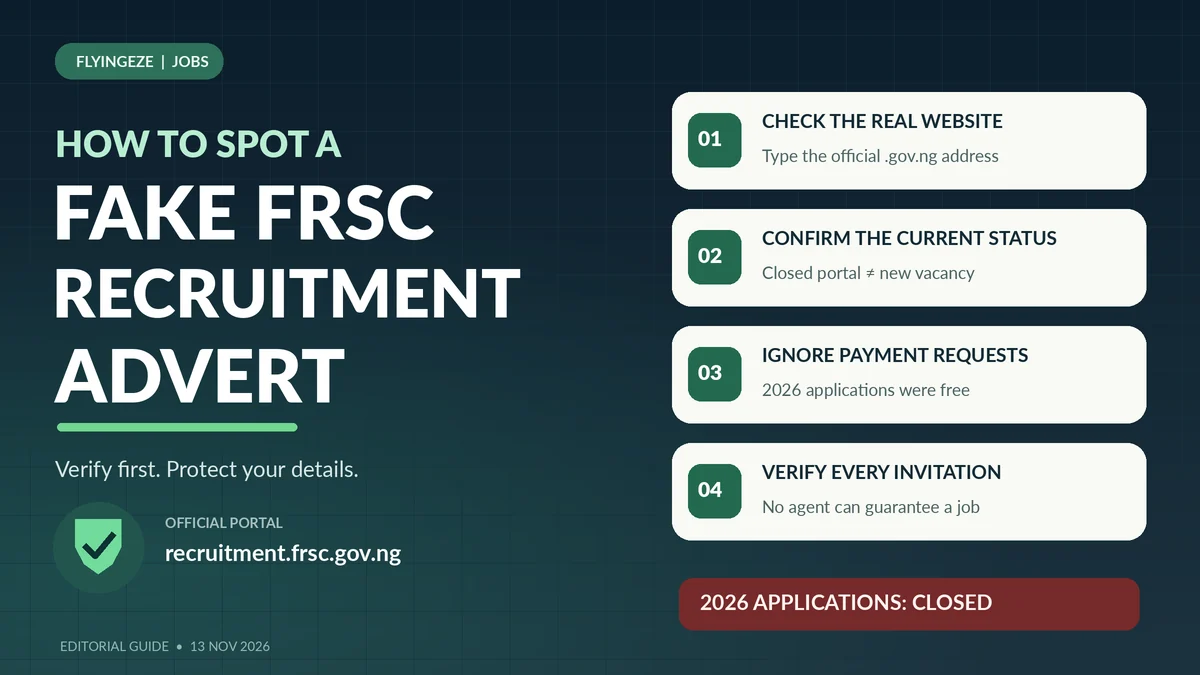
To check whether an FRSC recruitment advert is genuine, start at frsc.gov.ng and independently open recruitment.frsc.gov.ng . Compare the actual recruitment status, application dates, vacancies and instructions with the message you received. Do not pay an agent, submit sensitive documents or travel to a supposed screening venue based solely on a social-media post, PDF, WhatsApp message or forwarded link.
For people searching recruitment of FRSC, the current status matters: as checked on 13 November 2026, the official Federal Road Safety Corps recruitment portal says “Applications Closed” and explains that existing applicants will be contacted about subsequent steps. Any message claiming that the same 2026 application window is currently open or can be reopened for a fee conflicts with the visible official status unless FRSC later publishes an authenticated change.
False recruitment messages have already caused confusion during the 2026 exercise. In September, FRSC rejected a viral notice that purported to send unshortlisted applicants to camps for verification. In a separate statement, it denied claims that a politician had obtained 50 appointments for constituents. Those real incidents show why an attractive advert or apparently official invitation is not enough. This guide gives candidates, parents and guardians a practical verification process, explains how genuine recruitment stages differ and describes how to respond if a suspicious advert has already collected money or personal information.
FRSC recruitment advert verification: the essentials
| What to verify | Reliable check | What should concern you |
|---|---|---|
| Genuine recruiting organisation | FRSC official website | A notice that cannot be traced to an authorised FRSC channel |
| Application portal | recruitment.frsc.gov.ng | A lookalike link or unrelated form collecting applicant details |
| Current application window | Check the live portal and dated FRSC announcements | Someone offering fresh 2026 applications while the portal is closed |
| Recruitment charges | 2026 FRSC application was officially free | An agent requesting money for a form, shortlist or appointment |
| Screening or training invitation | Compare with verified instructions for the specific recruitment stage | Pressure to report to an unconfirmed camp or venue |
| Guaranteed job or reserved slots | Formal recruitment and appointment must follow FRSC procedure | A politician, officer or broker claiming to sell positions |
| Support or clarification | FRSC's official contact page | A WhatsApp-only contact insisting you act immediately |
The short rule is simple: verify the source, date, status, destination and requested action separately. A genuine-looking logo proves none of those facts by itself.
1. Confirm the exact FRSC recruitment website
The official 2026 recruitment site is https://recruitment.frsc.gov.ng/. It is a subdomain under frsc.gov.ng, the Federal Road Safety Corps website. You can type the address yourself or reach it through an authenticated FRSC announcement rather than tapping a link from an unknown sender.
Inspect the entire address, not just the first words or a familiar logo. For example, recruitment.frsc.gov.ng.example.invalid is a fictional warning example and is not an FRSC subdomain: its actual registered domain is example.invalid. Similarly, a link that places the FRSC name in a path, a URL shortener or an advertisement is not automatically official. Do not enter your credentials merely because the website has HTTPS or a padlock; those indicate an encrypted connection, not government ownership.
Be cautious with QR codes, which can hide the destination until they are scanned. If you cannot confidently identify the resulting domain, abandon the link and open the known official address directly.
2. Check the recruitment date and whether the portal is open
A recruitment advert can have been genuine when originally published but misleading when shared months later. The 2026 FRSC recruitment notice said online applications would open on Friday, 3 July 2026 and remain available for four weeks. It covered officer, marshal inspectorate and road marshal assistant positions, according to the dated announcement reported by The Punch .
That window has passed. The live recruitment portal now says applications are closed and that existing applicants will be contacted for next steps. This does not establish that an entirely new recruitment exercise will never occur; it means there is no basis to advertise a currently open application from the closed portal.
When you receive a screenshot, first ask: When was the notice published? Which recruitment year does it cover? Is it describing a fresh application, screening, interview, training or appointment? The answer can change how you interpret the same message. FlyingEze's earlier report announcing the 2026 FRSC recruitment is a useful historical reference, but it should not be mistaken for a new opening in November.
3. Compare the advert's cadres and requirements with the original notice
A credible recruitment announcement should identify the relevant vacancy categories and explain its application rules. The 2026 exercise included three broad cadres: Officer, Marshal Inspectorate and Road Marshal Assistant. Requirements differed by position and included relevant degrees or HNDs, diplomas, SSCE qualifications or specialist professional and trade credentials.
Scammers may exploit these distinctions by promising a “special officer slot” that ignores the published qualification requirements. If an offer says that any applicant can obtain any rank without meeting the stated conditions, confirm it independently rather than assuming an exception has been approved.
Do not treat a copied age range, qualification table or physical standard as proof of authenticity. A fake advert can reproduce genuine details from an old recruitment announcement while changing only the application link or payment instruction. Verify the whole notice, not just one matching requirement. The same applies to future recruitment: the 2026 criteria do not automatically become permanent rules.
4. Reject payments for application forms, shortlisting or appointments
FRSC's 2026 recruitment announcement explicitly stated that applications were free. The Corps also warned applicants against people claiming to facilitate employment for money. A payment to secure a shortlisted status, preferred posting, personal “recommendation” or guaranteed appointment should be treated as a serious red flag.
Fraudulent charges may be labelled as portal activation, screening processing, medical verification, interview clearance, transport, uniform allocation or a refundable appointment bond. The name of a fee does not make it official. If the demand comes from an individual, verify the underlying service directly with FRSC instead of transferring funds to a personal account or following a private payment link.
Be precise about what this means: an applicant might independently pay ordinary third-party expenses for obtaining personal documents, transport or medical assessments where legitimately required. That does not authorise a broker to collect an FRSC recruitment or job-allocation payment. The critical question is who is demanding the money, for what purpose, and under which published FRSC instruction?
5. Do not mistake screening or training for an appointment
A shortlist, screening invitation or training-school instruction is not necessarily a final job offer. In September 2026, FRSC denied reports that a member of the House of Representatives had secured 50 recruitment slots for constituents. According to Channels Television's 17 September report , the Corps explained that invitations to training schools and its academy were part of further evaluation and that no appointment letters had yet been issued at that stage.
FRSC's clarification did not mean that every subsequent invitation would be false. It meant that the stage matters: passing an earlier assessment does not automatically confer employment. Candidates should distinguish an application acknowledgement, interview notice, training invitation and properly authorised appointment letter.
Do not pay someone who promises to convert a screening result into a job. Similarly, an invitation forwarded by a friend is not enough to establish that the friend's venue, date or requirements apply to you.
6. Check the sender, but never rely on the sender name alone
Fraudsters can impersonate an organisation through email display names, copied letterheads, social-media accounts or WhatsApp profiles. A message labelled “FRSC Recruitment Department” is not necessarily from FRSC, and an apparently professional PDF can be fabricated. Even an email address that looks familiar should be examined in full; display names and some sender details can be spoofed.
Do not use the contact number inside the suspicious message as your only verification channel. Instead, find contact information independently at frsc.gov.ng/contact-us . The official contact page lists the general email info@frsc.gov.ng and published telephone enquiries. The toll-free 122 number is associated with emergency services, so routine recruitment checks should use suitable general contact options rather than diverting emergency lines.
If an advert lists a social-media profile, find that profile from an official FRSC website link before treating it as authentic. A verification badge, large follower count or use of the FRSC emblem is not sufficient evidence on its own.
7. Verify physical screening, camp and document-submission instructions
One documented 2026 scam specifically attempted to redirect candidates to physical locations. On 20 September 2026, FRSC disowned a viral notice directing people who had not been shortlisted or had not received an invitation to report to the nearest FRSC camp for verification by 25 September. The Corps said it had not issued that instruction and urged applicants not to act on the notice. The warning was reported by Daily Post and BusinessDay .
This is a valuable example because the fake instruction sounded plausible: it referred to an actual recruitment exercise, applicants who were anxious about shortlisting and a time-limited verification process. It did not simply advertise a fictional organisation.
Before visiting any claimed centre, confirm the venue, date, group of candidates, documents required and issuing authority through the channels the Corps has authenticated for that exercise. Never surrender original certificates, identity documents or your phone to an unknown intermediary. Where original records are needed for an authorised inspection, follow the actual official instructions and retain control of your documents.
Common red flags in fake FRSC recruitment adverts
| Warning sign | Why it matters | Safer response |
|---|---|---|
| “New 2026 applications open today” while portal says closed | Conflicts with the current official status | Verify on recruitment.frsc.gov.ng |
| Shortlisted status sold for a fee | Recruitment cannot be legitimately purchased from a broker | Stop payment and confirm the genuine process |
| A site with an unfamiliar domain | May collect sensitive identity information | Type the official address yourself |
| “Guaranteed slot through a politician” | FRSC denied similar claims in September 2026 | Check a formal FRSC announcement |
| Urgent order to report to an unconfirmed camp | Matches a documented fake-notice pattern | Independently verify the exact invitation |
| WhatsApp-only recruitment officer | Sender identity is not established | Use official FRSC contacts |
| Demand for password, OTP or bank PIN | May be credential theft rather than recruitment | Never share security secrets |
| PDF appointment letter before the process ends | Can be forged; earlier screening is not appointment | Confirm authenticity through FRSC |
| Repeated requests for new “clearance fees” | May be a staged advance-fee scam | Stop paying and preserve evidence |
Can a recruitment advert be genuine if it appears on Facebook, X or WhatsApp?
Yes, a legitimate notice may be shared on social media, but the platform alone cannot prove authorship. A genuine announcement can be copied by an unrelated account, edited or circulated long after the deadline. A post might accurately repeat the old application link while adding an invented phone number or a different payment requirement.
The safer workflow is to use social media only as a tip. Then leave the message, navigate independently to FRSC's official site, check the portal status, and compare any active notice with the exact text and date of the post. If the post is about shortlisting rather than new applications, verify the specific stage instead of assuming an open form will appear.
This is a broader Nigerian recruitment-fraud issue, not unique to FRSC. FlyingEze has published guidance on recognising fake job offers . Nigeria's Computer Emergency Response Team (ngCERT) also warns that fake messages, WhatsApp links and impersonated organisations can be used to obtain identity and banking information.
What if the advert contains the correct FRSC logo and an official-looking letter?
A logo, signature image, letterhead, stamp or uniformed photograph may be copied from public materials. Even an apparently authentic letter can be paired with a malicious registration link. Treat visual branding as a clue to investigate, not as conclusive proof.
Verify specific facts that are harder to fake at once: the recruitment year, issuing channel, application dates, applicant category, whether the relevant portal is active, and whether FRSC has actually announced the stated screening stage. If someone claims a “special allocation” or appointment before the normal process, remember that FRSC publicly rejected a claimed allocation of 50 positions in September 2026.
Do not publish another candidate's full application number, NIN, phone number or identity card online merely to ask strangers whether the document looks real. Use official support channels and redact unnecessary personal information from public discussions.
How to verify an invitation if you already applied in 2026
The closed portal does not automatically mean every communication to a previously registered candidate is fake. The portal says existing applicants will be contacted about subsequent steps. What you must verify is whether a particular invitation was genuinely issued and whether it matches your application status.
- Keep your original application confirmation and registration details available privately.
- Check the official FRSC recruitment page for any published update and follow the authenticated instructions for existing candidates.
- Inspect the invitation for the correct name, stage, date, venue and document requirements; inconsistencies warrant verification.
- Do not open suspicious attachments or provide a password, bank PIN or OTP to an alleged recruitment officer.
- Use FRSC's official contact information to seek clarification when the instruction cannot be corroborated.
- Avoid announcing to others that you have received a final job offer until a valid appointment is formally communicated.
FRSC has not established a universal public rule that every genuine communication must come by one specific SMS sender ID or email subject line. Avoid online checklists that promise certainty based on those unverified details. Judge the message against official procedures instead.
What to do if you submitted details to a suspicious FRSC link
Your response should depend on what you actually shared. Opening a page without submitting information is different from uploading identity documents or giving a third party access to your email or phone. Stop further interaction with the suspicious sender while you assess the exposure.
If you entered a password or one-time code
Change the affected password using the genuine service, ideally from a trusted device. Secure the linked email account, review recovery settings, and replace reused passwords elsewhere. Where available, enable multi-factor authentication. If you shared a bank OTP, contact the bank immediately through its published fraud-support channel.
If you uploaded NIN, certificates or contact information
Save the URL, screenshots and date of submission, but do not send more documents to the same operator. Be alert for follow-up impersonation attempts using the exposed details. Report suspected misuse to the relevant authority and account providers as appropriate; possession of an identity number alone does not prove every account has been compromised.
If you downloaded a fake application or remote-support tool
Do not run unknown installers. If software has already been installed, disconnect suspicious remote-access sessions, seek competent device assistance and secure important accounts from another trusted device. An unsolicited “recruitment verification app” is not proof of an FRSC-sanctioned process.
What to do if you paid a fake FRSC recruitment agent
Do not send a second payment to release a promised refund, unlock a shortlist or obtain a supposedly final appointment. Save your bank receipt, recipient details, chat records, account name, phone number, advertised URL and date. Preserve original messages without editing them.
- Contact your bank or payment provider promptly using its official fraud channel. Request investigation or any available transaction-recall steps; recovery is not guaranteed.
- Report the alleged impersonation to FRSC using contact information independently obtained from its official website.
- Report suspected fraud to an appropriate law-enforcement body, such as the police or EFCC, through verified channels where appropriate.
- Protect personal accounts if you also supplied identity details, passwords or OTPs.
- Keep a clear timeline of communications, payments and support reference numbers for any subsequent investigation.
FlyingEze's guide on what to do after sending money to a suspected fraudulent bank account explains why preserving records and contacting the payment provider quickly matter. A report can support an investigation, but neither FRSC nor a bank can guarantee a successful refund in every case.
Where to report or verify a suspicious FRSC advert
Start with the official FRSC sources: frsc.gov.ng , recruitment.frsc.gov.ng and frsc.gov.ng/contact-us . The latter lists info@frsc.gov.ng and telephone options for enquiries. The 122 toll-free number is an emergency service line and should not be used unnecessarily for routine recruitment questions.
For suspected financial crime, use the official channels of the relevant bank, police or Economic and Financial Crimes Commission . If the incident involves phishing or malicious software, ngCERT publishes cybersecurity advisories and reporting guidance. Report factual details rather than sharing unverified accusations or applicants' private information publicly.
A useful report explains where the advert appeared, the exact URL or sender, the date, what was requested, whether any payment or document was sent and which evidence has been retained.
How to prepare safely for a future FRSC recruitment exercise
While the current application portal is closed, applicants can review eligibility, keep academic and professional documents organised, maintain secure email access, and learn about the three main recruitment cadres. It is sensible to bookmark the official recruitment portal and check official announcements periodically.
There is no verified next opening date in the sources reviewed. Do not pay to join a “2027 priority list” or assume that a July 2026 advertisement will apply to a later exercise. Every new recruitment notice must be assessed on its own announced dates, eligible positions and official instructions. This guide is about verifying an advert, not promising employment or identifying an active vacancy.
Frequently asked questions about fake FRSC recruitment adverts
Is FRSC recruitment currently open?
As checked on 13 November 2026, the official FRSC recruitment portal displays Applications Closed. Existing applicants are told they will be contacted for subsequent steps. The status should be rechecked if a newer official announcement appears.
What is the official FRSC recruitment portal?
The official address used for the 2026 exercise is https://recruitment.frsc.gov.ng/ . Verify the complete hostname rather than following lookalike links.
Can I apply through a WhatsApp link?
A WhatsApp message may point to a genuine website, but WhatsApp is not proof that the advert is authorised. Open the official domain independently and check whether applications are actually being accepted.
How much does an FRSC recruitment form cost?
The 2026 application was free. Do not pay an agent for a form, shortlist or promised appointment. Verify any future instructions against official FRSC notices.
Is a message telling me to go to the nearest FRSC camp genuine?
Do not assume so. FRSC explicitly disowned a September 2026 message that ordered unshortlisted candidates to appear at camps. Verify the specific venue and stage through official channels before travelling.
Can a politician or FRSC officer guarantee recruitment slots?
FRSC denied a September 2026 claim that a lawmaker had secured 50 recruitment slots. A promised position through influence or payment should not substitute for the formal appointment process.
Does an invitation to training mean I have been employed?
Not automatically. FRSC clarified during the 2026 exercise that training invitations could be part of further assessment, not final appointments.
Can I trust an advert with an FRSC logo and signature?
Not without independent verification. Logos, signatures and screenshots can be copied or altered. Check the issuing source, dates, portal status and requested action.
What should I do after paying a suspected fake recruitment agent?
Stop paying, preserve messages and transaction records, contact your bank promptly and report the suspected fraud through verified FRSC and law-enforcement channels. A refund cannot be guaranteed.
Final checklist: verify before you apply, travel or pay
- Start from FRSC's official website and inspect the exact recruitment URL.
- Check whether applications are actually open and whether the advert's date matches the present recruitment stage.
- Confirm the named cadre, eligibility criteria and instructions against a genuine official announcement.
- Reject demands for money in exchange for a shortlist, appointment, guaranteed slot or private verification.
- Do not confuse application, screening, training and final appointment.
- Independently verify emails, SMS messages, social-media posts and supposed camp invitations.
- Never share passwords, OTPs, bank PINs or unnecessary personal documents with an unknown contact.
- If something goes wrong, keep evidence and use official FRSC, banking and law-enforcement channels.
For anyone following the recruitment of FRSC, the strongest protection is independent verification. Genuine notices can be outdated, false adverts can contain true details, and even official-looking messages can be fabricated. As of 13 November 2026, applications are closed at the verified portal. For future opportunities or follow-up instructions to existing applicants, check the official source and the exact stage before taking action.