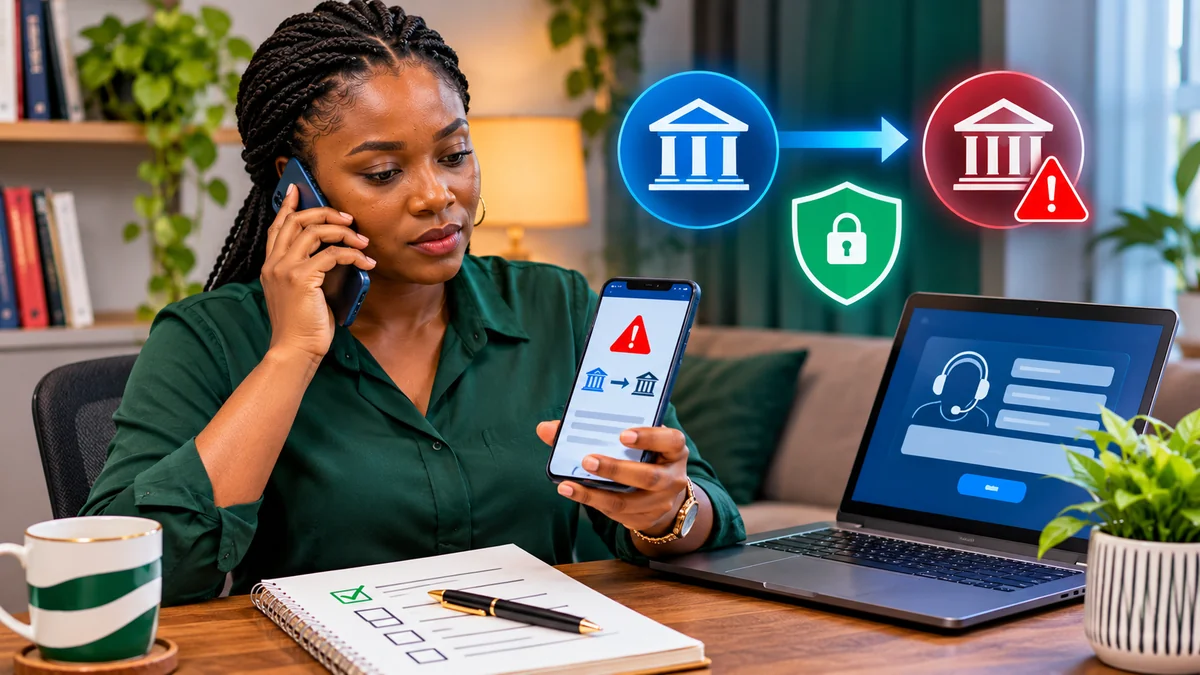
If you have just sent money to an account you suspect is fraudulent in Nigeria, contact your bank or payment provider immediately. Report the transaction as suspected fraud, ask the institution to initiate an urgent trace and recovery request through its authorised channels, and obtain a complaint reference number. Save your transfer receipt, transaction reference, messages and any other evidence, then report suspected criminal conduct to an appropriate law-enforcement agency.
Do not wait for the recipient to reply, do not send more money to “unlock” a refund, and do not assume that an instant bank transfer can be reversed simply because you report it. The Central Bank of Nigeria's (CBN) fraud-awareness guidance recommends immediate contact with your financial institution, reports to the authorities and securing compromised credentials.
This guide explains the first steps, the difference between fraud and a mistaken transfer, how to report a case to the Nigerian Police Force's cybercrime centre or the EFCC, and when to escalate unresolved bank complaints to the CBN. Information verified on 3 November 2026. This is general consumer information, not personalised legal advice.
What to do in the first 10 minutes
Speed matters because a recipient may withdraw or move the money before the bank can assess the complaint. The following is a practical emergency checklist, not a guaranteed recovery timetable.
- Stop further payments. Do not transfer “processing fees”, “refund charges”, “tax” or an additional instalment to someone you now suspect is dishonest.
- Open your genuine banking app or use a verified bank contact channel. Do not follow a support link sent by the suspected scammer. Report the suspicious payment and request immediate fraud-desk attention.
- Give the bank the precise transfer details. Supply the amount, date and time, sender institution, recipient account name and number, receiving institution, and transaction/reference ID from your receipt.
- Ask for a documented case number. Request confirmation that the complaint has been logged as a suspected fraudulent transfer, not merely as a routine failed transaction.
- Preserve the evidence. Save statements, app receipts, conversations, advertisement screenshots, seller profiles, call logs and the reason you believe the transaction was fraudulent.
- Secure your own account if access may have been compromised. Ask your bank about account/card restrictions, change exposed passwords using a trusted device and enable appropriate authentication controls.
If the transfer was made from a wallet, fintech app, payment service bank or other licensed provider rather than a conventional commercial bank, begin with the provider that actually debited your funds. Ask it to refer the transaction to the receiving institution through its available payments and fraud procedures.
Step 1: Tell your sending bank exactly what happened
Call the official fraud or customer-service line, open an in-app dispute, or visit a branch. Use the telephone number or help section in an app you already trust, or the institution's verified website. Never rely on a stranger's WhatsApp “recovery officer”.
Explain that you authorised a transfer because of a suspected deception, if that is what happened. For instance, you might have paid for goods advertised by an impersonator, transferred money after receiving a false invoice or sent funds to a purported investment operator who misrepresented the transaction. Be factual: suspicion is sufficient reason to ask for urgent review, but you should not assert that a person has been convicted of fraud.
Ask the bank to:
- Log an urgent suspected-fraud complaint and give you its unique reference.
- Trace the transaction using its payment reference and identify the receiving institution.
- Notify the appropriate receiving-bank team and request a permitted hold, restriction, recall or recovery review where the evidence and applicable rules allow.
- Explain any further documents needed, the next update date and how you should follow up.
- Confirm the outcome or refusal in writing so the complaint has an auditable history.
The bank may investigate internally and coordinate with the recipient institution or authorised payment infrastructure. An individual customer generally should not expect to instruct the Nigeria Inter-Bank Settlement System (NIBSS) directly to reverse a completed transaction. Work through the financial institution that processed your payment and its established dispute channels.
CBN's consumer education guidance specifically tells customers to report suspected fraud or transaction errors promptly.
Step 2: Understand what the bank may and may not be able to reverse
Many Nigerian interbank transfers settle rapidly. When funds have reached a valid beneficiary account, a sender cannot assume that tapping “reverse” or presenting a screenshot will undo the payment. The receiving institution may need to verify the allegation, review available funds and follow applicable regulatory or legal processes before restricting access or facilitating recovery.
The distinction between three situations is important:
| What happened? | How to describe it | What may be investigated |
|---|---|---|
| You were deceived into approving the transfer | Suspected fraudulently induced or authorised push payment | Beneficiary account activity, deception evidence, bank fraud procedures and possible law-enforcement action |
| Money left your account without your permission | Suspected unauthorised debit or account takeover | Account compromise, access logs, device/activity evidence and responsibility under applicable rules |
| You entered the wrong account details yourself | Customer-error or mistaken transfer | Wrong-recipient dispute process, available funds, beneficiary consent and other applicable procedures |
Do not label an accidental transfer as criminal fraud to pressure a bank into acting. Conversely, if you were tricked by a fake seller, tell the bank the whole story rather than claiming that the app transferred money by itself. Misdescribing the incident can complicate the investigation.
CBN's payments-system regulatory materials include regulations for instant interbank transfers and dispute handling. The exact steps and authority to place restrictions depend on the case; recovery is not guaranteed simply because the transaction is disputed.
Step 3: Preserve the information an investigator will need
Bank fraud teams and investigators need more than a statement that “I was scammed.” Collect a clear timeline showing how the request for payment arose, the promises made, what you checked, the transfer itself and when you discovered the suspected deception.
Useful evidence includes:
- Payment record: transaction ID, amount, currency, sender and recipient institution, transfer date/time, account details and downloaded receipt.
- Communications: complete WhatsApp, SMS, email or social-media chats, voice notes and relevant phone numbers.
- Advertisement or offer: links, seller profile names, product listings, invoices, websites, screenshots and any claimed business identity.
- Proof of non-delivery or deception: messages about missing goods, false shipping information, impersonation evidence or contradictory account instructions.
- Reporting trail: when you contacted your bank, complaint number, replies, police/EFCC reference and any formal correspondence.
Keep original files where possible. Export chat histories before accounts or messages disappear, but do not edit screenshots to improve the story. Store sensitive documents securely and share them only through official investigation channels. Avoid posting someone else's account number, identity documents or unverified accusations publicly.
Step 4: File a criminal complaint with the police or EFCC
A bank complaint focuses on financial processing and potential recovery. A law-enforcement report addresses suspected criminal conduct, gathering evidence and investigating the people behind it. These actions can run in parallel; there is no need to wait two weeks before reporting serious suspected fraud to the authorities.
Nigerian Police Force National Cybercrime Centre (NPF-NCCC)
The police operate an official National Cybercrime Centre e-reporting portal . Its published instructions describe creating an account, completing the requested identity verification, submitting supporting material and tracking case progress. The official contact page also lists report@nccc.npf.gov.ng and recommends using the secure citizen reporting portal for incidents.
Only provide NIN/BVN information through the genuine government site when the service requires it. Do not forward these identifiers to somebody claiming to “help speed up” a police complaint on Telegram or WhatsApp.
Economic and Financial Crimes Commission (EFCC)
The EFCC website offers official petition-related services and contact information. Its phishing advisory encourages prompt reporting of suspected scams to an EFCC zonal command or other law-enforcement agency. Use the website to obtain the current official reporting instructions; the published central email is info@efcc.gov.ng.
In a petition, describe the suspected offence clearly, attach transaction evidence and identify any bank complaint number already issued. Ask for acknowledgement or a reference where the agency provides one. Neither filing a petition nor securing a police report automatically obliges a bank to refund a completed transfer.
Step 5: Secure your accounts if the scam involved stolen information
If you only made a payment to a suspicious seller, the primary issue may be recovery of that payment. However, if you shared your login details, card numbers, one-time password, PIN, screen access or installed an unfamiliar app, assume there may be further risk to your accounts.
Use a trusted device and verified bank support to ask about restricting online banking, cards or transfers as appropriate. Change exposed passwords, sign out unfamiliar sessions, review transaction alerts and enable multi-factor authentication where available. Check other accounts that reused the same password. If your SIM or phone has been compromised, contact your mobile network and financial providers promptly.
CBN's fraud-awareness page advises protecting login credentials and securing affected accounts. Its 2026 instant-payment reforms overview also describes additional customer controls, including voluntary instant-transfer restrictions and configurable limits. Ask your institution what is available on your particular account rather than assuming every app exposes the same options.
Step 6: Track your bank complaint and escalate correctly
Keep the initial complaint reference and every subsequent response. Ask for an update that identifies what action has been taken: was the transaction traced, was the receiving institution contacted, is more evidence needed, and has a determination been made? The bank may not be able to disclose private details of another account holder, but it can explain its complaint process and communicate its decision.
The CBN's consumer complaint guidance generally tells customers to complain to the financial institution first and allows escalation to the CBN if the bank does not resolve the complaint within the applicable period, commonly two weeks for general complaints. Some categories have different timelines. Do not treat two weeks as permission for banks to delay urgent fraud reporting or as a guarantee that the funds will be returned within that period.
The official CBN Complaints Portal instructs customers to lodge their complaint with the financial institution, obtain a tracking reference and allow approximately 24 hours for the institution to upload the case before checking it on the portal. That 24-hour portal step is not a promise of complaint resolution.
If the bank does not acknowledge or adequately resolve the complaint in accordance with the applicable process, escalate with the case reference, correspondence and supporting evidence. The CBN publishes cpd@cbn.gov.ng for complaints about regulated financial institutions. Verify contact details on the official CBN contact page before sending personal documents.
CBN complaint review is not the same as a police investigation or a guaranteed financial reimbursement. Keep the two processes documented separately.
Can the receiving bank freeze the alleged scam account?
You can ask your sending bank to contact the receiving institution urgently and assess whether a temporary restriction or other lawful protective step is available. Whether funds can actually be held depends on what remains in the account, the evidence, relevant financial-sector procedures and any legal requirements. A bank cannot necessarily freeze any account indefinitely merely because a caller alleges fraud.
The recipient may have already withdrawn money, transferred it onwards, or received and spent it before a complaint was logged. Recovering such funds can be more complicated than returning a payment that is still traceable and available. Do not attempt to threaten or harass the named account holder or pay a supposed intermediary to force a freeze.
In January 2026 the CBN publicly discussed reducing institutional fraud-response times at a Nigeria Electronic Fraud Forum session. Faster industry responses are valuable, but a policy ambition or response benchmark is not a guarantee of account freezing or refund. The actionable step for consumers is still immediate formal reporting through verified banking channels.
Important: Do not mistake proposed reimbursement rules for existing guarantees
In late 2025, the CBN published an exposure draft on authorised push-payment fraud . It proposed investigations, institutional duties and certain reimbursement eligibility conditions—including a 72-hour customer reporting threshold in the draft.
An exposure draft is a consultation document, not proof that those proposed rights and deadlines have entered into force. The official sources checked for this article did not establish a subsequently finalised rule making every fraud victim entitled to reimbursement within a fixed period. Do not rely on social-media claims that a completed transfer must automatically be refunded within 48 hours, or that reporting after exactly 72 hours necessarily ends all options. Report immediately regardless of how much time has passed and ask the bank to apply the regulations actually in effect.
A sample message for your bank's fraud desk
The following template can be adapted for an in-app complaint, email or branch submission. Replace the placeholders with facts and keep your passwords, PINs and OTPs out of the message.
Subject: Urgent suspected fraudulent transfer — request for trace and recovery review
I am reporting a transfer that I made after what I now believe may have been a fraudulent representation. On [date and time], I sent ₦[amount] from my account at [sending institution] to account [recipient account] at [receiving institution], with transaction reference [reference number].
I suspect fraud because [brief factual explanation]. I request that your fraud/dispute team urgently investigate, trace the transfer, contact the receiving institution and assess any lawful restriction or recovery action available. Please confirm my complaint number, documents required and the next update date. I have attached the transfer receipt and relevant communications.
Thank you.
For a suspected unauthorised debit, rewrite the description to say that you did not approve the transaction, if true. Never use a pre-written template to misrepresent what happened.
What not to do after a suspected transfer scam
- Do not pay a “recovery fee”. Scammers commonly contact distressed victims again, claiming they can unlock or retrieve money.
- Do not share OTPs or passwords. Genuine complaint handling does not require sending secret login codes to an unknown person.
- Do not publish accusations without evidence. Preserve information for authorised investigators rather than organising public harassment.
- Do not delete chats or transfer receipts. The full chronology may be needed for banks or police.
- Do not fabricate a wrong-transfer or unauthorised-debit claim. Explain the actual circumstances.
- Do not assume a transaction reference means money is recoverable. It helps identify the transfer but is not a refund commitment.
One common example is a recruitment scam involving a fake processing fee. FlyingEze's guide to identifying fake remote-job offers explains warning signs that can help applicants avoid making the payment in the first place.
How to reduce the risk before making another bank transfer
Bank transfer fraud prevention in Nigeria is easier when you take a short verification step before approving a payment. Call a business through an independently verified number, confirm any changed invoice details with a known contact, inspect the account name carefully, and be suspicious of urgent pressure or payment instructions that move conversations to a new number.
Use suitable transaction limits and security alerts; do not let another person control your screen during a transfer. For a merchant, reconcile payments using the bank or payment provider's actual transaction records rather than trusting an SMS screenshot. For a personal purchase, keep invoices and communications until delivery is complete. NIBSS's October 2026 fraud-prevention discussion highlights the value of account controls, risk alerts and faster reporting features.
Frequently asked questions
Can I reverse a transfer I voluntarily sent to a scammer?
Not automatically. Report it immediately and ask your institution to investigate and coordinate possible recovery. Whether money can be returned depends on the transaction, available funds, findings and applicable procedures.
Should I contact the scammer's bank directly?
Your own sending bank or payment provider should be your first contact. You may also use verified public fraud-reporting channels of the receiving institution, but do not rely on a stranger's number or assume the receiving bank can discuss a third party's private account with you.
Do I need a police report before telling my bank?
No. Do not delay the bank complaint while trying to obtain a police document. Report to the bank immediately and make a police or EFCC report in parallel; supply additional records when requested.
How soon should I complain to the CBN?
Begin with your financial institution. Follow the CBN's applicable complaint-escalation process if the institution does not acknowledge or resolve your case within the relevant requirements. The CBN portal's 24-hour case-upload instruction is not a 24-hour refund promise.
What if several days have already passed?
Report the case now. Recovery may become more difficult over time, but do not assume a missed informal deadline means there is nothing the institution or authorities can investigate. Ask for a documented response.
Conclusion: Act quickly, document everything and use official channels
If you suspect that a Nigerian bank transfer went to a fraudulent account, report it to the financial institution that sent the money immediately, request urgent fraud-desk tracing, and preserve the evidence. Secure any compromised account details and file an appropriate police or EFCC report. Keep the bank's tracking number so you can follow up and, where justified, escalate unresolved financial-service complaints to the CBN.
No credible guide can guarantee recovery of funds after a completed transfer. Quick reporting, accurate evidence and lawful investigation provide the clearest path to finding out what can still be done—without exposing yourself to a second scam.