CDCFIB Recruitment Scams: Red Flags Applicants Should Know
A job applicant receives a WhatsApp message saying their name has appeared on a confidential Civil Defence shortlist. The sender uses a government-looking profile picture, mentions a real recruitment date and asks for a “processing fee” before releasing an invitation letter. Another message directs the applicant to a website that resembles the official recruitment portal and asks for a National Identification Number (NIN) and verification code.
Both are examples of CDCFIB recruitment scam warning signs. Fraudsters can exploit legitimate recruitment exercises, particularly when thousands of candidates are waiting for screening, shortlisting or appointment news. The danger is not limited to money: a fake portal can collect identity documents, passwords or other sensitive information.
The safest rule is to verify every recruitment instruction independently, never pay an unofficial agent and never provide an OTP, password or sensitive document through an unsolicited link. The official recruitment starting point identified in the Board's later communications is recruitment.cdcfib.gov.ng .
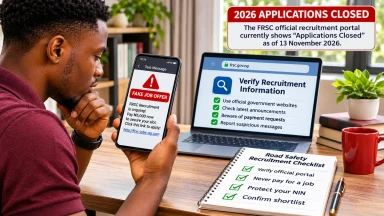
Recruitment-status note, checked 11 November 2026: the official CDCFIB notice currently says the 2024/2025 exercise has concluded. Separate reports describe a late-October to mid-November access window for existing successful candidates completing later-stage requirements. That is not evidence of an open new application round. Candidates must check the current official instructions relevant to their own stage.
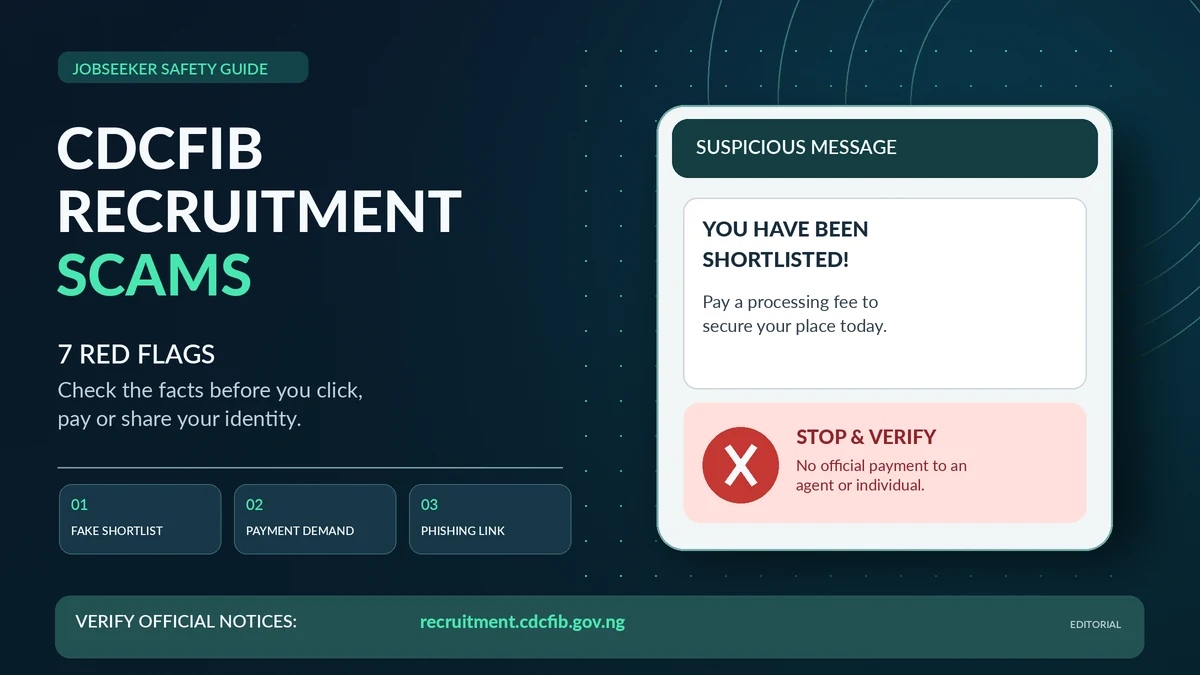
This guide identifies seven major red flags, explains verified cases of forged CDCFIB communications and sets out what to do if you clicked a suspicious link, shared information or sent money.
First, understand who runs CDCFIB recruitment
CDCFIB is the Civil Defence, Correctional, Fire and Immigration Services Board. Its recruitment process covers the Nigeria Security and Civil Defence Corps (NSCDC), Nigeria Immigration Service (NIS), Nigerian Correctional Service (NCoS) and Federal Fire Service (FFS). The fact that a message mentions one of these agencies does not make it an official recruitment instruction.
The Nigeria Immigration Service warned in February 2026 about websites falsely claiming to recruit on its behalf and directed candidates to the Board's authorised process. The Board itself warned in June 2026 that misleading recruitment announcements were circulating on social media and advised readers to check verified channels. FlyingEze's CDCFIB recruitment explainer covers agency roles and eligibility; the focus here is how to recognise and respond to fraud attempts.
CDCFIB recruitment scam red flags at a glance
| Red flag | Typical claim | Safer action |
|---|---|---|
| 1. A fee for recruitment access | “Pay to unlock your shortlist or appointment.” | Do not pay; confirm the free official process. |
| 2. An unverified shortlist | “Your name is on our private successful-candidates list.” | Check the authorised applicant dashboard. |
| 3. A forged government notice | “The Minister has changed screening dates.” | Find the announcement independently on official channels. |
| 4. A suspicious recruitment link | “Use this alternate portal because the official site is down.” | Open the verified Board address yourself. |
| 5. A request for identity or login secrets | “Send your NIN, password and OTP for verification.” | Keep credentials private; do not forward codes. |
| 6. Fake screening or drug-test charges | “Pay a medical or NDLEA test activation fee.” | Check the specific stage and NDLEA's no-payment notice. |
| 7. Guaranteed placement and pressure | “An insider can secure your job before midnight.” | Reject secret appointments and high-pressure demands. |
These are practical warning categories, not a finding that every message with poor spelling or an unusual format is fraudulent. What matters is whether the claimed authority, request and payment details can be verified through the actual Board or relevant government agency.
Red flag 1: Someone asks for a recruitment, shortlist or appointment fee
The most direct warning sign is an unofficial payment request. Scammers may call the money a registration charge, clearance fee, service code, shortlist activation, venue reservation, appointment-letter fee or refundable processing deposit. They may demand a bank transfer, payment-app transaction, cryptocurrency or a prepaid voucher.
During the 2025/2026 recruitment process, the Board's public communications repeatedly described recruitment as free. In July 2025, The Guardian reported a Board warning that it had not authorised any person to collect payments for jobs. The warning extended to intermediaries claiming special access to selection.
Ordinary personal expenses such as transport, internet access or obtaining a legitimate identity record are not the same as a fee paid to secure a CDCFIB position. However, no unknown agent should be paid to influence a government recruitment outcome. A statement that money is “refundable once your salary starts” is a pressure tactic, not proof of official authorisation.
Action: do not transfer funds. Save the account details and message as evidence and use the official contact or reporting procedures described below.
Red flag 2: A private shortlist or examination result is offered for money
Impersonators may claim to have a confidential list of successful candidates, a result that “has not yet been uploaded”, or the ability to move an applicant from reserve status to the final batch. A screenshot with a person's name or an agency emblem is easy to fabricate and may reuse information the applicant already posted online.
A legitimate recruitment stage should be verifiable through the Board's designated channel, when that function is actually available. The authenticity of a shortlist depends on its source, not the number of times it has been forwarded. Be especially cautious of downloadable PDFs that require payment or password-protected lists provided only through Telegram and WhatsApp.
Do not give someone your application reference, full NIN and date of birth just so they can “check for you”. If your details have already been used in a legitimate application, access the authorised portal yourself and keep your results private.
Red flag 3: A forged press release or appointment letter appears genuine
This has happened in documented CDCFIB recruitment coverage. In June 2026, the Board rejected a circulating notice claiming recruitment had been postponed. According to The Punch's report , the forged letter even mentioned the real government recruitment portal. Its inclusion of a correct website did not make the rest of the document genuine.
A second case was confirmed by the Federal Ministry of Information and National Orientation on 13 August 2026. The Ministry disowned an 11 August press release falsely attributed to the Minister of Interior, which claimed the exercise had been deferred until after the 2027 election because of funding constraints. The Ministry said the document was not issued by the Minister, Ministry or Board. That denial described the position in August; it should not be confused with the official portal's later November status statement.
Another August 2026 Board warning dismissed a purported notice assigning a new date for status checks after medical screening. A copied electronic signature and formal letterhead were insufficient evidence.
Action: search for the original announcement on the official portal, the Ministry's website or an independently verifiable official statement. A genuine URL printed inside an image cannot authenticate the image itself.
Red flag 4: You are directed to a lookalike or “emergency” portal
Fraudsters can create web pages with government colours, copied logos and words such as “recruitment”, “final shortlist” or “verification”. They may also hide a suspicious destination behind a shortened URL or a misleading hyperlink label.
The Board's current recruitment starting point is https://recruitment.cdcfib.gov.ng/ . Check the actual address bar, especially on mobile. A hostname such as cdcfib.gov.ng.example.com is only an illustrative lookalike: it belongs under example.com, not the Nigerian government's gov.ng domain. Having “cdcfib” in a website's title does not prove authorisation.
There is a historical complication worth understanding. An official Nigerian Correctional Service notice from June 2025 used a recruitment.cdcfib.org application address. Later Board and service communications designated recruitment.cdcfib.gov.ng. Therefore, do not declare every archived notice mentioning .org a scam; verify the date and authorised destination for the current stage. An old legitimate link is not, by itself, a new application invitation.
Likewise, a padlock icon only shows that the browser has an encrypted connection to the named website; it does not guarantee that the operator is a government agency. The safest approach is to navigate independently from a verified government announcement, not from a stranger's “backup portal”.
Red flag 5: A supposed official requests your NIN, OTP or bank credentials
Some recruitment processes legitimately use a National Identification Number, registered phone number or application reference to identify a candidate. That does not authorise an unsolicited caller to collect them, and it certainly does not justify disclosing an email password, one-time passcode, banking PIN or card security code.
Fraudsters can combine an applicant's NIN, address, date of birth, certificate details and other information to make impersonation attempts more convincing. A suspicious page may also request an SMS code to take over an unrelated account. Never forward an OTP, even if the caller knows the service you selected or correctly states your application number.
Take particular care with photographs of identity documents, school certificates and screenshots of a real applicant dashboard. A blurred-out name may not remove other identifiers such as a reference number or QR code.
The Economic and Financial Crimes Commission's phishing advisory warns that criminals imitate government agencies and trusted organisations through email, text, social media and fraudulent websites to obtain private information.
Red flag 6: You are asked to pay for a CDCFIB drug or medical test
This warning is especially relevant to late-stage candidates. On 30 October 2026, the National Drug Law Enforcement Agency (NDLEA) said that the Ministry of Interior had already made a bulk payment covering the mandatory Drug Integrity Test (DIT) for new intakes under the four services.
NDLEA said the eligible candidates must not pay an NDLEA official, test centre or any other payment channel for that recruitment-specific exercise. It instructed them to use the designated access point provided through their respective institutional portals.
Reporting at the time also described cases where candidates followed a general drug-test application route that displayed a charge, rather than the special route intended for the Ministry-funded exercise. That illustrates an important nuance: a fee appearing inside a real agency's wider service does not mean the fee applies to your particular recruitment stage. It does not automatically mean the entire drug-testing website is fraudulent.
**Action:** use only the instructions for your verified application stage. Do not pay a private intermediary for a “drug-test code”, “medical clearance” or “exam-centre allocation”. If someone demands money at a genuine venue, seek clarification from the relevant agency and preserve the details.
Red flag 7: An “insider” guarantees selection and demands secrecy
A purported officer, political contact or staff member may say they can secure a posting or add an applicant to a final list if a deposit arrives within an hour. They may discourage the candidate from discussing the offer with family, calling the Board or using the official portal.
Watch for phrases such as “private arrangement”, “do not call the office”, “our director approved this”, or “your name will disappear if you delay”. These are illustrative examples of high-pressure language, not quotations from one specific documented scam.
Recruitment decisions should follow the authorised process, not a secret payment route. Even an apparently genuine uniform, identity card, office photo or voice note is not sufficient proof that the person can arrange employment.
What if the official CDCFIB portal says recruitment has concluded?
Do not interpret closure as an invitation to use an alternative private portal. As at 11 November 2026, the official CDCFIB notice says the 2024/2025 recruitment exercise has concluded. Earlier October communications referred to access for candidates already participating in later-stage checks, including activities discussed in connection with a mid-November deadline. Neither automatically establishes an open intake for first-time applicants.
The right question is not simply “Is a portal page loading?” but “Does an authenticated Board notice authorise me to perform this exact step at this stage?” An old screenshot can be reused after its deadline. If a message says the portal has reopened for fresh forms, locate a new official announcement before submitting anything.
For a separate, more detailed walkthrough of the official website, FlyingEze's How to Identify the Genuine CDCFIB Recruitment Portal is scheduled in this editorial series. Its public link should be used only after that article is live.
How to verify a suspicious CDCFIB message in five minutes
- Stop the requested action. Do not make a payment, follow a shortened link or upload a document while checking.
- Record the claim. Note the supposed recruitment stage, deadline, issuer and what you are being told to do.
- Open the official site independently. Enter recruitment.cdcfib.gov.ng yourself rather than reusing the message's link.
- Cross-check announcements. Where necessary, look at verified Board, Ministry of Interior or relevant service notices. Compare the dates carefully.
- Reject unauthorised intermediaries. If the offer depends on a private bank transfer, WhatsApp code, secret shortlist or guaranteed appointment, do not proceed.
The process may take longer if the official website is unavailable, but waiting to verify is safer than providing permanent identity information to an untrusted service. FlyingEze has also covered the Board's warning about fake recruitment portals .
Three example messages: what should applicants do?
| Illustrative message | What's suspicious | Recommended response |
|---|---|---|
| “Congratulations! Pay ₦20,000 today to activate your final appointment.” | Private payment and guaranteed appointment | Do not pay; save the message and independently confirm the process |
| “The Minister has postponed recruitment. Read the attached signed notice.” | Possibly forged press release, even if it includes a real URL | Find an original Ministry or Board statement |
| “Send your NIN and six-digit OTP to confirm your screening venue.” | Requests identity details and a secret verification code through informal chat | Do not share; use the authenticated applicant portal if authorised |
These examples are fictional, and the amount quoted is illustrative, not an official CDCFIB fee or a verified payment demand from a specific case.
What to do if you have already interacted with a suspected scam
If you clicked a suspicious link but entered nothing
Close the page, avoid downloading any suggested app or document, and inspect your browser for unexpected permissions or downloaded files. Update your device and use a reputable security check if an unfamiliar programme was installed. Clicking alone does not prove your identity has been stolen, but further interaction can increase risk.
If you entered a password or OTP
Go directly to the legitimate service and change the affected password. Change reused passwords on other accounts, secure the associated email and enable multifactor authentication where available. If you supplied an OTP, contact the relevant account provider promptly because the code may have authorised an action already.
If you shared your NIN or documents
Preserve copies of what you sent and to whom. Be alert to follow-up attempts using your personal details; seek guidance from the relevant issuing authority or identity service where necessary. Do not publish your complete NIN or document images in a public complaint.
If you paid money
Contact your bank or payment provider immediately through a verified channel. Provide the transfer reference, time, amount, recipient information and copies of the message, and ask about available fraud-reporting or recovery procedures. Prompt reporting can help, but reimbursement or reversal is not guaranteed.
If you have evidence of attempted fraud
Keep the original message, sender handle, URL, timestamps, receipts and screenshots. The EFCC advises reporting suspected phishing to its nearest zonal command or law-enforcement agency and identifies info@efcc.gov.ng as a reporting contact. You can also report the account or content to the social platform used, and notify the Board through an independently verified government channel. Avoid confronting a suspected fraudster or circulating unverified accusations.
For wider context on how fabricated job offers work, see FlyingEze's guide to spotting fake job offers and recruitment scams .
How families and WhatsApp group administrators can reduce scam exposure
Recruitment rumours often spread through trusted circles. A relative may forward a notice out of genuine concern; a group administrator may pin an apparently official PDF without checking its source. Good intentions do not make the content reliable.
Before sharing a recruitment message, verify the date, the issuing agency and the exact action it requests. Avoid reposting “final lists” containing candidates' personal details. If a notice is disproved, correct it in the same group instead of quietly deleting the original message. Encourage applicants to follow official announcements, not the most confident person in the chat.
Frequently asked questions
What is the most common CDCFIB recruitment scam warning sign?
A request for money in exchange for application access, shortlisting, screening or a guaranteed job is among the clearest red flags. The Board has warned that its recruitment process is free and that unofficial agents are not authorised to collect recruitment payments.
What is the legitimate CDCFIB recruitment website?
The Board's later official communications identify recruitment.cdcfib.gov.ng . Verify the current recruitment stage and published instructions before entering details. The 2025 official announcement used an older .org address, so historical notices must be assessed by date rather than automatically labelled fake.
Can a fake CDCFIB letter show the correct government link?
Yes. The Board disowned a forged June 2026 postponement notice that reportedly included the authentic recruitment portal. A correct link on a fake document does not validate its claims.
Do CDCFIB applicants have to pay for the NDLEA drug test?
For the recruitment-specific Drug Integrity Test addressed by NDLEA on 30 October 2026, the agency said eligible candidates should not make any payment because the Ministry of Interior had covered the cost. Candidates should follow the access route provided by their authorised institutional portal.
Is CDCFIB recruiting fresh applicants in November 2026?
The official public notice checked on 11 November 2026 says the 2024/2025 exercise has concluded. Reports about access for existing candidates should not be mistaken for a verified new application round.
Should I send my NIN to someone offering to check the shortlist?
No. Use the official candidate process yourself where it is available. Never send a password or OTP to an unofficial contact, even if the person claims to work for one of the services.
Where can I report a fake CDCFIB recruitment payment request?
Report suspected fraud to the EFCC or an appropriate law-enforcement authority using verified channels. If money was transferred, contact the bank or payment service immediately and retain the evidence. You may also report the impersonating account to the platform.
Conclusion
CDCFIB recruitment scams can imitate authentic websites, copied official letters, shortlist announcements and screening procedures. The most dangerous patterns are payment demands, deceptive links, requests for identity or login secrets, and promises of insider influence.
The best defence is straightforward: read the current official notice, independently verify the claimed stage, never pay agents for a job, keep sensitive information private and report suspicious activity promptly. An applicant should not have to trust a forwarded message or surrender personal credentials to discover what the Board has officially announced.