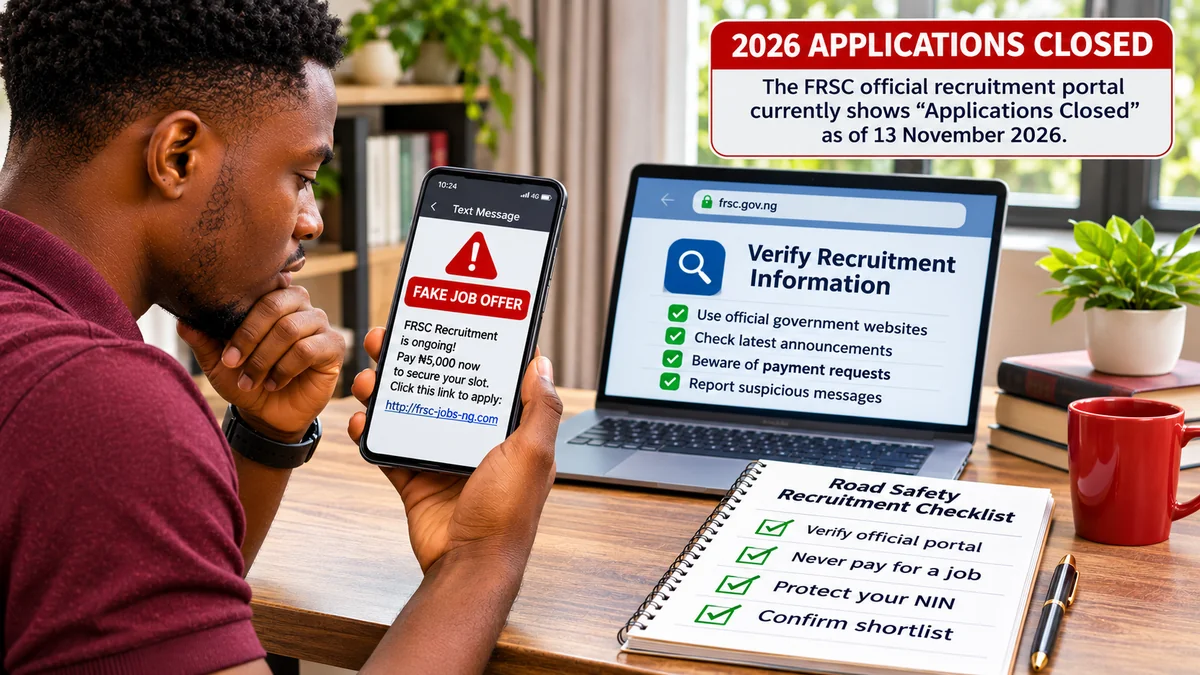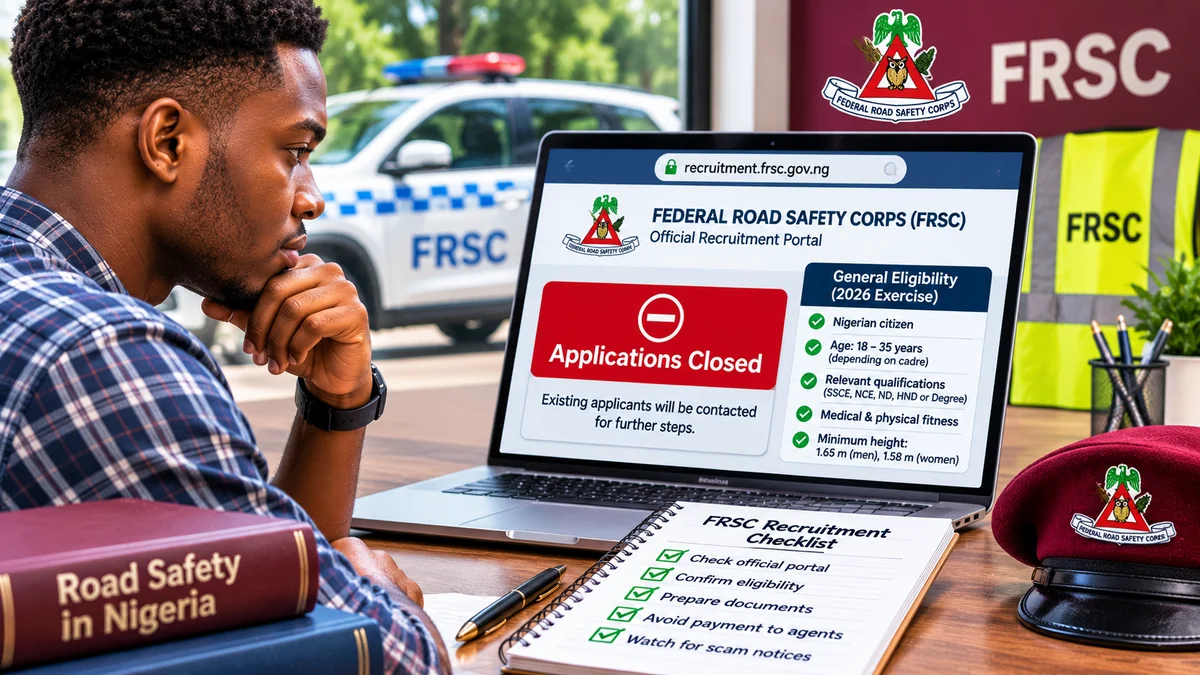
Current status (13 November 2026): The Federal Road Safety Corps (FRSC) is not accepting new recruitment applications through its official recruitment portal . The portal displays “Applications Closed” and says people who already applied will be contacted about further steps. This checklist is therefore for existing 2026 applicants preparing for any verified next stage and for job seekers organising documents ahead of a future officially announced exercise—not a claim that registration is open today.
When people search for recruitment of FRSC, they often find lists of certificates with little explanation about what is compulsory, what depends on the job and what should only be taken to screening when invited. The result can be wasted journeys, inconsistent personal details or unnecessary payments. This practical guide separates the 2026 recruitment notice's documented requirements from sensible preparation steps and unconfirmed items, so applicants know what to collect, what to check and what not to assume.
Research verified: 13 November 2026. FRSC's 2026 application notice and current official portal were checked alongside attributed reporting. A future exercise may have different requirements, deadlines, file formats and screening arrangements.
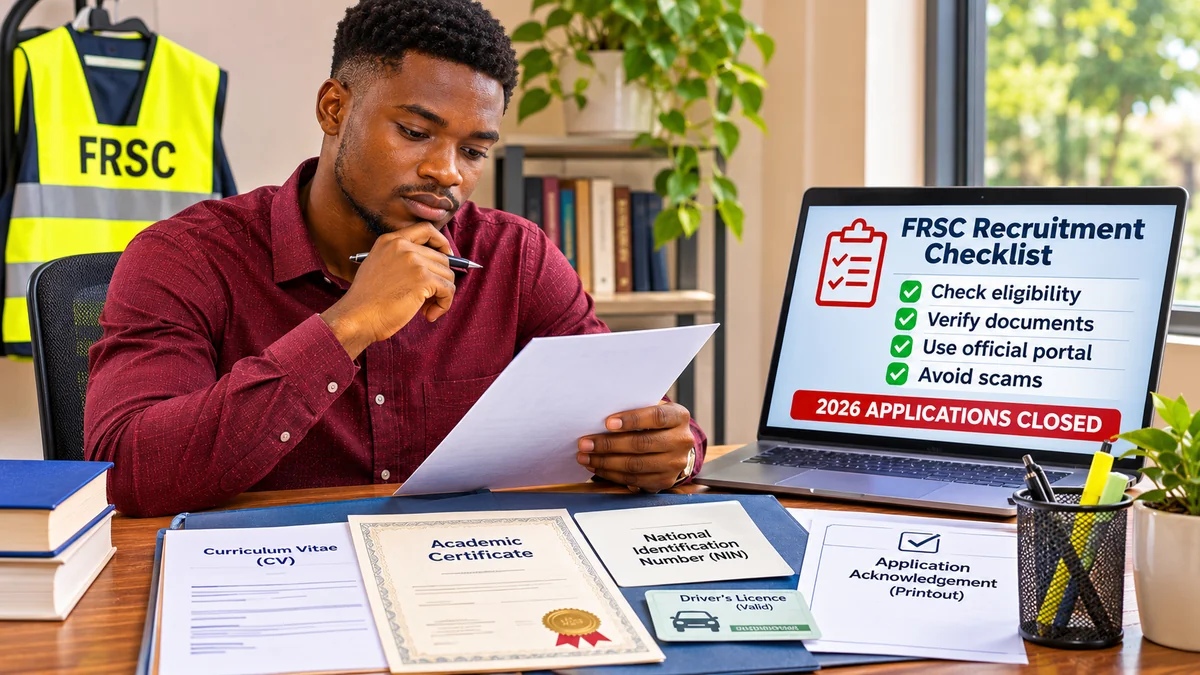
FRSC recruitment documents checklist: the essentials
Start by identifying the cadre and position you applied for, or hope to apply for later. During the 2026 exercise, FRSC recruited across the Officer Cadre, Marshal Inspectorate Cadre and Road Marshal Assistant Cadre. The exact certificates were not interchangeable across these categories.
| Item to prepare | Why it matters | Requirement status |
|---|---|---|
| National Identification Number (NIN) | Identity information requested in the 2026 online form | Explicitly listed as a registration field |
| Correct name, date/place of birth and origin details | To ensure the application matches genuine personal records | Explicitly listed as registration fields |
| Active personal email and phone number | Draft activation and subsequent communication | Explicitly required in the 2026 process |
| Academic certificates appropriate to your cadre | Evidence you meet the position's minimum entry qualification | Required, with the type depending on the position |
| Professional certificate or practising licence | For relevant medical, health, technical and other specialised posts | Position-dependent |
| Correct class of valid driver's licence | For driver and motorcycle-rider vacancies | Position-dependent |
| Printed completed application form | Record required for shortlisted candidates at screening | Explicitly mentioned in the 2026 notice |
| Proof of medical fitness | Supports any formal medical screening or certification requirements | Fitness required; follow the exact instructions for when/how to obtain evidence |
| Birth certificate, origin certificate, passport photos, NYSC records or copies | May help substantiate claims or meet later document requests | Preparation items; do not assume each is universally required without a current instruction |
The most important distinction is that a document mentioned in a general preparation guide is not necessarily required for every applicant at initial registration. FRSC's published 2026 application instructions requested specific form fields and qualifications; screening-stage materials could vary by cadre and invitation. The Punch's July 2026 account of the official notice confirms the main fields and states that shortlisted candidates were expected to present printed copies of their application forms.
1. Confirm your identity and personal information
Before you upload or submit anything, write down your personal details exactly as they appear on legitimate records. The 2026 registration form requested the NIN, surname and other names, date and place of birth, nationality, state and local government area of origin, hometown, contact address, gender, marital status, height and weight. It also requested an intended physical screening venue.
Use one consistent spelling of your name. If a document contains a discrepancy—for example, a reversed surname or a different birth date—seek guidance from the appropriate issuing authority rather than altering a scan yourself. A minor formatting difference and an identity inconsistency may be treated differently, so do not guess that either will be ignored.
Keep your NIN confidential. It may be required in the legitimate recruitment form, but it is not safe to enter it into random “FRSC shortlist checkers” or send a photograph of your identification to an unverified WhatsApp agent. The official 2026 recruitment address was recruitment.frsc.gov.ng , a subdomain of FRSC's government website .
2. Match your educational certificates to the cadre
The 2026 FRSC advertisement used different entry routes. Nigerian Tribune's report of the recruitment notice and The Punch describe the three categories as follows:
| 2026 cadre | Relevant qualification examples | What to verify |
|---|---|---|
| Officer Cadre | Recognised university degrees, HND or specific professional qualifications for designated posts | The exact discipline, qualification level and professional licence for the vacancy |
| Marshal Inspectorate | NCE, ND/OND and recognised nursing, midwifery or community health credentials for particular posts | Which certificate the specific Inspectorate vacancy accepts |
| Road Marshal Assistant | Specified SSCE results, including credits in English Language and Mathematics for general posts; trade qualifications for specialised jobs | The grade, number of credits, trade or licence conditions for the particular post |
Do not apply for a medical position merely because you have a general science degree, or for a driving post without the required class of licence. Professional vacancies can require registration with an appropriate council or proof of current practising authority. The general word “graduate” does not override the qualifications attached to a specific job title.
Organise the originals of all qualifications you actually hold. A key instruction in the 2026 notice was to declare all certificates and qualifications at recruitment, with a warning that undeclared qualifications would not be accepted for future career progression in the Corps. That is a reason to be accurate and complete—not a reason to claim credentials that have not been awarded.
3. Prepare licences and trade evidence if your role requires them
A valid National Driver's Licence could be relevant to the 2026 exercise, but it was especially important for driver and motorcycle-rider positions, where the notice demanded the appropriate licence class. Other specialised posts could require trade certificates or evidence of relevant skills.
Before a verified future application, check your licence's name, class, expiration date and consistency with your identification. A provisional, expired or unsuitable licence should not be assumed sufficient for an advertised driving role. If your job requires professional registration—for example, in a health discipline—check that the issuing body and credential are recognised, and that the licence is current where required.
Do not spend money buying a qualification or renewing a licence for a promised recruitment round that FRSC has not announced. Preparing existing genuine documents is sensible; paying to satisfy an invented “urgent deadline” is not.
4. Secure a personal email address and working phone line
The 2026 application process asked candidates to provide and confirm their own email address and to use an accessible phone number. Applicants first entered information into a draft and then verified their email before completing the application process.
FRSC's own Activate Without Email page explains that applicants whose activation message did not arrive could use the same email, surname and date of birth recorded in their draft to activate their account. That historical feature demonstrates why accurate details were important. It does not reopen the closed 2026 application window.
Check your inbox, spam folder and security settings. Keep your account password private and use an email address that will remain accessible after the application. If you use a cybercafé, do not let its operator keep your login password or retain unneeded copies of your identification documents.
5. Check height, fitness and other eligibility criteria early
FRSC's 2026 notice described medical fitness and personal eligibility conditions. Reported minimum heights were 1.65 metres for men and 1.58 metres for women. The age ranges differed by cadre, with officers generally 18–35, Marshal Inspectorate candidates 18–30, and particular articulated-vehicle and tow-truck drivers 26–40.
Some published reports also cited a medical-fitness certificate from a government-approved hospital. Applicants should distinguish being fit for the role from when the recruitment authority requires a certificate or examination. Unless an authenticated instruction specifies a stage or approved provider, do not book and pay for repeated assessments because of an unofficial checklist. A real healthcare professional should determine the appropriate fitness examination, not a recruitment agent.
The 2026 notice also described citizenship by birth, computer literacy, character requirements, single marital status and certain other conditions. These are historical terms of that particular exercise, not a prediction of a later round. If a rule appears unclear or potentially discriminatory, seek clarification through official channels; do not misrepresent your circumstances to try to fit an eligibility field.
6. Prepare clear document copies—without inventing upload rules
Some candidates find it convenient to organise digital copies of identification, school results, degrees and applicable licences in advance. The right preparation is to ensure every copy is authentic, readable and consistent with the original. A phone scan can be useful for organisation, but it should never be edited to change a grade, name or licence validity.
Use neutral file names such as academic-certificate.pdf or driving-licence.jpg in your private folder, and do not include passwords, NINs or banking details in the file name. Back up the files securely, with access limited to you. File type, dimensions, maximum size and upload order should be taken only from the official portal for the actual exercise; this article cannot verify one universal FRSC document-upload specification.
Other documents sometimes mentioned by general recruitment tutorials include a birth certificate or age declaration, local government or state-of-origin certificate, recent passport photograph, NYSC discharge or exemption record, and a CV. Those may be useful to assemble if relevant, but the available 2026 notice does not establish that every applicant must upload all of them. A CV or NYSC certificate should not be represented as a substitute for the actual cadre qualification.
7. Review every application field before final submission
During the 2026 exercise, the documented workflow was to visit the official portal, choose a qualifying position and specialisation, enter personal information, select Submit Draft Application and confirm the email address. The detailed form could request more information in later sections.
If a future authorised portal allows applications, use this checking sequence:
- Confirm the recruitment notice is current and the application window is genuinely open.
- Read the chosen role's qualification, age and licence conditions in full.
- Enter your identity and contact fields exactly as recorded on genuine documents.
- Use the intended screening location only where the form requests one.
- Disclose all academic and professional qualifications accurately.
- Upload only what the official portal requires, in the formats it specifies.
- Review the complete application before the final confirmation; keep a copy of the submission.
Shortlisted candidates for the 2026 exercise were advised to present printed copies of their completed application forms at screening. Save any acknowledgement, application reference or confirmation generated by the real portal; do not fabricate a receipt or assume a screenshot of a draft means the submission was final.
8. Make a separate checklist for an official screening invitation
Application submission and screening are different stages. If you already applied in 2026 and receive a purported invitation, first verify that it genuinely comes from FRSC. Then follow the exact venue, date, identity and document instructions contained in that authenticated communication.
| Before screening | Practical action |
|---|---|
| Invitation authenticity | Confirm the notice using FRSC's official portal or other verified agency communication |
| Application evidence | Print and keep the completed form or acknowledgement provided by the portal |
| Identity evidence | Organise the genuine identity documents specifically requested in the invitation |
| Qualifications | Arrange original certificates and clearly legible copies as instructed |
| Role-specific evidence | Carry applicable professional or driving licences if the invitation requires them |
| Fitness and medical records | Follow the authority's current requirements for examination and certificates |
| Travel arrangements | Confirm the venue, time and reporting rules before spending money on transport |
Do not travel to an FRSC camp solely because a forwarded message says everyone must appear. On 20 September 2026, the Corps disowned a viral notice telling candidates who were not shortlisted to report to camps before 25 September. The Punch reported FRSC's warning that the notice was false and that applicants should rely on official channels.
A training invitation is also not an employment appointment. In its September 2026 clarification, FRSC disputed claims about allocated recruitment slots and said that attending a later evaluation stage was not equivalent to receiving a formal appointment letter. Channels Television documented that distinction.
Common FRSC application mistakes to avoid
Applying for a cadre that does not match your qualifications
A candidate with only general SSCE results should not assume they qualify for an Officer Cadre position requiring a degree. Conversely, a graduate should not conceal a qualification because someone claims it will increase their chance at a lower-level vacancy. Read each role's actual conditions and declare qualifications truthfully.
Using someone else's phone or email
Recruitment updates may be sent to the details in the application. An email account owned by a cybercafé operator or friend can leave the applicant unable to retrieve an activation message or subsequent notice. Take control of your own login and contact channels.
Submitting a draft but not completing verification
The 2026 process included draft submission and email activation. Saving a partial form is not the same as a confirmed final application. Retain the accepted acknowledgement and investigate any pending activation through the genuine site rather than paying a third party.
Paying for an unofficial medical test, shortlist or appointment
The 2026 application was announced as free. The Corps has warned against agents claiming they can influence recruitment. Legitimate personal costs, such as making private photocopies or paying for transport when actually instructed to attend, should not be confused with an FRSC “slot fee”.
Using documents that do not match
Name, date-of-birth or certificate details that conflict with one another can delay verification. Where a correction is genuinely needed, ask the issuing institution for its formal process rather than editing the digital image.
Following outdated deadlines or fake shortlists
The 2026 window opened on 3 July for four weeks. It is closed as of the verification date. A recruitment blog promising a fresh “2026/2027 application link” or a shortlist for payment is not authoritative simply because it appears high in a search result.
How to identify a genuine FRSC recruitment message
Use the official FRSC website and recruitment portal as starting points. A convincing graphic, coat of arms, official-sounding email subject or HTTPS padlock is not enough to authenticate a notice. Check the full web address and whether FRSC has published the same message independently.
Do not share your NIN, bank details, password, one-time code or document scans because a private messenger promises a screening shortcut. FlyingEze's guide to recognising fake job and recruitment offers explains common impersonation and payment-pressure tactics that apply here too.
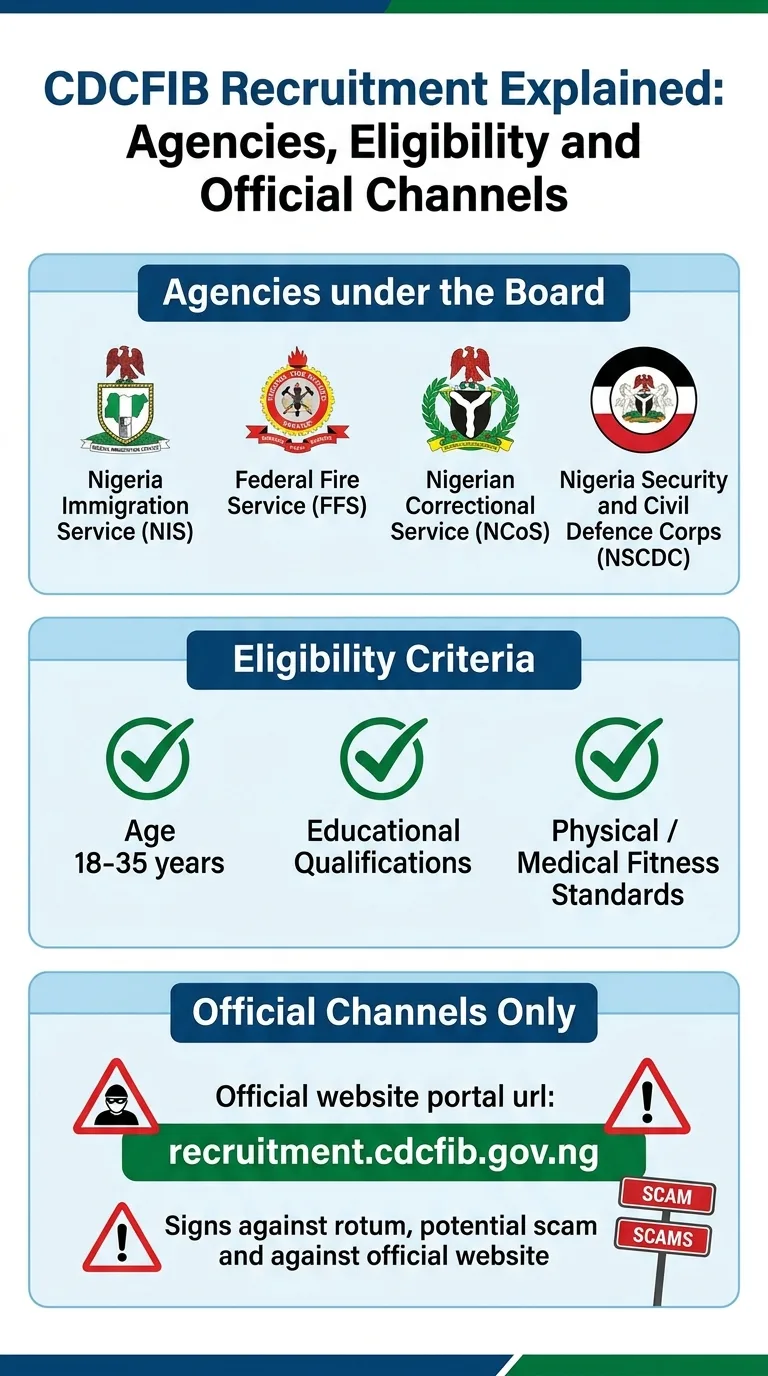
For additional context, FlyingEze reported the CDCFIB board's warning about imitation recruitment portals . That notice concerns different agencies, not FRSC; it illustrates why applicants must not confuse separate government recruitment websites.
Printable preparation checklist: what to organise today
This list is intentionally divided by what you can do while recruitment is closed and what must wait for a new authorised notice.
- Now: Confirm your exact legal name, birth details and NIN record.
- Now: Secure a personal email address and active contact number.
- Now: Gather genuine SSCE, diploma, degree or trade certificates relevant to your likely cadre.
- Now: Check applicable professional and driving licences for accuracy and validity.
- Now: Make secure, readable personal copies of existing documents.
- Now: Review the 2026 eligibility rules as historical guidance, not a promise of future recruitment.
- When recruitment opens: Verify the live advertisement, cadre, date and official portal before entering sensitive information.
- During an authorised application: Follow the exact upload format, review every field and save the confirmed final submission.
- Only if officially shortlisted: Confirm the invitation and prepare originals, photocopies, fitness records and venue instructions actually requested.
Avoid paying an agent to “prepare an FRSC file” as if doing so creates an official application. There is no evidence in the checked portal of a new public application round open on 13 November 2026.
Frequently asked questions about FRSC recruitment documents
Is the FRSC recruitment portal open now?
No. The official FRSC portal says applications are closed as of 13 November 2026, while existing applicants will be contacted about further steps.
What documents did FRSC recruitment require in 2026?
The notice required accurate identity and contact information, including NIN, and genuine academic or professional qualifications appropriate to the role. A valid driver's licence was required for certain driver/rider posts, and shortlisted candidates were to bring printed application forms. Other documents may be requested at screening.
Do I need an NYSC discharge certificate for every FRSC vacancy?
Do not assume so. The roles had different qualification requirements. Consult the exact current officer or other vacancy instruction before treating an NYSC document as mandatory for every applicant.
Do I need a medical fitness certificate before applying?
The 2026 notice described medical-fitness requirements, with some coverage specifying a certificate from a government-approved hospital. Follow the relevant official stage and provider instructions; do not spend money on an unauthorised assessment while the portal is closed.
What should I do if my email activation message did not arrive?
The official 2026 portal provides an activation-without-email page using the details from a draft application. This is relevant only to a genuine existing application and does not mean new submissions are open.
Should I print my FRSC application form?
Yes, where the system provides an accepted completed application: the 2026 notice said shortlisted candidates would need printed copies at screening. Keep both a secure electronic copy and the printed version if you already applied.
Does FRSC ask applicants to pay for a recruitment slot?
The 2026 recruitment announcement said applications were free and FRSC warned against recruitment agents demanding money. A promise of guaranteed shortlisting or an appointment for a private payment is a serious warning sign.
What if my certificate carries a different name?
Do not alter the original. Contact the issuing authority or official recruitment channel to clarify the accepted correction or supporting-document process for that discrepancy.
Does being invited to screening mean I have a job?
No. Screening, training and appointment are separate stages. FRSC's September 2026 clarification specifically distinguished candidates undergoing further evaluation from candidates formally appointed.
Conclusion: prepare your records, but wait for verified instructions
The best FRSC recruitment application checklist starts with accurate identity details, genuine educational credentials, role-specific licences and direct control of your phone and email. Existing 2026 applicants should also preserve their submitted application and respond only to authentic screening communication.
As of 13 November 2026, the 2026 recruitment portal remains closed. Rather than paying an agent or following a recycled form, use the time to review your records and understand which qualifications apply to your preferred cadre. When FRSC formally announces another exercise, compare this preparation list with the new official advertisement before submitting or travelling.
Editorial verification: 13 November 2026. Sources: official FRSC recruitment portal and activation page, FRSC government website and dated reports of the 2026 notice and fraud warnings. This article is not an official FRSC checklist and does not confirm a future recruitment timetable or individual candidate selection.