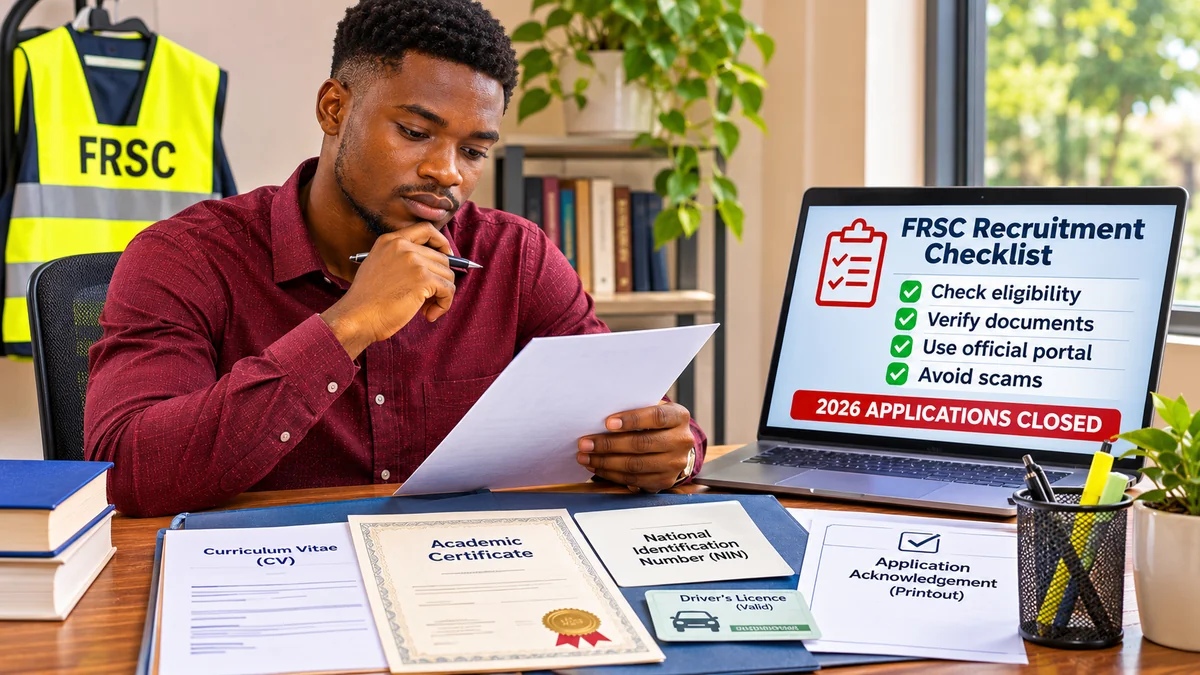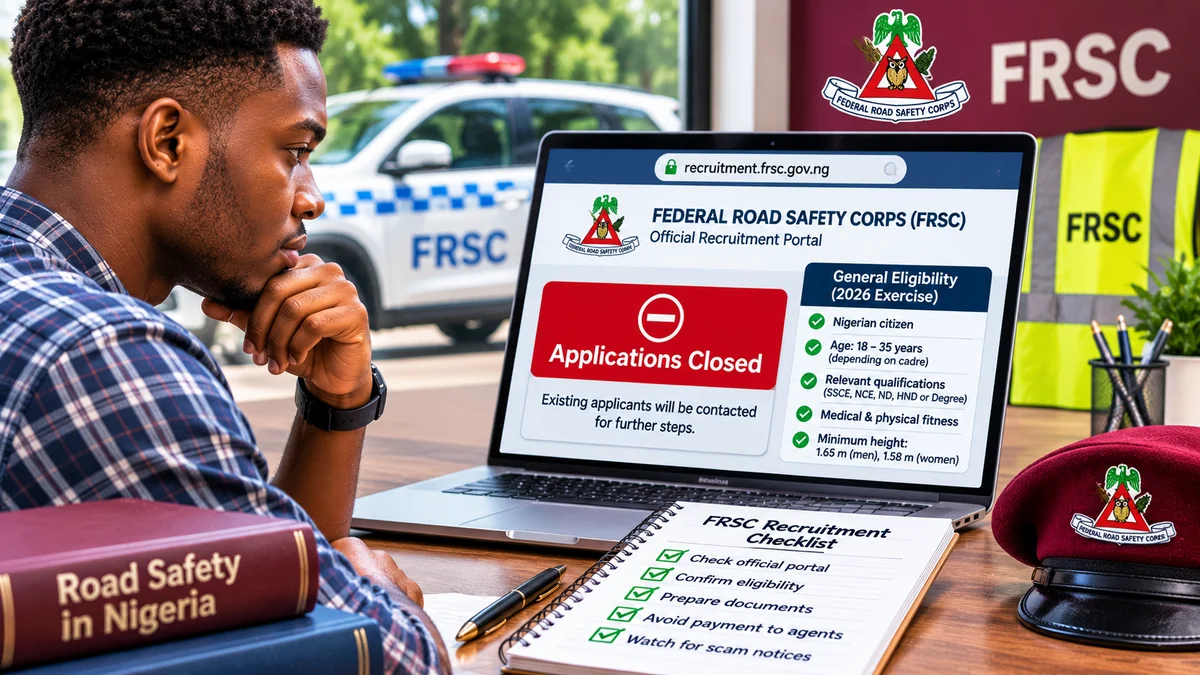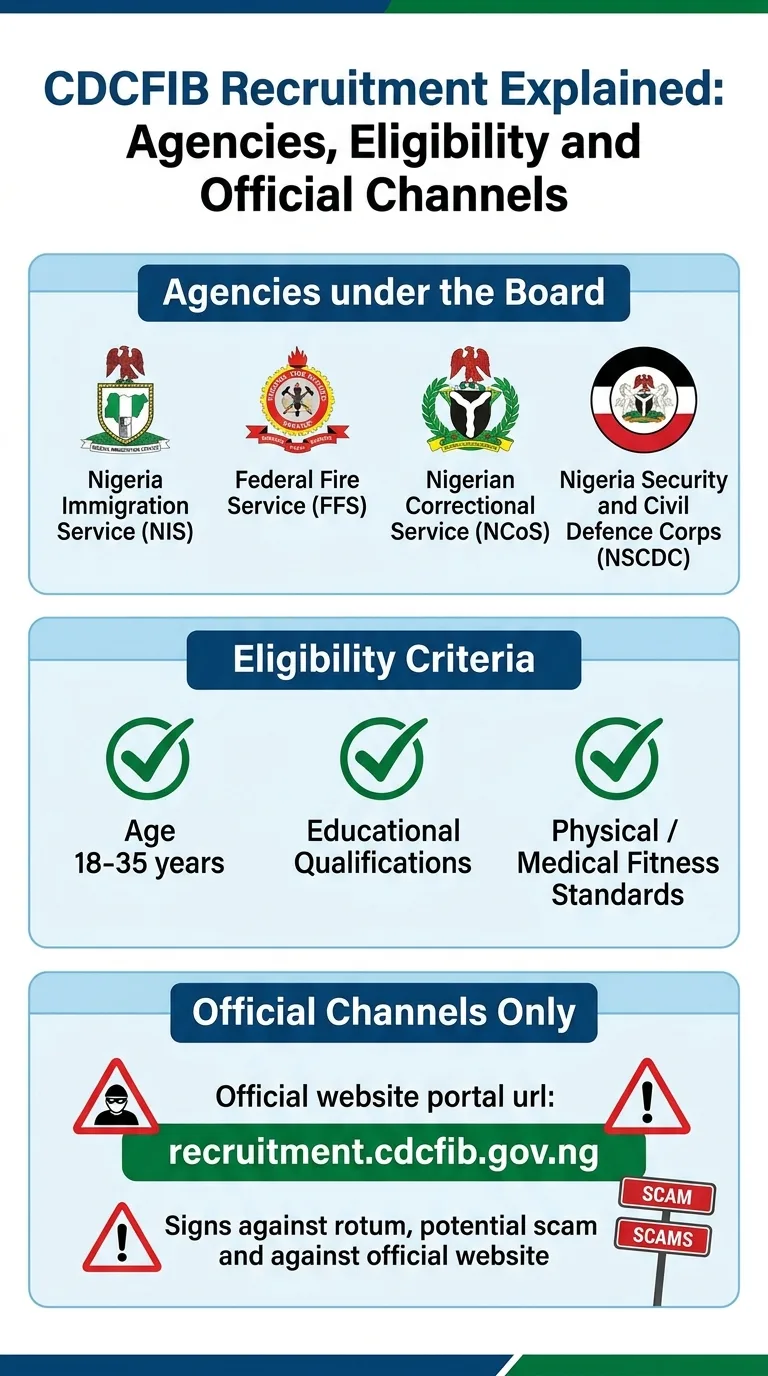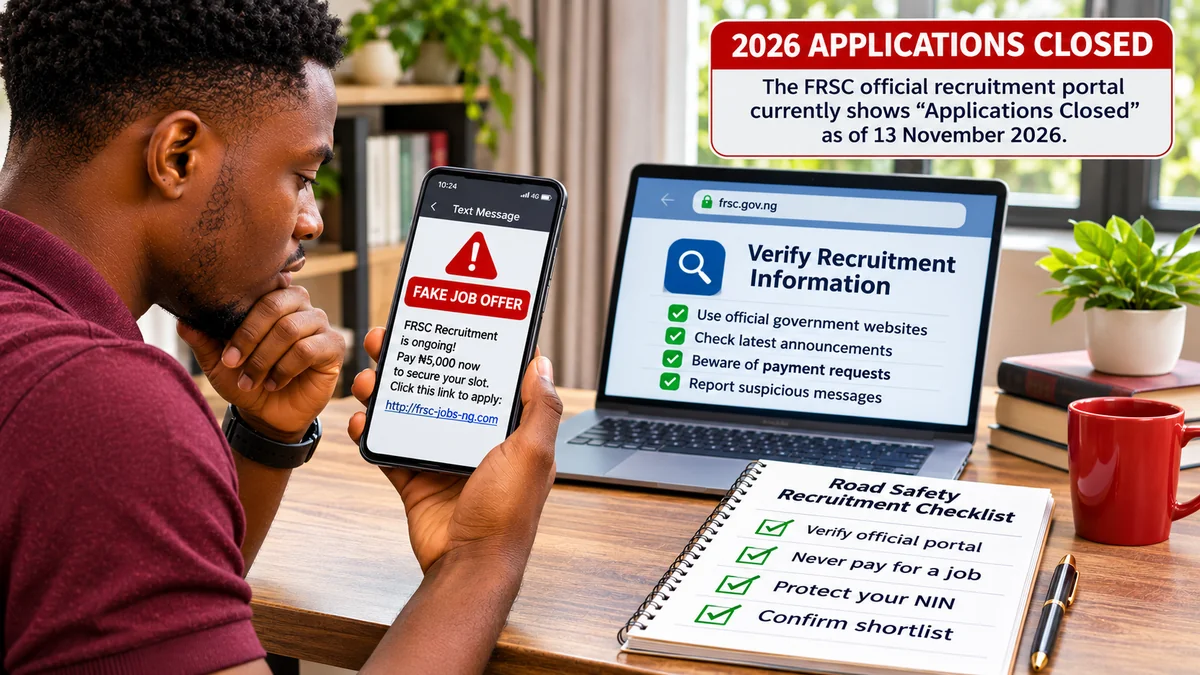
Current recruitment status (13 November 2026): The Federal Road Safety Corps (FRSC) is not accepting fresh applications through its official 2026 recruitment portal . The portal states “Applications Closed” and says existing applicants will be contacted regarding further steps. FRSC's 2026 application exercise opened on 3 July for a four-week period and was advertised as free. Any message offering a paid late form, guaranteed shortlist or private recruitment slot deserves careful scrutiny.
Searching for recruitment of FRSC can bring up old application guides alongside genuine news and suspicious links. Fraudsters may exploit the uncertainty between applying, being shortlisted, attending screening and receiving a final appointment. This guide examines two documented 2026 FRSC misinformation incidents, explains illustrative scam patterns, gives a reliable verification process and shows what to do if you have already sent money or personal information to a suspicious contact.
Research verified on 13 November 2026. This is an independent consumer-safety guide, not an FRSC announcement. Examples labelled “scenario” illustrate plausible fraud tactics; they are not allegations that an identified individual or organisation committed a crime.
FRSC recruitment fraud: the warning signs at a glance
The quickest precaution is to compare any claim against the current official application status. As of this guide's verification date, the portal is closed. Even if an applicant previously submitted a valid form, a payment demand from an unknown agent is not evidence that an invitation, shortlist or appointment is genuine.
| Message or offer | Why it is risky | Safer response |
|---|---|---|
| “Pay for late FRSC registration.” | The verified 2026 application period has ended, and registration was advertised as free. | Check the official portal; do not pay. |
| “A politician or officer can allocate you a job slot.” | FRSC denied claims of politically allocated appointments in September 2026. | Require formal verification through FRSC. |
| “If you missed shortlisting, report to any FRSC camp immediately.” | FRSC disowned a similar viral notice in September. | Confirm any venue and date independently. |
| “Submit your NIN and bank details on this link.” | Imitation portals can collect identity or financial data. | Navigate to frsc.gov.ng independently. |
| “Send a password or OTP to unlock your application.” | Codes can be used to take over email, payment or other accounts. | Never read a sensitive code to a stranger. |
| “Your appointment letter is ready; pay an activation fee.” | An attachment can be forged and does not establish an official appointment. | Verify the actual recruitment decision with FRSC. |
An unfamiliar message is not automatically fraudulent, and a legitimate candidate may receive genuine updates. The rule is to authenticate the source and instruction before acting, especially where payment, travel or personal information is involved.
What FRSC actually warned about in September 2026
Fake camp-verification notice: 20 September 2026
FRSC disowned a viral message telling applicants who had not been shortlisted—or who had not received an invitation—to report to the nearest FRSC camp for verification by 25 September 2026. The Corps said it had issued no such directive and told the public not to travel to offices, camps or training institutions because of the circulation. Its warning also cautioned against payments, sharing personal information and links distributed by unauthorised individuals. The incident was reported on 20 September by The Punch and by the News Agency of Nigeria via P.M. News .
This was a real warning about a specific message, not evidence that all future FRSC screening invitations are fake. Genuine applicants should check any instruction to attend a location against the official recruitment communication for their particular exercise.
False claims of 50 recruitment slots: 17 September 2026
FRSC also denied a viral claim that a federal lawmaker had secured 50 appointments for constituents. In its September clarification, the Corps explained that candidates invited to designated training schools or the FRSC Academy were undergoing further evaluation, and an invitation was not itself a final appointment letter. Channels Television and The Punch reported the statement.
The lesson is that an alleged connection to an influential person cannot replace an authenticated selection process. A paid “slot” should never be treated as a legitimate way into public service.
Seven common recruitment scam tactics and how they work
The following are illustrative scenarios, informed by FRSC's documented warnings and broader Nigerian anti-fraud guidance. They show how applicants can recognise risk; they do not claim that each exact scenario occurred in the 2026 FRSC exercise.
1. The fake recruitment portal
A post advertises “FRSC registration still open” and directs readers to an address that looks official but adds extra words, unusual hyphens or a different domain. The form asks for names, NIN, date of birth, contact information and sometimes payment details.
Protection: Type frsc.gov.ng or recruitment.frsc.gov.ng yourself. Examine the actual hostname—not just a logo or the first word in a web address. The official 2026 recruitment portal currently displays applications closed. A padlock icon alone does not authenticate a government website.
2. The paid shortlist or “connection” offer
Someone claims to know a recruiter and asks for an upfront payment to move your name to the shortlisted candidates' list. They may promise a refund if the job is not secured, or invoke a supposed official title to appear credible.
Protection: Do not pay for a private shortlist or appointment. FRSC's July 2026 notice explicitly said the application was free. Its September statements rejected recruitment based on private influence or claimed political allocations. Keep evidence of any suspicious solicitation.
3. The false screening or camp invitation
An official-looking PDF or WhatsApp message demands that applicants report to a training centre on short notice. It may threaten automatic disqualification if the candidate does not travel or provide documents immediately.
Protection: Check the notice through FRSC-controlled channels before booking transport. FRSC's September 2026 fake camp-verification alert is a concrete reason not to treat a message forwarded by friends as sufficient authorisation.
4. The forged appointment letter
A document bearing an FRSC logo promises employment and asks the recipient to pay for a uniform, “file opening”, placement, accommodation or activation. A forged letter may contain signatures, stamps and realistic formatting.
Protection: Do not infer appointment from a letter's appearance or a training invitation. Obtain confirmation through FRSC's legitimate recruitment process. Never transfer money because an unknown person sent you a supposedly signed PDF.
5. Phishing disguised as application verification
A caller, email or fake portal says your application details are incomplete and asks for a one-time code, email password or banking credentials to “confirm the shortlist”. The Economic and Financial Crimes Commission warns that phishing commonly uses fake websites and messages impersonating trusted institutions to obtain sensitive information. See the EFCC's phishing advisory .
Protection: Never disclose a password, bank PIN or OTP to a recruiter or a chat contact. Sign in through the genuine account service you initiated, and examine what any verification message actually authorises before using it.
6. Identity-document harvesting
A supposed officer requests a scanned NIN slip, birth certificate, bank details or school credentials “for quick processing” outside the official portal. These records could be misused for identity fraud or further impersonation.
Protection: Provide documents only through a verified and necessary application or screening channel. Check exactly which records are required and why. Do not broadcast credentials in public Telegram groups or send them to a social-media profile simply displaying FRSC branding.
7. The refund and recovery scam
After someone has lost money to a fake recruitment offer, another contact claims to be a recovery officer and asks for a second fee or more personal data to retrieve the original payment.
Protection: Stop dealing with the original contact and any unverified “recovery service”. Use your bank's fraud desk and the official law-enforcement reporting route. No one can guarantee that stolen funds will be recovered, and another payment may deepen the loss.
How to verify an FRSC recruitment advert in five minutes
This checklist is designed for quick decisions when a message arrives on WhatsApp, Facebook, X, SMS or email.
- Check the date. Is the claim about the July 2026 opening, an existing candidate's next stage or a supposedly new intake? An old advertisement may still appear in search results.
- Open the genuine portal yourself. Visit recruitment.frsc.gov.ng and compare the status with the claim. Do not use the suspicious message's shortened link.
- Look for independent confirmation. Check FRSC's main website and its verified public communication channels. If you cannot authenticate a venue, shortlist or appointment claim, do not act on it.
- Inspect the request. Demands for money, codes, bank credentials or unusual urgency should trigger extra scrutiny. The 2026 recruitment was advertised as free.
- Save evidence but do not amplify the claim. Keep a screenshot, date and the complete URL for reporting. Avoid circulating the message as confirmed news.
A complete guide to the real 2026 application requirements is available in FlyingEze's June 2026 FRSC recruitment launch report . That story is historical: its original invitation to apply does not override the portal's present closed status.
False urgency: why deadlines are often used to pressure job seekers
Scammers can create a sense that a vacancy will disappear within hours. Examples include “limited slots left”, “send money before midnight” and “report by tomorrow or forfeit your offer”. These tactics discourage applicants from checking facts, contacting trusted people or comparing a message with an official notice.
A legitimate recruitment process can have firm deadlines, but the existence of a deadline is not itself proof of legitimacy. The critical question is who issued the instruction and where it can be independently verified. The fake September camp notice exploited precisely this type of urgency by attaching a date and a physical reporting requirement to an unauthorised message.
What to do if you already paid a suspected FRSC recruitment scammer
Time matters, especially if a bank transfer or sensitive account was involved. Take these steps as soon as you reasonably can:
- Stop payments and communication. Do not send additional “clearance” or “refund” fees, and do not click more links.
- Contact your bank or payment provider through its genuine support channel. Report the transfer as suspected fraud, provide the reference and ask what protective or dispute steps may be available. A reversal is not guaranteed.
- Secure exposed accounts. If you entered passwords or gave away an OTP, change affected passwords from a trusted device, review sign-in sessions and notify the relevant account providers.
- Preserve evidence. Save the full recipient account details, transaction receipt, chat history, screenshots, dates, web addresses and any forged letter. Do not alter or delete originals unnecessarily.
- Report the suspected cybercrime. The Nigeria Police Force National Cybercrime Centre provides an e-reporting route for online fraud and identity theft. Follow the live official portal's submission and privacy requirements.
- Notify FRSC about impersonation. Use the contact information published on FRSC's official Contact Us page to flag a fake use of the Corps' name or logo. Do not use road-emergency services for routine recruitment enquiries when non-emergency channels exist.
If you suspect an offender has used your identity documents to open other accounts, mention that exposure to the relevant provider and in any police report. If you have lost access to your phone number, email or banking app, ask each affected service to protect the account. You may also report phishing or suspected financial fraud through the nearest appropriate law-enforcement office; the EFCC advises prompt reporting .
Where to report fake FRSC recruitment notices
| Organisation | Official route | When it may help |
|---|---|---|
| Federal Road Safety Corps | frsc.gov.ng/contact-us | Verify a recruitment-related communication or report impersonation of FRSC |
| Nigeria Police Force National Cybercrime Centre | nccc.npf.gov.ng — follow the e-reporting portal | Report online fraud, phishing or identity theft |
| Economic and Financial Crimes Commission | EFCC official phishing advisory and reporting guidance | Report suspected financial fraud or impersonation through official channels |
| Your bank or payment provider | Its verified app, hotline or fraud-reporting team | Report an unauthorised or fraud-induced payment and request protective action |
FRSC's official Contact Us page includes info@frsc.gov.ng. Check current contact information on the agency's site before sending details. The FRSC emergency line is primarily for road-safety emergencies, not routine recruitment clarification.
Keep reports factual. State what was claimed, what you paid or shared, when it happened and which evidence you have. Reporting creates a record and may support an investigation, but it does not promise a refund or immediate arrest.
How to protect your NIN, academic documents and bank details
Real recruitment processes may request identifying information to assess candidates. The danger arises when sensitive records are collected through a source that has not been authenticated. Avoid sharing your NIN slip, certificate scans, date of birth, address and bank information with an alleged agent simply because the person knows your application number or claims to be connected to the Corps.
Store documents privately and, where possible, limit copies to authorised uses. If you must use a cybercafé or shared computer, sign out of accounts, do not save passwords in the browser and remove downloaded files containing personal details. Use a strong, unique password for your email because it may be the recovery route for application communications.
For a broader overview of recruitment and employment fraud tactics, see FlyingEze's guide to identifying fake job offers and recruitment scams in Nigeria . Its advice on impersonation, advance payments and suspicious links also applies to fake public-service vacancies.
How family and friends can help without spreading fake notices
A friend may forward a fake recruitment message in good faith. Instead of sharing it again, reply with the official recruitment URL and the latest verifiable status. If the claim asks people to travel, pay or surrender personal information, warn recipients to verify before acting.
Families can help applicants cross-check messages against a genuine domain, compare the dates in the notice and confirm whether any instruction came directly from FRSC. This approach is more useful than publicly naming someone as a fraudster without evidence. When there is a credible allegation of financial loss or identity theft, preserve the evidence and refer it to the appropriate provider or law-enforcement channel.
Frequently asked questions about FRSC recruitment scams
Is FRSC recruitment open in November 2026?
As of 13 November 2026, the official portal says applications are closed. Existing applicants may receive further communication, but no fresh application window was verified.
Does FRSC charge money for recruitment?
The 2026 application exercise was advertised as free. FRSC has warned applicants not to make payments to individuals claiming they can facilitate recruitment or secure slots.
How can I identify a fake FRSC recruitment website?
Check the full hostname. The official 2026 recruitment portal is recruitment.frsc.gov.ng . A similar name on an unrelated domain, a shortened link or a convincing logo is not sufficient evidence of authenticity.
Is an FRSC training invitation the same as an appointment?
No. In September 2026, FRSC explained that invitations to designated training institutions were part of further assessment and did not themselves constitute final appointment letters.
What was the fake FRSC camp notice in September 2026?
FRSC rejected an unauthorised message instructing candidates who were not shortlisted to visit an FRSC camp by 25 September 2026. It told applicants not to act on the message and to use official channels.
Can an FRSC officer or politician sell me a recruitment slot?
There is no verified legitimate route to purchase a slot. FRSC disowned a September claim that appointments had been allocated to a lawmaker and warned against purported influence over selection.
What should I do if I already shared my NIN or password?
Stop using the suspicious link. Change any compromised password from the genuine service, review linked accounts and contact relevant providers about identity exposure. Preserve evidence and consider reporting suspected misuse to the NPF National Cybercrime Centre.
How do I report an FRSC recruitment scam?
Report financial transfers promptly to your bank, document suspected impersonation with FRSC through its official contacts , and use the NPF National Cybercrime Centre's official e-reporting route for online fraud.
Conclusion: verify the recruitment, not the rumour
Most FRSC recruitment scams share a common approach: they promise an advantage that cannot be independently verified, then pressure job seekers to pay, travel or share private information. In 2026, the Corps publicly rejected both a fake camp-verification notice and false claims about allocated recruitment appointments. Its official application portal now shows applications closed.
Before taking any step, check the actual FRSC website, confirm the date and stage of recruitment, and be sceptical of agents selling access to a government job. If you have already been targeted, protect your accounts, alert your bank where relevant, preserve evidence and report suspected cybercrime. A genuine opportunity does not require you to buy a secret route into FRSC.
Editorial verification: 13 November 2026. Primary sources include FRSC's official recruitment and contact pages, with dated reporting of its September fraud warnings, and official NPF-NCCC and EFCC reporting guidance. No individual job offer, applicant record or alleged fraudster was investigated for this article.