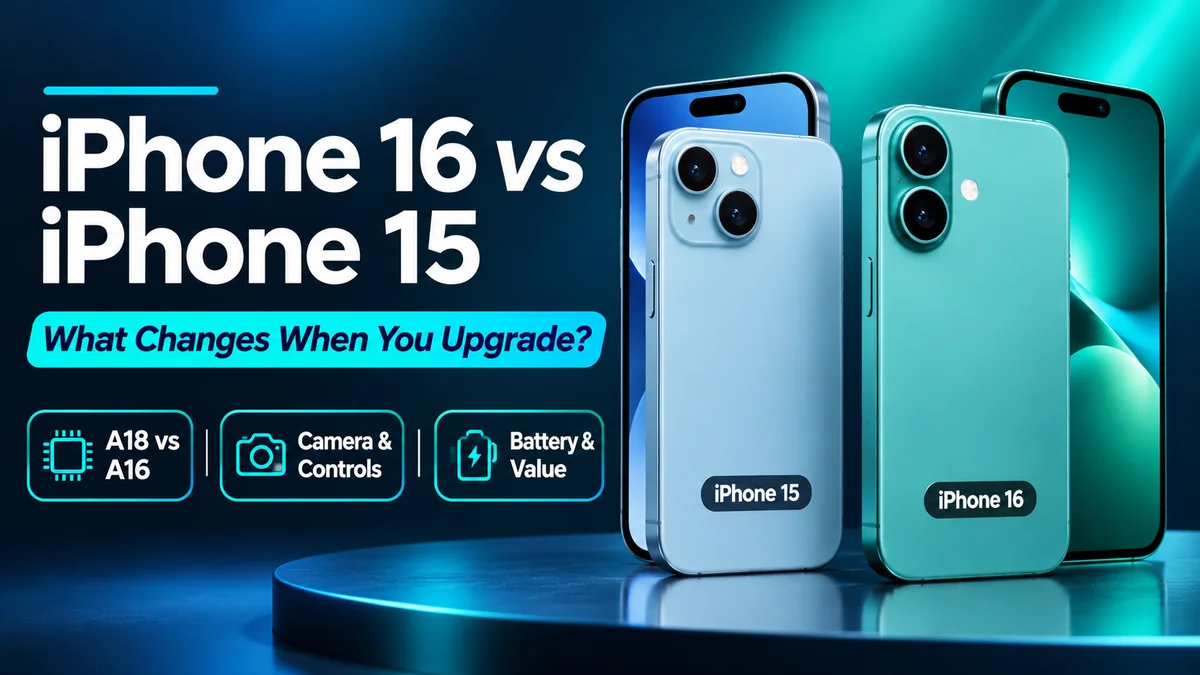
Should you upgrade from the iPhone 15 to the iPhone 16? For many owners of the standard iPhone 15, the answer is only if you specifically want Apple Intelligence, the newer camera controls, macro photography or better battery endurance—and the net cost is reasonable. The iPhone 16 adds Apple's A18 chip, an Action button, Camera Control and improved wireless charging, but both standard phones have a 6.1-inch OLED display, a 48MP main camera, USB-C and a 60Hz refresh rate.
In other words, the iPhone 16 vs iPhone 15 decision is about capabilities you will actually use, not a dramatic change in size or basic appearance. This guide, reviewed on 25 November 2026, compares the regular 6.1-inch models. The iPhone 15 Pro, iPhone 16 Pro and Plus versions have important differences and should not be confused with their standard counterparts.
iPhone 16 vs iPhone 15: key differences at a glance
| Feature | iPhone 15 (standard) | iPhone 16 (standard) |
|---|---|---|
| Release year | 2023 | 2024 |
| Processor | A16 Bionic | A18 |
| Display | 6.1-inch Super Retina XDR OLED, 60Hz | 6.1-inch Super Retina XDR OLED, 60Hz |
| Original storage choices | 128GB, 256GB, 512GB | 128GB, 256GB, 512GB |
| Main camera | 48MP; 2x optical-quality crop option | 48MP Fusion; 2x optical-quality crop option |
| Ultra Wide | 12MP, fixed focus | 12MP, autofocus; supports macro |
| Camera hardware control | On-screen controls | Dedicated Camera Control |
| Other side control | Ring/Silent switch | Customisable Action button |
| Apple Intelligence | Not supported on the standard iPhone 15 | Supported; feature availability varies |
| Apple-rated video playback | Up to 20 hours | Up to 22 hours |
| MagSafe wireless charging | Up to 15W | Up to 25W with suitable accessories |
| Wi-Fi | Wi-Fi 6 | Wi-Fi 7 where supported |
| USB-C data rate | USB 2, up to 480Mb/s | USB 2, up to 480Mb/s |
| Weight | 171g | 170g |
Figures are drawn from Apple's iPhone 15 specifications , iPhone 16 specifications and its model comparison tool . Published battery-life numbers are laboratory ratings, not a promise of the same result for every user.
1. Performance: A18 versus A16 Bionic
The iPhone 15 uses the A16 Bionic, while the iPhone 16 moves to the A18. Both have six-core CPUs and five-core GPUs in the standard models, but they are different generations of Apple silicon. The A18 brings additional performance headroom and efficiency for demanding applications, computational photography and supported AI tasks.
However, a faster chip does not automatically transform ordinary use. If your existing iPhone 15 opens messaging, banking, web and navigation apps quickly, an upgrade may feel incremental. If you play intensive games, edit large media projects, multitask heavily or plan to keep the phone for several years, the extra headroom can matter more.
Upgrade test: name a current task that your iPhone 15 struggles to perform. If the answer is merely that the newer chip sounds better, the performance difference alone is a weak reason to spend.
2. Apple Intelligence is the clearest feature divide
The standard iPhone 16 supports Apple Intelligence , whereas the regular iPhone 15 does not. This is a hardware compatibility distinction: updating the base iPhone 15 to a newer iOS version does not make it an Apple Intelligence-supported model. The iPhone 15 Pro and 15 Pro Max are separate cases and do support Apple Intelligence.
Depending on the software release, language and country, supported features can include writing assistance, image-related tools and more capable interactions with Apple's services. Apple continues to change the feature set, and certain features may have availability restrictions or usage limits. Confirm the exact functions you care about on Apple's current support page rather than assuming every demonstration applies everywhere.
If AI tools form part of your daily work, this is a meaningful reason to choose the iPhone 16 over the standard 15. If you do not use them, the mere presence of the feature is not a practical benefit.
3. Cameras: both take 48MP photos, but the 16 is more versatile
The main camera is not a complete reinvention
Both models use a 48MP main camera and can offer a 2x optical-quality framing option by using the high-resolution sensor. Neither regular model has a separate long-range telephoto camera. That matters: a retailer claiming that the iPhone 16's “2x Telephoto” is a new dedicated optical lens is overstating the difference from the regular iPhone 15.
In ordinary daylight conditions, many photos from either phone can look very good. Results vary with light, subject movement, processing and framing. Buying the newer generation does not guarantee a dramatic improvement in every photograph.
Macro photography is a real upgrade
The iPhone 16's 12MP Ultra Wide has autofocus, enabling macro photography and close-up video. The regular iPhone 15's 12MP Ultra Wide lacks that macro capability. If you photograph jewellery, flowers, insects, documents with fine details or products for a small business, this is a tangible creative advantage.
Apple also offers updated photographic controls, spatial photo and video capture, and features such as Audio Mix for adjusting certain recorded sound elements on the iPhone 16. These features are particularly relevant for creators, but they are not equally important for someone who mostly takes family pictures.
Camera Control changes how you shoot
The iPhone 16 has a dedicated Camera Control that can launch the camera and help adjust supported shooting options. It is useful for people who regularly capture quick moments, though a touch-sensitive control takes time to learn and does not guarantee better results.
Who benefits most? Frequent close-up photographers and mobile creators have more reason to upgrade than casual photographers who already like their iPhone 15 images.
4. Design and display: more similar than different
Both standard models have a 6.1-inch Super Retina XDR OLED screen with a 2556 × 1179 resolution, Dynamic Island and a 60Hz refresh rate. Both offer a quoted outdoor peak brightness of 2,000 nits. That means the iPhone 16 does not solve the most common complaint from buyers accustomed to smoother 120Hz screens.
The phones are nearly the same physical size: Apple lists matching height, width and depth, while the iPhone 16 is about one gram lighter. The iPhone 16 switches to vertically arranged rear cameras, while the 15 has a diagonal layout; finishes and colours differ as well.
The newer model also replaces the Ring/Silent switch with a configurable Action button, which can trigger features such as a focus mode, shortcut, torch or voice memo. Some users value that convenience; others rarely use custom buttons. The changed camera layout and controls also mean you should not assume a fitted iPhone 15 case works correctly on an iPhone 16.
Both phones have IP68 ratings under specified laboratory conditions, but water resistance can diminish with wear and repairs. Neither should be treated as permanently waterproof.
5. Battery life and charging: modest endurance gain, useful MagSafe gain
Apple rates the iPhone 15 for up to 20 hours of video playback and 16 hours of streamed video, versus 22 hours and 18 hours respectively for the iPhone 16. This is a two-hour difference in Apple's stated test categories—not a guarantee of two extra hours of heavy gaming, weak-signal data use or hotspot activity.
The iPhone 16's higher MagSafe wireless charging capability can reach up to 25W under suitable conditions, compared with up to 15W on the iPhone 15. The right charger, adapter, battery temperature and state of charge affect the result. Both phones can reach around 50% charge in roughly 30 minutes with appropriate wired charging equipment under Apple's test conditions.
For owners of an older iPhone 15, battery condition can matter more than the model difference. A two-year-old handset with a heavily worn battery may feel much weaker than a fresh iPhone 15 or iPhone 16. Compare the cost and reliability of a proper battery service with the total upgrade cost before replacing the whole phone. Apple's battery guidance explains capacity and cycle-count considerations.
6. Connectivity: USB-C remains, but Wi-Fi improves
Both devices use USB-C for charging and data, and both standard models are limited to USB 2 transfer rates of up to 480Mb/s. If you regularly move large video files to a computer, buying the regular iPhone 16 does not deliver a faster wired connection simply because it is newer.
The wireless difference is more notable on paper: the iPhone 15 supports Wi-Fi 6, while the iPhone 16 supports Wi-Fi 7 in supported regions and with suitable networks. Wi-Fi 7 will not automatically make a slow mobile-data connection faster, nor will it help much if your router and internet service are the bottleneck. Both have 5G capabilities, but band compatibility and network conditions vary by regional model.
In Nigeria, pay particular attention to imported devices. US-market iPhone 15 and iPhone 16 models are eSIM-only; many devices sold in other markets support a physical nano-SIM and eSIM. Confirm the region-specific hardware, carrier-lock status and whether your network can activate eSIM. FlyingEze's guide to checking which SIM is active is useful after setting up a supported dual-SIM configuration.
7. Storage: the newer model does not solve a capacity mistake
Both standard iPhones originally came in 128GB, 256GB and 512GB configurations. Neither has expandable microSD storage. So an owner moving from a 256GB iPhone 15 to a 128GB iPhone 16 would be trading capacity away, even though the phone is newer.
| Your current situation | Better decision |
|---|---|
| Using less than half of 128GB, mainly apps and streaming | 128GB could remain adequate if you maintain backups |
| Near your iPhone 15's storage limit | Choose more capacity, not just a newer model |
| Recording regular 4K video or keeping large games offline | Compare 256GB or 512GB total costs |
| Buying second-hand | Verify the storage in Settings, not only on a listing screenshot |
Check Settings > General > iPhone Storage before shopping. Cloud backups and iCloud Photos can help manage media, but a cloud subscription does not increase the phone's physical storage capacity. For more background, FlyingEze has covered how low free storage can affect everyday iPhone use .
8. Upgrade economics: calculate what you actually pay
Because both models were released before 2026, retail prices vary by remaining new stock, storage, warranty, region, condition and seller. There is no single trustworthy naira amount to insert into a general comparison without checking a specific retailer's current quote. Historical launch prices are not current Nigerian prices.
Instead, calculate your net upgrade cost:
Net upgrade cost = iPhone 16 purchase price − realistic iPhone 15 resale or trade-in value + necessary extra costs.
Extra costs can include a charger, new case, repair, shipping or an eSIM replacement process. For a purely hypothetical example, if you are quoted ₦800,000 for the replacement device, can sell your current phone for ₦550,000 and need ₦20,000 in accessories, the net cost is ₦270,000. These figures illustrate a calculation, not verified current market prices.
Ask yourself whether Apple Intelligence, macro photography, camera controls and battery improvements are worth that net cost. If not, keeping the iPhone 15 and saving the money is a reasonable decision. If your current phone is damaged or costly to repair, the calculation may change.
9. Buying used or refurbished: compare condition before generation
A clean, unlocked iPhone 15 with healthy battery performance may be a better purchase than a badly repaired, carrier-locked iPhone 16. Follow Apple's pre-owned iPhone checklist and inspect the device in person when practical.
- Activation Lock: ensure the previous owner has removed their Apple Account and you can activate the phone. Do not buy a device still protected by another owner's lock.
- Carrier lock: in Settings > General > About, check whether “No SIM restrictions” appears; otherwise confirm the lock status.
- Battery: inspect maximum capacity, cycle information where available and relevant service warnings.
- Repair history: review Parts and Service History for reported replacements or unknown components.
- Hardware test: try Face ID, cameras, screen, speakers, microphones, USB-C charging, Wi-Fi and mobile reception.
- Seller protection: request a receipt, clear warranty terms and a practical return policy. Avoid paying substantial sums before confirming the device works.
Remember that some phones advertised as “new” or “UK-used” may have different SIM hardware, prior activation or refurbishment histories. The description is not a substitute for checking the specific unit. Also distinguish regular iPhone 15 and 16 devices from Pro models when comparing software features and cameras.
10. Who should upgrade—and who should wait?
Upgrade to iPhone 16 if...
- You use or genuinely need supported Apple Intelligence features and currently own the regular iPhone 15.
- You frequently photograph small objects and want an autofocus Ultra Wide with macro support.
- You expect to make daily use of Camera Control or the Action button.
- Your current phone needs costly service and a competitively priced replacement makes financial sense.
- You can get the same or more storage, a trustworthy warranty and the correct SIM variant at a reasonable net price.
Keep the iPhone 15 if...
- Your phone is fast, reliable and has acceptable battery health.
- You mostly browse, message, stream, call and take standard photographs.
- You were expecting a higher refresh-rate screen or much faster USB-C transfers; the standard iPhone 16 delivers neither.
- The upgrade would force you down to a smaller storage size or into an uncertain used-device purchase.
- The new features do not justify the amount you would spend after selling or trading in the old phone.
If you are purchasing your first iPhone rather than upgrading, compare same-capacity, similarly conditioned offers for both models and include newer alternatives. That is a different decision from replacing an iPhone 15 you already own and can continue using.
Frequently asked questions
Is iPhone 16 a major upgrade over iPhone 15?
It is a meaningful upgrade for Apple Intelligence compatibility, camera controls, macro photography, newer processing hardware and improved battery ratings. It is not a major change in screen size, refresh rate, main camera resolution or USB-C transfer speed.
Does the regular iPhone 15 support Apple Intelligence?
No. Apple lists support for the iPhone 15 Pro models and iPhone 16 models or later; the standard iPhone 15 and iPhone 15 Plus are excluded. Check regional, language and software requirements for particular features.
Is the iPhone 16 camera much better than the 15?
Not in every situation. Both have 48MP main cameras and 2x crop-based framing. The iPhone 16 adds macro capability through its autofocus Ultra Wide, Camera Control and other creative tools, which matter more for certain shooting styles.
Does upgrading give me a 120Hz screen?
No. Both standard iPhone 15 and 16 displays refresh at 60Hz. A 120Hz panel requires comparing different models.
Is the iPhone 16 battery better?
Apple's stated video-playback ratings rise from up to 20 hours on the 15 to up to 22 hours on the 16. Actual performance depends on usage, signal, software and battery health.
Should I buy iPhone 16 with 128GB or 256GB?
Buy based on your actual storage use, not the generation alone. A 256GB model offers more headroom for photos, apps and 4K video. Do not replace a nearly full 256GB iPhone 15 with a 128GB iPhone 16 merely for the newer chip.
Final verdict: features first, upgrade second
The iPhone 16 is the more capable of the two standard models: A18 performance, Apple Intelligence support, the Action button, Camera Control, macro photography, more capable MagSafe charging and better stated battery life all favour it. But the regular iPhone 15 remains a capable device with a 48MP main camera, USB-C and a nearly identical 6.1-inch OLED experience.
For someone who already owns an iPhone 15, the strongest default is to keep it unless a specific iPhone 16 feature solves a real need or the net upgrade cost is unusually attractive. Compare storage, condition, regional SIM support and warranty before focusing on the model number. Upgrading well means paying for a useful improvement—not simply paying for a newer label.