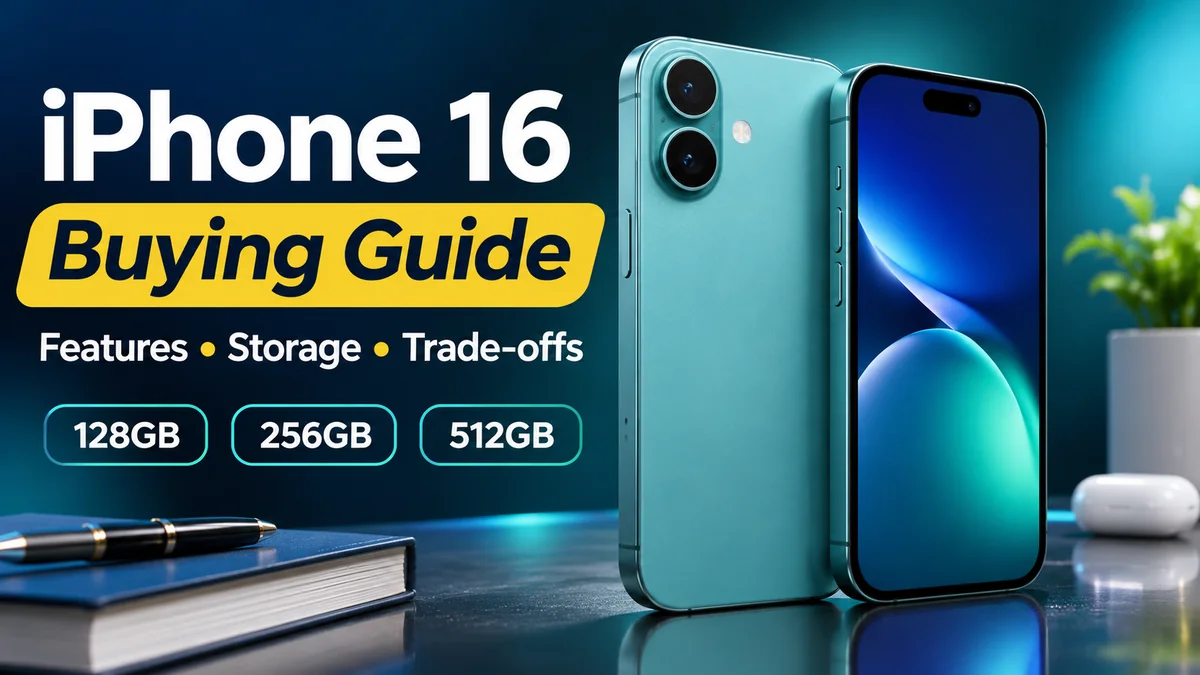
Is the iPhone 16 still worth buying in 2026? It can be a sensible purchase if you want a compact Apple phone with a strong main camera, USB-C, the A18 chip and Apple Intelligence support—provided the price is meaningfully lower than a newer alternative with the storage you actually need. Its biggest compromises are a standard 60Hz display, no dedicated telephoto lens and slower USB data transfers than Pro models.
For shoppers searching iphone16, the harder decision is often not the colour but whether to buy 128GB, 256GB or 512GB, and whether a new unit is worth more than a properly inspected used device. This independent guide uses Apple's published technical specifications and support guidance, with buying context reviewed on 25 November 2026. It covers the standard iPhone 16, not the iPhone 16 Pro, Plus or 16e, unless a comparison is clearly labelled.
iPhone 16 key specifications at a glance
| Feature | Standard iPhone 16 | Why it matters |
|---|---|---|
| Launch year | 2024 | It is a previous-generation device in 2026 |
| Display | 6.1-inch Super Retina XDR OLED; 2556 × 1179 pixels; 60Hz | Sharp and bright, but not as fluid as a 120Hz panel |
| Processor | Apple A18 | Strong everyday performance and Apple Intelligence compatibility |
| Original storage options | 128GB, 256GB, 512GB | Available new stock may vary by market and retailer |
| Rear cameras | 48MP Fusion main; 12MP Ultra Wide with macro capability | Flexible everyday photography, but no separate long telephoto lens |
| Front camera | 12MP TrueDepth | Selfies, video calls and Face ID |
| Video | Up to 4K Dolby Vision at 60fps | Good for creators; footage consumes storage quickly |
| Buttons | Action button and Camera Control | Customisable shortcut and quick camera adjustments |
| Wired connection | USB-C with USB 2 speeds, up to 480Mb/s | Convenient charging, relatively slow large-file transfer |
| Apple battery rating | Up to 22 hours of video playback | Standardised test claim, not guaranteed real-world endurance |
| Weight | 170g | Relatively manageable one-handed size |
| Durability rating | IP68 in controlled testing | Water-resistant, not permanently waterproof |
Specifications come from Apple's iPhone 16 technical specifications and Apple's Nigeria technical page . Apple's September 2024 announcement listed all three storage capacities; the combinations shown for direct purchase can change as stock and product lineups evolve.
What the iPhone 16 does well
A18 performance remains practical
Apple's A18 chip gives the standard model enough processing power for messaging, browsing, photography, social apps, streaming, navigation and many demanding games. Buyers moving from an older iPhone are likely to notice improved responsiveness and camera processing; the exact improvement depends on the phone they currently own.
The phone supports Apple Intelligence , including supported writing, image and assistant features. Availability depends on software version, region and language settings, and some capabilities evolve over time. Do not pay extra based on a feature described in a viral demo without checking whether it is enabled on the current software in your region.
A capable main camera and useful camera controls
The 48MP Fusion camera can deliver detailed photos in good light and includes a 2x crop-based optical-quality option. That is useful for portraits and everyday framing, but it is not equivalent to a dedicated longer-range telephoto lens when photographing distant subjects. The 12MP Ultra Wide helps with landscapes and group photos, and autofocus enables close-up macro shooting.
Camera Control provides quick access to shooting and settings, while the Action button can be assigned to convenient functions. Video recording reaches up to 4K Dolby Vision at 60fps. A casual user may be satisfied; someone shooting concerts, sports or professional-looking product video should compare zoom reach, low-light results, storage and external workflows with the Pro range before buying.
USB-C, MagSafe and sensible size
USB-C means the iPhone 16 shares a common connector with many recent devices, although charger and cable capabilities still matter. Apple's specification rates its wired data connection at USB 2 speeds rather than the faster transfer rate available on certain Pro models. MagSafe supports compatible magnetic accessories and up to 25W wireless charging under the stated conditions; Apple says the appropriate charger and power adapter are sold separately.
At 6.1 inches and around 170g, the standard model suits buyers who do not want a larger phone. The display is bright, with Dynamic Island and OLED contrast, but the refresh rate remains its most obvious day-to-day compromise for people accustomed to 120Hz Android phones or Pro iPhones.
Which storage size should you buy: 128GB, 256GB or 512GB?
Storage is one of the few iPhone decisions that cannot be upgraded later. There is no microSD card slot. Apple lists the iPhone 16's original capacities as 128GB, 256GB and 512GB, but not every variant may still be sold new in every location.
| Capacity | Best suited to | Trade-off |
|---|---|---|
| 128GB | Messaging, banking, streaming and occasional photos with cloud or computer backups | Less headroom for large games, offline videos and frequent 4K recording |
| 256GB | Most people keeping a phone for several years, with a growing photo library and several large apps | Higher purchase cost than 128GB |
| 512GB | Heavy offline media, frequent high-resolution video and users who prefer to retain files locally | Extra cost can outweigh the benefit for light users |
For most long-term buyers, 256GB is the balanced choice when the extra cost is reasonable. The 128GB version remains legitimate value if your current storage use is well under capacity and you are disciplined about backups. Choose 512GB only when you can explain why you need the extra space.
Before ordering, check your existing iPhone's Settings > General > iPhone Storage, allow room for app updates and future photos, and review how much footage you save. iCloud storage is a separate subscription service: it can help with sync and backups but does not turn a 128GB phone into a 256GB phone. If you record long 4K clips, test the size of typical projects before budgeting.
A simple storage decision example
Imagine two buyers with the same budget. One streams music, keeps a modest photo library and clears downloaded videos regularly; 128GB may be enough. The other records weekly school, business or creator videos, stores offline entertainment and wants four years of use; 256GB is safer. A professional videographer who routinely works without cloud connectivity might justify 512GB, but should also compare a Pro model's camera and transfer features.
Battery life and charging: what the numbers actually tell you
Apple rates the standard iPhone 16 for up to 22 hours of local video playback and up to 18 hours of streamed video under its test conditions. These are not promises of 22 hours of intensive gaming, hotspot use or weak-signal mobile browsing. Screen brightness, reception, temperature, apps and battery age change real-world results.
With suitable equipment, Apple advertises up to 50% charge in around 30 minutes. A charging brick is not included with a typical new iPhone 16 package; confirm the box contents and whether the seller bundles accessories. Quality chargers, appropriate cables and safe power sources matter more than exaggerated “super-fast” claims.
When buying used, request the battery's health information and inspect the device before final payment. A lower maximum-capacity reading does not automatically make a phone unusable, but it may reduce endurance or justify a future service cost. Also check for battery-service warnings and whether a replacement part was correctly recognised. Apple's pre-owned iPhone guide provides a detailed inspection checklist.
Five trade-offs worth knowing before you pay
1. The display is 60Hz, not 120Hz
The iPhone 16 has an excellent-looking OLED panel for static images and everyday use, but scrolling and animations are less smooth than on a 120Hz screen. Apple later brought ProMotion up to 120Hz to the standard iPhone 17 , alongside a larger 6.3-inch display. If display smoothness is high on your priority list, compare the phones side by side.
2. There is no dedicated telephoto camera
Do not confuse the 2x crop-based option with the separate telephoto system on Pro models. If you frequently photograph distant stages, wildlife or sports, the base model may be limiting.
3. USB-C does not guarantee fast data transfer
The standard iPhone 16's USB-C connection is limited to USB 2 data speeds. It still charges and supports compatible video output, but moving very large video libraries through a cable can be slower than on devices with faster data interfaces.
4. Storage is permanent
There is no expandable card slot; moving to a higher-capacity iPhone later means replacing the handset. Buying the cheapest variant can be false economy if storage alerts will regularly interrupt your work.
5. Newer models change the value calculation
In 2026 the iPhone 16 is not the newest mainstream iPhone. Apple's iPhone 17 offers a 256GB starting capacity, ProMotion and other upgrades. A discounted iPhone 16 can still be worthwhile, but comparing a low-priced 128GB iPhone 16 against a 256GB newer phone without accounting for storage is misleading. Calculate the actual difference between similarly suitable configurations.
iPhone 16 versus iPhone 16 Plus, 16 Pro and iPhone 17
| Model | Why consider it | Main caution |
|---|---|---|
| iPhone 16 | Compact, A18, strong main camera; potential discounted value | 60Hz screen, no dedicated telephoto |
| iPhone 16 Plus | Larger 6.7-inch screen and higher Apple video-playback rating | Less convenient in one hand; still 60Hz |
| iPhone 16 Pro | ProMotion, more advanced camera options and faster wired data | Often costs more; a used Pro needs the same battery and repair checks |
| iPhone 17 | 120Hz ProMotion, newer processor, updated cameras and 256GB base capacity | May be more expensive than discounted iPhone 16 stock |
These comparisons describe product features, not a live price ranking. See Apple's model comparison for configuration details. Local prices vary by storage, condition, import variant, warranty, exchange rates and whether a device is carrier-locked.
Buying an iPhone 16 in Nigeria: checks that matter
Check the actual SIM configuration
iPhone 16 units purchased in the United States are eSIM-only, without a physical SIM tray. Versions from many other markets support a nano-SIM and eSIM. An imported “UK-used” phone and a US-market phone may therefore behave differently when you try to install a physical SIM. Verify the specific model's SIM support and whether your Nigerian mobile network can provision eSIM for your line before paying.
Check network unlock status
In Settings > General > About, look at Carrier Lock. Apple's used-iPhone guidance says “No SIM restrictions” indicates an unlocked iPhone. Avoid relying on a seller's verbal promise if the phone is locked to a foreign carrier.
Inspect Activation Lock and device ownership
For used devices, the seller should remove their account and let you complete setup. Do not buy an iPhone that remains Activation Locked. An apparently cheap phone locked to somebody else's Apple Account is not a bargain. Make sure you can activate it before finalising the transaction, and retain verifiable proof of purchase.
Check battery health, repairs and function
Examine Settings > Battery for health information and Settings > General > About for any Parts and Service History. A genuine or used replacement part is not automatically a reason to reject a phone, but an “Unknown” part or a warning needs investigation. Test Face ID, cameras, microphone, speakers, Wi-Fi, charging, display, buttons and mobile reception.
Compare full costs, not only the advertised phone price
Consider warranty terms, battery replacement risk, case, screen protection, charger, data-plan or eSIM requirements, and return policy. Apple introduced the iPhone 16 at US$799 for the 128GB model in September 2024, but that historical US launch figure is not a November 2026 Nigerian retail quotation. Avoid converting it into a supposed current naira market price without checking actual seller offers.
For historical shopping context, FlyingEze previously covered UK iPhone 16 promotions ; that older deal coverage is not a current Nigerian offer and should not be used as a live price list.
How to decide whether an offer is genuinely good value
Compare at least two offers for the same storage size, condition, SIM variant, carrier status and warranty. Then compare the best iPhone 16 offer with a suitable newer model rather than simply choosing the phone carrying the larger discount percentage.
- If you only use 60GB today, a discounted 128GB iPhone 16 may fit your needs.
- If you use 150GB today, a 128GB model is not a viable choice, however cheap it looks.
- If the price difference between a 256GB iPhone 16 and a 256GB iPhone 17 is modest, the newer screen, cameras and likely longer remaining product lifecycle may justify the difference.
- If a used 16 Pro costs about the same as a new standard 16, weigh camera features against battery condition, warranty and service history.
No single storage or model wins at every price. “Worth buying” depends on what you give up, not merely on whether the phone is still powerful.
Common mistakes to avoid
- Assuming “new” means authorised warranty: ask who provides the warranty, what region it covers and how service claims are handled.
- Overlooking eSIM-only imports: confirm your network and activation options first.
- Trusting screenshots of battery health: inspect the actual device's settings where possible.
- Buying a locked phone: test activation and mobile connectivity before payment.
- Ignoring storage: a 128GB purchase can become restrictive with games, media and videos.
- Comparing unrelated prices: a used 128GB US eSIM-only unit is not directly equivalent to a new unlocked 256GB international-market unit.
- Expecting Pro features: the regular iPhone 16 does not have 120Hz ProMotion or a dedicated telephoto camera.
Frequently asked questions
Is the iPhone 16 still good in 2026?
Yes, for buyers who value its A18 performance, cameras, compact size and Apple ecosystem and can get it at a sensible discount. It is less compelling if a newer 256GB iPhone with a 120Hz screen costs only slightly more.
Is 128GB enough for iPhone 16?
It can be for light-to-moderate use with regular backups. If you film frequent 4K video, install large games or keep an extensive offline library, 256GB is usually a safer starting point.
Does iPhone 16 have Apple Intelligence?
Yes, the iPhone 16 supports Apple Intelligence. Specific features require compatible software and language or region settings, so check Apple's current availability guidance.
Does the iPhone 16 support physical SIM in Nigeria?
It depends on the region in which the device was originally sold. US models are eSIM-only; many other regional models support a physical nano-SIM alongside eSIM. Verify the exact model before paying.
Does the iPhone 16 have a 120Hz display?
No. The standard iPhone 16 has a 60Hz display. Buyers who prioritise ProMotion should compare Pro models or the standard iPhone 17.
Should I buy a used iPhone 16?
Only if it passes activation, carrier-unlock, battery, repair-history and hardware checks—and its price advantage compensates for the additional risk. Apple's official pre-owned inspection guide is a useful checklist.
Verdict: who should buy the iPhone 16?
Buy the iPhone 16 if you want a capable, relatively compact iPhone and find a trustworthy offer below the price of a better-equipped alternative. For many people, 256GB is the best long-term balance; 128GB is reasonable when your usage is modest, while 512GB is a specialist choice.
Look elsewhere if you need 120Hz scrolling, longer zoom, faster large-file transfers or the longest possible remaining product lifecycle. In those cases, compare a suitable Pro model or newer standard iPhone rather than stretching your budget just for the iPhone 16 name.
The strongest buying rule is simple: choose the storage you need, inspect the exact variant and condition, and compare the full price against a genuinely comparable newer model.