To write a job application letter in Nigeria, identify the exact position, explain why you are suitable, support your claims with one or two genuine examples, and end with a clear, professional request for consideration. A strong letter is usually no longer than one page for an ordinary non-academic job and should be adapted to the employer's instructions—not copied unchanged into dozens of applications.
If you searched for an “application letter for job application”, you may need a formal printed letter, a PDF attachment or a short email introducing your CV. The underlying purpose is the same: connect what the employer needs with what you can actually do. This guide covers the correct structure, a reusable template and original examples for fresh graduates, NYSC applicants, teachers and applicants with work experience.
The guidance draws on Jobberman Nigeria and university career services, including the University of Pennsylvania and the University of Victoria . The example letters are fictional learning materials: replace all names, experiences, dates and achievements with truthful information before submitting anything. Research checked 16 November 2026.
What is a job application letter?
A job application letter, often called a cover letter or letter of application, is a short professional message sent to an employer to explain your interest in a specific job and why your background is relevant. It supplements the CV, which provides a more systematic record of qualifications, experience and skills.
For example, a CV might state that you volunteered to maintain attendance records during NYSC. A good application letter explains how that responsibility demonstrates accuracy and organisation for an administrative-assistant vacancy. The letter interprets the evidence rather than repeating every line of the CV.
In Nigeria, an advert may use phrases such as “send an application letter and CV”, “forward your cover letter”, or “apply with a formal letter addressed to the Registrar”. Follow the wording, application portal, deadline and requested document format in the actual advert. A university, government body or school may specify a more formal layout; a private-sector or remote vacancy may simply ask for a concise email. Neither style has a universal advantage when it contradicts the employer's directions.
Job application letter vs CV vs statement of purpose
| Document | Its main purpose | Typical content |
|---|---|---|
| Job application or cover letter | Explain why this particular job fits you | Role, relevant evidence, employer-specific motivation and next step |
| Curriculum vitae (CV) | Summarise your professional or academic background | Education, experience, skills, projects and qualifications |
| Personal statement or statement of purpose | Explain interests and objectives for a specified programme | Motivation, goals and fit with admissions or programme criteria |
| Application email | Deliver or introduce application materials | Clear subject, short message and attachments or required links |
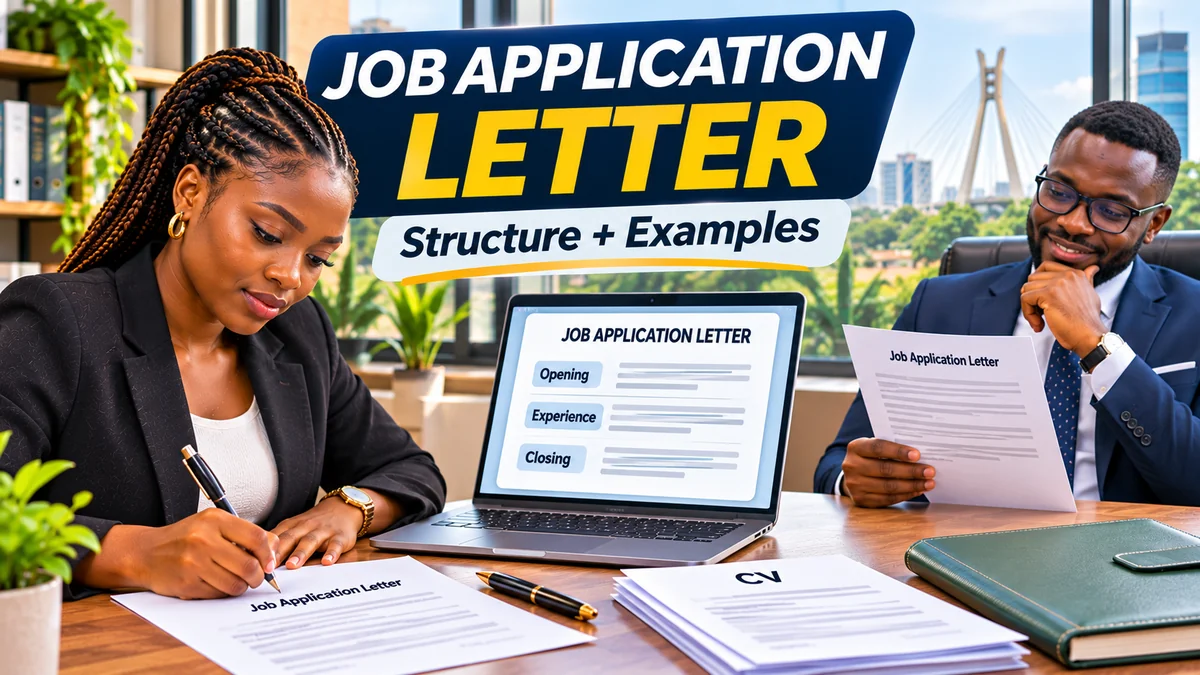
The correct format for a job application letter in Nigeria
- Your contact details: Full name, city/state, reachable Nigerian or international-format phone number, and professional email address. A complete home address is often unnecessary for an email application unless requested.
- Date: Use the actual date of submission, not an outdated template date.
- Recipient: Hiring manager's name where verified, or an appropriate department such as The Human Resources Manager, followed by the organisation's name and address where relevant.
- Greeting: “Dear Ms [Surname]” when a name is known, or “Dear Hiring Manager” / “Dear Recruitment Team” otherwise.
- Subject or reference: For a formal printed letter, use a direct subject such as APPLICATION FOR THE POSITION OF ACCOUNTS ASSISTANT. For email, put the role and any required vacancy reference in the subject field.
- Opening paragraph: Name the exact role, identify the employer and give your strongest one-sentence match.
- Evidence paragraph: Connect two or three advertised requirements with specific, truthful experience or projects.
- Motivation and closing: Explain why the organisation or work interests you, thank the employer and state that your CV or documents are attached.
- Sign-off: Use “Yours sincerely” or “Kind regards” in an appropriate professional context, followed by your full name. Printed applications can include a signature when requested.
These are practical conventions, not government-mandated rules for every Nigerian job. Penn Career Services recommends a one-page letter for most non-academic applications and encourages candidates to address the hiring person by name when possible. The University of Salford likewise suggests three or four focused paragraphs for typical roles.
A copy-and-edit job application letter template
Start with this structure, then remove all brackets and replace the information with your own. Do not send it untouched to employers.
[Your full name]
[City, State]
[Professional email] | [Phone number]
[Date]The Hiring Manager
[Organisation name]
[Organisation address, if required]Dear Hiring Manager,
APPLICATION FOR THE POSITION OF [EXACT JOB TITLE]
I am applying for the position of [exact job title], advertised through [verified source]. My experience in [relevant area] and ability to [priority skill] align with your requirement for [specific duty].
During [genuine project, previous role, NYSC or volunteering experience], I [specific action]. This resulted in [honest outcome, completed deliverable or lesson], demonstrating my ability to [relevant capability]. I also have experience with [second relevant tool or duty], which would help me contribute to [named job responsibility].
I am interested in [organisation name] because [specific verified reason connected to its work or the role]. I have attached my CV and would welcome the opportunity to discuss how I could contribute.
Thank you for considering my application.
Yours sincerely,
[Your full name]
Example 1: application letter for a fresh graduate or NYSC applicant
Scenario: A recent university graduate applies to a fictional company for an entry-level administrative assistant position. The applicant uses a real-type academic or NYSC project as evidence rather than inventing employment history. All details below are illustrative.
[Applicant's name]
Enugu, Nigeria
[Email] | [Telephone]
16 November 2026The Hiring Manager
[Company name]Dear Hiring Manager,
APPLICATION FOR ADMINISTRATIVE ASSISTANT POSITION
I am writing to apply for the Administrative Assistant position advertised on [source]. As a recent graduate with experience organising project records and supporting team activities, I would welcome the opportunity to contribute accurate documentation and dependable administrative support to your organisation.
During my final-year group project, I helped coordinate meeting schedules, maintained shared records and reviewed submissions for completeness before our presentation. This experience strengthened my organisation, written communication and spreadsheet skills. During [NYSC placement or verified volunteer activity, if applicable], I also supported [specific responsibility], which taught me to work carefully with deadlines and confidential information.
I am particularly interested in this role because it combines administrative coordination with opportunities to improve everyday processes. I am confident that my willingness to learn and attention to detail would help me support your team.
My CV is attached for your review. Thank you for considering my application, and I would appreciate the opportunity to discuss my suitability.
Yours sincerely,
[Applicant's name]
Why it works: It connects the applicant's evidence to record-keeping, coordination and deadlines. It does not claim a fake three-year employment record. If NYSC has not been completed or a graduation requirement applies, describe your actual status accurately. The University of Toronto Scarborough career service specifically encourages students to use school and volunteering experience to demonstrate skills.
Example 2: application letter for a teaching job in Nigeria
Scenario: An applicant seeks a junior secondary school teaching position. The school, teaching subjects and qualifications must be verified in the real application. This example uses placeholders and does not imply that every Nigerian school has identical hiring requirements.
[Applicant's name]
Nsukka, Enugu State
[Email] | [Telephone]
16 November 2026The Principal
[School name]
[School address]Dear Principal,
APPLICATION FOR THE POSITION OF BASIC SCIENCE TEACHER
I am applying for the Basic Science Teacher vacancy advertised by [school name]. I hold [true qualification] and have developed lesson planning, classroom communication and assessment skills through [teaching practice, supervised school placement or genuine tutoring experience].
During my supervised teaching experience, I planned lessons around defined learning objectives and used simple demonstrations to help students understand difficult concepts. I also reviewed class exercises to identify areas requiring revision and adjusted subsequent explanations accordingly. These experiences strengthened my ability to communicate clearly, work with feedback and support learners with different needs.
I am interested in joining a school that values effective teaching, safeguarding and continuous learning. If selected, I would follow the school's curriculum, assessment policies and professional expectations while contributing to its wider learning community.
My CV and requested supporting documents are attached. Thank you for your time and consideration. I would welcome an opportunity to discuss my suitability for the position.
Yours sincerely,
[Applicant's name]
Why it works: The letter describes teaching practice instead of relying on vague claims such as “I love children”. Applicants should follow the specific school's recruitment, qualification, subject and document requirements. Do not claim a teaching licence or professional registration you do not hold.
Example 3: application letter for a customer service job
Scenario: A candidate applies to a retail, hospitality or service business for a customer support role. Use only genuine experience, including volunteering or appropriate previous employment.
[Applicant's name]
Lagos, Nigeria
[Email] | [Telephone]
16 November 2026The Recruitment Team
[Company name]Dear Recruitment Team,
APPLICATION FOR CUSTOMER SERVICE REPRESENTATIVE
I am interested in the Customer Service Representative role advertised on [source]. My experience responding to enquiries, recording issues and following up with colleagues has prepared me to support customers in a calm and organised manner.
In my previous [verified work or volunteer setting], I handled questions about [real service or product category], kept accurate notes and referred issues outside my responsibility to the appropriate person. When a customer raised a complaint about [genuine type of problem], I confirmed the details, explained the next step and followed through until the matter was resolved or properly escalated. This helped me understand the importance of listening, clear communication and realistic commitments.
I am particularly interested in [company name]'s work in [verified service area]. I would bring patience, attention to detail and a willingness to learn your customer-support procedures and tools.
Thank you for reviewing my attached CV. I would appreciate the opportunity to discuss how my skills could contribute to your service team.
Kind regards,
[Applicant's name]
Why it works: The evidence is relevant to customer enquiries and complaint handling. Do not add a claimed “98% satisfaction score” unless a real employer measured it and you are authorised to disclose it.
Example 4: application letter for an experienced professional or career changer
Scenario: An employee from operations applies for a project coordinator position, explaining transferable skills rather than pretending to have held the target title.
[Applicant's name]
Abuja, Nigeria
[Email] | [Telephone]
16 November 2026The Human Resources Manager
[Organisation name]Dear Hiring Manager,
APPLICATION FOR PROJECT COORDINATOR ROLE
I am applying for the Project Coordinator position advertised on [verified source]. My background in operations support has provided practical experience with scheduling, progress reporting and collaboration across teams, which closely match the coordination requirements described in your vacancy.
In my current or previous verified role at [employer], I helped maintain a shared task register, followed up on assigned deliverables and prepared concise status updates for team meetings. When competing deadlines affected a scheduled activity, I worked with the responsible colleagues to clarify priorities and revise the work plan. This improved visibility of outstanding tasks and strengthened my ability to communicate risks early.
I am motivated to move into project coordination because I want to apply these skills more directly to planning and delivery. I have also developed familiarity with [specific project tool genuinely used] and am committed to deepening my knowledge of project reporting and stakeholder communication.
My CV is attached. I would welcome the opportunity to discuss how my transferable experience can support your current projects.
Yours sincerely,
[Applicant's name]
Why it works: The letter bridges operations and project coordination with concrete tasks, without inventing a project-manager title or measurable business outcomes. A career change is easier to explain when you demonstrate a common skill rather than apologise for lacking a perfect job-title match.
How to write an application letter step by step
Step 1: read the vacancy carefully
Before writing, identify the exact job title, essential qualifications, required experience, location, submission channel, deadline and requested documents. Underline two or three duties that you can genuinely demonstrate. For instance, “maintain accurate records”, “communicate with clients” and “work with Excel” suggest an evidence-based letter for an administrative role.
If the advert includes a vacancy reference, reproduce it accurately. If it asks for a statement on each selection criterion, address those criteria explicitly. Do not assume a generic one-page letter replaces a requested application form.
Step 2: independently verify the employer
Read the organisation's official website and careers page. Look for the work it actually does, rather than writing a sentence such as “your great and esteemed company is the best in Africa” without evidence. If a message arrived unexpectedly through WhatsApp or Telegram, confirm that the vacancy exists on an authentic employer or reputable job-board channel before sending documents.
Step 3: write a direct opening
A useful opening names the role and gives the strongest relevant qualification or experience: “I am applying for the Accounts Assistant role advertised on [source]. My experience preparing reconciliations and maintaining spreadsheet records aligns with the position's reporting requirements.”
Step 4: show evidence, not adjectives
Use an action, a context and a result. The Jobberman Nigeria cover-letter guide recommends connecting skills to the role and using specific examples. University of Victoria Career Services likewise advises candidates to show how their previous experiences match requirements rather than simply listing strengths.
Instead of “I am hardworking and computer literate”, try “I created a simple spreadsheet for tracking project submissions and checked it weekly for missing entries.” The second sentence describes something a recruiter can ask about. Only include numbers or achievements you can substantiate.
Step 5: explain why this particular role interests you
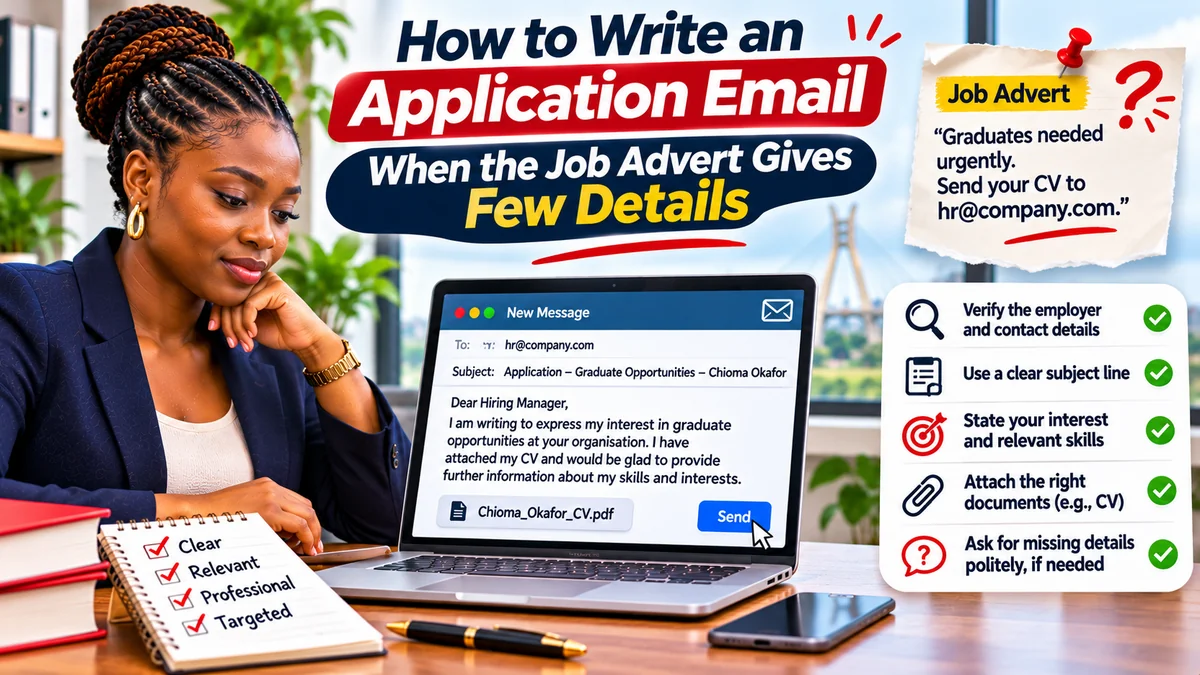
Step 6: close confidently and professionally
Step 7: proofread and submit exactly as instructed
Check spelling, dates, employer name, job title, attachment names, links and required qualifications. Read the letter aloud to catch repeated phrases and awkward sentences. A hiring manager should be able to tell within the opening lines which position you want and why your skills are relevant.
How to send a job application letter by email
If the employer says “email your CV and application letter”, it may expect two attachments, whereas another advert may allow the email itself to serve as the cover letter. Follow the actual instruction. If both documents are requested, attach both; do not replace a required file with only a casual email message.
Example email subject: Application – Administrative Assistant – [Applicant Name] – [Reference if required]
Dear Recruitment Team,
I am applying for the Administrative Assistant position advertised on [source]. I have attached my application letter and CV, which outline my experience with record-keeping, scheduling and accurate documentation.
Thank you for considering my application. I would welcome the opportunity to discuss my suitability.
Kind regards,
[Full name]
[Telephone]
PDF, Word document, printed letter or handwritten application?
| Submission channel | Recommended approach |
|---|---|
| Online application portal | Upload only the requested file types and answer the portal's questions |
| Email asking for PDF | Use a clean, selectable-text PDF that opens normally |
| Email asking for Word document | Send a properly formatted DOCX if permitted |
| Hard-copy application | Print a clear formal letter, include the requested address or reference, and sign if required |
| Handwritten letter | Use handwriting only where the employer expressly asks for it |
| Email body as application | Use a concise message with clear evidence and the required CV attachment |
PDF is often a practical default where no other format is specified because it tends to preserve layout, but not all employers or application systems accept it. Do not assume that a PDF is universally required or that a DOCX file is automatically rejected by software. For digital submissions, avoid image-only scans unless specifically requested: they can be harder to read, search and assess.
How long should a job application letter be?
For most private-sector non-academic jobs, aim for roughly 200–350 words and one page where that comfortably covers the essentials. This range is an editorial rule of thumb, not a formal Nigerian labour-law requirement. Some effective letters are shorter. University, academic, civil-service or specialist applications may have longer supporting-statement requirements; follow the vacancy instructions.
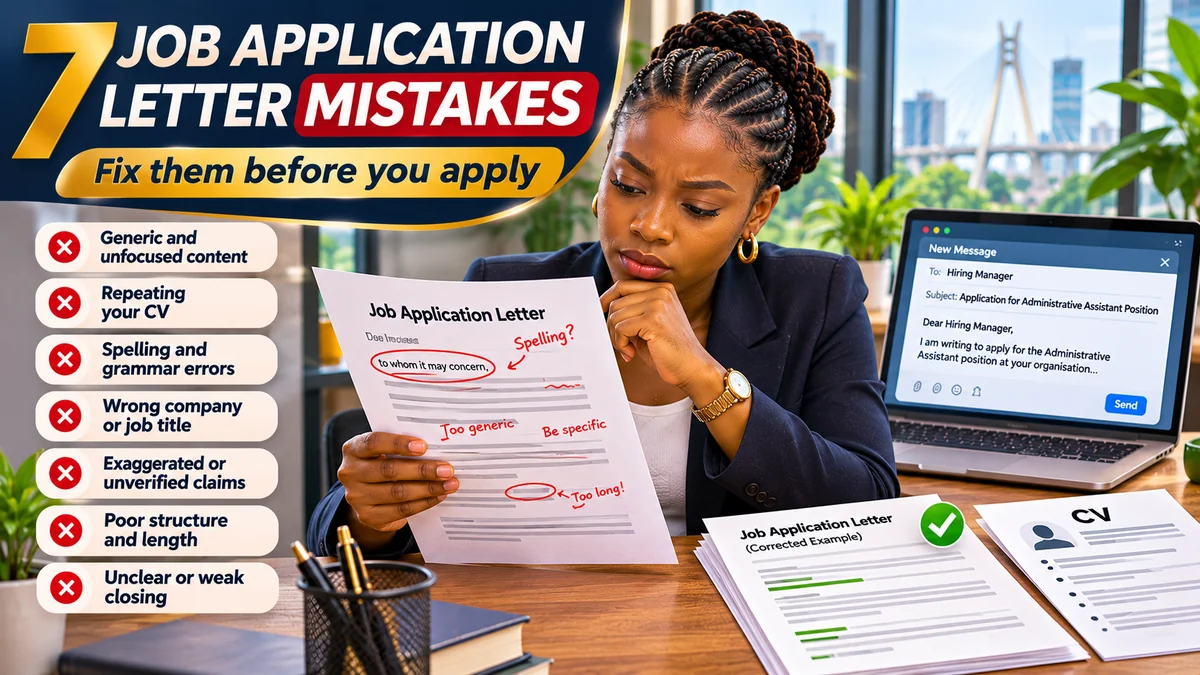
Common mistakes Nigerian jobseekers should avoid
- Copying a generic letter unchanged: It may contain a different company name or fail to address the vacancy.
- Repeating the entire CV: Use the letter to explain two or three relevant achievements, not list every qualification again.
- Making unsupported claims: “Best candidate”, “perfect computer skills” and invented sales figures reduce credibility.
- Using a vague subject: “APPLICATION” alone may be insufficient when a company advertises several jobs.
- Excessive flattery or pleading: Focus on what you can contribute, not exaggerated praise or pressure to hire you.
- Assuming experience means only paid work: Genuine projects, supervised placements, NYSC and volunteering can demonstrate transferable skills.
- Sending sensitive documents too early: Do not send NIN, BVN, banking credentials, passwords or OTPs to an unverified recruiter.
- Ignoring the advert's document requirements: Wrong filenames, missing attachments and missed deadlines can undermine an otherwise strong application.
- Using complicated formatting: Cluttered documents can be difficult for people and some application systems to review.
- Inventing content with AI: Grammar assistance is useful; fabricated employers, certificates and achievements are not.
Can AI help write your job application letter?
AI writing tools can help you organise facts, compare your experience with a vacancy, check clarity and suggest a more concise paragraph. They do not know your actual experience unless you supply it. Use them as editors, not substitutes for evidence.
A safe workflow is to provide the job description, your authentic achievements, your intended tone and the requested format. Ask for a draft that uses only the supplied facts; then review every line. Remove false metrics, incorrect dates, generic praise and claims that do not reflect your skills. Follow any employer policy about automated assistance or assessments.
Never paste sensitive company records, other people's personal information, private interview questions or identity credentials into a tool merely to improve an application. The University of Manchester's cover-letter guidance emphasises employer-specific research and evidence, both of which still require your own judgment.
How to avoid job-application scams
A polished application letter cannot protect you if the vacancy itself is fraudulent. Before applying, verify the organisation and recruitment destination independently. Be suspicious of unrequested messages offering a job without meaningful screening, pressure to pay for placement or requests for financial credentials.
In April 2026, the US Federal Trade Commission warned about fake recruiters sending vague job texts and later seeking payments. Although the warning originates outside Nigeria, the underlying fraud patterns apply to anyone considering a questionable offer. For local context, FlyingEze's guide to fake remote-job offers in Nigeria explains further red flags and safer verification steps.
Use a company website and contact route you found independently—not the phone number supplied only in a suspicious message—to confirm the vacancy. Ordinary job applications usually need a professional contact method and relevant career documents, not your bank PIN or account password.
A practical application checklist
| Before sending | Check |
|---|---|
| Correct role | Exact title, reference, work location and closing date |
| Verified employer | Official website, recruiter and submission destination |
| Evidence | At least one true example matched to important duties |
| Personalisation | Company-specific reason for applying, without invented claims |
| Professional format | Clear header, subject, paragraphs, readable font and sign-off |
| Consistency | Dates, names, contact details and skills match your CV |
| Documents | Requested attachments, correct filenames and file types |
| Privacy | No unnecessary identity or banking information shared |
| Final proofread | Names, grammar, links and actual email attachments reviewed |
If you are still looking for suitable roles, FlyingEze's guide to finding legitimate remote jobs in Nigeria covers ways to evaluate vacancies before tailoring the application.
Frequently asked questions
How do I start an application letter for a job in Nigeria?
Start by naming the exact advertised position and a relevant qualification or achievement. For example: “I am applying for the Sales Assistant role advertised on [source]. My experience assisting customers and maintaining sales records matches the position's stated duties.” Use your real experience, not a fictional claim.
Is an application letter the same as a cover letter?
In many Nigerian job adverts, the terms are used interchangeably. Both introduce the candidate and explain fit with a role. Follow any particular instructions the employer gives about format or supporting questions.
Can a fresh graduate write a good application letter without job experience?
Yes. Use verifiable final-year projects, supervised placements, NYSC, volunteering, campus activities or practical training. Explain your personal contribution and link it to the role's essential duties. Do not invent a company or employment history.
Should I write “Dear Sir/Madam”?
A verified hiring manager's name is preferable. If none is available, “Dear Hiring Manager”, “Dear Recruitment Team” or an appropriate official title is a clear modern alternative. Where a public-sector or school vacancy specifies a recipient or formal convention, follow it.
Should my application letter be handwritten?
Only if the employer requires a handwritten letter. Typed letters and properly formatted digital attachments are normally appropriate for electronic applications. Do not assume handwriting is a standard requirement for all Nigerian jobs.
Do I need to attach a CV?
Attach the CV when requested. If a job advert asks only for a portal application or specific documents, follow those instructions. An application letter complements a CV but does not automatically replace it.
Is PDF better than Word for a Nigerian job application?
A searchable PDF usually preserves formatting well, but the employer's specified file type always takes priority. Use DOCX when required or permitted. Avoid unreadable image-only scans and overly complex layouts.
How many paragraphs should a job application letter have?
Three or four concise paragraphs are common: introduction, relevant evidence, motivation and closing. More may be appropriate if the employer asks for a detailed supporting statement.
Can I use the same letter for different job vacancies?
You may reuse your underlying structure and genuine achievements, but tailor the job title, employer-specific motivation and the evidence you emphasise. Sending the same generic letter unchanged to different roles is not recommended.
What should I put in the email subject?
Use a clear format such as “Application – Customer Service Representative – [Your Name]” and include any vacancy reference required by the employer. Avoid unrelated words and vague subjects such as “Urgent request”.
Conclusion: a strong letter makes your evidence relevant
A professional job application letter in Nigeria does not need complicated language or exaggerated claims. It needs a clear role, an authentic reason for applying, a short explanation of relevant skills and an example the employer can verify. The format may change between a printed formal letter, PDF attachment and email, but the underlying purpose stays the same.
Start with the job advert, check the employer, select your strongest true evidence and write in plain, respectful English. Proofread the final version alongside your CV and follow the application instructions exactly. Specific, truthful and well-targeted writing gives an employer a reason to consider your application; no template can guarantee an interview or offer.