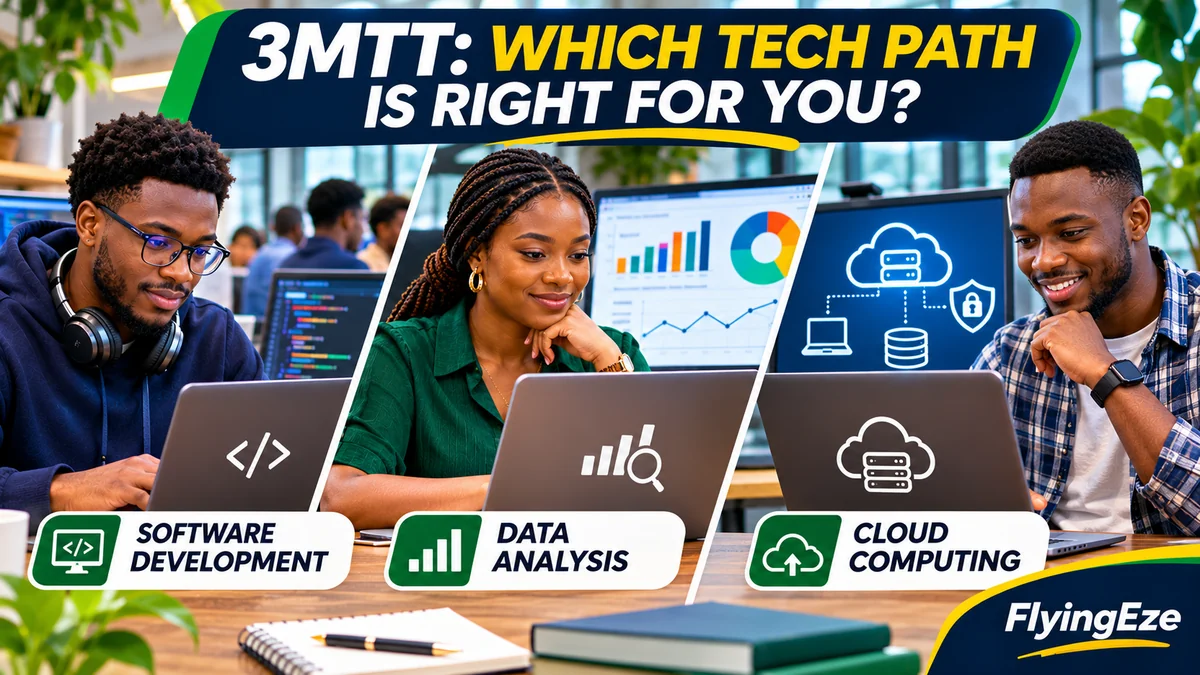
Choose Software Development in Nigeria's 3 Million Technical Talent (3MTT) programme if you enjoy building applications and solving problems with code; choose Data Analysis & Visualisation if you enjoy investigating figures and explaining what they mean; choose Cloud Computing if you are curious about servers, networks, infrastructure and keeping online systems reliable. The strongest choice is not necessarily the track with the loudest salary claims. It is the one whose everyday work you are willing and equipped to practise consistently.
The Federal Ministry of Communications, Innovation and Digital Economy's official 3MTT website and NITDA's capacity-building page list all three among twelve first-phase technical skills. Their names sound related because modern applications run in the cloud and generate data, but their entry-level tasks, learning priorities and potential portfolios are different.
This guide compares them for students, recent graduates, career changers, self-taught learners and Nigerians seeking digital employment. It also explains the real limitations: a training place is not a job offer, the advertised first-phase format should not be mistaken for a promise about every new cohort, and choosing a track does not replace practical work. Research verified on 3 November 2026.
What are the three 3MTT learning tracks?
In simple terms, software developers build digital tools; data analysts interpret information; cloud practitioners run and support digital infrastructure. They may work on the same product but tackle different questions.
| Factor | Software Development | Data Analysis & Visualisation | Cloud Computing |
|---|---|---|---|
| Core question | How do we build this application? | What does the data tell us? | How do we deploy, operate and protect the system? |
| Typical starting skills | HTML, CSS, JavaScript or Python; debugging; Git | Spreadsheets, data cleaning, charts, SQL, basic statistics | Computers, Linux, networking, storage, access control |
| Beginner practice | Publish a useful small website | Analyse a sample sales dataset | Explain and safely configure a basic cloud architecture |
| Evidence for a portfolio | Working app, source repository, explanation of decisions | Cleaned dataset, dashboard, insights and recommendations | Architecture diagram, controlled lab, setup and security notes |
| Common difficulty | Persistent debugging and design decisions | Messy data, interpretation and communicating uncertainty | Infrastructure concepts, permissions and troubleshooting |
| Possible longer-term roles | Frontend, backend or full-stack developer | Reporting, business or data analyst | Cloud support, systems administration, cloud operations |
These are career illustrations, not guarantees that a particular cohort teaches every listed tool or awards any named certification. Consult the syllabus and training provider for the specific offer you receive.
1. Choose Software Development if you want to build things
Software development involves turning requirements into working websites, applications, APIs and services. Beginners often start with the web: HTML structures a page, CSS controls presentation and JavaScript adds behaviour. They learn to inspect errors, test features, use version control and break large problems into smaller steps.
MDN's beginner web-development curriculum starts with setting up tools, understanding files and building a first website. It explicitly treats the journey as moving from beginner to competent, not becoming an expert after a few lessons. You can try its first website project before committing to the track.
A beginner portfolio might contain a responsive community-events website, a simple budgeting calculator and a booking form with validation. Describe what each project solves, show a live working version where appropriate and link to source code you are authorised to share.
What makes the track difficult?
Programming requires repeated practice. Code fails for reasons that are not always obvious, and learners may spend more time diagnosing errors than typing solutions. Understanding the basics matters more than copying a tutorial or relying on AI to generate an app you cannot explain.
If you find satisfaction in fixing bugs, designing features and improving a tool until somebody can use it, development may suit you. If you strongly dislike extended hands-on troubleshooting, test the experience before making it your first choice.
2. Choose Data Analysis if you like evidence and business questions
Data analysts collect, clean, organise, query and visualise information to support decisions. A retailer might ask which products have declining sales; a hospital might study appointment attendance; a school might compare performance patterns without revealing private student information.
The work is not just creating attractive charts. An analyst must ask whether the data is accurate, which comparison is fair and what a graph does not prove. Spreadsheet skills, SQL and basic statistical reasoning are useful foundations, while dashboards help communicate findings.
Microsoft's beginner Power BI learning path covers connecting to sources, shaping data and presenting interactive reports. Its data preparation pathway explains the cleaning and transformation work that must happen before trustworthy analysis.
For a starter project, create a fictional small-shop sales file containing date, product, quantity, unit price and location. Clean duplicates, calculate revenue, identify top sellers and make three charts explaining changes over time. End with a short report that distinguishes observations from assumptions.
Is Data Analysis easier than programming?
For somebody already comfortable with Excel and business records, it may be the fastest entry point. However, advanced analysis can involve SQL, statistics, coding and complicated data models. Not liking mathematics at school does not automatically disqualify you; willingness to check calculations and reason carefully matters more than a label.
Do not confuse the 3MTT Data Analysis & Visualisation track with its separately listed Data Science and AI/Machine Learning tracks. They are related but not identical programmes or job roles.
3. Choose Cloud Computing if you like how systems work
Cloud computing concerns the infrastructure and managed services that applications use: virtual machines, storage, databases, identity management, networking, monitoring and backups. Instead of only asking how an app is written, a cloud learner asks where it runs, who may access it, how it scales and what happens when something fails.
Microsoft's Azure Fundamentals material covers basic cloud concepts and services such as compute, networking, storage, governance and security. This is an example of a publicly available learning pathway, not an assertion that 3MTT awards an Azure certification.
A useful beginning project is to draw an architecture for a small online shop: customer browser, application, database, storage, backups and monitoring. Explain which parts need public access, where secrets belong and how a failure would be noticed. If you later use a free cloud lab, set spending limits and remove resources afterward; commercial cloud accounts can incur charges.
Do you need coding before learning cloud computing?
You need not already be a professional developer to begin understanding cloud concepts. Nevertheless, basic networking, command-line use, Linux, security and some scripting become increasingly valuable. Someone new to computing may initially find the number of connected concepts challenging.
The August 2026 National Digital Cloud Policy identifies cloud infrastructure as a priority for Nigeria's digital economy. That supports the field's relevance, but it is not proof of a guaranteed vacancy for every trainee or a reliable forecast of salaries.
Which 3MTT track is best for a complete beginner?
There is no universal answer. A learner who has never written code but loves creating websites can start software development; a graduate who enjoys school projects involving questionnaires and charts may prefer analysis; and someone who has helped troubleshoot routers or computers may find infrastructure concepts naturally interesting.
Consider where you have a head start rather than following the most popular track on social media. Existing accounting or research experience transfers into analysis. Experience configuring websites or building small scripts transfers into development. Experience with helpdesk tasks, networking or system administration transfers into cloud.
Make the choice conditional on the training provider's actual beginner prerequisites. A basic cloud course and an advanced cloud-operations fellowship may have very different expectations, even when both use the word “cloud”.
What do equipment, electricity and internet costs mean for your choice?
A laptop is especially valuable for practising all three paths, even if a phone can handle some course videos and reading. Software development benefits from a code editor, browser and tools for running projects. Data analysis benefits from spreadsheets or data-visualisation software and the ability to work with files. Cloud computing benefits from a terminal, internet access and carefully controlled sandbox or lab accounts.
Do not assume the programme provides free devices, permanent internet bundles or electricity support. The official first-phase FAQ says participants covered personal transportation, meals and related expenses themselves. Equipment and support arrangements can differ by later cohort or partner, so confirm them before making a financial commitment.
To reduce costs, start with openly available learning materials, small offline exercises and download-friendly lessons where permitted. Keep project files backed up. For cloud labs, read the pricing and free-tier conditions; avoid experimenting with real customer data or publicly exposing accounts.
A seven-day experiment before you choose
Rather than guessing which career will be exciting, conduct a small trial. The following is an independent career-selection exercise, not an official 3MTT assessment.
| Day | Exercise | What to notice |
|---|---|---|
| 1–2 | Create a two-page website using HTML and CSS; add one simple interactive feature if ready | Did debugging and building feel rewarding? |
| 3–4 | Clean a fictional sales spreadsheet; chart revenue by product and explain three observations | Did finding patterns and presenting conclusions appeal to you? |
| 5–6 | Learn cloud compute, storage and networking concepts; draw a secure deployment diagram | Were infrastructure and security questions engaging? |
| 7 | Review the projects and choose a primary track plus one supporting skill | Which work would you willingly practise again next week? |
Rate each area from one to five on enjoyment, comprehension, access to necessary tools, willingness to practise and connection to your goals. Do not score the area solely by how much you learned in two days. Beginners naturally move at different speeds.
What jobs or income opportunities could follow each track?
Software development can lead toward junior web development, testing-adjacent technical work, application support or eventually product engineering. Data analysis can support reporting, operations, research assistance, business intelligence or more advanced analytics roles. Cloud computing can lead toward infrastructure support, operations, systems administration and later specialised platform roles.
Those are possible career directions, not confirmed open vacancies. Entry-level hiring varies by employer and requires evidence of capability beyond a completion certificate. There is no responsible basis for promising a particular Nigerian salary or a remote international job immediately after a short course.
The official 3MTT placement page describes connections to employers and a job board. Treat such pathways as opportunities to explore, not automatic placement. Build professional communication skills, document projects and ask for feedback as you progress.
For learners interested in infrastructure security, a neighbouring path is cybersecurity. FlyingEze's guide to free cybersecurity training opportunities for Nigerians provides further context, although cybersecurity remains a separate skill and should not be confused with the cloud track.
Can you combine Software Development, Data Analysis and Cloud Computing?
Yes, but beginning with all three at full intensity usually makes progress harder to measure. Choose one primary skill while borrowing complementary skills from another. A developer who understands cloud hosting can deploy applications. A data analyst who learns SQL and Python can automate analysis. A cloud practitioner who learns scripting can manage infrastructure more efficiently.
A practical progression is foundation → portfolio → related specialisation. For instance, a software learner might build a small app before learning deployment; an analyst might create a dashboard before exploring cloud-based data platforms; a cloud learner might understand basic networking before infrastructure automation.
The ministry's March 2026 partner-network announcement reflects a broader programme ecosystem, while specialised initiatives such as DeepTech_Ready have different objectives and prerequisites. Do not assume eligibility or course transferability between programmes without checking their official terms.
How 3MTT training and selection actually work
The 3MTT main website explains that its original phase identified twelve tracks, used an entry assessment to benchmark applicants, and combined self-paced online instruction with applied in-person learning. It described an average course length of around three months and no programme commitment fee for that phase.
These are published first-phase details, not verification that registration is currently open or that every 2026 learning route follows the same schedule. For instance, the related NextGen fellowship advertises hybrid, peer-led and virtual arrangements, while DeepTech_Ready offers more specialised data and AI training. Confirm the programme name, cohort, eligibility criteria, deadlines and training location directly from its official page.
Never pay a third-party agent on the promise that they can guarantee selection or a job. Avoid unofficial forms requesting passwords, payment-card PINs or identity details outside legitimate application requirements.
A realistic learning plan after selecting a track
Month one: master the foundations and practise every week. Development learners can build static pages and learn version control; analysts can work with clean sample spreadsheets; cloud learners can explain foundational concepts and use safe exercises.
Month two: complete a small project independently. Write down the problem, steps, errors encountered and what you changed. Share your work with mentors or peers for criticism rather than presenting a copied tutorial as original work.
Month three: improve the project into a portfolio example, write a concise description and practise explaining it. Prepare a CV or online profile that states what you genuinely know. Continue learning beyond the course because short training is a foundation, not full career mastery.
Adjust this sequence to your actual cohort. A provider may use a different syllabus, project schedule or training duration.
Common mistakes Nigerian applicants should avoid
Choosing only for perceived salary: no credible programme source promises immediate earnings from one of these tracks. Confusing Data Analysis with Data Science: foundational dashboards are not the same as advanced machine-learning research. Confusing Cloud Computing with DevOps: they overlap, but the official 3MTT skills list treats them separately.
Buying expensive courses before testing your interest: use official and free educational material first. Ignoring English communication and teamwork: technical skill is only part of collaboration and employability. Expecting a certificate to replace a portfolio: practical, verifiable work usually gives employers stronger evidence of ability.
Finally, check internet, electricity and personal schedules honestly. Consistent learning for a manageable number of hours is more effective than registering for a path that you cannot practise.
Frequently asked questions
Are Software Development, Data Analysis and Cloud Computing official 3MTT tracks?
Yes. All three appear in the official twelve-skill first-phase list on the 3MTT and NITDA websites. Current availability should still be checked for the exact cohort or fellowship.
Which of the three is easiest for a beginner?
It depends on prior skills. Data Analysis may feel familiar to people who already use spreadsheets; Software Development suits those who enjoy creating and debugging; Cloud Computing often benefits from basic IT and networking knowledge. None is effortless.
Do I need to know programming to study Data Analysis?
Not necessarily at the beginning. Spreadsheets, careful reasoning and visualisation can come first. SQL and sometimes Python become useful as the work grows more technical.
Can I learn Cloud Computing without previous IT experience?
You can learn the fundamentals from the beginning, but networking, command-line and operating-system basics may require additional preparation before more advanced cloud labs.
Is 3MTT training free, and does it provide a laptop or stipend?
The main site's first-phase FAQ states there was no commitment fee and that financial support covered the training, not transport and meals. Do not assume that laptops, stipends or identical funding terms apply to every later cohort; check the current official offer.
Will 3MTT guarantee a job when I finish?
No placement guarantee was established by the official information reviewed. The programme offers talent-development and employer-connection activities, but hiring depends on performance, opportunities and employers' selection decisions.
Conclusion: choose the work you want to practise
The best 3MTT choice is the track that fits your interests, starting skills, learning resources and long-term goals. Select Software Development if building applications excites you, Data Analysis if turning messy information into useful decisions is rewarding, or Cloud Computing if you are drawn to the infrastructure behind digital services.
Test all three through small exercises, check the terms of the specific 3MTT cohort, then commit to one primary path. A credible portfolio and sustained practice will matter more than choosing whichever digital skill currently attracts the most online attention.