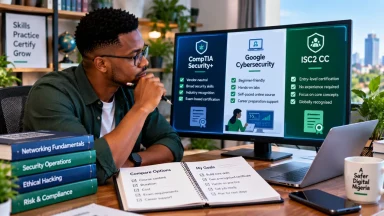
Searching for cybersecurity courses in Nigeria does not have to begin with expensive bootcamp tuition or a foreign certification voucher. Several established technology organisations offer free cybersecurity lessons, while selected Nigerian initiatives provide funded training for eligible applicants. The difficulty is knowing which resources are genuinely free, which include practical exercises, and which only waive tuition while charging for exams or advanced features.
This 2026 guide examines opportunities that Nigerians can explore online, explains the difference between open-access learning and selective fellowships, and provides a realistic plan for building foundational skills without paying for every course you see advertised. Free training is not automatically a free professional certification or a guaranteed job.
Free cybersecurity training opportunities: comparison table
| Provider | Free offer | Important limitation |
|---|---|---|
| Cisco Networking Academy | Introductory cybersecurity course with learning labs | Course badge, not a CompTIA or ISC2 exam credential |
| IBM SkillsBuild | Cybersecurity lessons and eligible digital credentials | Badges have their own completion criteria |
| Microsoft Learn | Security, identity and compliance learning paths | SC-900 certification examination is separate and normally paid |
| PortSwigger Web Security Academy | Interactive web-security lessons and labs | Specialised application-security focus |
| Fortinet Training Institute | Self-paced cybersecurity and network-security theory | Optional hands-on labs and certain exams cost extra |
| TryHackMe | Selected rooms on a free account | Full learning paths and extended lab features are paid |
| Nigeria's 3MTT programme | Fee-free training in the cited phase, including cybersecurity | Selection and cohort availability vary; personal costs remain |
| CyberGirls Fellowship | Funded cybersecurity training for eligible young African women | Applications temporarily closed as of verification |
Online availability, account requirements and admission status may change. The table does not claim that places are currently available in every programme.
1. Cisco Networking Academy: a free starting point
Cisco Networking Academy's Introduction to Cybersecurity is listed as free, self-paced and approximately six hours long, with seven introductory labs. It explains privacy, threat types, network vulnerabilities, organisational protection and cybersecurity career possibilities.
For Nigerian secondary-school graduates, university students and career changers, its main strength is accessibility: beginners can test whether they enjoy the subject before committing significant money. Cisco also offers broader learning in networking, a useful prerequisite for many security roles.
The course's digital achievements reflect the particular learning activities completed. They should not be represented as a separately proctored Security+ or ISC2 CC professional certification. A sensible next step is to learn networking basics and write a short summary explaining how an organisation can protect accounts and data.
2. IBM SkillsBuild: free fundamentals and learning credentials
IBM SkillsBuild is a free digital-learning programme serving students and adult learners. Its catalogue includes cybersecurity foundations, threat intelligence and security operations content at different levels.
The IBM Cybersecurity Fundamentals digital credential , for example, has published learning and assessment requirements, including a qualifying end-of-course score. This is useful evidence of structured study, but it remains a learning credential rather than a universal licence to practise cybersecurity.
Start with an introductory module, check the credential conditions and record three concepts you can apply: access control, threat identification and incident escalation. Avoid collecting badges without understanding their content.
3. Microsoft Learn: security, identity and cloud concepts
Microsoft Learn's introduction to security, compliance and identity is a free beginner learning path covering Zero Trust, shared responsibility, encryption, identity providers and governance. It can help learners interested in cloud identity administration or governance, risk and compliance (GRC).
The material is linked to preparation for Microsoft's SC-900 credential , whose examination is separately administered and priced according to the country or region. Free Microsoft Learn study content does not make the SC-900 exam free.
A beginner can complete a module, take the available knowledge checks and create a fictional access-policy checklist. Technical concepts such as authentication and authorisation are also useful outside Microsoft-specific security roles.
4. PortSwigger Web Security Academy: practise on authorised targets
PortSwigger Web Security Academy states that its online training and interactive laboratories are 100% free. Topics include access control, web application vulnerabilities and defensive security concepts. It is especially relevant to web developers and prospective application-security practitioners.
Unlike lessons that only explain ideas in text, the academy provides intentionally designed challenges where learners can apply techniques in a controlled environment. Start with introductory lessons and document the underlying weakness, why it matters and how a developer could prevent it.
Security testing must stay within authorised labs or systems you have explicit permission to assess. A free training account does not authorise attempting the same techniques against public websites or unrelated businesses.
5. Fortinet Training Institute: free theory, paid extras
Fortinet Training Institute provides free self-paced cybersecurity material, including networking and security operations subjects. Fortinet's official support guidance explains that self-paced lessons are free to enrol in through its training library.
However, optional on-demand interactive labs are not included in the free theoretical lessons; instructor-led courses and examination services can also have separate charges. This distinction matters when comparing a free course with a private training provider advertising a complete laboratory package.
Fortinet may suit learners interested in enterprise network defence. Begin with concepts you understand and check the current certification requirements separately before buying exam access.
6. TryHackMe: free selected practice rooms
TryHackMe's free-rooms directory includes beginner-friendly exercises and more advanced security challenges. Its official pricing page lists a free tier with access to selected rooms and limited browser-based AttackBox usage, while broader learning-path access requires a subscription.
For a Nigerian beginner, the free exercises can help make unfamiliar subjects more concrete. Select introductory web, Linux or defensive-analysis exercises rather than jumping straight into difficult offensive challenges.
Check whether a particular room is free before starting, and practise only inside the platform's permitted environment. A free account is a chance to sample practical learning, not a promise that every course, lab or professional certification is included.
7. Nigeria's 3MTT: funded training, subject to selection
The 3 Million Technical Talent (3MTT) programme lists cybersecurity among its focus areas. Its published FAQs say there is no selection commitment fee for the cited training phase, describe an entry assessment and explain that learning may combine remote and in-person activities.
The same FAQs clarify that participants remain responsible for transport, meals and other personal costs. This is therefore not necessarily a zero-cost experience for every selected learner.
As of this verification, the portal's programme descriptions do not establish an open, immediately available cybersecurity intake for every applicant. Follow official announcements for your intended phase, and do not pay an individual who promises to arrange selection.
8. CyberGirls: a free fellowship, but applications are closed
CyberSafe Foundation's CyberGirls Fellowship is a funded programme for eligible young African women, with the official page currently indicating ages 18–28. It combines structured training, mentoring and exposure to pathways including security operations, GRC, network security and digital forensics.
The organisation's page states that applications are temporarily closed and provides a way for interested candidates to request notification about future opportunities. Do not treat old recruitment graphics as proof of an active 2026 opening.
Applicants should also distinguish this beginner-oriented fellowship from the separate CyberSafe–SANS AI-security fellowship, which required substantial existing cybersecurity experience and whose 2026 application deadline has passed.
9. What about the formerly free ISC2 Certified in Cybersecurity exam?
An important outdated claim persists in many online videos: that any new learner can enrol for a free ISC2 Certified in Cybersecurity (CC) examination.
ISC2 announced in April 2026 that new enrolments in its One Million Certified in Cybersecurity initiative would end on 20 May 2026. That programme has concluded for new applicants. Existing eligible participants with valid exam codes may be able to sit their examinations by 31 December 2026.
CC itself remains available through paid pathways. It is therefore misleading to list the closed initiative as a currently open free certification opportunity for all Nigerians. FlyingEze's comparison of Security+, Google Cybersecurity and ISC2 CC explains the different credential models and costs.
10. Learn with free tools, not just video lessons
After introductory study, combine lessons with authorised practice. The Wireshark sample-capture collection provides example network traffic for analysis, while OWASP Juice Shop is a free, intentionally vulnerable application designed for training.
Practising with sample packet captures or simulated applications can teach evidence-based reporting. However, inspect shared datasets for licensing and sensitive information before redistributing them, and never test another person's system without permission.
FlyingEze's beginner cybersecurity portfolio guide demonstrates how to turn authorised practice into clear reports that an interviewer can evaluate.
A four-week free cybersecurity learning plan
| Week | What to learn | Practical output |
|---|---|---|
| 1 | Cisco or IBM fundamentals, passwords, phishing and privacy | One-page security checklist |
| 2 | Networking, identity concepts and basic operating systems | Simple network diagram with explanations |
| 3 | Selected PortSwigger, Wireshark or TryHackMe exercises | Documented permitted lab analysis |
| 4 | Choose SOC, GRC or application-security interest | Two polished project summaries and learning goals |
This is a suggested schedule, not a certification or employment guarantee. Learners balancing work, electricity or data costs may need more time. Consistency matters more than racing through multiple courses.
How to avoid hidden charges and misleading promises
Before registering, examine the official course page and clarify what is free: lessons, labs, certificates, exams, mentoring or placement support. A provider may offer free videos but charge for assessments or practical environments. A “scholarship” may be limited by age, location, application deadlines or selection.
Budget realistically for mobile data, a laptop, electricity, exam-centre travel and any optional subscriptions. Avoid agents demanding “activation fees” for an otherwise free public programme. Never hand over bank PINs, one-time passwords or identity documents through an unsolicited chat link.
For readers deciding whether to pay later for an examination or bootcamp, FlyingEze's cybersecurity course and fee comparison explains training credentials, regional pricing and certification differences.
Frequently asked questions
Can Nigerians learn cybersecurity online completely free?
Yes. Free lessons and selected practical resources are available from Cisco, IBM, Microsoft, PortSwigger, Fortinet and other providers. Internet access and other personal costs may remain.
Do free cybersecurity courses include recognised certifications?
Some offer completion badges or learning credentials. These are different from separately proctored professional certifications, which may have exam fees and ongoing obligations.
Is 3MTT cybersecurity training open now?
The official portal confirms cybersecurity as a skill area and states no commitment fee for its cited phase, but that alone does not verify current admission availability. Check the latest official intake notice.
Can I get an entry-level job after one free course?
One short course rarely demonstrates all the knowledge needed. Employers may assess networks, operating systems, evidence of hands-on practice, communication and role-specific skills.
Internal Linking Recommendations
Compare learning formats and complete costs in FlyingEze's cybersecurity courses in Nigeria guide . Use the career-entry roadmap to choose a realistic first role and the beginner portfolio guide to document practical projects. For independent credentials, the Security+ versus Google versus ISC2 comparison explains examination and renewal requirements.
Conclusion: start free, specialise deliberately
The best free cybersecurity training opportunities for Nigerians are not necessarily the longest courses or the programmes with the most impressive badges. Start with credible, accessible resources, practise within authorised environments and keep notes showing what you have learned.
If you are comparing cybersecurity courses in Nigeria, begin with Cisco or IBM for fundamentals, use Microsoft or Fortinet for an area of interest, and add hands-on exercises through PortSwigger or selected TryHackMe rooms. Monitor selective Nigerian fellowships separately; do not confuse a closed application window with a live offer.
Research verified 31 October 2026. Course access, paid features, fellowship intakes and exam requirements can change. Review official providers before enrolling.