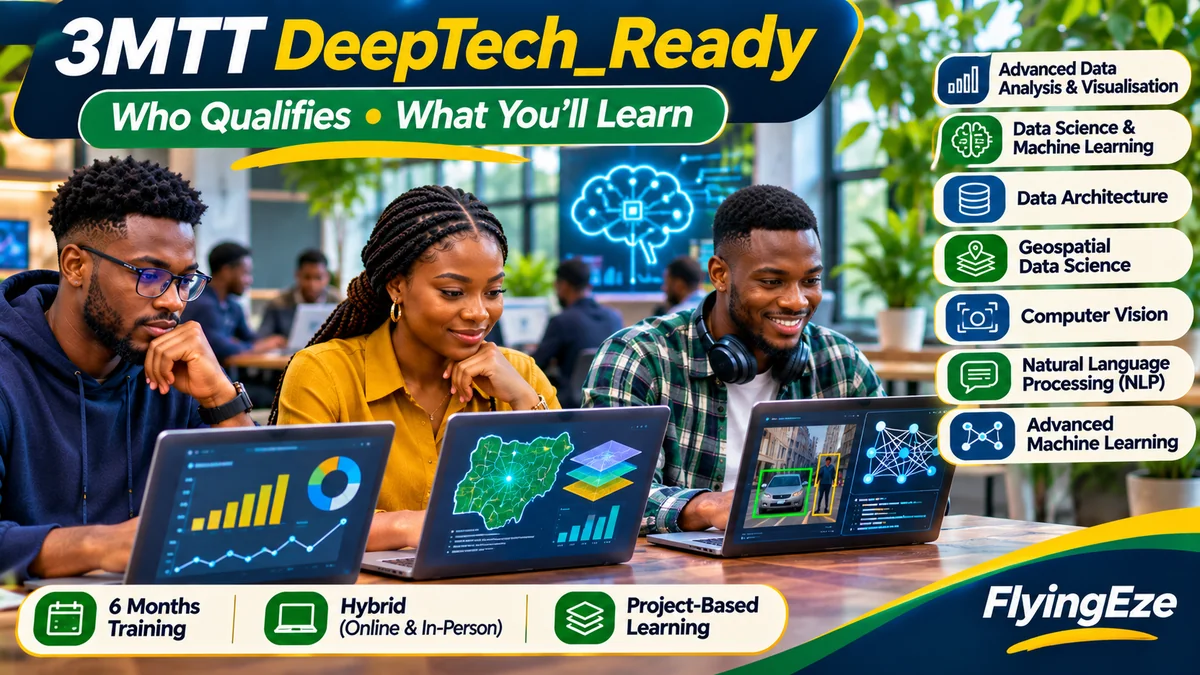
The 3MTT DeepTech Ready Programme is a free, approximately six-month upskilling initiative for eligible Nigerian youths and technical learners who want practical Data Science and Artificial Intelligence skills. Its official programme page says it is open to existing 3 Million Technical Talent (3MTT) fellows and individuals with basic-to-intermediate knowledge in relevant fields, with different prerequisites for individual courses. The published support FAQ additionally describes an 18–35 age range and a foundational assessment threshold of 70%; applicants should confirm whether those earlier criteria still apply to their specific cohort.
Unlike introductory digital-skills programmes, DeepTech_Ready focuses on more specialised work: advanced data analysis, machine learning, data engineering concepts, geospatial data, computer vision, natural language processing and advanced mathematical techniques. It blends self-paced learning, supported in-person activities, hands-on projects and mentorship rather than promising instant employment.
The initiative was launched by the Federal Ministry of Communications, Innovation and Digital Economy with Data Science Nigeria and support from Google.org. Its stated ambition is to train 20,000 young Nigerians across successive cohorts, not to award 20,000 places in a single application window. This guide separates official facts from historical cohort instructions so applicants can make informed decisions. Research verified 3 November 2026.
What is the 3MTT DeepTech_Ready Programme?
DeepTech_Ready is a specialised upskilling route associated with the broader 3 Million Technical Talent (3MTT) programme . The ministry announced the first cohort on 31 January 2025 in partnership with Data Science Nigeria, with funding support from Google.org. The ministry said the six-month learning journey would combine self-paced and on-site activities, practical projects and job-readiness support. Its launch announcement named seven subject areas.
Deep technology here means applying technical methods to challenging problems that need more than basic computer literacy: understanding datasets, training or evaluating predictive models, processing text and images, or designing reliable data infrastructure. It does not mean every participant will become an AI researcher after six months.
According to the implementing partner, Data Science Nigeria , the training model includes localised video lessons and learning centres. Its programme report describes five AI specialisation tracks, nine courses and 54 practical topics in its implemented curriculum. Those delivery groupings do not exactly mirror the seven broad subjects on the ministry's promotional list; readers should check the current course catalogue rather than assuming seven independently selectable classes are open at once.
Who qualifies for DeepTech Ready?
The main programme page gives the clearest general eligibility statement: applications are intended for 3MTT fellows and people with basic-to-intermediate knowledge in relevant technical fields. It warns that each course has its own prerequisites. This means you do not necessarily need to have finished a separate 3MTT fellowship, but an advanced course may be unsuitable without foundational study.
| Eligibility question | What the official material says |
|---|---|
| Must I be Nigerian? | Yes, the support FAQ identifies Nigerian youths as the target group |
| What is the age range? | The published DeepTech FAQ lists ages 18–35; check current cohort rules before relying on it |
| Must I already be a 3MTT fellow? | No universal requirement is stated: the main page also permits people with relevant technical foundations |
| Do I need technical experience? | Basic coding, mathematics and statistics are identified as foundations, with course-specific prerequisites |
| Is there a test? | Yes; the support FAQ describes a foundational evaluation and a 70% minimum threshold |
| Is selection automatic? | No. Registration, assessment and selection are distinct stages |
| Can unsuccessful applicants try later? | The support FAQ says they can reapply for later cohorts |
The support FAQ is useful but carries older cohort language. The 70% threshold and 18–35 rule are therefore best reported as published historical eligibility guidance, not a permanent guarantee for every future intake. The live application dashboard and the official instructions for the particular cohort take precedence where they differ.
What technical knowledge should applicants have?
For most specialisations, expect to benefit from basic Python programming, mathematics, statistics and data handling. The programme support FAQ explicitly names these foundations and recommends a computer with internet access, with tools such as Python, SQL and Jupyter Notebook. Its guidance says a phone may handle some activities, but a laptop is recommended for assignments and projects.
Someone comfortable cleaning spreadsheets but unfamiliar with code could begin preparing through introductory Python and descriptive statistics. Someone who has written software but has little statistical knowledge should learn concepts such as distributions, model evaluation and the difference between training and test data. An existing 3MTT fellow is not automatically an expert in all these areas.
If you have never used a spreadsheet, written basic code or studied quantitative reasoning, the ordinary 3MTT foundational tracks may be a better starting point. You can also try an introductory course such as Google's Machine Learning Crash Course to assess how much preparation you need. That is an external self-study resource, not a mandatory DeepTech_Ready module.
What training does DeepTech_Ready cover?
The official programme landing page lists seven broad specialisations. These descriptions explain the kind of work each field involves; exact modules, assignments, assessment schedules and the available choices can differ between cohorts.
1. Advanced Data Analysis and Visualisation
This field turns complex datasets into useful explanations for organisations. Learners may explore data cleaning, descriptive statistics, querying, dashboard design and communication of evidence. Imagine examining anonymised inventory records to identify when stockouts happen and why one branch performs differently. The task is not merely drawing colourful charts; analysts must verify data quality and avoid misleading conclusions.
Those building fundamentals can explore Microsoft's introductory Power BI learning path alongside SQL and spreadsheet practice.
2. Data Science and Machine Learning
Machine learning develops models that identify patterns or make predictions from examples. Practical concepts include preparing datasets, separating training and test information, choosing algorithms, measuring error and explaining limits. A beginner project could estimate demand using fictional retail sales, with a clear description of how the model was evaluated.
The scikit-learn documentation offers examples of supervised machine-learning methods. These are independent educational references and do not imply that the programme uses a particular framework in every class.
3. Data Architecture
Data architecture concerns how information is collected, structured, stored, accessed and governed. A developer might know how to store records in a database; a data architect asks how different sources can be integrated reliably, who should have access, how records are documented and how quality is maintained. The subject connects data engineering, governance, system design and analytics.
A sensible beginner project is to design a fictional business data flow showing how sales data moves from a POS system into a protected reporting database, with diagrams for validation and access permissions.
4. Geospatial Data Science
Geospatial work analyses data connected to locations, coordinates, routes or regions. Examples include mapping flood exposure, estimating travel distances or assessing access to public services. Students should understand map projections, location accuracy and privacy risks. Publishing real people's precise locations without authorisation can create serious harm.
A practice portfolio could use an open, properly licensed geographic dataset to compare service coverage between Nigerian local government areas. It should explain data limitations and avoid presenting guesses as verified measurements.
5. Computer Vision
Computer vision uses computational methods to interpret images and video. Applications can involve classifying objects, detecting defects or analysing visual scenes. Learners need to consider image labelling, model errors, bias, privacy and the conditions under which a model performs poorly. A model trained on clear daytime photographs may fail on blurry or poorly lit images.
For a safe portfolio, a learner might classify categories of everyday objects using a licensed public dataset instead of photographing identifiable people without their consent.
6. Natural Language Processing (NLP)
NLP focuses on the computational processing of human language. Tasks include classifying text, extracting information, analysing sentiment and designing language-based applications. A small project might group fictional customer-service messages by topic, then assess classification errors instead of claiming the model understands every message.
Because language varies by dialect and context, Nigerian English, Pidgin and indigenous languages present different data and evaluation challenges. Models should not be declared reliable without appropriate testing on the populations and languages they will serve.
7. Advanced Machine Learning Techniques and Mathematics
The government launch announcement describes mathematics and advanced machine learning, while the main programme page uses the label Advanced Machine Learning Techniques. This area may require stronger foundations in linear algebra, calculus, probability, optimisation and model evaluation. It is appropriate for learners ready to move beyond basic predictive models, not a shortcut around fundamentals.
Before choosing it, ask the training provider for specific prerequisites and the assessment standard. A strong academic interest in AI is valuable, but attempting complex techniques without the basics often creates gaps that make project work harder.
How long is the training, and is it free?
The DeepTech_Ready landing page specifies six months per cohort, combining self-paced learning, on-site learning and online support. The programme support FAQ adds weekly assignments, capstone projects, mentorship, applied learning cluster attendance and feedback. It says selected participants do not pay for the training.
Do not confuse this six-month specialist programme with the original general 3MTT website's approximately three-month average for its foundational first-phase courses. They are different learning offers. Also distinguish free tuition from the costs of participation: internet, laptop access, transport to physical sessions and meals may still create expenses. Confirm any equipment, support or stipend arrangements for the exact cohort; no general monthly stipend is established by the sources reviewed.
The FAQ treats in-person Applied Learning Cluster participation as an important requirement. Consider the nearest accessible centre and your work or family commitments before applying. Data Science Nigeria reports a nationwide network of 50-plus AI learning centres, but that does not guarantee a seat at any particular centre or town.
How are candidates selected?
The historical DeepTech FAQ says selection involves evaluation of foundational skills, with a stated minimum score of 70%. The official registration help article describes account creation, entering a training or assessment platform, selecting DeepTech_Ready, providing background information and completing a technical assessment. Those screenshots mention a specific older cohort banner and platform workflow.
Therefore, do not assume the same banner, assessment link or 70% threshold appears unchanged on the next intake. Follow the live instructions shown in your registered account and any official cohort-specific notice. Passing a threshold may be necessary for selection but is not equivalent to receiving a confirmed offer.
To prepare, practise basic Python, reasoning about tables, descriptive statistics and explaining a small project. Review questions carefully, use only permitted materials and never buy alleged assessment answers from an unofficial contact.
How to apply for the 3MTT DeepTech Ready Programme
- Visit the official DeepTech_Ready programme page and read the eligibility statement and seven listed areas.
- Select the official Apply link. It opens the 3MTT registration environment; the exact application flow may depend on the current cohort.
- Sign in to an existing 3MTT account or register through the authorised portal if new registration is offered.
- Complete your profile and provide only the identification and technical information explicitly requested by the legitimate form.
- If a DeepTech_Ready application or assessment is available, follow its directions for selecting a course and completing any required test.
- Save your application or assessment confirmation and monitor official dashboard messages and programme communications for the result.
Application-status caution: an 8 April 2026 government youth-opportunities page describes applications as open on a rolling basis, and the official DeepTech landing page still displays an Apply link. However, the application portal is JavaScript-driven and its current logged-in intake state could not be independently verified from the public pages. Applicants should not interpret this article as confirmation of a currently available seat, a newly announced deadline or guaranteed same-day registration.
The official pathway is free for selected learners according to the programme support documentation. Do not pay agents for guaranteed admission or share one-time sign-in codes and identity documents over random social-media accounts.
What do selected learners receive?
The stated training package includes structured lessons, applied projects, access to mentors and career-readiness activities. The main programme page advertises job-matching support and one-on-one mentorship. The FAQ says learners who meet completion requirements can receive a certificate, while the implementation partner describes nationwide learning centres and a project-led curriculum.
Importantly, **job matching is not job placement**. The FAQ explicitly states that employment is not guaranteed. No verified source promises a remote role, a particular salary, a Google job or a specific professional vendor certification simply because an applicant completes DeepTech_Ready.
The value is stronger when participants finish with evidence they can show: a documented dataset, reproducible code, a reliable model evaluation and an explanation of limitations. Keep a portfolio free of private customer information and clearly credit open-source material or teammates.
How does DeepTech Ready differ from ordinary 3MTT training?
| Question | Foundational 3MTT first-phase offering | DeepTech_Ready |
|---|---|---|
| Main objective | Build foundations in a wider range of technical skills | Deepen Data Science and AI capability |
| Specialisations | Twelve first-phase skills, including software, cloud and analysis | Seven broad AI/data subjects advertised on official page |
| Published duration | About three months on average for original phase | Six months per cohort |
| Entry expectations | Foundational assessment to match learners | Relevant prior knowledge and assessment; course-specific prerequisites |
| Learning format | Hybrid, cohort-specific | Self-paced, on-site support, projects and mentoring |
Someone new to technology may benefit from the foundational route before attempting applied AI or machine learning. Someone with existing Python, statistics or data-analysis practice may find DeepTech_Ready a more appropriate next step. The deciding factor should be actual prerequisites, not only the name of the programme.
A practical preparation checklist before applying
Spend a week assessing your readiness. On days one and two, practise Python variables, loops and basic file handling. On days three and four, work with a small fictional CSV dataset and calculate meaningful summary statistics. On day five, learn the concept of training versus test data. On day six, build a chart or small prediction experiment. On day seven, explain in plain language what worked, what failed and which information you would need next.
Tools such as Google Colab can help learners practise notebooks in a browser, subject to connectivity and platform limits. The exercise is an independent preparation recommendation, not an official 3MTT entrance test or a guarantee of a passing score.
Prepare a reliable email address, internet access and enough time for online and physical sessions. Review the application website's privacy information before submitting identity data. Avoid uploading sensitive client data as a demonstration project.
Frequently asked questions
Is DeepTech Ready open only to existing 3MTT fellows?
No. The main DeepTech_Ready page also invites applicants with basic-to-intermediate technical knowledge, subject to specialisation prerequisites and selection.
What is the age limit?
The published support FAQ describes Nigerian youths aged 18–35. Because this guidance is associated with an earlier cohort, confirm the current intake's age criteria in the official application instructions.
Is a minimum 70% assessment score required?
The official programme FAQ states a 70% threshold in its published selection guidance. Check the current cohort's assessment notice before treating that figure as a fixed requirement for all future intakes.
Is the training free?
The programme support FAQ states that selected participants receive training free of charge. Personal expenses such as equipment, internet and travel may still apply; verify any additional support offered to your cohort.
Is the programme entirely online?
No. The advertised model combines self-paced online study with supported on-site learning, and the programme FAQ emphasises applied learning cluster attendance.
Does Google.org teach every class or guarantee Google employment?
No such claim is supported. Google.org is a funding supporter; Data Science Nigeria is the implementation partner. Job matching and career support are not guaranteed employment.
Are applications currently open?
A government opportunities listing dated April 2026 described rolling applications, and the official DeepTech landing page displays an Apply link. Current cohort acceptance cannot be fully established without access to the live logged-in application process; check the official portal.
Conclusion
3MTT DeepTech_Ready is a six-month, project-focused opportunity for eligible Nigerians who want to move beyond basic digital literacy into Data Science and AI. The official material identifies existing fellows and technically prepared newcomers as its audience, describes specialisations from advanced analysis to NLP and computer vision, and provides for assessment, mentorship and practical learning.
Before applying, check the requirements of your chosen course, distinguish historical FAQs from the current cohort, and use only the authorised registration portal. The strongest outcome is not merely getting accepted: it is building demonstrable skills, completing responsible projects and becoming better prepared to compete for real opportunities.