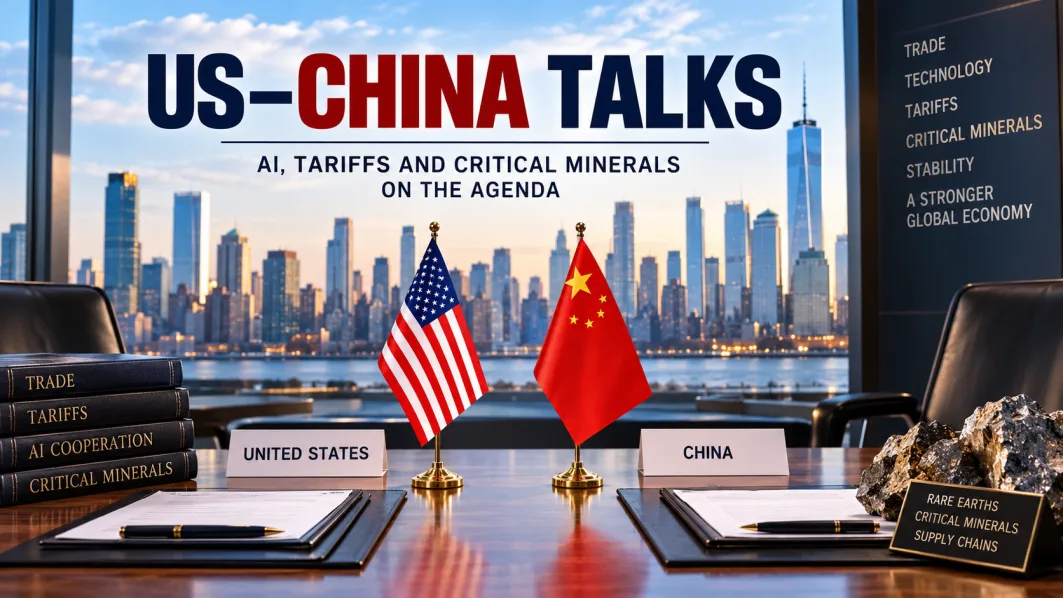
Senior US and Chinese officials opened a new round of economic talks in New York on 20 September 2026, with artificial intelligence, tariffs, trade and critical-mineral supply among the issues under discussion ahead of a planned meeting between US President Donald Trump and Chinese President Xi Jinping.
US Treasury Secretary Scott Bessent and Chinese Vice Premier He Lifeng are leading the discussions. The talks come as the current US-China trade truce approaches its 10 November expiry date and as both sides continue to manage disputes over technology, market access and strategic supply chains.
AI and technology are now part of the economic agenda
Artificial intelligence has become an increasingly important part of the wider US-China economic relationship. The two countries are competing across advanced semiconductors, cloud infrastructure and AI systems while also confronting questions about safety, controls and cross-border technology access.
The New York talks are therefore broader than a traditional tariff negotiation. They sit at the intersection of trade policy, strategic technology and national economic security.
Tariffs and the trade truce remain central
Tariffs remain a core source of tension. The current truce is due to expire on 10 November, leaving negotiators with a limited window to determine whether it can be extended or replaced with a wider arrangement.
Any agreement would have implications for companies that depend on US-China trade flows, including manufacturers, technology firms, agricultural exporters and global logistics businesses.
Critical minerals are another pressure point
Critical minerals and rare-earth supply are also important because they are essential to electric vehicles, electronics, advanced manufacturing, defence systems and many clean-energy technologies.
China remains a dominant player in several parts of the rare-earth supply chain, while the United States and its partners have been trying to diversify sources and processing capacity.
Agriculture and aircraft purchases are also in focus
The talks also include broader commercial issues such as agricultural and aircraft purchases. These areas have featured repeatedly in past US-China trade negotiations because of their importance to exporters and to the overall trade balance.
For businesses, the significance of the talks lies not only in whether a headline agreement is reached, but also in whether the two sides can reduce uncertainty around tariffs, technology restrictions and supply chains.
What happens next
The New York discussions are being watched closely because they are expected to help prepare the ground for a planned Trump-Xi summit. Negotiators could use the talks to narrow differences, extend the existing truce or establish areas for further negotiation.
No final agreement should be assumed from the opening of the talks. The main questions are whether the two sides can make progress on trade and technology disputes and whether they can keep the broader economic relationship from deteriorating further.