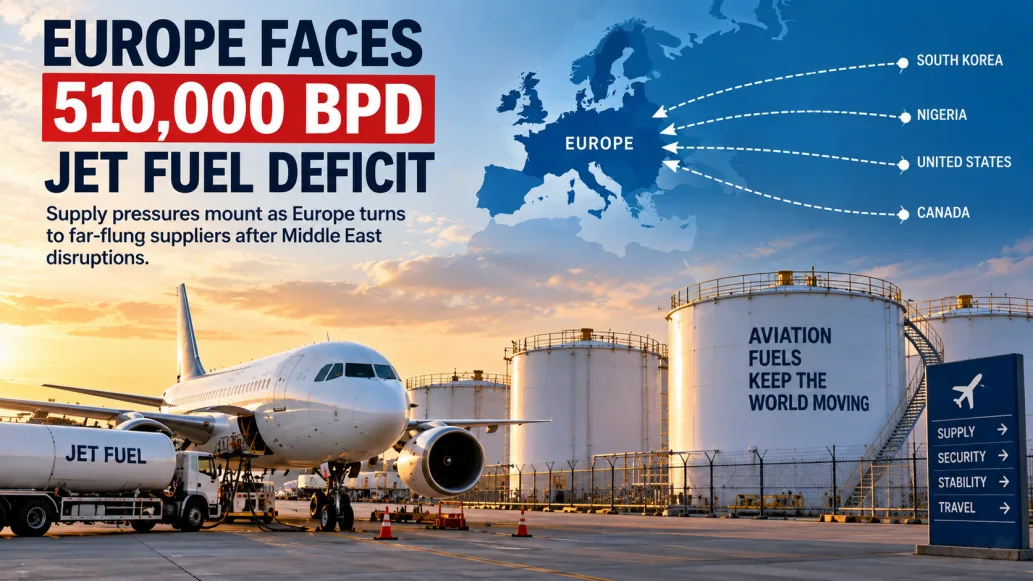
Europe is expected to face a substantial jet-fuel shortfall in the fourth quarter of 2026, with consultancy Energy Aspects forecasting a deficit of about 510,000 barrels per day as traditional Middle East supply remains disrupted.
The tightening market is forcing European buyers to source aviation fuel from more distant suppliers, including Nigeria, South Korea, the United States and Canada. The shift is significant because longer supply routes can raise freight costs, complicate logistics and increase pressure on already tight regional inventories.
Europe's jet-fuel deficit could reach 510,000 barrels a day
Reuters reported on 21 September that Energy Aspects expects Europe to face a jet-fuel deficit of roughly 510,000 barrels per day in the fourth quarter. The forecast reflects the loss or reduction of traditional supply flows from the Middle East and a resulting need to draw cargoes from farther afield.
Jet fuel is a highly specialised middle distillate used by commercial aviation. Europe relies heavily on imports to supplement regional refinery output, so disruption in major supplying regions can quickly tighten the balance between supply and demand.
South Korea emerges as a major replacement source
One of the clearest changes in trade flows is the increase in South Korean jet-fuel shipments to Europe. Reuters, citing Kpler data, said September shipments were running at about 129,000 barrels per day, the highest monthly level since October 2022. LSEG data showed a similar increase.
That is a notable change because South Korea sits far from the main European consuming centres. Longer voyages generally mean greater freight exposure and a longer replenishment cycle, which can make supply chains less flexible when inventories are already tight.
Nigeria, the US and Canada are also helping fill the gap
Europe is also drawing more aviation fuel from Nigeria, the United States and Canada. Nigeria's inclusion in the replacement supply mix is particularly notable because it reflects how Middle East disruptions are reshaping fuel routes across multiple regions.
These alternative cargoes provide important supply relief, but they do not necessarily eliminate the deficit immediately. Shipping times, freight economics, refinery output and product specifications all influence how quickly additional volumes can reach European storage hubs and airports.
Inventories are under pressure
European jet-fuel inventories are also tight. Reuters reported that independent stocks in the Amsterdam-Rotterdam-Antwerp hub, one of Europe's most important fuel storage and trading centres, recently fell to a seven-year low.
Low inventories matter because they leave the market with less of a cushion against further disruption. Even when replacement cargoes are available, delays at ports, weather disruption, refinery outages or renewed geopolitical tension can have a larger effect when stored volumes are already limited.
What the deficit could mean for airlines
A projected deficit does not automatically mean airports will run out of fuel. European fuel markets are highly integrated, and traders can redirect cargoes when price signals justify the additional shipping cost.
However, sustained tightness can raise wholesale jet-fuel prices and increase the cost of securing supply. Fuel is one of the largest operating expenses for airlines, so prolonged increases can put additional pressure on margins and, over time, can contribute to higher ticket prices or fuel surcharges depending on each carrier's hedging position and commercial strategy.
Airlines with effective hedging programmes may be partly insulated from short-term market moves, while carriers that buy more of their fuel at spot prices can feel the impact more quickly.
Why the supply shift matters beyond aviation
The emerging trade pattern also shows how geopolitical disruption is redrawing global energy flows. Cargoes are travelling longer distances, buyers are relying on a wider range of suppliers, and regions that were previously secondary sources are becoming more important to European energy security.
For Nigeria, stronger demand from Europe could create additional opportunities for refined-product exports if domestic production and export capacity can support sustained volumes. For Europe, the immediate priority is supply resilience: securing enough product to meet aviation demand while rebuilding inventories ahead of periods of heavy travel.
What to watch next
Key indicators over the coming weeks will include European inventory levels, shipping volumes from South Korea and Nigeria, freight rates, refinery output and any improvement in Middle East supply flows.
If alternative cargoes continue arriving at elevated rates, the market may absorb part of the projected deficit. If disruptions deepen or inventories fall further, however, aviation-fuel costs could remain under pressure into the final months of 2026.