Aerospace suppliers are accelerating work on alternative materials, older coating technologies and recycling as constraints affecting China-linked supplies of critical minerals put pressure on jet-engine manufacturing.
The industry relies on specialised materials to protect turbine components from extreme heat and wear. Current supply concerns involving materials including yttrium and tungsten are pushing researchers and manufacturers to examine ways to reduce exposure to concentrated supply chains without compromising engine performance or safety.
Why jet-engine coatings matter
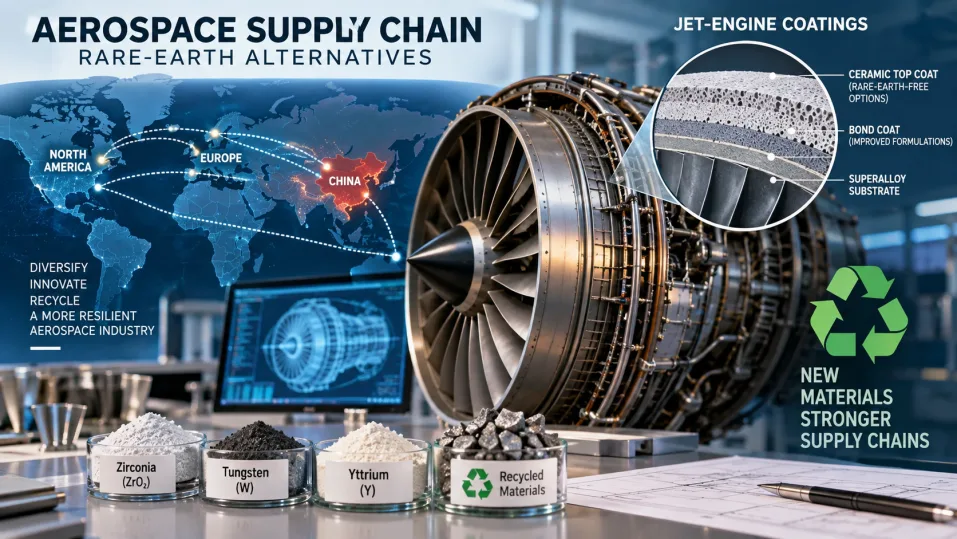
Modern turbine engines operate at exceptionally high temperatures. Thermal-barrier coatings help protect metal components, allowing engines to operate efficiently while extending component life. Some advanced coating systems use rare-earth elements because of their heat resistance and stability.
That technical advantage creates a supply-chain challenge when production or processing is concentrated in a small number of countries. China plays an important role in global critical-mineral supply and processing, making export constraints, higher prices or logistical disruption relevant to aerospace manufacturers around the world.
Suppliers are revisiting alternative materials
According to current Reuters reporting, aerospace suppliers and researchers are examining several approaches. Canada's National Research Council is studying older turbine-coating technologies that could reduce dependence on constrained materials. Oerlikon Metco is also developing products designed to avoid rare-earth inputs.
Zirconia-based ceramics and modified thermal-barrier coating systems are among the technologies attracting renewed attention. The objective is not simply to replace one material with another, but to identify combinations that can withstand demanding engine conditions while remaining manufacturable at aerospace quality standards.
Recycling becomes more important
Recycling is another part of the response. Recovering valuable metals and coating materials from manufacturing waste and retired components can reduce demand for newly mined material and provide manufacturers with an additional source of supply.
However, recycling cannot immediately replace primary supply. Aerospace materials must meet strict specifications, and establishing reliable recovery, processing and certification systems takes time.
Dependence will not disappear quickly
The search for alternatives does not mean the aerospace sector can rapidly eliminate its dependence on Chinese supply chains. Developing a new material for aviation requires extensive testing and qualification before it can be used in safety-critical components.
Changing a turbine coating can involve laboratory evaluation, durability testing, manufacturing validation and regulatory or customer approval. Those requirements mean alternatives that look promising today may still take years to reach widespread commercial use.
A broader aerospace supply-chain shift
The work reflects a wider effort across aviation and advanced manufacturing to diversify critical-material sources. Manufacturers are increasingly considering supply resilience alongside cost, performance and availability when designing future components.
For airlines, the issue is largely upstream, but persistent material shortages can eventually affect engine maintenance, spare-parts availability and manufacturing costs. The immediate development is therefore primarily an industrial supply-chain story rather than evidence of an operational shortage for airlines.
What happens next
Researchers and suppliers will continue testing alternative ceramic systems, improving recycling processes and seeking additional sources of critical minerals. The most successful technologies will need to demonstrate that they can match existing materials on safety, durability, manufacturability and cost.
The transition is likely to be gradual, but the renewed focus on alternative coatings shows how geopolitical and mineral-supply risks are increasingly influencing the engineering decisions behind modern aircraft engines.