You can start an online service business in Nigeria with a small budget by selling one useful skill to a clearly defined customer, using tools you already own and charging for a specific outcome. You do not need an office, an expensive website or a catalogue of services to test demand. You do need a skill you can deliver, reliable communication, a way to accept lawful payments, written terms and attention to registration, tax and privacy obligations.
If your goal is to learn how to make income online, a service business offers a direct route: a customer has a problem, you solve it, and the customer pays for the work. But “online” does not mean effortless, and “small budget” does not mean every legal or operating cost disappears. This Nigeria-focused guide shows how to choose a service, assess demand, build proof, set prices, find customers, protect payments and launch in 30 days—with no invented earnings guarantee.
What is an online service business?
An online service business sells work or expertise delivered, managed or booked through the internet. Unlike an online retailer, you may need little or no stock; unlike a digital-product seller, you usually perform work for each order. Examples include designing marketing materials for restaurants, writing product descriptions, maintaining small-business websites, organising bookkeeping spreadsheets, editing videos, tutoring students remotely and providing administrative support.
Some services require regulated qualifications or licences. Do not offer professional legal advice, investment services, medical care or regulated financial services merely because a social-media page allows you to advertise them. The easiest ethical starting point is a service for which you have demonstrated ability and appropriate authorisation.
| Small-service idea | Example first deliverable | What you must already know |
|---|---|---|
| Social-media design | Five original branded graphics with two revision rounds | Basic visual design, file formats and brand consistency |
| Video editing | Three captioned short videos from supplied footage | Editing, sound and licensed media use |
| Virtual assistance | Organised appointments, response templates and weekly updates | Communication, confidentiality and time management |
| Spreadsheet support | A sales and expense tracker with instructions | Spreadsheet formulas and accuracy checks |
| Website maintenance | Approved content updates and tested backups | Web publishing, security and change control |
| Online tutoring | Four lessons with a learning goal and progress feedback | Subject mastery, teaching and safeguarding |
Choose an outcome, not a fashionable label. “I help independent salons organise bookings” explains the buyer and value more clearly than “I provide all digital solutions.”
Step 1: Choose one service and one customer group
Start with a short personal inventory: what can you do to an acceptable standard today, what equipment do you already have, and who experiences the problem frequently enough to pay for a solution? If you only have a phone, some communications and basic design tasks may be realistic; detailed coding or large video projects might require a laptop.
Define your first offer with four details: buyer + problem + deliverable + deadline. For example: “For small restaurants with inconsistent social pages, I create five original menu-promotion graphics within four working days after receiving approved photos and brand details.” This is a productised service—a repeatable package with clear boundaries—not an invitation to unlimited requests.
Research ten potential buyers before paying for a new brand identity. Look at their public websites and social profiles, record an observable problem, and ask respectful questions. Do not assume that a missing website proves an owner wants one. One response from an actual buyer is more useful than dozens of generic online claims that a niche is “profitable”.
Step 2: Validate demand before spending the launch money
Make a list of 15–20 organisations that genuinely match your offer. Pick a sample of five, identify a relevant problem and prepare a short, personalised message offering a specific improvement. Contact people through appropriate public business channels; respect opt-outs and platform rules. Avoid collecting or scraping unnecessary personal data.
Ask prospects what currently happens, what the problem costs in time or missed sales, who approves purchases and what a successful result would look like. Keep a simple tracker: business, problem observed, contact date, response, next action and decision. Silence is feedback too. If no one understands your offer, refine the problem statement before buying more software.
For local service providers, discoverability may matter. FlyingEze's guide to Google Business Profiles for home-based and service-area businesses explains why address display and eligibility must match how the business actually operates. A purely online operator should not fabricate a physical office to obtain a map listing.
Step 3: Set up a credible presence without an expensive website
A beginner can often demonstrate competence using a concise portfolio page, professional contact details and two or three labelled samples. Include an introduction, who you serve, what is included in the package, how the process works and a reliable contact method. Show the actual work rather than filling the page with stock photos and unsupported testimonials.
Portfolio projects can be created for demonstration, but label imaginary projects clearly. Get permission before displaying a client's name, photographs, financial data or private messages. An email address and a short work-sample document may be enough to test demand. A custom domain, paid advertising and sophisticated automation can wait until there is evidence of genuine buyer interest.
When you later build a website, check its accessibility on phones, make the call to action clear and protect enquiries. FlyingEze has an existing guide to web-design mistakes that can cost clients . A visually polished website will not compensate for unclear services or slow delivery.
Step 4: Make an honest ₦50,000 operating budget
Consider this illustrative first-month operating budget for someone who already owns a working phone or laptop and has the skills and necessary software access. These are planning allocations—not verified vendor prices, government fees or a claim that every Nigerian can launch for ₦50,000.
| Budget line | Illustrative allocation | Why it exists |
|---|---|---|
| Internet and data | ₦15,000 | Research, calls, file delivery and follow-up |
| Power and charging | ₦8,000 | Electricity and available power backup |
| Optional tools and work assets | ₦5,000 | Specific approved templates or utilities if necessary |
| Calls and client communications | ₦5,000 | Client coordination and meeting access |
| Small promotion experiment | ₦7,000 | Optional controlled visibility test, not required ad spending |
| Contingency reserve | ₦10,000 | Unexpected, legitimate operating expenses |
| Total | ₦50,000 | Illustrative operating allocation only |
Important exclusions: CAC filing charges, any professional licence, taxes, new devices, major backup hardware, paid course fees and significant software subscriptions are not included. These may be necessary for your circumstances and can make the actual launch budget higher. Obtain current quotations before committing. The optional promotion money is better retained if you have not yet validated the offer.
Do not spend the entire amount on a logo, domain, branded stationery or premium tools before your first serious customer conversation. The most valuable early investment is often a working portfolio and a dependable process.
Step 5: Price the service so that a sale is worth doing
Beginners often copy another person's price without knowing the time and costs involved. Start with a bottom-up estimate: the hours required for the agreed work, your reasonable target compensation for those hours, directly attributable expenses, possible revisions and applicable payment charges. Add appropriate overhead and a margin rather than assuming the whole invoice is profit.
Hypothetical example: You quote ₦60,000 to produce and deliver a fixed package of design assets. You incur ₦8,000 in directly attributable work costs. For an eligible local Paystack transaction of ₦60,000, its published standard fee of 1.5% plus ₦100 would be ₦1,000, below the local fee cap. Paystack's official pricing page specifies the fee and cap, although account-specific conditions and alternative channels must be checked.
| Example item | Amount |
|---|---|
| Package price paid by client | ₦60,000 |
| Direct work expenditure | −₦8,000 |
| Illustrative Paystack local transaction fee | −₦1,000 |
| Contribution before shared overhead and tax | ₦51,000 |
This ₦51,000 is not net personal take-home pay. It does not yet account for ongoing data, power, equipment wear, marketing, tax or unpaid sales time. If delivery takes 12 hours, it represents ₦4,250 per delivery hour before those further costs. Ten more hours spent finding the customer would substantially reduce the effective earnings per hour.
Write out the work scope and when a change attracts a separate fee. Repeated “small extras” can destroy the value of a seemingly good project.
Step 6: Use a simple proposal and written agreement
A useful one-page proposal includes the customer's goal, deliverables, number of revisions, what the client must supply, start date, milestones, completion criteria, price, payment schedule and what is outside scope. In the agreement, also address confidentiality, ownership of completed work, use of third-party assets, cancellation, refunds where applicable and how disputes or delays will be handled.
For example, a design package could include five graphics and two rounds of corrections after receiving all approved content. Additional graphics, rewriting the entire campaign or new formats would be quoted separately. That clarity protects both parties.
Where appropriate, agree on a sensible upfront deposit or a funded milestone before substantial work begins. For marketplace assignments, follow the platform's authorised payment and escrow procedures rather than bypassing protections. Never request or disclose client banking passwords or one-time verification codes.
Step 7: Accept payments and keep a proper paper trail
For local customers, an eligible business can receive documented bank transfers or use a supported payment provider. Paystack Payment Pages allow eligible merchants to share a checkout link for one-time or recurring payments. Account verification, applicable fees, settlement and refund policies still matter. For overseas clients, confirm the actual cross-border payout path, foreign-exchange costs and whether your institution supports the transaction before signing.
Give each job an identifier and keep a basic invoice register with the client, scope, gross fee, invoice date, payment due, amount received, platform fees, balance outstanding and delivery confirmation. Do not confuse transfers between your own accounts with business revenue. Save invoices and bank or processor statements securely.
FlyingEze's detailed guide to calculating payment processing costs can help you compare payment routes rather than focusing solely on a headline percentage.
Step 8: Handle CAC registration, tax and client privacy responsibly
Business name registration is a legal question, not just a branding choice
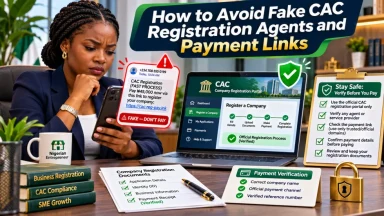
Check which business structure and registration obligations apply before conducting ongoing trade. The Corporate Affairs Commission's official business-name guidance lists a name-availability check, an online pre-registration application, required documents and payment of the applicable filing fee. CAC says individuals can register a business name themselves without necessarily hiring a professional intermediary. Its official registration portal contains current procedures.
Do not treat the ₦50,000 operating example as inclusive of official government costs, or assume a business name automatically provides limited-liability company protection. The appropriate structure depends on risk, ownership and the nature of the work. For exact registration requirements and fees, see FlyingEze's CAC registration guide and its guide to official CAC fees .
Income tax applies based on the legal and tax circumstances
Online earnings are not automatically tax-free because a client pays through an app or from abroad. The Federal Ministry of Information's June 2026 tax transition guidance confirms the new Nigeria Tax Act framework applying from January 2026, while the Joint Revenue Board has published its 2026 personal-income-tax guidance. Where applicable, self-employed individuals should maintain income and expense records and prepare required returns; specific obligations depend on their status and the relevant tax authority. Consult an appropriately qualified tax adviser for complex transactions.
For a practical starting point, FlyingEze explains how freelancers organise income and expenses for 2026 tax filing .
Protect your customers' information
When handling names, phone numbers, addresses, login details, customer lists or employee records, collect only what is necessary, use appropriate access controls, store information securely and agree how it may be used. The Nigeria Data Protection Commission emphasises lawful processing and privacy in entrepreneurship. Requirements can vary with your activities and the role you play as a data controller or processor.
For additional steps, read FlyingEze's data-protection checklist for Nigerian small businesses . Do not share client spreadsheets in public folders or upload confidential records into AI tools without appropriate authority, security checks and contractual permission.
Step 9: Find your first clients without spam or fabricated testimonials
Use a simple acquisition system. Pick a specific customer category, observe a real problem, share a tailored example of the improvement you can deliver, and ask whether the person would like a short conversation. Keep your message useful and brief. A restaurant that posts photos without clear pricing or menu design may appreciate a sample graphic; a consultant using an outdated website may value a clear maintenance proposal.
A first-contact message might say: “I noticed your updated menu is difficult to read on a phone. I create mobile-friendly menu graphics for small restaurants. Would you be open to seeing one sample and a fixed-price quote?” Do not claim an existing client relationship, invent sales results or impersonate a partner.
Track enquiries, proposals, accepted jobs, revenue, actual working hours and referrals. Ask satisfied clients whether they will give truthful feedback or introduce someone who faces a similar problem. Do not buy fake reviews or mass-message scraped contacts.
A realistic 30-day launch plan
| Period | Actions | Evidence of progress |
|---|---|---|
| Days 1–7 | Choose one service, define buyer, verify professional and registration obligations, research problems | One clear offer and a small qualified prospect list |
| Days 8–14 | Build two labelled samples, write package scope, estimate costs and create a basic profile | Portfolio, price workpaper and delivery checklist |
| Days 15–21 | Contact suitable prospects personally, discuss needs, issue tailored proposals | Responses, conversations and properly documented quotations |
| Days 22–30 | Deliver any accepted project, seek feedback, reconcile payments, refine the offer | Customer feedback and a measured sales pipeline, whether or not a sale occurred |
Thirty days is a testing period, not a guaranteed deadline for making money. If no one buys, identify why: wrong customer group, unclear deliverable, insufficient proof, unsuitable price or lack of demand. Improve one factor at a time rather than repeatedly purchasing expensive courses and software.
Know when the small business is becoming sustainable
Review four numbers every month: qualified enquiries, proposals accepted, contribution after direct costs and total hours worked. Then assess how much remains after recurring business overhead and applicable tax. A business with three regular clients can be healthier than a business with hundreds of social followers and no paying customers.
Do not hire staff, take out a loan or buy a large software subscription solely because the first sale went well. Build a basic cash buffer, document the process and check that your average project is profitable after the time spent finding and serving customers. If you start receiving repeat enquiries for the same task, consider a recurring package with clear service limits.
Common mistakes to avoid
- Offering everything: a scattered menu of services makes it difficult to communicate your value and estimate delivery.
- Buying tools before finding demand: expensive subscriptions do not create buyers.
- Underpricing: a quoted fee must cover both delivery and the often-invisible cost of finding the customer.
- Starting without an agreement: unclear work scope can turn one job into unlimited revisions.
- Ignoring records and compliance: contracts, invoices, tax evidence and responsible data handling matter even at small scale.
- Trusting quick-money schemes: be sceptical of supposed clients or job platforms demanding that you deposit money before receiving pay.
The US Federal Trade Commission warns that fake online jobs can show invented earnings and demand deposits to unlock them. Such tactics can appear on WhatsApp and Telegram regardless of the country involved. If an unfamiliar contact requests a payment to release a commission, stop and verify independently.
Frequently asked questions
Can I start an online service business in Nigeria with ₦50,000?
It may be possible to fund a limited first-month operating test with that amount if you already have the necessary skill and device. The example budget excludes CAC registration, regulated licences, equipment purchases and other potentially mandatory costs. Your actual lawful startup costs may therefore exceed ₦50,000.
Which online service business is best for a beginner?
The best starting offer is one you can deliver competently, that solves a specific buyer problem and that can be tested at modest cost. Examples include design, tutoring, administrative support and basic spreadsheet organisation. Do not advertise expertise you lack.
Do I need a website to find my first customer?
Not always. A professional portfolio, a reliable contact channel and a few demonstrated samples can establish the offer. A website becomes useful when it supports trust, discoverability and a proven sales process.
Should a customer pay before I begin?
It depends on the agreement and platform. A sensible deposit, funded milestone or clear staged payment schedule can reduce exposure, but it must be documented and consistent with the service and the client's rights.
How do I know my service price is profitable?
Deduct direct expenses, transaction fees, shared overhead and applicable taxes from revenue, and calculate the real hours spent on selling, delivery and revisions. Do not treat the entire amount deposited as profit.
Can I run the business for foreign clients?
Potentially, but first verify the client's identity, the legal scope of the assignment, payout eligibility, fees, currency-conversion costs, privacy obligations and the terms governing intellectual property.
The bottom line
Starting an online service business in Nigeria with a small budget works best when you start narrow, verifiable and financially disciplined. Choose one service you can actually deliver, talk to real buyers before paying for extras, show honest samples, use written agreements and track each payment and expense. Budget separately for all registration, tax, licensing and privacy obligations relevant to your situation.
Getting your first paying client may take longer than a month. The practical goal is not overnight wealth: it is to build a repeatable service that someone values enough to pay for—and improve it using evidence rather than hype.
Editorial note: Verified against official Nigerian and provider materials on 16 November 2026. The ₦50,000 budget, ₦60,000 price and all business outcomes are hypothetical examples, not government fee quotations, market averages or earnings guarantees. This is general business information, not individual legal or tax advice.