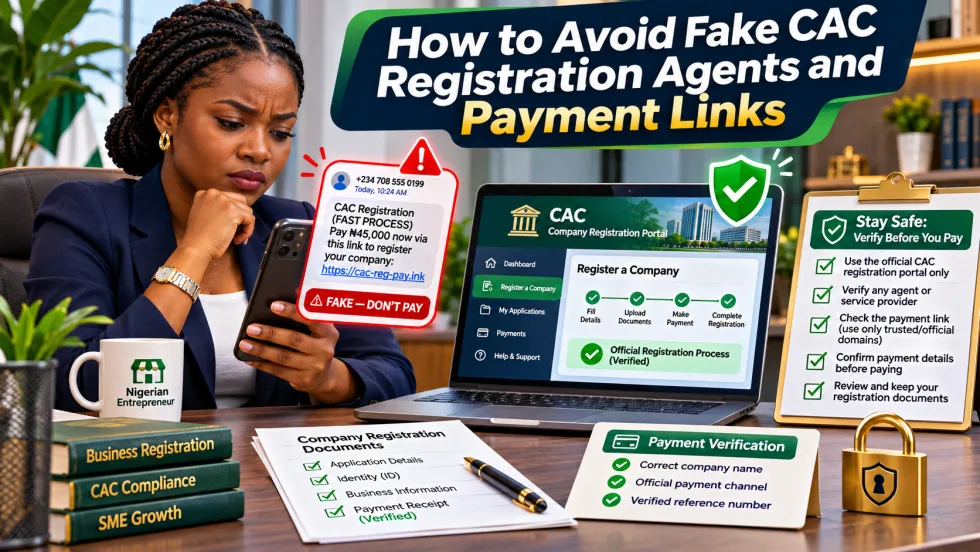
To avoid fake CAC registration agents and payment links, start from the Corporate Affairs Commission's official website or iCRP portal, confirm who is handling your application, and pay only through the legitimate payment flow for your own filing. Do not rely on a WhatsApp logo, a forwarded Remita link, a claimed “CAC agent number” or a promise of guaranteed approval. If you are applying for Free CAC Registration, also verify the programme directly with SMEDAN before submitting identity documents or transferring money.
Registration scams can target people who have never applied, entrepreneurs waiting for CAC approval, and business owners who have already hired professional help. A message may claim that a name is about to expire, a certificate is awaiting release, or a free registration slot will be cancelled unless you pay a “processing” or “activation” fee. These are illustrative scam patterns, not evidence that any particular person or organisation is committing fraud.
This practical guide explains how the real CAC portal works, what legitimate agents can and cannot promise, how to inspect a payment request, how to verify a certificate, and what to do if you have already shared credentials or sent money. It draws on CAC, SMEDAN, Nigeria's computer emergency response team (ngCERT) and the Economic and Financial Crimes Commission (EFCC). Research checked: 16 November 2026.
Quick answer: seven checks before paying anyone for CAC registration
- Start from a known official domain: cac.gov.ng or the CAC registration portal at icrp.cac.gov.ng ; do not begin with a payment link inside a stranger's message.
- Identify the actual filing: Business name, limited company, name reservation, annual return and certified extract are different CAC services with different charges.
- Confirm the agent: Ask for the professional's full identity, firm, accreditation details, scope of work and fee breakdown; confirm concerns independently with CAC.
- Check the real assessment: The charge must match the service and the authenticated portal's payment instructions, not a screenshot or verbal quote alone.
- Inspect the payer and destination: Remita can be part of CAC's legitimate payment process, but a genuine-looking Remita reference or payment page does not prove that the bill is for your application.
- Protect accounts and identification: Do not hand over portal passwords, OTPs or banking PINs. Upload ID, photograph and signature only through a legitimate, authorised process.
- Verify the final result: An application receipt, name reservation or agent-generated certificate image is not the same as an approved CAC filing and verifiable registration record.
The official CAC iCRP FAQ describes name reservation, an Approval Validation (AV) code, Remita payment, the later registration filing and dashboard statuses. Those steps offer an independent way to test claims made by a third party.
What counts as a fake CAC registration agent or payment-link scam?
An agent scam typically involves somebody misrepresenting their identity, authority, fees or the status of a registration to obtain payment or personal information. A payment-link scam may use a lookalike website, a misdirected invoice, a fraudulent bank account or a social-engineering message designed to make an applicant complete an unauthorised transaction.
Nigeria's ngCERT phishing advisory warns that attackers imitate reputable organisations through email, SMS, WhatsApp and social networks to steal personal information and money. Its 27 August 2026 advisory also discusses impersonation, fake payment-detail changes, phishing and other social-engineering tactics.
Not every paid registration service is dishonest. Accredited practitioners and service providers can assist clients with filings, and professional help may be sensible for complex structures. The risk arises when the provider is unverified, the transaction is misrepresented or you lose control of your account and original records.
1. Know the real CAC registration route before speaking to an agent
For an ordinary Nigerian business name, CAC says an individual proprietor can complete registration without hiring a lawyer, chartered accountant or chartered secretary. Its business-name page links users to the official registration portal and sets out name availability, online documents and the filing fee.
The current iCRP process starts with an account and name reservation. Successful name reservation generates an AV code. The applicant uses this for a business registration, enters business and proprietor information, uploads a means of identification, passport photograph and signature, reviews the application, and follows the portal's payment instructions. CAC's FAQ identifies Remita as the payment processor used in those steps.
An applicant should then be able to see the filing in the relevant CAC dashboard and distinguish Pending, Queried and Approved statuses. Approved business-name filings have a certificate and status report available for download. A genuine agent may help with those steps, but a verbal assurance that “CAC has approved it” is not a substitute for an official result.
For a complete tutorial rather than fraud-prevention advice, FlyingEze's CAC registration guide covers the standard process in more detail.
2. Check whether the agent is real—and what the agent is authorised to do
CAC's portal has a separate accredited-agent account registration route . This confirms that CAC recognises an accreditation category. It does not mean every person displaying a CAC logo on social media is accredited, nor does an agent's normal business-name registration automatically establish professional accreditation.
Before granting access or paying, request the following:
- The person's full professional name and the registered firm or business they represent.
- The claimed CAC accreditation or professional identification details and any verifiable professional-body membership.
- A business address and independent contact details that you can verify outside the person's WhatsApp conversation.
- An itemised quotation separating statutory CAC fees, payment or document costs, and the agent's own fee.
- A written scope: which entity is being registered, who owns the account, who can access documents, and how you will receive the final official records.
Important limitation: A public list of every currently accredited agent was not established from the official sources reviewed for this article. Do not assume a screenshot, a supposed accreditation number or access to an account-creation page proves current approval. Where uncertain, ask CAC through its independent help and complaint channels whether and how the claim can be verified.
Even if an agent is genuine, never assume that agent can waive statutory fees, bypass CAC eligibility rules or guarantee the approval of a restricted business name. A legitimate service agreement should preserve your control over your identity, account and records.
3. Watch for copied CAC websites, fake support accounts and altered addresses
The address that appears in a message may look almost identical to the correct one. Attackers can add extra words, move the apparent brand into a subdomain of an unrelated site, use URL shorteners or send a search-advertisement link that takes you somewhere other than CAC.
For example, the legitimate host icrp.cac.gov.ng is different from a hypothetical unrelated host written to look like it belongs to CAC. The words “CAC”, “official” or “gov” appearing somewhere in a long address do not establish ownership. A lock icon or HTTPS encryption does not prove that the business behind a website is honest.
A practical verification routine:
- Open a fresh browser tab and manually enter cac.gov.ng or icrp.cac.gov.ng .
- Use the website's own navigation to reach the required service. For a SMEDAN initiative, start at smedan.gov.ng .
- Compare the host in the browser address bar, not just a preview card or screenshot.
- Do not enter your login credentials after being forwarded to a page you cannot independently verify.
- Do not download unsolicited “CAC registration forms”, apps or document viewers simply because a message says they are required.
ngCERT has warned that fraudulent sites and messages can imitate trusted organisations and prompt users to disclose details or download harmful content. If a link came unexpectedly, reaching the service by independent navigation is safer than trusting the link itself.
4. Do not confuse a genuine Remita transaction with a legitimate CAC bill
Remita is part of the workflow described in CAC's official iCRP documentation. That is why a fake-agent message containing a Remita reference can appear plausible. However, a payment reference—commonly called an RRR, or Remita Retrieval Reference—should not be treated as proof that the underlying bill is correctly linked to your application.
Follow the actual assessment created through the authenticated CAC process. Check the service, amount, payer information and beneficiary or bill details shown during the payment process. If the bill was generated by an agent, independently confirm that the assessment corresponds to your own registration and agreed scope.
| Payment situation | How to respond |
|---|---|
| CAC dashboard initiates payment and directs you to its supported checkout | Review the application details and complete payment through the verified flow |
| Unknown person sends a Remita reference claiming “urgent certificate release” | Do not pay based on the reference alone; check your CAC dashboard and verify with CAC |
| Agent requests an agreed professional service fee | Verify the provider and obtain a written invoice; distinguish this from statutory fees |
| Sender demands a personal transfer to “unlock a free slot” | Treat the claim as high risk; verify the actual programme and do not transfer money for guaranteed selection |
| Your card or bank account was debited but CAC still shows unpaid | Keep transaction evidence and ask the authorised payment provider or CAC for reconciliation before paying twice |
CAC's official refund policy not guarantee reimbursement for money voluntarily sent to an unrelated scammer. In the latter case, contact your bank or payment provider immediately and report the suspected fraud.
5. Know the ordinary CAC fee so a fabricated charge stands out
The Federal Government's CAC fee schedule published on 29 May 2025 lists ₦1,000 for ordinary business-name reservation and ₦20,000 for registration and listed certified documents: a ₦21,000 base before applicable extras. It separately lists ₦5,000 for restricted-word name reservation. Fees for companies, partnerships, incorporated trustees and later services differ.
This number is a reference point—not a rule that every legitimate CAC-related invoice must equal ₦21,000. An agent's separately agreed professional fee, special approvals, other entity types or payment charges may affect the overall total. Ask which items each charge covers, and compare them with the official schedule and authenticated portal.
A claimed “registration fee” that changes whenever you question it, or an unexplained charge to activate an already-approved certificate, is a reason to pause. Avoid using an old receipt or blog post as final evidence of today's amount. FlyingEze's official CAC-fee breakdown
6. Be especially careful with fake “Free CAC Registration” offers
The SMEDAN–CAC free-registration initiative is genuine. SMEDAN's official 27 September 2025 announcement 250,000 qualifying MSMEs. The announcement does not mean every business can register free or that every service provided by CAC is covered.
A scammer may borrow that genuine programme's language to promise “confirmed selection” after paying a token fee. Another may copy the SMEDAN account-creation page or falsely claim that an agent controls the remaining slots. A real programme can be misused in a fraudulent pitch.
- A SMEDAN account or profile is not a CAC business-name registration certificate.
- An application or acknowledgement does not guarantee selection among the programme's intended beneficiaries.
- Claims about remaining places or the current deadline must be checked in official notices.
- The scheme is not established as a blanket free-incorporation offer for limited liability companies.
- Do not pay a stranger for a supposedly reserved waiver slot without independent confirmation from SMEDAN or CAC.
As of the 16 November 2026 research check, publicly accessible information did not independently establish how many of the announced places remained available. Free-registration applicants should therefore avoid treating a forwarded deadline or “last ten slots” message as authoritative.
7. Protect your NIN, signature, passport photograph and account access
Business-name registration legitimately requires identity-related documents. CAC's current iCRP FAQ specifies means of identification, passport photograph and signature image for each proprietor. That necessity makes document-harvesting scams particularly dangerous: the same items used to complete a legitimate filing can be misused by someone collecting them dishonestly.
Where possible, upload documents through your own verified CAC account. If a professional must handle a filing on your behalf, make sure the arrangement is clear, use the minimum information necessary, and confirm how records will be stored, accessed and returned. Do not send original identity documents to unknown social accounts merely because they promise faster processing.
Never share CAC account passwords, one-time verification codes, bank passwords, banking PINs or the credentials to the email account used for registration. Enable available multi-factor authentication and use a unique password. If an agent insists on receiving an OTP to “confirm your free slot”, stop and independently verify the request.
If a document must be shared with a verified professional, consider secure channels and an explicit purpose limitation. Do not publicly watermark or alter required identification in a way that makes the official upload invalid; ask the recipient or authority what formats they accept.
8. Recognise the difference between a reservation, an approval and a real certificate
Fraudulent sellers may forward an impressive “CAC certificate” image before any actual filing is approved. Others provide an AV code for a name reservation and claim the entire business is registered. In the legitimate workflow these are different milestones.
CAC's FAQ describes an AV code issued after name reservation. That code enables a separate registration stage. The final application can show Pending, Queried or Approved, and CAC makes the certificate and status report available following approval.
Use the official CAC public search
For more verification detail, FlyingEze's guide to checking CAC records
Common scam messages: what they imply and how to respond
The examples below are fictional warning scenarios, not quotations from identified offenders. They illustrate how legitimate registration terminology can be used to create pressure.
| Illustrative message | Why it is suspicious | Safer response |
|---|---|---|
| “I work at CAC. Transfer ₦7,500 to activate your free SMEDAN slot within 30 minutes.” | Unverified staff identity, urgency, and a fee for a purported waiver | Do not pay; check SMEDAN and CAC through official channels |
| “Your business name is approved. Click here and send your OTP to release the certificate.” | Credential harvesting disguised as registration support | Check approval inside your own iCRP account; do not share OTPs |
| “Pay this RRR I generated. It is linked to your application, trust me.” | The bill's payer and service may not correspond to your filing | Independently review the correct portal assessment |
| “I have an accredited CAC ID; send your portal password and BVN.” | Unnecessary credential and financial-data collection | Verify identity, decline password disclosure and use a controlled process |
| “Use this new CAC website because the official portal is down.” | Potential lookalike domain and manufactured outage story | Navigate independently from the known CAC website |
Not every unexpected message is necessarily fraudulent, but these patterns justify stopping the transaction until you can independently confirm the sender, service and payment request.
What to do if you clicked a fake CAC link but have not paid
First, stop interacting with the suspicious page. Do not enter a password or submit more identity information. If you downloaded an unfamiliar file, avoid opening it and use your device's trusted security tools. Do not forward a dangerous link to friends as a warning without clearly advising them not to click it.
If you entered your CAC or email password, go to the authentic site using a fresh browser tab and a trusted device or connection. Change the exposed password, end other sessions if supported, enable available multi-factor authentication, and change any other accounts where that password was reused. Check whether any contact email or account-recovery settings were changed.
If you entered card or banking credentials, contact the bank through its official app, telephone number or branch immediately. Follow its instructions on protecting the account, blocking cards or securing transactions. You do not need to wait for money to disappear before treating exposed financial credentials as urgent.
ngCERT's 2026 credential-security advisory
What to do if you already paid a fake CAC agent or payment link
Act promptly, preserve evidence and use independently verified channels. A bank or payment provider may be able to investigate a transfer or payment, but recovery is not guaranteed and depends on the transaction, timing and applicable rules.
- Contact your bank or payment provider immediately. Explain that you suspect a fraudulent transfer or payment and request the official fraud-dispute process, including any available attempt to recall or trace funds.
- Preserve the evidence. Save the original message, sender's phone number or profile, full URL, transaction time, amount, bank details or RRR, bank alert, account details, email headers if available, and screenshots of the interaction.
- Secure the related accounts. Change compromised passwords, activate two-factor authentication and warn the bank if financial information or identity documents were exposed.
- Notify CAC through its official help desk. Explain whether any actual CAC application or portal account may have been affected. Ask for guidance about correcting records or reporting suspicious payment instructions.
- Report suspected fraud to law enforcement. The EFCC's public phishing warning +234 809 332 2644 and info@efcc.gov.ng. Reconfirm details on the official EFCC website before using them.
- Report suspicious digital activity. ngCERT encourages reporting phishing attempts through its official channels, which can help identify malicious pages or campaigns.
Do not pay a second person offering a guaranteed “fraud recovery” or “CAC refund activation” service. That may be a second scam targeting the same victim. If the money was actually paid to CAC through a genuine transaction, its refund policy
Official contact points for CAC registration and payment problems
- Official registration portal: icrp.cac.gov.ng
- Complaint form: icrp.cac.gov.ng/support/help/
- Customer service telephone: 07080629000 (international format +234 708 062 9000)
- Helpdesk email: helpdesk@cac.gov.ng
- Customer service email: cservice@cac.gov.ng
- Official office: Plot 420, Tigris Crescent, off Aguiyi Ironsi Street, Maitama, Abuja
These details were checked from CAC's current portal on 16 November 2026. For the free-registration initiative, independently navigate to smedan.gov.ng and any verified instructions on its official MSME platform .
If you send a complaint, explain the problem precisely and include relevant references. Do not include bank passwords, OTPs or sensitive credentials in a support email. Where identification is requested, ask for an approved secure submission method.
A safer way to work with a genuine professional agent
Many founders legitimately choose professional help because they want advice on business structure, shareholding, restricted names or other complex issues. Safety is not necessarily about avoiding all agents; it is about maintaining a transparent, accountable relationship.
Agree in writing on the service and price. Keep copies of the filed information. Where possible, use a portal account you control, or obtain clear arrangements for agent access and handover. Confirm that the registered details accurately identify the business and its owners. Preserve receipts and request official approval documents directly from the actual system.
A genuine professional should be willing to answer basic questions about what is being filed, how statutory charges differ from their own fee, why identity documents are required, and how the completed records can be verified. A refusal to provide any verifiable details or pressure to disclose account credentials is a strong reason to stop.
After registration, business owners should still track filings and other obligations. FlyingEze's post-CAC registration checklist
Frequently asked questions
How do I know whether a CAC registration agent is genuine?
Ask for the person's identity, firm details, accreditation or professional membership claims, a written scope and fee breakdown. Do not assume that a logo or a displayed ID proves accreditation. Independently contact CAC if you cannot verify the claim or if the agent requests unusual access.
Can I register my CAC business name without an agent?
Yes. CAC's official business-name guidance says individual proprietors can use the registration portal without hiring a lawyer, chartered accountant or chartered secretary. Professional help remains an option when useful, but it is not a universal requirement.
Is it safe to pay CAC registration fees through a Remita link?
CAC's iCRP uses Remita for relevant payment steps. The safest approach is to initiate the payment inside the verified CAC workflow and check the bill's details. A Remita reference forwarded by an unknown person does not by itself prove that the payment belongs to your registration.
Can a fake CAC agent generate a real Remita reference?
A payment reference identifies a transaction or bill; it does not inherently prove the sender's authority or that it is for your intended service. Always review the actual assessment and payer information independently before paying.
What is the official CAC website in Nigeria?
CAC's main website is cac.gov.ng and its official Company Registration Portal is icrp.cac.gov.ng . For CAC's genuine SMEDAN-backed free-registration scheme, begin at smedan.gov.ng .
Is Free CAC Registration actually available?
SMEDAN and CAC announced a scheme intended to provide free business registration for up to 250,000 qualifying MSMEs. It is not a universal waiver of all CAC fees, and submitting a SMEDAN profile is not the same as being selected or receiving a CAC certificate. Check current availability through the official agencies.
Should I send my NIN, passport photograph and signature to a CAC agent?
These items may be needed for legitimate registration, but only send them through a verified, secure and authorised arrangement. Never hand over your CAC or email password, OTP or banking PIN. Use your own official account where practical.
How can I tell whether a CAC certificate is authentic?
Check the registered name and number against CAC's official public-search or other authorised registry processes, and obtain the actual certificate or status report after approval. A screenshot, reserved-name code or SMS from an agent is not sufficient proof by itself.
Will CAC refund money I sent to a fake agent?
CAC's refund policy applies to qualifying payments made through its own system. It does not promise reimbursement of transfers sent to an unrelated fraudster. Contact the bank or payment provider promptly, preserve proof, and report the suspected crime.
What should I do if I clicked a fake CAC payment link?
Stop using the page. If you entered credentials, change them from the genuine website, enable available account protections and contact your bank immediately if financial information was supplied. Report the suspicious link through verified CAC or cybersecurity channels.
Can an agent guarantee that CAC will approve my business name?
No agent can legitimately guarantee that CAC will approve every proposed name or application regardless of the rules. An available name, complete filing and properly processed payment still require the relevant approval process.
Final safety checklist before you submit or pay
- I reached CAC or SMEDAN through an independently verified official domain.
- I understand exactly which entity and service I am applying for.
- I have verified the agent's identity and clarified the professional fee separately from statutory charges.
- I reviewed the payment assessment inside the legitimate process.
- I did not disclose any portal password, OTP or banking PIN.
- I am not paying for a guaranteed “free registration” slot.
- I have retained transaction records and can track my own filing.
- I know that a name reservation is not the same as a completed registration.
- I will verify the certificate and official CAC record once approved.
Conclusion: verify the person, the process and the payment
Fake CAC registration offers exploit a real need: Nigerian entrepreneurs want to formalise businesses without wasting time or money. The official tools to protect yourself are straightforward—CAC's own website, the authenticated iCRP workflow, verifiable registration records and independently confirmed support channels.
If you want Free CAC Registration, verify the SMEDAN–CAC programme before sharing documents or paying anyone. If you use a professional, verify their authority and keep statutory fees separate from service charges. If you see a suspicious payment link or have already paid, act promptly through your bank, CAC and appropriate fraud-reporting channels.
The safest registration is one you can independently trace from a legitimate application to an authentic CAC approval—not one that depends on a stranger's urgent payment request.