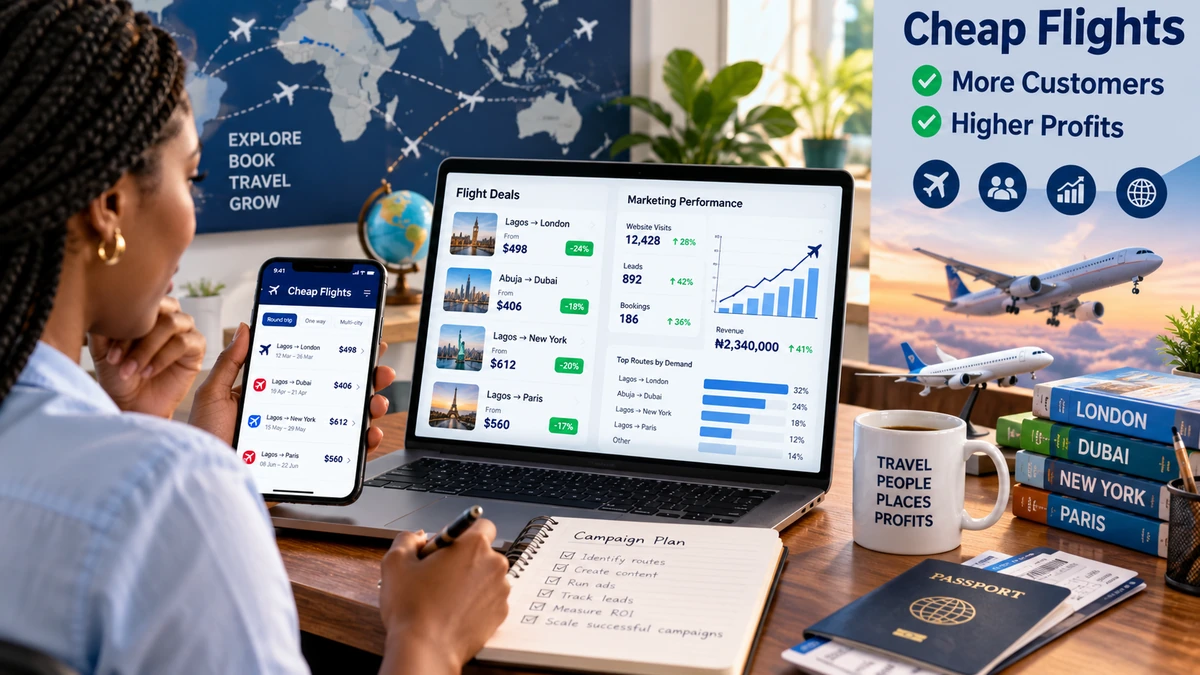
A cheap flight can attract attention, but it does not automatically create a profitable sale for a travel agency, tour operator or independent trip planner. A fare may disappear before a customer books; another may produce a tiny referral payment while generating hours of customer-service work. Small businesses need a way to identify offers that customers can actually buy and that make commercial sense.
The opportunity is to use cheap flights as a starting point for helpful, measurable services: itinerary research, transparent booking assistance, group travel, accommodation coordination or clearly disclosed referrals. The competitive advantage comes from data-driven planning, not claims of secret fares or guaranteed savings.
Here is a practical approach for travel businesses in Nigeria, elsewhere in Africa and international markets, with examples that distinguish verified platform capabilities from illustrative business calculations.
1. Choose a legal, workable revenue model first
Before advertising, decide what the business will sell. Models include a separately disclosed planning or ticketing service fee, authorised airline or consolidator remuneration, commissions on eligible hotel or tour bookings, and referral payments from approved affiliate programmes. Some firms combine these, but each income stream has different contracts, responsibilities and refund exposure.
Do not assume an airline pays commission on every ticket. The International Air Transport Association's travel-agent accreditation guidance explains how accredited agents access ticketing and airline relationships. IATA's New Distribution Capability describes a standard for distributing airline offers; it is not a free public licence to issue tickets or scrape any airline website.
A small business without ticketing authority can investigate legitimate referral agreements or work with an authorised ticketing partner. Verify local licensing, tax, payment and consumer obligations before selling tickets or holding customers' money.
2. Track routes people will realistically purchase
A promotion is valuable when it matches a genuine customer need. A Nigerian agency might track Lagos–London family visits, Abuja–Dubai trips, regional business travel or student journeys based on its actual enquiries. A firm based elsewhere should build its own list rather than copying trending routes from foreign markets.
Create a simple demand sheet: origin and destination, one-way or return, normal booking lead time, typical party size, luggage needs, travel dates, budget and whether the customer requires direct flights. Separate leisure, business, student and family segments where their needs differ.
Google Flights supports price tracking for routes, flights, chosen dates and eligible flexible-date searches. Those alerts are useful for manual research, not proof of live inventory or permission to republish Google's content automatically. Use authorised supplier feeds and contractual tools if building a commercial fare-monitoring system.
3. Verify promotions before sharing them
Airfares move as seats sell and offers expire. For every candidate deal, check the operating airline, route, departure and return dates, booking deadline, final price including mandatory charges, booking currency, baggage allowance, connection rules and actual checkout availability.
Record the date and time of the check and the supplier that verified it. Where a quote depends on the customer's circumstances, use wording such as “Fare checked at 10:00 WAT; subject to availability” rather than promising the price will remain available all day.
In the United States, DOT airfare advertising rules require displayed airfare prices to include mandatory taxes and surcharges. The UK's Advertising Standards Authority guidance similarly warns against misleading prices and unsupported savings claims. Determine the rules applicable to the market being advertised; do not treat these as interchangeable global laws.
4. Rank deals by value, not percentage discounts alone
Consider three factors when deciding which flights merit promotion: customer value, booking likelihood and business contribution. A large advertised discount may be unsuitable if luggage costs are high or a self-transfer creates an immigration problem.
| Decision factor | What to check | Why it matters |
|---|---|---|
| Customer fit | Departure city, total travel hours, visas, bags, arrival time | Determines whether a traveller can use the offer |
| Fare quality | Verified total price, schedule, seller and change conditions | Reduces misleading or unbookable promotions |
| Commercial value | Contracted commission or fee minus servicing and marketing costs | Shows whether the campaign can contribute profit |
| Operational risk | Separate tickets, refunds, payment disputes and delayed reissues | Protects small teams from expensive exceptions |
Google Flights' Best versus Cheapest distinction illustrates why the lowest headline fare can involve more stops, airport changes or self-transfers. An agency should evaluate those trade-offs before calling an itinerary a bargain.
5. Build useful campaigns for particular travel needs
Broad social posts saying “cheap international flights available” rarely answer the customer's questions. More useful campaigns are specific: a family-friendly route guide with baggage information, a flexible-date comparison for students or a business-travel package showing meeting-friendly arrival times.
Publish an honest landing page with the offer's date range, typical journey duration, what is included, the source or booking channel, service charges, available assistance and a clear next action. Never invent a fare to collect leads.
Educational content can attract search traffic over time. For example, a detailed guide to using AI to research cheap flights may help readers discover tools, while a travel business can offer human assistance with complex ticket and documentation questions.
6. Measure leads, bookings and actual contribution
Clicks and likes show interest, not commercial success. Connect each campaign to a meaningful outcome such as a qualified enquiry, a paid planning appointment, a confirmed ticket issued by an authorised seller or a verified affiliate conversion.
Google Analytics 4 recommends events including generate_lead, qualify_lead and purchase . Its UTM guidance supports consistent campaign tags for identifying social, email and paid-search traffic. Use an enquiry or order identifier to reconcile approved bookings with advertising reports without exposing passport details in analytics URLs.
Record refunds, chargebacks, cancelled bookings and unpaid affiliate conversions. The goal is to measure realised contribution rather than an optimistic total based on enquiries that never paid.
7. Calculate whether a promotion can make money
Suppose a small agency runs a promotional test. All amounts below are hypothetical and are not market benchmarks or promised revenue.
| Illustrative measure | Result |
|---|---|
| Landing-page visits | 400 |
| Qualified leads (6% of visits) | 24 |
| Paid, completed sales (25% of leads) | 6 |
| Contribution per sale after direct fulfilment costs | ₦30,000 |
| Contribution before campaign costs | ₦180,000 |
| Advertising plus campaign operations | ₦85,000 |
| Illustrative campaign contribution | ₦95,000 |
The ₦95,000 is not net company profit: rent, payroll, taxes, disputed payments and other fixed or unexpected costs may remain. A lower conversion rate or reversed sale could erase it.
Track cost per qualified lead (campaign spend divided by qualified leads), customer acquisition cost (campaign spend divided by newly acquired paying customers) and contribution after marketing. Avoid treating the entire ticket value as agency revenue when most of it belongs to the airline or supplier.
8. Test promotion channels instead of broadcasting everywhere
A small team can start with two manageable channels. Search content captures customers already researching a route; an opt-in email newsletter or relevant social community can reach travellers who are still deciding.
For each channel, create distinct tagged links and test specific offers. Compare the number of qualified enquiries, response time, issued bookings and costs. Do not run every possible creative variation at once; changes become harder to interpret when budget and sample sizes are small.
A practical test compares two clear messages—for example, “lower fare, one connection” against “more convenient itinerary with checked baggage”—using genuinely comparable inventory. The winning campaign is the one that produces better verified business outcomes, not necessarily more clicks.
9. Earn trust through transparent partnerships
Travel influencers, local student advisers, hotels and conference organisers can bring relevant audiences. Define whether partners are paid for a booking, a qualified referral or content production, and ensure the contract permits the promotional claims made.
The US Federal Trade Commission's endorsement guidance says material affiliate relationships should be disclosed clearly and near the recommendation. A useful disclosure is: “We may earn a commission when you book through this link.” A vague “affiliate link” label may not adequately explain the financial relationship.
If content is sponsored, identify it. Do not claim airline partnerships, special ticketing authority or exclusive discounts without an agreement that supports those statements.
10. Respect customer data and avoid fake urgency
A travel-enquiry form can capture intended route, travel dates, number of passengers and preferred contact method. At the early marketing stage, avoid collecting passport scans, identity documents or payment-card details unnecessarily.
Use permission-based messaging and provide an easy unsubscribe method. Rules depend on location: the UK Information Commissioner's Office explains when marketing emails and texts need consent or qualify for an exception. Nigerian operators should evaluate obligations under Nigeria's data-protection framework and obtain jurisdiction-specific advice where needed.
Do not purchase questionable passenger lists, imply that you know someone's private flight itinerary or use fabricated countdown timers. The FTC's 2026 travel-scam warning describes fraudulent deals and impersonation of airlines or travel businesses. Trust is an economic asset: one deceptive promotion can damage repeat business.
11. Run a measured 30-day pilot
| Period | Action | Evidence to collect |
|---|---|---|
| Days 1–7 | Define legal revenue model, shortlist routes, verify suppliers and set up tracking | Supplier terms, fare-check log, baseline costs |
| Days 8–21 | Publish two route-specific campaigns and respond promptly to enquiries | Leads, quoted fares, booking outcomes, support time |
| Days 22–30 | Reconcile paid bookings and reversed transactions; refine or stop weak campaigns | Net realised income, advertising spend, contribution |
Review each test honestly. If a campaign drives attention but little confirmed revenue, improve the offer or audience before increasing advertising spend. If a small route segment produces repeat customers with manageable support requirements, consider a cautious expansion.
Frequently asked questions
Can a small travel business earn money from cheap-flight promotions without issuing tickets?
Potentially. It can explore lawful service fees, approved affiliate programmes or agreements with authorised ticketing partners. Income depends on contracts, eligible transactions and local regulatory requirements.
What flight-price data is safe for an agency to use?
Use publicly displayed information for ordinary manual research, verify actual supplier checkout offers and obtain permission for automated feeds or commercial redistribution. Public visibility does not automatically authorise scraping or resale.
Which performance number matters most?
Realised contribution after direct servicing, commissions and campaign spend is more informative than impressions or gross airline ticket value. Also monitor qualified lead and customer acquisition costs.
Should agencies promote every fare drop?
No. Promote offers that are genuinely available, suited to the audience, transparently priced and worth the business's delivery costs and reputational risk.
Conclusion
Cheap-flight promotions can support a sustainable small travel business, but only when the operation is built around verified fares, relevant customers and a clear revenue model. The best campaigns connect practical travel advice with trustworthy sellers, transparent pricing and efficient customer service.
Start with a few well-understood routes, measure completed sales rather than clicks and expand only when the figures justify it. In travel retail, reliability and positive contribution matter more than viral discount posts.
Research verified 28 October 2026. Flight prices, affiliate programmes, agency accreditation rules and advertising laws change. Obtain current supplier terms and jurisdiction-specific advice before launching a commercial campaign.