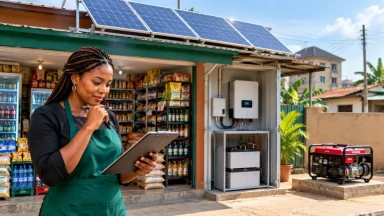
For a small shop owner in Nigeria, reliable electricity keeps lights, fans, payment terminals, security cameras and other essential equipment working. But before buying solar panels or batteries, one question matters most: How much electricity does your shop actually need?
Choosing equipment based only on an inverter's advertised capacity can lead to costly mistakes. A shop using lighting and phone charging needs a different system from one operating freezers or air conditioners. Here is how to estimate your requirements before seeking a professional installation quotation.
1. Understand the components of a solar system
A small business solar installation usually includes solar panels that convert sunlight into DC electricity, an inverter to supply AC appliances, a battery for stored energy, and a charge controller (often built into a hybrid inverter). Wiring, mounting, earthing, isolation switches and electrical protection are also essential. See the US Department of Energy's solar PV design basics .
Watts (W) describe an appliance's power at a point in time; watt-hours (Wh) measure energy consumed over time. A 50W fan running for eight hours uses 50 × 8 = 400Wh.
2. Calculate your shop's daily electricity consumption
List each appliance, its wattage, quantity and daily operating hours. Look at manufacturer labels or use a plug-in energy meter. Multiply:
Daily electricity use (Wh) = appliance watts × number of appliances × operating hours.
Example: a small retail shop
| Appliance | Quantity | Watts each | Hours/day | Energy/day |
|---|---|---|---|---|
| LED bulbs | 6 | 10W | 8 | 480Wh |
| Standing fans | 2 | 50W | 8 | 800Wh |
| POS/router equipment | 1 | 25W | 10 | 250Wh |
| Laptop | 1 | 60W | 5 | 300Wh |
| CCTV system | 1 | 20W | 12 | 240Wh |
| Phone charging | 1 | 20W | 5 | 100Wh |
| Total | 2,170Wh |
The shop's illustrative daily demand is 2,170Wh ÷ 1,000 = 2.17kWh per day. Real usage can differ: a 60W laptop adapter will not necessarily draw 60W continuously, while a freezer cycles its compressor on and off. Measure variable loads when possible.
3. Calculate how many solar panels the shop needs
Solar panel labels show rated peak output in watts peak (Wp), not a guarantee of continuous generation. Output varies with solar irradiation, temperature, panel orientation, dirt and shading. The World Bank's Nigeria solar-resource maps can help assess local potential.
Peak sun hours express sunlight energy as an equivalent number of hours at 1,000W per square metre. For a preliminary example, assume four peak sun hours daily and a 75% system performance factor:
Panel capacity (Wp) = daily energy (Wh) ÷ [peak sun hours × performance factor].
2,170 ÷ (4 × 0.75) = 723Wp. Adding a 20% planning margin gives roughly 868Wp. Two 550W panels offer a nominal 1,100Wp (1.1kWp) array and extra headroom.
The sunlight figure, loss factor and margin are illustrative, not guaranteed Nigerian averages. Use local monthly data for a final design. If you instead calculate using Global Solar Atlas PVOUT figures (kWh/kWp/day), be careful not to double-count losses already included in that model.
4. Calculate battery capacity for evening and outage use
Battery sizing depends on how much electricity you need when the panels cannot supply the load. Suppose the shop requires 900Wh of AC electricity during evening hours and outages.
Allow for the battery's depth of discharge (DoD) and inverter efficiency:
Nominal battery Wh = required AC Wh ÷ (allowable DoD × inverter efficiency).
At 80% DoD and 90% inverter efficiency: 900 ÷ (0.80 × 0.90) = 1,250Wh. With an additional 20% planning margin, this becomes 1,500Wh (1.5kWh) nominal.
A compatible 2.56kWh LiFePO₄ battery may offer useful headroom, subject to its discharge-current limits, temperature range, battery management system and manufacturer specifications. A nominal 25.6V, 100Ah battery holds 25.6 × 100 ÷ 1,000 = 2.56kWh before operational losses and discharge limits.
Lithium and lead-acid batteries have different usable capacity, charging characteristics, maintenance requirements and expected cycle life. Compare usable energy rather than advertised ampere-hours alone.
5. Choose the correct inverter rating
Inverters are sized primarily for simultaneous power demand, whereas daily energy drives solar array sizing and battery-backup energy drives storage sizing.
If all appliances in the worked example operate together, running demand is approximately 60 + 100 + 25 + 60 + 20 + 20 = 285W. A suitably specified 1–1.5kW pure sine-wave inverter may be considered, but a professional must check surge ratings, future expansion, charging limits, solar input and battery compatibility.
Refrigerators, freezers, pumps and air conditioners can draw much higher starting current than running current. An advertised 1kVA rating does not automatically equal 1kW; consult the unit's real-power and power-factor specifications.
6. Worked example: a practical starting configuration
| Item | Illustrative size |
|---|---|
| Daily electricity consumption | 2.17kWh |
| Solar panels | Two 550W panels, 1.1kWp total |
| Battery | Compatible 2.56kWh LiFePO₄ |
| Inverter | Appropriately specified 1–1.5kW pure sine wave |
| Battery-backed AC energy | 900Wh for the assumed outage/evening period |
This is a preliminary sizing example, not an installation specification. It assumes four peak sun hours, a 75% solar performance factor, 80% allowable battery DoD, 90% inverter efficiency and additional planning margins. Longer outages, cloudy weather, added refrigeration and other changes may require significantly more capacity.
7. Factors that influence solar performance in Nigeria
Nigeria has substantial solar resources, but solar production changes between regions and seasons. Northern locations such as Kano may experience different irradiance patterns from Lagos, Enugu or Port Harcourt. The World Bank's country-level PV potential research explains why local conditions matter.
- Rainy-season cloud cover: lower production can delay battery charging.
- Shading: trees, tanks and surrounding buildings may cut output.
- Heat: PV module efficiency commonly decreases as cell temperatures rise.
- Dust: dirty panels receive less sunlight and need appropriate maintenance.
- Growing demand: extra refrigerators, fans or computers change the required design.
For critical loads, study the less-productive months and decide how much backup autonomy is needed instead of relying solely on annual averages.
8. Avoid common solar-sizing mistakes
- Buying the inverter first: a large inverter cannot make up for inadequate battery energy.
- Ignoring motor startup loads: compressors and pumps may need a much higher surge rating.
- Treating nominal battery capacity as entirely usable: discharge limits and losses matter.
- Ignoring battery recharging: panels must power daytime loads and replenish storage.
- Mixing incompatible equipment: check battery voltage, panel-string voltage, MPPT range and maximum currents.
- Neglecting electrical safety: protection devices, quality cabling, suitable installation conditions and commissioning are essential.
Nigeria's Nigerian Electricity Management Services Agency renewable-energy certification guidelines cover competencies for installations involving inverters, storage batteries and protective electrical equipment. Seek a competent, appropriately certified installer to finalise, test and commission the system.
9. Is solar worth it for a small Nigerian business?
Solar can reduce generator runtime, fuel purchases and electricity disruptions, but the financial case depends on installation cost, usage patterns, maintenance, battery replacements and the alternative electricity it offsets.
Solar is one element of a broader energy transition. FlyingEze previously covered investment supporting Nigeria's renewable-energy deployment . For individual shops, a well-planned hybrid setup may provide a useful balance of cost and reliability.
Frequently asked questions
How many panels do I need for a small shop in Nigeria?
It depends on the appliances, hours of use and local sunshine. For the illustrative 2.17kWh/day example, two 550W panels offer a preliminary 1.1kWp option under the assumptions above.
Can a 1kVA inverter power a small shop?
Sometimes, if it has sufficient real-power and surge ratings for the simultaneous loads. Check its specifications and appliance startup demand.
How long will a 2.56kWh lithium battery last?
At 80% depth of discharge and 90% inverter efficiency, a nominal 2.56kWh battery yields roughly 1.84kWh of AC energy. That is theoretically around 6.1 hours at a constant 300W, before additional practical variables.
Can solar panels power a shop without batteries?
Some correctly configured systems can serve daytime loads without batteries, but will not necessarily supply reliable power at night or when sunlight falls.
What size system does a shop with a freezer need?
Measure the freezer's daily energy consumption and compressor starting load, then account for required outage backup and seasonal solar production. A freezer can substantially alter the design.
Conclusion
To calculate solar panel and battery requirements for a Nigerian shop, first measure daily watt-hours, then estimate local solar output, battery-backed energy and the maximum simultaneous wattage. For the example above, a 1.1kWp array, compatible 2.56kWh lithium battery and correctly specified 1–1.5kW inverter are a starting point for professional assessment—not a universal shopping list.
The right solar system is one sized for your actual usage, budget, safety needs and backup expectations.