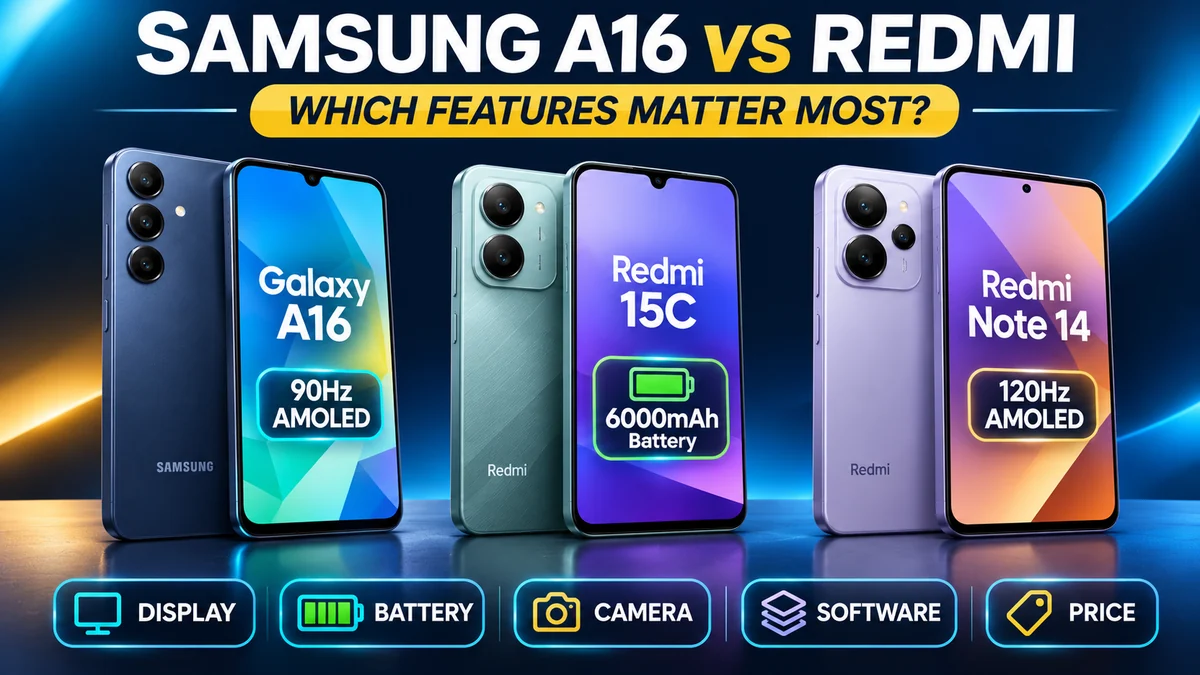
When comparing the Samsung Galaxy A16 with budget Redmi phones, the features that matter most are display quality, usable performance, battery life, camera flexibility, software support and the final price for an equivalent memory configuration. A bigger battery, more megapixels or a higher screen refresh rate can sound impressive, but none of those figures automatically makes one phone the best purchase.
For Nigerian buyers in November 2026, three useful reference points are the Samsung Galaxy A16 4G, Xiaomi Redmi 15C 4G and Xiaomi Redmi Note 14 4G. They sit around overlapping budget prices but offer noticeably different trade-offs. The Galaxy A16 favours a sharp AMOLED screen and a long published update promise. The Redmi 15C emphasises low purchase cost, a large battery and a bigger screen at lower resolution. The Redmi Note 14 moves towards a sharper 120Hz AMOLED display, stereo speakers and additional camera hardware, generally at a different RAM and price tier.
Important: The comparisons below are of 4G versions. The Samsung Galaxy A16 5G, Redmi 15C 5G and Redmi Note 14 5G are distinct devices with different hardware and often different prices; do not mix their specifications. This article is a research-based buying guide, not a hands-on laboratory test conducted by FlyingEze. We checked Samsung and Xiaomi's official product pages, attributed external testing and Nigerian retail-price tracking. Research checked 11 November 2026.
Samsung A16 vs Redmi 15C vs Redmi Note 14: specifications compared
| Feature | Samsung A16 4G | Redmi 15C 4G | Redmi Note 14 4G |
|---|---|---|---|
| Representative official model | SM-A165F | 4G version on Xiaomi Nigeria page | Standard Redmi Note 14, not Note 14 5G |
| Screen | 6.7-inch Super AMOLED, 1080 × 2340, up to 90Hz | 6.9-inch LCD, 1600 × 720, up to 120Hz | 6.67-inch AMOLED, 2400 × 1080, up to 120Hz |
| Common processor | MediaTek Helio G99 | MediaTek Helio G81-Ultra | MediaTek Helio G99-Ultra |
| Examples of physical RAM/storage | 4GB/128GB, 6GB/128GB and other market variants | 4GB/128GB, 6GB/128GB, 8GB/256GB | 6GB/128GB, 8GB/128GB, 8GB/256GB |
| Main rear camera | 50MP plus 5MP ultrawide and 2MP macro | 50MP main plus auxiliary lens | 108MP plus 2MP depth and 2MP macro |
| Selfie camera | 13MP | 8MP | 20MP |
| Typical battery | 5,000mAh | 6,000mAh | 5,500mAh |
| Maximum wired charging | 25W | 33W | 33W |
| Dust/splash rating | IP54 | IP64 | IP54 |
| microSD arrangement on cited models | Hybrid second SIM/microSD | Dedicated microSD plus two SIMs | Hybrid second SIM/microSD |
| Audio convenience | Single speaker, no standard 3.5mm jack on reviewed configuration | 3.5mm headphone jack | Dual speakers, 3.5mm headphone jack |
| Mobile network | 4G | 4G | 4G |
| Published update promise | Up to six OS generations and six years of security maintenance | Check the specific Xiaomi model's current policy | Check the specific Xiaomi model's current policy |
Sources: Samsung Africa's A16 4G specifications , Xiaomi Nigeria Redmi 15C specifications and Xiaomi Nigeria Redmi Note 14 specifications . Some features, accessories and configurations depend on region. A comparison of advertised specifications does not replace testing the exact device.
1. Display quality matters more than refresh rate alone
The Samsung A16 has a 6.7-inch Full HD+ Super AMOLED screen at up to 90Hz. The Redmi 15C has a larger 6.9-inch display running up to 120Hz but only 1600 × 720 resolution. The Redmi Note 14 combines a 6.67-inch Full HD+ AMOLED screen with up to 120Hz.
That difference can be more important than it first appears. AMOLED panels generally offer deep blacks and strong contrast. Full HD+ resolution can make text and smaller interface details look sharper than the Redmi 15C's HD+ panel. A 120Hz refresh rate can make scrolling smoother when apps support it, but it does not restore pixels that the display does not have or guarantee that the phone's processor will sustain smooth animation under load.
For someone who spends hours reading documents, handling email, browsing websites or watching videos, the Samsung A16's sharper AMOLED panel may be preferable to the cheaper Redmi 15C's larger but less detailed screen. The Redmi Note 14 offers a compelling middle ground for people who want both Full HD+ AMOLED and 120Hz. Its published peak-brightness figure should not be compared directly with an unrelated device's typical brightness, as test modes and conditions differ.
Which feature matters? Compare screen technology, resolution, visibility, size and refresh rate together, then look at the devices side by side if possible. The number “120Hz” on a box does not decide the winner.
2. Battery capacity is useful—but not a runtime guarantee
On paper, the Redmi 15C takes the battery-size lead with 6,000mAh, followed by Redmi Note 14 at 5,500mAh and Samsung A16 at 5,000mAh. Xiaomi lists 33W charging for both Redmi models, compared with Samsung's up-to-25W wired charging for the A16.
That makes the Redmi 15C interesting for users who prioritise battery capacity over screen sharpness. A person who spends long days in a market, on campus or travelling may appreciate the extra capacity. However, battery runtime depends on processor efficiency, brightness, apps, mobile-signal strength, heat, background activity and battery condition. A phone with 6,000mAh is not guaranteed to last exactly 20% longer than a 5,000mAh phone in every workload.
The charger in the box is another easily missed cost. Xiaomi Nigeria's Redmi 15C specification lists an adapter among the package contents. The Nigeria Redmi Note 14 specification lists a 33W in-box charger, while Xiaomi's Africa-wide page says that no power adapter is included. Samsung states that the Galaxy A16's compatible 25W charger is sold separately . These differences reinforce the need to check the actual sealed regional retail package before purchase.
A quoted 33W or 25W is a maximum supported charging level—not a fixed promise about the time needed for a full charge.
3. Choose a camera by the pictures you take, not its megapixel number
The Galaxy A16 offers a 50MP primary rear camera, 5MP ultrawide and 2MP macro. Redmi 15C lists a 50MP main camera with an auxiliary lens. The Redmi Note 14 lists a 108MP main, 2MP depth and 2MP macro setup on its Nigeria specification page.
The 108MP headline on the Redmi Note 14 may help capture detail under suitable conditions, but it does not automatically defeat the Samsung A16 in every scene. Image quality also depends on sensor size, processing, lens quality, focus and lighting. The Galaxy A16 offers a dedicated ultrawide camera, which the standard Redmi Note 14 4G listing lacks. That may matter more than headline megapixels for someone photographing a room, a shop interior or a large group.
Redmi Note 14 also lists a 20MP selfie camera, compared with 13MP on Samsung A16 and 8MP on Redmi 15C. Again, resolution by itself does not establish which photograph will look better. Compare actual samples taken in a similar setting or inspect full-resolution images from a reputable independent review.
Do not confuse Redmi Note 14 4G with Redmi Note 14 5G. Xiaomi's 5G specification lists a different camera arrangement, including optical stabilisation and an ultrawide camera. Copying those specifications into a 4G comparison would mislead buyers.
Which feature matters? Prioritise reliable main-camera results, the presence or absence of a useful ultrawide, selfie needs and low-light performance—not the largest number printed beside the camera.
4. Processor, physical RAM and storage affect daily responsiveness
Samsung's Galaxy A16 4G commonly uses the MediaTek Helio G99. Redmi Note 14 4G uses the Helio G99-Ultra, while Redmi 15C 4G uses the Helio G81-Ultra. These processors are not identical in capability, and more physical RAM can make a difference to multitasking.
In its Galaxy A16 4G review , Notebookcheck found generally usable budget-device performance but reported occasional stutters. Comparative benchmark compilations indicate that G99-class chips commonly have more processing headroom than the G81-Ultra; however, synthetic scores are not guaranteed real-world speeds and depend on the device and test conditions.
Xiaomi Nigeria lists Redmi 15C configurations including 4GB/128GB, 6GB/128GB and 8GB/256GB. It also advertises “memory extension”, which borrows storage space to supplement memory management. That is not the same as adding physical RAM. Redmi Note 14 Nigeria lists 6GB/128GB, 8GB/128GB and 8GB/256GB, with faster UFS 2.2 storage on the listed specification. Redmi 15C uses eMMC 5.1 on its official page.
If you frequently move between documents, browser tabs, messaging, banking and video calls, consider the available physical RAM and storage technology as well as the chip. Do not buy a low-RAM phone solely because the advertisement uses a large “extended RAM” number. For demanding mobile games, compare independently tested devices rather than assuming any of these budget models is equivalent to a gaming phone.
5. Software updates and security can be more valuable than another camera
Samsung advertises up to six generations of Android/One UI OS upgrades and six years of security maintenance for the Galaxy A16. That is a clear, published long-term support commitment. However, it belongs to the original device support cycle; a purchase in November 2026 does not start six new years from that date. Check the exact regional model and current security-maintenance schedule.
The Redmi 15C ships with Xiaomi HyperOS 2 according to Xiaomi's Nigeria page; the Redmi Note 14 uses Xiaomi HyperOS in the published specification. Xiaomi software updates and security support must be checked for each specific device and region. The official specification pages consulted here do not establish a directly comparable six-generation promise for both Redmi models, so this guide does not invent one or claim that they receive no updates.
For work, school, personal finance or banking, software support matters because security patches address vulnerabilities and updated platforms help maintain app compatibility. But the manufacturer's promise is only part of device security: keeping the phone updated, using a strong lock screen, installing legitimate apps and controlling permissions remain the owner's responsibility.
For more context on how Samsung markets its broader Galaxy A family, see FlyingEze's earlier Galaxy A-series coverage . This comparison uses current product documents for the specific models rather than applying features from a different Galaxy A phone.
6. Durability, SIM slots and audio may decide the purchase
All three have some splash and dust protection, but they are not waterproof. Samsung A16 and Redmi Note 14 are rated IP54; Redmi 15C is rated IP64. The first digit concerns solid-particle ingress, while the second concerns water protection. A higher first digit does not turn IP64 into a device suitable for underwater use. Manufacturers warn that ordinary wear and repairs can reduce the protection.
People who use two SIM cards and a microSD card have a more concrete difference to consider. Xiaomi lists dual SIM plus microSD for the Redmi 15C, whereas the cited Samsung A16 and Redmi Note 14 configurations use a hybrid second SIM/microSD slot. If you depend on two networks and need extra removable storage simultaneously, the Redmi 15C arrangement may be more convenient.
For sound, Redmi Note 14 Nigeria lists dual speakers, Dolby Atmos and a 3.5mm headphone jack. Redmi 15C also lists a 3.5mm jack, useful for wired earphones or certain audio accessories. The commonly reviewed Galaxy A16 has a single speaker and lacks a conventional 3.5mm headphone socket. Those everyday conveniences can matter more than a small advertised camera difference, particularly for students listening to lectures.
7. What do Samsung A16 and budget Redmi phones cost in Nigeria?
Current purchase value needs dated, comparable offers. A Nigerian Samsung price tracker and Xiaomi/Redmi price tracker , both reporting checks on 9 November 2026, provide these illustrative market observations for new devices:
| Phone | Memory example | Indicative listed price |
|---|---|---|
| Samsung Galaxy A16 4G | 4GB/128GB | ₦210,000–₦267,000 |
| Redmi 15C 4G | 4GB/128GB | ₦170,000–₦240,000 |
| Redmi Note 14 4G | 8GB/128GB | Around ₦266,000 in the tracked listing |
The Redmi Note 14 example has more RAM than the 4GB examples, so it is not a perfectly matched price comparison. The ranges also reflect different sellers and may overlap. They are not official manufacturer prices, live inventory guarantees or quotes for every colour, region or condition.
Do not compare a 4GB/128GB unit with an 8GB/256GB one without noticing the difference. Check whether the device is new, refurbished or used, and include a charger, shipping, case and legitimate warranty coverage in the final cost. Some listing prices may already be outdated by the time you visit the store.
As a simple hypothetical decision, suppose the Samsung A16 4GB/128GB costs ₦230,000, the Redmi 15C 4GB/128GB costs ₦190,000, and the Redmi Note 14 8GB/128GB costs ₦266,000. The Redmi 15C saves ₦40,000 versus that Samsung quote, while the Redmi Note 14 costs ₦36,000 more and offers a different display, memory and audio package. These are illustration prices within the observed range, not offers to buy.
The best value is the phone whose useful advantages justify its total premium. A phone can be “cheaper” and still disappoint if its screen, performance or storage does not suit the buyer.
8. Who should choose which phone?
| Buyer's priority | Most sensible starting choice | Trade-off to accept |
|---|---|---|
| Sharp AMOLED for reading and long published support | Samsung Galaxy A16 4G | Smaller battery and slower nominal charging than the Redmi alternatives |
| Lower price, larger battery and a dedicated microSD slot | Redmi 15C 4G | 720p LCD and lower-performance chipset |
| 120Hz AMOLED, stereo audio, headphone jack and more physical RAM | Redmi Note 14 4G | Price and regional bundle may be different |
| Best camera flexibility for ultrawide shots | Compare Samsung A16 4G first | Its ultrawide is only 5MP and low-light quality remains limited |
| Maximum main-camera megapixel count | Redmi Note 14 4G | 108MP alone does not prove better images |
| 5G connectivity | None of the three 4G versions | Compare Galaxy A16 5G or a genuine Redmi 5G variant separately |
There is no universally best choice. A small-business owner who spends hours reviewing spreadsheets might value sharp text and security support more than a slightly bigger battery. A courier may prefer the Redmi 15C's battery capacity and convenient removable storage. A student listening to music and watching lessons may prioritise the Redmi Note 14's AMOLED screen and stereo sound.
9. What changes when you compare 5G models instead?
Do not let the seller quietly substitute a different model into the table. The Galaxy A16 5G uses different network hardware and may have a different processor or security-maintenance timeline from the 4G model. Similarly, the Redmi Note 14 5G has a different camera arrangement and charging specification from the standard Redmi Note 14 4G. Redmi 15C 5G is also a separate product.
Before paying a 5G premium, check your mobile operator's 5G coverage, eligible SIM or plan, supported bands and actual device model code. A 5G badge alone does not guarantee faster browsing in a location with weak coverage. This article is intentionally a 4G-to-4G comparison so screen, battery and pricing differences are easier to interpret.
10. How to check a budget Samsung or Redmi phone before paying
- Write down the exact model name and code. Confirm Galaxy A16 4G or the exact Redmi 15C/Note 14 version, not an ambiguous product title.
- Compare physical RAM and internal storage. Ignore virtual memory when calculating real installed RAM.
- Inspect the actual display. Compare sharpness, brightness, colours, scrolling and touch response in the same environment.
- Check the full camera arrangement. Verify whether the phone has an ultrawide lens rather than assuming every triple-camera advertisement includes one.
- Test network and SIM requirements. Make sure the device supports the networks you use and your desired SIM/microSD combination.
- Confirm charger and accessories. Check the regional retail package; published Samsung and Xiaomi pages do not always list identical box contents.
- Check updates and app compatibility. Inspect installed software and the official manufacturer's support policy for that exact model.
- Check warranty and ownership. Ask for a receipt and return policy; avoid locked phones, suspicious imports and requests to pay outside the approved marketplace process.
- Inspect condition. For used phones, check battery deterioration, prior repairs, water damage, fingerprint unlock, charging, microphone, speakers and cameras.
- Compare the final, all-in cost. Include charger if needed, delivery, protective case and local repair or warranty support.
A suspiciously cheap offer is not automatically fraudulent, but it deserves more verification. Buy from a seller who can identify the exact regional configuration and explain the return and warranty terms. For background on Xiaomi's budget-market positioning in Nigeria, FlyingEze previously covered the local launch of the Redmi A5 . That report is historical context, not a live price listing for the phones compared here.
Frequently asked questions
Is Samsung A16 better than Redmi 15C?
The Galaxy A16 4G offers a sharper Full HD+ AMOLED screen and a clearly advertised extended update policy. The Redmi 15C 4G offers a larger 6,000mAh battery, up to 33W charging, a larger but lower-resolution display and often a lower price. The best choice depends on your priorities.
Is Redmi Note 14 better than Samsung A16?
The standard Redmi Note 14 4G offers a 120Hz Full HD+ AMOLED display, a 5,500mAh battery, 33W charging, dual speakers and different memory options. The Samsung A16 has a dedicated 5MP ultrawide camera and a clearly published long software-support promise. Compare the price and use case rather than declaring an overall winner from specifications alone.
Which has the biggest battery?
Among the three 4G models compared, Redmi 15C has 6,000mAh, Redmi Note 14 has 5,500mAh and Samsung A16 has 5,000mAh. Actual battery life still depends on usage and efficiency.
Which is best for watching movies?
Samsung A16 has a sharp 6.7-inch AMOLED screen, while Redmi Note 14 adds a 120Hz AMOLED display and stereo speakers. Redmi 15C has the largest panel but lower 720p resolution. The right choice depends on whether visual sharpness, audio or screen size matters most.
Which phone charges fastest?
Redmi 15C and Redmi Note 14 list up to 33W wired charging; Samsung A16 lists up to 25W. Actual charging time depends on adapter compatibility, battery conditions, software and temperature.
Does the Redmi Note 14 4G have a 108MP camera?
Yes. Xiaomi's Nigeria specifications list a 108MP main rear camera alongside 2MP depth and macro cameras. More pixels do not automatically mean superior photographs in every condition.
Is the Redmi 15C better for gaming?
Not automatically. Its Helio G81-Ultra is an entry-level processor, and a 120Hz LCD does not establish stronger game performance. Compare actual chipsets, physical RAM and independent game tests before buying.
Can I use two SIM cards and a memory card?
Xiaomi lists a separate microSD arrangement with dual SIM support on the Redmi 15C 4G. The cited Galaxy A16 and Redmi Note 14 4G use a hybrid second slot, so a second SIM and microSD may compete for the same position.
Which model has the best software support?
Samsung explicitly advertises up to six OS generations and six years of security maintenance for Galaxy A16 from its original support cycle. For the Redmi models, verify the current region- and SKU-specific policy; the Xiaomi specification pages used here do not provide the same directly comparable blanket commitment.
What are the prices in Nigeria?
In the 9 November 2026 market snapshot, Galaxy A16 4GB/128GB was around ₦210,000–₦267,000; Redmi 15C 4GB/128GB about ₦170,000–₦240,000; and a Redmi Note 14 8GB/128GB listing about ₦266,000. These are indicative seller-tracker observations, not fixed offers.
Are any of these 4G versions 5G-compatible?
No. The three models compared here are 4G versions. Samsung and Xiaomi also offer separately named 5G variants of relevant devices, with different technical details and prices.
Conclusion: choose the features you will notice every day
The Samsung Galaxy A16 is compelling for readers who value Full HD+ AMOLED sharpness, a familiar Samsung interface and a published extended update commitment. The Redmi 15C is attractive when battery capacity, a lower entry price and dual-SIM-plus-microSD convenience matter more than screen resolution or processor power. The Redmi Note 14 makes a stronger case for buyers who want 120Hz AMOLED, stereo speakers, a headphone jack and a more substantial memory configuration at an acceptable price.
Before buying in Nigeria, compare the actual 4G or 5G model, physical RAM, screen type, usable camera features, total cost, warranty and update policy. A well-matched budget phone offers more value than a headline specification you rarely use.