Quick answer: Multi-tenant SaaS serves multiple customer organisations through a coordinated software platform, often sharing some application infrastructure. Single-tenant hosting gives each customer a dedicated application deployment or infrastructure environment. Neither term alone determines whether the data is stored in one shared database: a multi-tenant SaaS platform can still use a separate database for each tenant. The right architecture balances cost, data isolation, performance, operational complexity and customer requirements.
In cloud computing, this is more than a hosting decision. It affects how an application identifies organisations, secures information, deploys new features, handles peak demand and grows from a few customers to thousands. A shared platform may use infrastructure efficiently, but must enforce tenant boundaries at every layer. A dedicated deployment offers stronger infrastructure separation, yet multiplies provisioning and maintenance work. A hybrid approach can combine both.
To make the trade-offs concrete, this guide compares pool, bridge and silo patterns, database-per-tenant designs, security and reliability risks, pricing implications and a checklist for choosing an architecture. It draws on official guidance from AWS, Microsoft Azure, Google Cloud, OWASP and PostgreSQL. Verified 14 November 2026. Worked financial examples are fictional and do not represent current cloud-provider prices.
What is a tenant in SaaS?
A tenant is generally a customer organisation or distinct account that uses a SaaS product under its own users, permissions, settings and data. For example, a hotel-management SaaS might serve Hotel A, Hotel B and Restaurant C as separate tenants. Each organisation can have multiple employees and branches, but users should see only information they are authorised to access.
That is different from a user. One person might belong to two organisations, while one organisation may have hundreds of users. It is also different from a deployment: a deployment can serve one tenant, many tenants or a subset of tenants. Microsoft's Azure tenancy-model guidance explicitly separates logical tenants from deployments.
At its heart, multi-tenancy means the application deliberately supports more than one tenant and preserves separation between them. It does not require all tenants to occupy the same SQL table, virtual machine or geographical region.
Multi-tenant SaaS vs single-tenant hosting at a glance
| Decision factor | Multi-tenant shared platform | Single-tenant dedicated hosting |
|---|---|---|
| Infrastructure | Some application or data resources are shared | Each customer has a dedicated deployment or stack |
| Tenant isolation | Logical boundaries plus optional isolated resources | Stronger resource separation, still needs access controls |
| Unit economics | Potentially lower cost per tenant from pooled capacity | Higher per-customer minimum resource and support footprint |
| Performance | Needs safeguards against noisy neighbours | Dedicated resources reduce cross-customer contention |
| Feature releases | Shared code and common rollout may be simpler | Separate deployments can complicate version management |
| Tenant customisation | Usually configuration, entitlements and feature flags | Greater opportunity for customer-specific deployment settings |
| Tenant-specific recovery | Depends on how data is partitioned | Usually easier when data and backups are dedicated |
| Scaling to many organisations | Requires tenant-aware isolation, metering and capacity planning | Requires extensive provisioning and fleet automation |
| Typical fit | Standardised SaaS used by many organisations | Customers with distinct compliance, performance or deployment needs |
These are tendencies, not guarantees. A poorly designed single-tenant system can be insecure and expensive; a well-designed shared SaaS can provide strong logical isolation. AWS's SaaS Lens warns that no single architecture works for every market, workload or compliance requirement.
1. The pool model: shared application and shared tenant-partitioned data
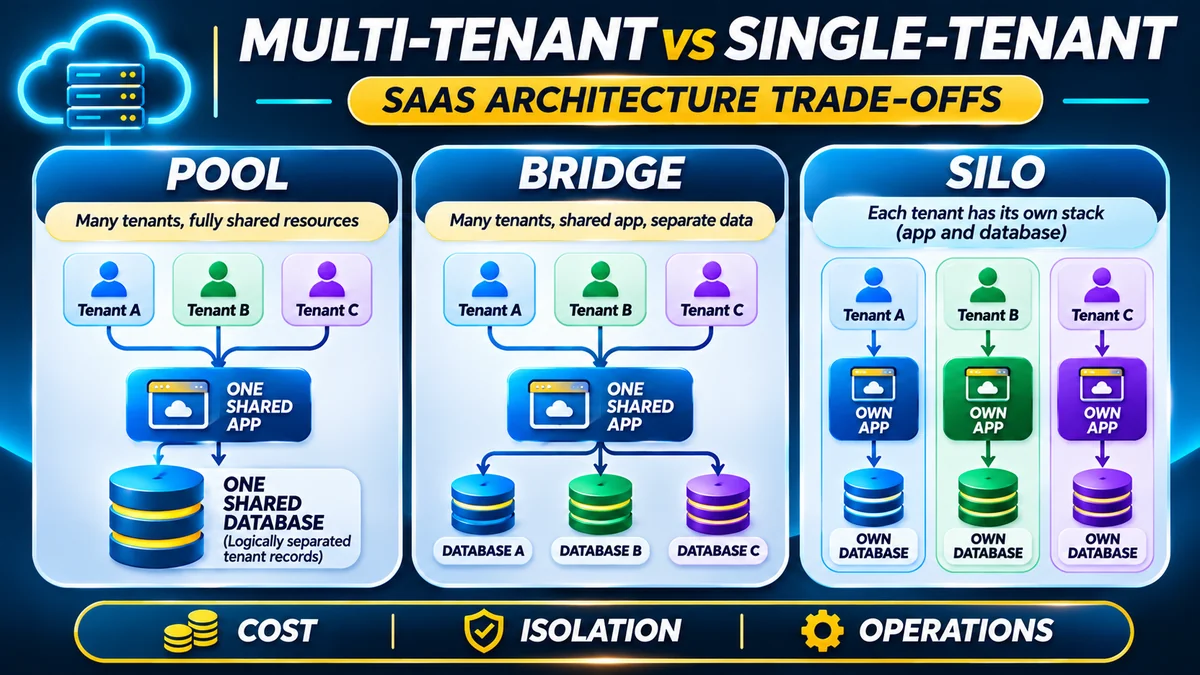
In a pooled architecture, organisations usually share the same application runtime and much of the underlying infrastructure. In a common database design, their records are stored in shared tables and distinguished with a verified tenant identifier. For example, an orders table may store orders belonging to several organisations, with every access restricted to its authorised tenant.
Why choose it? Shared infrastructure can lower minimum per-customer hosting costs and simplify rollout. A development team can deploy a common software version and expand a pooled environment rather than maintaining a complete stack for every customer.
What is harder? A single query, insecure API, caching mistake or background job that loses its tenant context can expose another customer's information. Shared databases also make tenant-specific restores, independent performance tuning and exceptional customer requirements more complicated.
Azure's SQL multitenancy guidance describes pooled databases as high-density and potentially cost-efficient while noting finite throughput, noisy-neighbour risk and more difficult per-tenant restore. Pooling is attractive for many small, similar customers; it is less straightforward where tenant workloads or recovery requirements differ significantly.
2. The silo model: a dedicated environment for each customer
In a silo or fully isolated deployment, each tenant can receive dedicated application instances, database resources and potentially network boundaries. A customer-specific stack may run in its own account, subscription, cluster, virtual network or other infrastructure partition, depending on the required isolation level.
Why choose it? Dedicated resources can simplify certain audit boundaries, allow customer-specific capacity and deployment settings, and reduce the likelihood that another customer's traffic consumes the same app or database resources. Tenant-specific backup and restoration are often more direct when storage and databases are truly separated.
What is harder? Every environment needs provisioning, updates, monitoring, backup, key rotation and support. At hundreds or thousands of customers, these tasks require dependable automation; the idle capacity of each dedicated deployment can also make the model expensive.
Microsoft's Azure Architecture Center notes that dedicated deployment stamps provide strong isolation but can become difficult and expensive to manage at scale. Single-tenant infrastructure is therefore a design choice to justify, not an automatic sign of higher product quality.
3. The bridge model: shared application, separate data or services
The bridge model combines pooled and siloed elements. A common pattern is one shared application deployment with one database per customer. All tenants use the same product code and front-end platform, but the application resolves the authenticated tenant and selects that tenant's own database.
This is still a multi-tenant SaaS architecture. A separate database does not turn the overall platform into single-tenant hosting when application instances, authentication, control plane, releases or operational services remain shared.
Bridge patterns may also use separate database schemas, storage containers, queues or dedicated high-demand services while sharing other resources. The isolation boundary can vary by component. AWS's tenant isolation whitepaper describes pool, silo and bridge as patterns that may be combined.
Advantages: a shared application release process, clearer data ownership, potentially easier tenant-specific backup and restore, and flexibility to assign larger database resources to high-demand tenants. Trade-offs: database creation, credentials, schema migrations, connection limits, backups and monitoring must all work across a growing fleet. A shared application server or queue can still be a noisy-neighbour bottleneck even when every tenant has its own database.
Database-per-tenant vs shared database: what actually changes?
| Storage choice | Isolation | Operational consequence |
|---|---|---|
| Shared tables with tenant-scoped rows | Logical isolation inside one database/schema | High density; every query and administrative path needs strong tenant enforcement |
| Shared database, separate tenant schemas | Namespace separation within one database service | Schema lifecycle and permissions multiply; infrastructure remains shared |
| Separate database per tenant | Dedicated database boundary, which may still share a database server/pool | Independent database lifecycle; connection, backup, migrations and quotas become fleet concerns |
| Separate database server and application stack | Dedicated service resources and stronger infrastructure boundary | Higher fixed cost and potentially more complex deployments |
These designs should be evaluated on data protection, performance, recovery, compliance, operating cost and expected tenant count. Azure notes that database-per-tenant patterns can improve independent recovery and configuration, and that appropriately chosen elastic pools may share database compute where supported. Pooling database capacity is not the same as putting all tenant rows in one database.
For extremely large numbers of tenants, a database-per-tenant design needs careful planning for provisioning rate, service quotas, connection pools, schema upgrades, backup retention and cost attribution. Even if each database is small, managing a very large number of them is a substantial systems challenge. There is no universal rule that one database per tenant is necessary—or impossible—for a large SaaS platform.
4. Security: isolation must be enforced, not merely assumed
Security is the most important non-negotiable requirement in a multi-tenant product. Every data access should be associated with a verified tenant context and an authorised user or service identity. A tenant ID supplied in a URL or request body is not proof that a user belongs to that tenant.
OWASP's Multi-Tenant Security Cheat Sheet recommends checking tenant membership on the server, enforcing tenant ownership at the access boundary, and carrying trusted tenant context through jobs and messages. That applies to API controllers, file downloads, search indexes, cache lookups, websocket notifications, exports and scheduled tasks—not just the primary SQL query.
Useful defensive controls include least-privileged credentials, tenant-aware queries, scoped object-storage paths, per-tenant cache keys, audit trails, explicit administrative cross-tenant workflows and automated cross-tenant access tests. For shared PostgreSQL tables, row-level security (RLS) can enforce policies in the database as a second line of defence. But database superusers and roles with BYPASSRLS bypass those policies, and RLS must be configured and tested carefully.
Separate databases reduce the risk of some cross-tenant query mistakes but are not a complete security solution. Incorrect connection routing, overly powerful service credentials, shared caches or misrouted files can still cause leaks. Conversely, a shared database with well-tested policies can be safer than an isolated stack managed with weak credentials and no monitoring.
5. Performance: understanding the noisy-neighbour problem
A noisy neighbour occurs when one tenant consumes disproportionate shared resources and slows other tenants down. Imagine a hotel chain generating an unusually large report while smaller organisations are checking bookings. If the report monopolises database connections, CPU or worker queues, unrelated customers may experience delays.
Dedicated stacks reduce cross-customer contention for their dedicated components, but still depend on provider-level shared services and external networks. A shared application with separate tenant databases avoids some storage contention yet may still experience shared-worker or API bottlenecks.
AWS's SaaS performance guidance recommends tenant-aware load measurements and strategies such as throttling, scaling or isolating high-demand components. Practical controls include limits on concurrent exports, per-tenant request quotas, fair job scheduling, database connection budgets and separate heavy-workload queues.
The key metric is not only overall CPU utilisation; it is also response time, throughput and error rate by tenant and subscription tier. An aggregate dashboard can look healthy while one customer is experiencing persistent latency.
6. Reliability and blast radius: who is affected by a failure?
A shared application's outage may affect all organisations hosted by that deployment. A failed database shared by every tenant can produce a similarly broad interruption. A dedicated customer environment can narrow the effects of a component failure, although failures in a common identity service or control plane may still affect every customer.
Cloud architects describe this as the blast radius—the number of customers or services affected when something breaks. Both AWS and Azure caution that pooling increases the potential reach of incidents unless the system is designed to partition failure domains.
One compromise is the deployment stamp or cell: operate several smaller application environments, each serving a bounded number of tenants. If a stamp fails, its tenants are affected rather than necessarily the entire platform. Microsoft's deployment-stamps pattern describes this approach for scaling and regional separation.
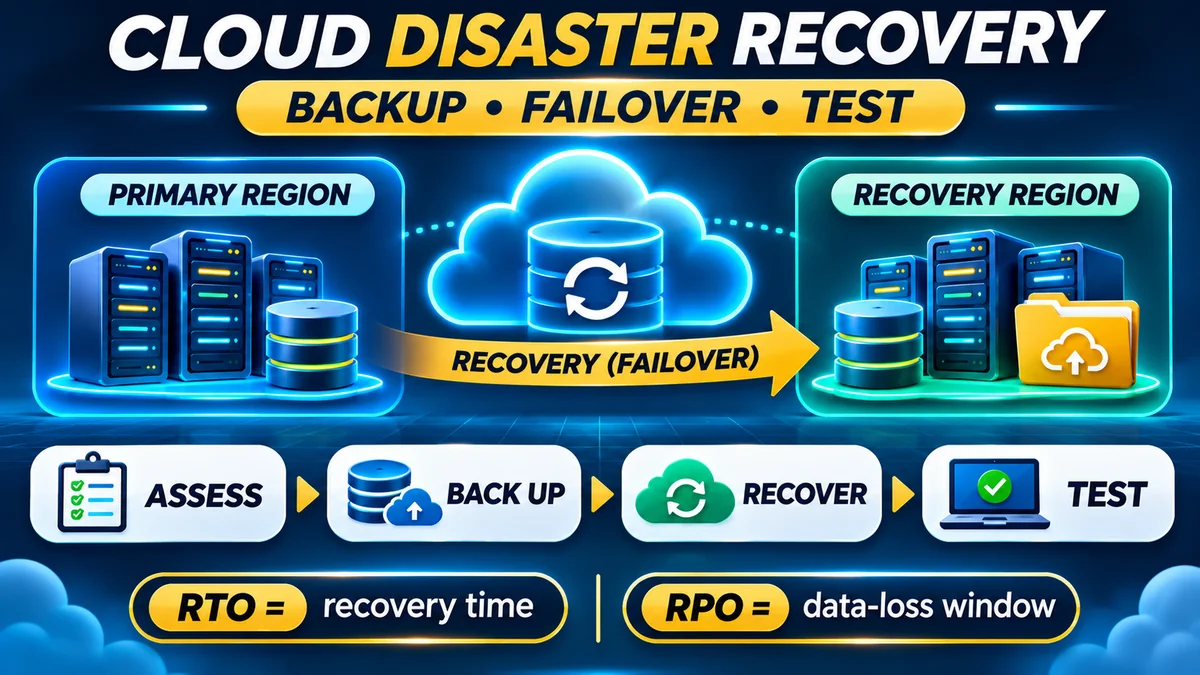
Whatever the model, define backup schedules, recovery objectives, failover plans and incident communication procedures. Individual tenant restoration is generally easier with a separately recoverable database. In a shared database, recovering one customer's accidental deletion can require restoring a copy and carefully extracting only that customer's data—not overwriting the live shared database.
FlyingEze's published 3-2-1 backup strategy for business data covers broader principles for retaining independent, recoverable copies.
7. Cost: why a lower infrastructure bill is not the whole story
Pooling resources can improve utilisation, reducing the average infrastructure cost per tenant. But a credible comparison also counts developer effort, security engineering, tenant-aware monitoring, onboarding automation, support, recovery complexity and infrastructure risk.
Consider a completely fictional SaaS serving 100 organisations:
| Monthly planning example | Shared-platform model | Dedicated-stack model |
|---|---|---|
| Infrastructure and platform allocation | $900 shared | $18 per tenant × 100 = $1,800 |
| Common monitoring and operational tooling | $300 | $600 |
| Total illustrative monthly spend | $1,200 | $2,400 |
| Average monthly platform cost per tenant | $12 | $24 |
These are not cloud vendor prices or claims of a guaranteed 50% saving; they demonstrate why spare dedicated capacity and fleet operations can change unit economics. A real budget must include database tiers, storage, support hours, data transfer, compliance requirements, tenant sizes and the cost of building secure isolation in software.
Do not average away expensive customers. A tenant that uses ten times the compute or data storage of the median tenant may be unprofitable under a flat subscription. AWS's tenant-activity guidance recommends metering use by tenant so providers can understand consumption and design pricing that reflects delivered value and resource demand.
8. Onboarding and offboarding: the hidden operational workload
To run a successful SaaS platform, creating an organisation must be a repeatable process. That may involve creating its identity records, selecting a region and deployment, issuing credentials, provisioning a database, seeding default settings and activating a subscription. The system should be able to retry incomplete steps without creating duplicate resources.
For a shared-database platform, onboarding may create logical tenant configuration without provisioning a new database. For database-per-tenant SaaS, it also needs database creation, schema application, credentials, connection routing, backup enrolment and monitoring. For dedicated stacks, a new tenant may require an entire infrastructure deployment.
A central tenant catalogue or control plane can track where every organisation lives, its configuration and its resource lifecycle. The Azure Architecture Center's control-plane guidance identifies tenant catalogues and lifecycle processes as core pieces of operating a multi-tenant solution.
Offboarding deserves equal attention: export and deletion policies, backup retention, revoking access and releasing billable resources must respect applicable agreements and law. The number of tenants is not the only measure of scale; it is also the number of automated, auditable lifecycle operations your platform can carry out safely.
9. Deployments and upgrades: one codebase versus many live environments
A common-code SaaS application makes it possible to release a new feature centrally, but it introduces risk if a faulty deployment affects every tenant at once. Adopt automated tests, staged releases, feature flags, safe database migrations, monitoring and rollback procedures. For migrations, test changes with large and small tenant datasets, not just an empty development database.
With dedicated deployments, organisations may receive updates at different times. This can satisfy customer requirements, but creates version drift and increases support complexity. A fleet management process should record what version each deployment runs and whether security patches have been applied.
Database-per-tenant designs can face a particularly difficult problem: rolling out schema changes to thousands of databases. Use compatible, repeatable, observable migrations; control concurrency; track failures; and plan how to recover if a migration stops partway. Never assume an individual successful migration means every tenant database has reached the same version.
AWS recommends a unified onboarding and operational approach across pooled and siloed models, rather than treating each enterprise tenant as a one-off software project.
10. Customisation, compliance and data residency
Some clients need unusual software settings, separate encryption keys, different backup retention periods or data hosted in a specific region. Dedicated deployments can offer clearer boundaries for these requirements. A hybrid SaaS can also provide a standard shared tier for most customers and an isolated tier for customers whose requirements justify it.
However, dedicated hosting does not automatically establish regulatory compliance. Compliance depends on the data involved, applicable law, contracts, access controls, processor relationships, logging, security policies and tested operations. Ask which actual requirement the architecture addresses instead of using “regulated” as a reason to purchase unnecessary infrastructure.
Azure's tenancy design guidance treats isolation as a spectrum and notes that one product can mix shared application services with dedicated databases or regional resources. A customer may require one particular component to be isolated without needing a separate copy of every service.
11. Scaling SaaS from dozens to thousands of organisations
At small scale, almost any well-built pattern may work. At very large scale, the limiting factor can move from raw CPU to resource quotas, connection counts, provisioning rates, tenant routing, monitoring cardinality, database migrations and operational workload.
In a shared database, consider partitioning and sharding once individual database limits or large-tenant workloads justify them. In database-per-tenant SaaS, plan for connection pooling, grouping compatible tenants into database service pools or clusters, database naming and provisioning constraints, and safe tenant relocation. In full-stack silos, automate whole-deployment creation, updates and retirement.
Deployment stamps can help by capping how many tenants share a set of resources and adding new stamps as capacity fills. The design needs a reliable routing catalogue so each incoming request reaches the correct application and database. Azure's architecture guidance describes why isolation, resource quotas and management costs should be evaluated together.
Do not assume a provider's example about “millions of databases” is a universal service guarantee or a recommendation to create one database per user. Capacity is configuration-specific; run practical scale tests and verify current quota limits.
12. Hybrid SaaS: an architectural middle ground
Many platforms do not have to choose one strict model forever. An effective hybrid tenancy design might share the login service, tenant catalogue, billing system and application code while providing dedicated databases to organisations with higher data isolation needs. The biggest customers could move to separate deployment stamps or dedicated compute while smaller customers remain in a pooled environment.
The critical requirement is consistent security and operations across tiers: tenant identity, permissions, monitoring, metering, incident handling, provisioning and account lifecycle should still work as one SaaS business. An enterprise offering should not depend on a manual series of one-off exceptions that no longer receives normal updates.
AWS's SaaS Lens architecture patterns recommend understanding how pooled, bridged and siloed infrastructure can be combined at different layers. Often the correct unit of isolation is a database, queue, workload or service, not necessarily a whole customer deployment.
How to choose: a practical architecture decision checklist
- Define each tenant: distinguish customer organisations from users, branches, projects and subscriptions.
- Classify tenant data: determine which data needs logical separation, dedicated storage or region-specific treatment.
- Measure workload differences: compare expected storage, API use, reporting jobs, connections and peak demand by tenant size.
- Decide the isolation boundary: shared tables, separate schemas, database per tenant, dedicated services or full stacks.
- Model total unit economics: include infrastructure, backups, support, automation, compliance and heavy-user consumption.
- Define availability requirements: limit noisy neighbours and the number of customers affected by a failure.
- Plan lifecycle automation: provisioning, migrations, monitoring, tenant relocation, export and deletion.
- Test security boundaries: attempt cross-tenant access through APIs, caches, object storage, search, background jobs and administrative actions.
- Design a scaling route: know when to shard a shared database, pool tenant databases or add deployment stamps.
- Document why: choose on measured requirements, not fashion or an unverified claim that one model is universally secure or cheap.
If the initial challenge is simply understanding what SaaS provides, FlyingEze's earlier guide to taking a SaaS startup onto mobile addresses product-delivery questions, while its B2B SaaS resilience article provides business-side context for pricing, retention and operational sustainability.
Frequently asked questions
Is multi-tenant SaaS the same as a shared database?
No. Multi-tenancy describes a product designed to serve multiple customer organisations. Its data may be stored in shared tables, separate schemas, separate tenant databases or different deployment environments.
Can a SaaS use one database per tenant?
Yes. A common bridge architecture uses a shared application and a separate database for each tenant. It remains multi-tenant SaaS because the platform manages multiple organisations through common services.
Does single-tenant hosting guarantee better security?
No. Dedicated resources can strengthen some isolation boundaries, but credentials, patching, access controls, application vulnerabilities, backups and operational procedures still determine practical security.
Which model is cheapest?
Pooled infrastructure often lowers average per-tenant resource cost, but the total depends on workload, security engineering, automation and tenant support. There is no universal cost winner.
What is a noisy neighbour in SaaS?
It is a tenant whose heavy use of shared compute, storage, database connections or other services degrades performance for other tenants. Quotas, capacity planning and resource isolation can help.
What is the difference between pool, bridge and silo?
Pool shares most resources; bridge shares some and isolates others, such as tenant databases; silo dedicates more or all of the customer stack. A product can mix the patterns.
Is database-per-tenant suitable for a million customers?
It may be possible in some specialised designs, but database provisioning, costs, quotas, connections, migrations and monitoring become major challenges. A service-specific feasibility assessment and scale testing are essential.
Can multiple tenants share one application but have different domains?
Yes. Tenant routing may use verified custom domains, subdomains or authenticated organisation selection. Domain selection alone should not bypass tenant authorisation.
How do SaaS companies stop customers seeing each other's data?
They enforce server-verified tenant identity and ownership checks in every data path, with database controls, scoped storage, protected caches, least privilege, audit logs and automated security testing.
What if one tenant needs its own cloud region?
A hybrid design can place that tenant's data or deployment in a suitable region while retaining a coordinated control plane, subject to applicable law, product support and latency requirements.
Is a microservices architecture required for multi-tenancy?
No. A well-designed modular application can serve multiple tenants securely. Microservices introduce their own networking, deployment and operational complexity and should solve a specific problem.
Can a SaaS product move a tenant from pooled to dedicated hosting later?
Yes, if its identity, routing, data export/import, compatibility and deployment design support migration. Plan and test tenant movement before promising it commercially.
Conclusion: choose the isolation boundary that your customers actually need
Multi-tenant SaaS and single-tenant hosting are architecture strategies, not rankings of quality. Shared platforms can provide efficient operations and attractive unit economics, while dedicated stacks make certain isolation and customer-specific requirements easier to satisfy. A bridge model—with shared applications and separate tenant data—is often a practical middle option.
The best design protects every tenant, limits shared-resource contention, supports recovery and remains manageable as customers and data grow. Begin with the workload and risk requirements, then choose the least complex isolation boundary that meets them. Revisit the decision as the product, tenant mix and cloud economics evolve.
Editorial verification: 14 November 2026. Principal research: AWS SaaS Lens and tenant-isolation whitepapers, Microsoft Azure multitenancy and Azure SQL Architecture Center, OWASP Multi-Tenant Security Cheat Sheet, Google Cloud tenant design practices, and official PostgreSQL row-security documentation. The cost comparison is fictional and does not represent a vendor offer or an audited industry average.