
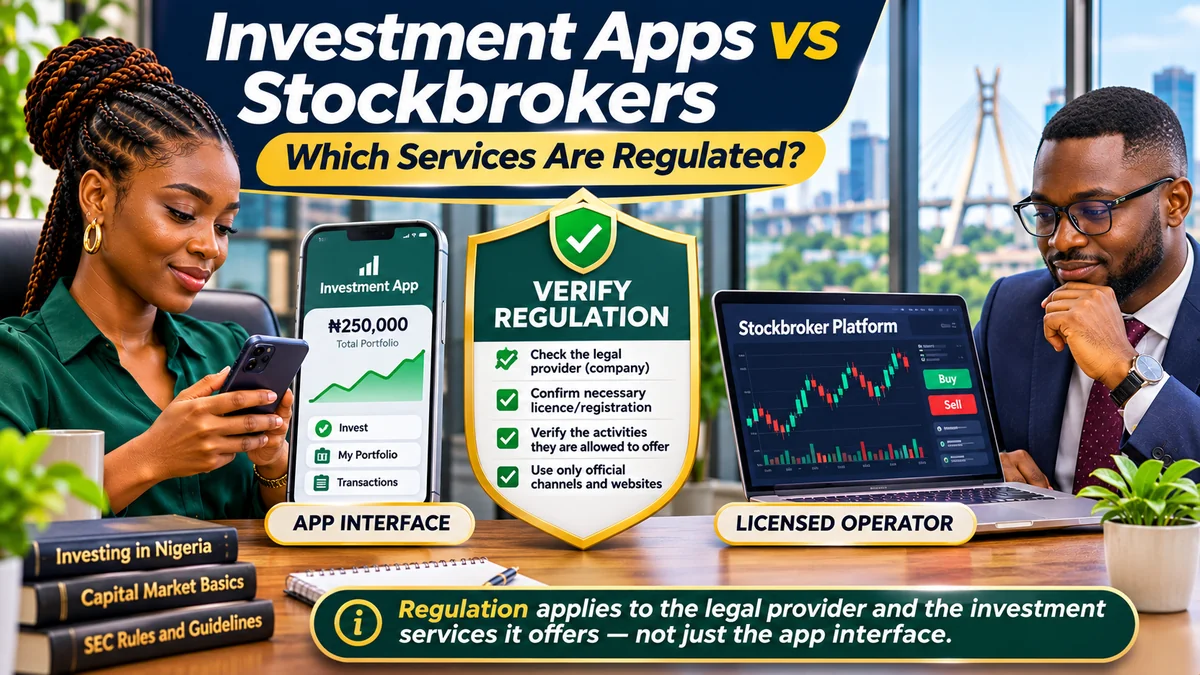
Investment apps and stockbrokers can both provide regulated investing services in Nigeria, but an app's design does not tell you which licences, registrations or protections apply. The critical questions are who legally operates the service, what that company is authorised to do, which broker executes an order, where your securities and cash are held, and whether the particular investment product is legitimate.
For Nigerians comparing investing platforms, this distinction matters because one app can offer several activities: Nigerian equities, overseas stocks, mutual funds, automated advice and a payment wallet. The companies responsible for those activities may not be the same, and regulatory permission for one service does not automatically cover the others.
This guide explains the regulatory map in November 2026, how to compare a traditional stockbroker with a digital investment app, what SEC and NGX records can establish, and how to check custody, fees and investor protection. It is general educational information, not a recommendation to buy a particular security or use a particular company. Research checked: 16 November 2026.
Short answer: investment app or stockbroker—which is regulated?
Both can be regulated. A stockbroker that executes trades in securities listed on Nigerian Exchange Limited (NGX) needs the applicable capital-market registration and NGX trading authorisation. An investment app may itself be registered for a role such as digital sub-broker, robo-adviser or fund/portfolio manager, or may work with separately regulated institutions. Those arrangements require verification, not assumptions.
The Securities and Exchange Commission's May 2026 public notice warned that unregistered online schemes and unauthorised investment advice were being advertised across social platforms, and told investors to check the regulator's official records. The NGX investor guide says investors who want to trade on the Nigerian exchange must use a registered NGX trading-licence holder.
| Service you see | Regulatory question | Useful official check |
|---|---|---|
| Traditional Nigerian stockbroker | Is the legal firm an authorised SEC broker/dealer and an active NGX trading-licence holder? | SEC capital-market operator register; NGX broker directory |
| Digital investing or stock app | Is the company a digital sub-broker, licensed broker or interface to a licensed partner? | SEC operator and fintech directories; named executing broker |
| Mutual-fund or portfolio app | Is the manager authorised, and what fund or portfolio arrangement are you buying? | SEC fund/portfolio manager details and relevant scheme disclosures |
| Automated portfolio suggestions | Who provides the robo-advisory service, and under what permission? | SEC fintech rules and operator record |
| Investment crowdfunding | Is the portal or intermediary authorised for the particular fundraising activity? | SEC fintech records and crowdfunding rules |
| Overseas stocks through a Nigerian-facing app | Who is the executing and carrying broker abroad, and which country's rules apply? | SEC Nigeria records plus applicable foreign broker regulator |
| Crypto or digital-asset platform | Does it have a relevant full permission or conditional incubation approval, and for what activities? | SEC's digital-finance announcements and exact status |
Registration is not a guarantee of profit. A supervised operator can still offer investments that fall in value, have limited liquidity or lose money. Investor protection primarily addresses regulatory conduct and market infrastructure; it is not blanket insurance against all investment losses.
How traditional stockbrokers work in Nigeria
A traditional stockbroker is a financial intermediary through which a customer can place buy and sell instructions for exchange-traded securities. It helps open the relevant trading account, performs Know Your Customer (KYC) checks, routes or executes orders and provides transaction records. Many established stockbrokers also offer their own online portals or mobile apps, so “traditional” does not mean “paper-based”.
Under the NGX's investor instructions , a person trading listed shares uses a stockbroker that holds an NGX trading licence. The exchange publishes a directory of trading-licence holders and marks firms active or inactive. That status matters: a historical mention of a stockbroker is not proof that it is currently authorised to execute a new trade.
Check the broker's exact legal name against the SEC capital-market operator directory , including the permitted function, and then confirm the exchange record. If an unfamiliar website claims to represent a licensed broker, call the contact details independently located on the broker's verified website or the regulator's record, not a phone number provided by the website alone.
Nigeria's post-trade infrastructure also matters. The NGX says investors can hold Nigerian securities through Central Securities Clearing System (CSCS) under a dealer or through an appointed licensed domestic custodian. The underlying securities record is not equivalent to a numerical balance displayed in a phone app.
How investment apps differ—and where regulation applies
An investment app is usually a distribution and account interface: it displays portfolios, accepts instructions, sends alerts and may collect funding information. It is not necessarily the company legally buying securities, managing assets or holding clients' money. Some fintech firms perform regulated activities directly; others introduce clients to brokers, investment managers or custodians under disclosed arrangements.
Nigeria's SEC fintech directory explicitly separates digital sub-brokers, robo-advisers, digital investment fund/portfolio managers and crowdfunding intermediaries. For example, its publicly available category page names Chaka Technologies and Bamboo System Technology under digital sub-brokers, Wahed under robo-adviser, and Cowrywise Financial Technology under digital investment management. These are examples of names appearing in the regulator's published categories—not a fresh certification of every current product, partnership or permission, and not investment recommendations.
A company might operate an app used to buy US stocks while employing a foreign broker to execute orders and a different firm to hold securities. In another app, a balance described as a “savings plan” could represent units in a collective investment scheme, cash with a bank or a contractual claim against the operator. You must read the legal disclosures to determine which.
The investor should ask a basic, specific question: “Which legal entity provides this particular service, and what authorisation does it hold?” A brand's general statement that it is “SEC-regulated” is less informative than an independently verified legal name, authorised function and partner list.
Digital sub-brokers, brokers and robo-advisers are not interchangeable
The SEC's published fintech rules address digital sub-brokers, recordkeeping, technology safeguards, cyber risks and robo-advisory controls. The category an entity holds matters because activities differ:
- Broker/dealer: Executes or arranges securities transactions within its regulatory permission and the relevant exchange framework.
- Digital sub-broker: Uses a digital channel to connect customers and broking arrangements under applicable SEC rules. It should not be assumed to be the exchange trading member or final custodian merely because it operates the app.
- Fund or portfolio manager: Manages an investment portfolio or fund under applicable authorisation. Performance, mandates, dealing rules and custody provisions matter.
- Investment adviser or robo-adviser: Provides advice or automated recommendations, with specific conduct and suitability obligations where relevant. Advisory permission is not proof the adviser directly executes trades or holds assets.
- Crowdfunding intermediary: Facilitates the kinds of investment crowdfunding permitted under the SEC's framework; an online promise of fixed returns is not automatically an authorised crowdfunding offering.
Companies can hold more than one regulatory function, and the exact combination should be visible in the current regulator record. Do not infer a permission merely because a service has a professional-looking website, a CAC registration number or a collaboration announcement with a well-known institution.
Does SEC fintech incubation mean a platform has a full licence?
Not necessarily. Nigeria's SEC operates Regulatory Incubation (RI) and Accelerated Regulatory Incubation Programme (ARIP) pathways for innovative firms and digital-asset businesses. Participation and conditional approval allow specified activities within defined limits; they should not be described as unconditional permission for every capital-market service.
In its 2 July 2026 ARIP announcement , the SEC said Approval-in-Principle is not a final licence and remains conditional on continued compliance. The SEC's incubation overview describes limited testing conditions and temporary regulatory relief.
Therefore, when a platform says “approved by SEC”, ask whether that means full operator registration, a permitted sandbox test, an Approval-in-Principle or merely an application in progress. Confirm the present status and authorised services through SEC records. An application form, payment receipt, provisional approval or old news headline is not interchangeable with an unrestricted licence.
Who holds your shares, fund units and uninvested cash?
For an investor, custody may matter just as much as the application's licensing category. Ownership and access are different things: a screen might show “₦500,000 portfolio value” while the underlying assets are recorded by a depository, custodian, trustee, fund manager or foreign brokerage firm. The agreement should explain whose name appears in the legal records and how customer assets are separated from operating money.
For Nigerian exchange-listed securities, NGX identifies CSCS as the central depository and settlement infrastructure and describes dealer and custody options. Nigeria's market moved to a T+1 equity settlement cycle from June 2026 ; this governs eligible trade settlement rather than promising that cash withdrawals from every app will take one day.
For mutual funds, inspect the investment scheme's documents and identify the manager, trustee or custodian, what units are held and how redemptions operate. For foreign stocks, request the name and jurisdiction of the carrying broker, the account-ownership arrangement, and whether a customer can independently obtain records from that broker. Some platforms offer fractional economic exposure through pooled or nominee arrangements: do not assume it is legally or operationally identical to holding one whole directly registered share.
A useful question is: “If the app disappears tomorrow, which independent organisation has the record of my assets, and how do I prove my claim?” A credible provider should be able to explain that process in writing, including any restrictions or insolvency risks.
What about investing in US stocks from Nigeria?
An app marketed to Nigerians can connect users to foreign markets. That may involve Nigerian entities, international brokers and custodians, each under potentially different rules. Local registration does not automatically establish US brokerage authorisation; conversely, a US-regulated brokerage partner does not automatically mean every Nigerian-facing marketing or advisory activity has the required local permission.
When a named US broker is involved, use FINRA BrokerCheck or the US Investor.gov guidance to verify the actual firm. Confirm which company carries the account and whether it is a member of the Securities Investor Protection Corporation (SIPC) . SIPC protection is conditional and intended for certain broker failures or missing customer assets; it does not protect against stock-price declines, currency losses or every structure used by an app.
Fees can include US brokerage costs, Nigerian payment charges, foreign-exchange conversion spreads, withdrawals and taxes. Ask who sets the exchange rate and whether you own individual securities, fractions or contractual entitlements. Also check whether transfers out to another broker are available and at what cost.
Does a CBN licence or bank partner make an investment app SEC-regulated?
No. Nigeria's Central Bank of Nigeria (CBN) oversees the payment system and banking activities , while the SEC supervises relevant capital-market services. A payment-service authorisation may matter for wallet funding, transfers or account infrastructure; it does not itself authorise the business to sell securities, manage a fund or provide regulated investment advice.
Similarly, a CAC certificate establishes a company's legal registration, not its permission to solicit investments. An app may work with a regulated bank for collection accounts and a separately registered investment operator for its products. Evaluate each partner's actual role rather than treating one partner's licence as a blanket badge for the whole platform.
Deposit protection should also not be confused with investment protection. A mutual-fund unit, share or other market investment is not transformed into an NDIC-insured bank deposit merely because funds can be added using a bank transfer.
How to verify an investment platform in Nigeria: a practical six-step check
- Find the exact legal company name. Read the platform's terms, customer agreement, privacy notice and disclosures. Distinguish the trading brand from the legal contracting entity and any appointed intermediary.
- Search the SEC operator register. Use SEC's registered-operator directory and check the entry's status and authorised function. A similarly named business or stale screenshot is not enough.
- Check the fintech and warning records. Review SEC's fintech directory and enforcement notices . Distinguish final registration from provisional or incubation status.
- Confirm NGX membership when buying Nigerian exchange-listed shares. Search the NGX trading-licence directory for the executing firm and current status.
- Identify custody and the real product. Ask who holds securities and cash, whether a nominee or fund structure is used, and where independent statements can be obtained. For US stocks, verify the overseas broker separately.
- Test the cost and risk disclosures. Check all transaction, management, FX, custody and withdrawal fees; liquidity and redemption terms; market and currency risk; dispute procedures; and the receiving account's name.
The SEC's registered-operator directory tells investors to carry out their own due diligence even when records are available. If the directory result is unclear, seek confirmation through the regulator's official contact channels before transferring money. Never let a promoter rush you by claiming that checking a licence will cause you to miss a guaranteed return.
Three examples: the same investment, different service arrangements
Scenario A: buying shares listed on NGX
You open an account with a verified NGX trading-licence holder and instruct it to buy shares in a listed Nigerian company. The broker handles the trading service, while the relevant securities record and settlement operate through market infrastructure. Verify both its SEC function and NGX status. A slick app is optional; licensed execution and clear records are not.
Scenario B: buying Nigerian stocks through a fintech interface
You download an app that lets you submit a stock order. The app operator may be a digital sub-broker, while a separate NGX member executes the trade and CSCS or an authorised custodian maintains the relevant holdings. Verify every disclosed entity. If the app refuses to name the broker or explain asset records, treat that as an unresolved risk.
Scenario C: putting money in an app's “investment wallet”
The interface offers a displayed yield or savings target. You need to know whether your money buys units in an authorised mutual fund, enters a bank account, funds a managed portfolio or becomes a claim against the platform. The right regulatory check depends on that legal product. The words savings, wealth or fixed income on the screen do not resolve the distinction.
These are illustrative workflows rather than descriptions of specific companies. Readers interested in the difference between funding and equity ownership may also consult FlyingEze's published guide to grants, loans and equity funding , which explains why shares differ from other financial arrangements.
Compare costs and protections—not just the app's advertised return
| Question | What to check | Why it matters |
|---|---|---|
| Trading or transaction fees | Broker commission, regulatory levies and minimum charges | Small, frequent trades may become expensive |
| Management or advice fees | Recurring percentage, fixed subscription, performance fee where permitted | Charges reduce net returns over time |
| Foreign-exchange conversion | Actual rate, markup, funding and payout currency | FX losses can outweigh a headline investment gain |
| Ownership and custody | Legal owner, nominee structure, custodian and statements | Determines what you can prove or transfer if an intermediary fails |
| Withdrawal and transfer | Redemption dates, notice periods, transfer-out fees and limits | Displayed value is not necessarily instantly accessible cash |
| Investor protection | Which regulator and which investor-protection regime, if any | Protection varies by service, market and institution |
| Investment risks | Price volatility, concentration, liquidity, counterparty and currency | Supervision does not eliminate losses |
Suppose you invest ₦100,000 in an asset and later sell it for ₦105,000 before charges. The gross gain is ₦5,000, or 5%. If combined trading, conversion and exit charges total ₦3,500, the simplified net gain is ₦1,500 (1.5%) before any applicable tax. The numbers are hypothetical; the lesson is to compare net cost and contractual exposure, not the headline return alone.
Warning signs of an unregistered or misleading investment service
In May 2026 , Nigeria's SEC warned about online schemes marketed through WhatsApp, Instagram, Telegram and other social networks, including platforms promising unrealistic or guaranteed returns. The Commission has also published specific warnings about entities falsely suggesting that they are supervised or authorised.
- The operator refuses to state its full legal name, SEC function or relevant broker/custodian partners.
- It displays a certificate, logo or “SEC approved” banner without a matching current regulator record.
- It says an application for registration or provisional sandbox admission is a final unrestricted licence.
- It promises a fixed, unusually high return without explaining the actual product and risks.
- It requests transfer to a personal account unrelated to the named investment service or changes payment details unexpectedly.
- It cannot explain how investors own securities, obtain statements or request withdrawals.
- It pressures users to recruit others, pay to release supposed profits or act immediately.
Do not conclude from silence alone that a firm is fraudulent, because records and names may require clarification. But if a provider cannot resolve material questions through independently verifiable channels, do not invest merely because its app has good reviews, attractive graphics or prominent social-media promoters.
What to do if an app you used cannot verify its licence
Stop making new deposits while you check the position. Save statements, receipts, account agreements, transaction IDs, communications and the original payment destination. Verify the legal entity and permissions through the SEC, and if the app names a broker or custodian, contact that institution through independently obtained details.
If you suspect actual fraud, notify your bank or payment provider promptly and follow its dispute process. Report suspected unauthorised capital-market activity to the SEC through its official site. If a criminal transfer occurred, FlyingEze's published guide to responding after paying a suspected fraudulent bank account explains evidence preservation and banking follow-up.
Do not pay a “recovery expert” upfront to unlock an investment balance. No regulator lookup or complaint guarantees that lost funds can be recovered.
Frequently asked questions
Are investment apps regulated by the SEC in Nigeria?
Some are, depending on the legal operator and service. SEC records include digital sub-brokers, digital fund/portfolio managers and robo-advisers. Others may depend on registered partners or operate under conditional fintech incubation. Verify the exact entity and activity.
Are stockbrokers more regulated than investment apps?
It is not a simple ranking. An NGX stockbroker must meet requirements applicable to broker/dealers and exchange trading members. An app may have relevant SEC permissions and licensed partners. The appropriate comparison is between actual legal service arrangements, not the design of two interfaces.
How do I know whether a stockbroker is licensed in Nigeria?
Search the SEC register for the legal name and broker/dealer function, then check the NGX trading-licence directory and its active status. Confirm the website and contact information independently.
What is a digital sub-broker?
It is a regulated intermediary category for certain digital securities-broking arrangements under SEC rules. Being an app-based sub-broker does not automatically make that firm the executing NGX member or custodian of all client assets.
Does SEC Approval-in-Principle mean an investment platform has a full licence?
No. SEC's July 2026 ARIP announcement explicitly states that Approval-in-Principle is conditional and not a final licence. Check what the entity can currently do and under which limitations.
Does a CBN licence cover investment products?
Not by itself. CBN regulates banking and payments activities, while relevant securities, fund management and investment advice services require the applicable capital-market permissions. A wallet or payment partnership does not replace SEC authorisation.
Is my investment safe because an app is regulated?
No. Authorised intermediaries are subject to rules and supervision, but stocks, funds and other investments can lose value. Custody, leverage, liquidity, fraud, foreign exchange and product design still matter.
Who owns my shares when I use an investment app?
That depends on the product and legal structure. Shares may be recorded through a depository, broker, custodian or nominee account. Ask for the legal owner, the beneficiary arrangement and an independently verifiable statement.
Can a Nigerian investment app sell US stocks legally?
It may be able to facilitate access under an appropriate structure, but you must verify the Nigerian-facing service provider, the overseas broker, applicable permissions and ownership arrangements. Do not assume a partnership announcement settles every licensing question.
Does SIPC protect against losses on US shares?
No. SIPC may provide limited protection in qualifying brokerage failures or when customer assets are missing at a member firm, subject to its rules. It does not insure ordinary stock-market declines or exchange-rate losses.
Where can I check registered investing platforms in Nigeria?
Start with SEC's operator register and fintech directory . For exchange-traded Nigerian shares, also use the NGX broker directory . Check current warnings and exact functions rather than relying on old screenshots.
Final checklist before funding any investing platform
- I know the app brand and the exact legal entity providing the investment service.
- I verified its present SEC status and the specific function it is allowed to perform.
- Where NGX shares are involved, I verified the actual trading-licence holder.
- I know the custodian, account structure and how to obtain independent asset records.
- I understand whether I own shares, fund units, fractional interests or another contractual product.
- I checked deposit, trading, FX, management, transfer and withdrawal costs.
- I understand market, liquidity and counterparty risks and any applicable investor protection.
- I am not relying on guaranteed-return marketing, a logo or app-store ratings as licensing proof.
Conclusion: verify the services behind the screen
Choosing between an investment app and a stockbroker is not a choice between “regulated” and “unregulated”. Nigerian stockbrokers operate under the applicable SEC and NGX requirements, while digital investment companies may be registered or conditionally admitted for different services. The most useful information is the legal provider, its authorised function, the executing intermediary, the custodian and the exact investment contract.
Before depositing money, check official SEC records, confirm NGX trading membership when applicable, examine overseas brokerage arrangements carefully, and read the risk and fee disclosures. Regulation can help create accountability, but informed investors still need to understand what they own, who holds it and how they could lose money.



