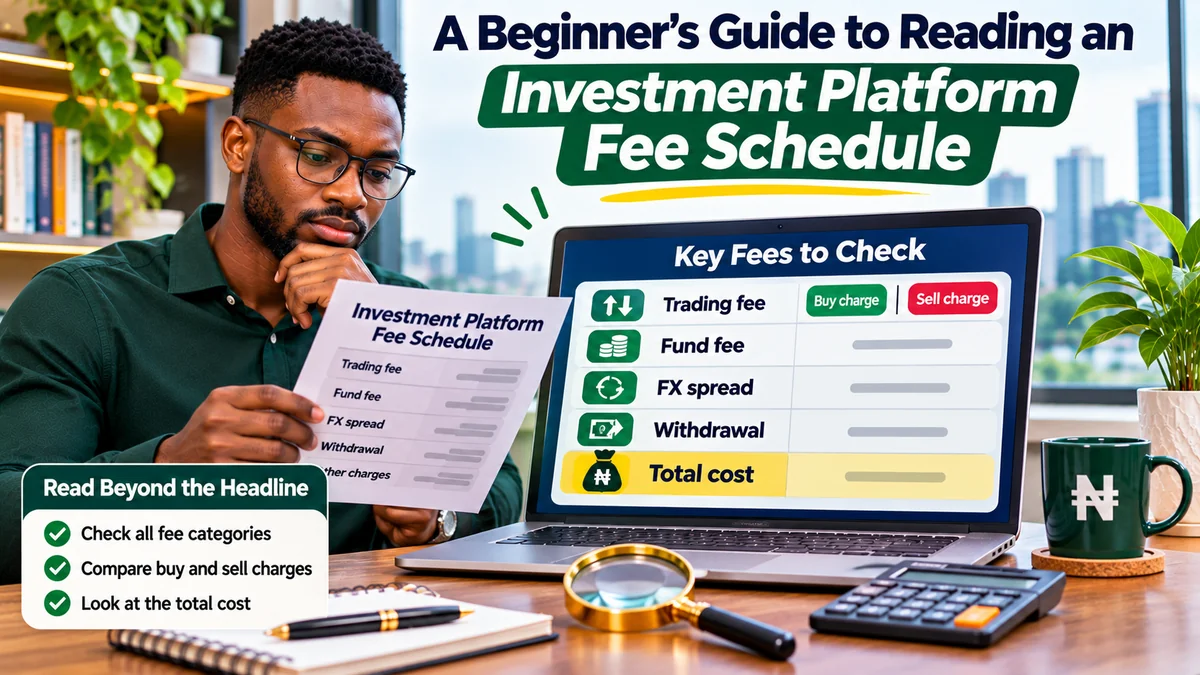
The fee schedule of an investing platform tells you what it costs to enter, hold and leave an investment—not just the amount advertised on its home screen. A beginner choosing among investing platforms in Nigeria should learn to distinguish a one-off trading commission from recurring fund expenses, exchange and regulatory charges, foreign-exchange spreads, and fees for withdrawals or early redemption.
An investment app can advertise “zero commission” and still impose other costs. Equally, an app that displays a percentage for buying shares may not show the full expense of selling those shares later. Fund investors face a different trap: some charges are already reflected in the fund's net asset value (NAV), so they may never appear as an individual debit from your bank account.
This guide explains each line of a typical fee schedule, works through a Nigerian share-trading example in naira, compares mutual-fund and foreign-investment charges and provides a worksheet you can reuse. The examples are educational; they are not quotations from a named app or investment recommendations. Research reviewed on 16 November 2026.
The one-minute rule: look for the total cost of the full investment journey
Before opening an account, ask the provider for the current written fees and answer five questions:
- Funding: Will a bank transfer, card payment or currency conversion cost anything?
- Buying: Which commission, exchange, settlement, regulatory, stamp-duty or other charges apply?
- Holding: Are there annual management, custody, platform, advisory or fund operating expenses?
- Selling: Is there another dealing commission, market charge or early exit penalty?
- Getting cash back: When can you withdraw, which conversion rate applies and are there withdrawal or transfer fees?
Investors should compare the same asset, amount, holding period and exit method on each platform. Otherwise a cheap-looking purchase fee might be outweighed by an expensive sale or withdrawal.
First decode the words in a fee schedule
| Term you may see | Plain-English meaning | What to check |
|---|---|---|
| Brokerage or dealing commission | Payment to the broker for executing a trade | Buy side, sell side, percentage, minimum |
| Regulatory or exchange fee | Market-related charge associated with a transaction | Whether levied on buying, selling or both |
| Settlement/depository fee | Charge relating to clearing or recording trades | Which body collects it, amount and VAT treatment |
| Stamp duty and VAT | Statutory tax components where applicable | Taxable base and whether the quoted fee includes them |
| Annual management fee | Ongoing charge for investment management | Annual percentage, calculation base and frequency |
| Expense ratio or total expense ratio (TER) | Recurring costs borne by a fund as a proportion of its assets | Which expenses are included; avoid double counting |
| Performance or incentive fee | Fee tied to an agreed performance measure | Threshold, calculation, high-water mark, timing |
| FX spread | Difference between available exchange rates or conversion prices | Actual rate to buy and the rate to sell back |
| Inactivity or account-maintenance fee | Charge for an unused or maintained account, if offered | Trigger, period, exemptions and refund rules |
| Redemption/withdrawal/transfer fee | Cost of getting out of an asset or moving cash/securities | Penalty, transfer timing, destination restrictions |
The US SEC's investor-education materials distinguish direct shareholder transaction charges from the ongoing expenses borne by a fund. Those concepts are useful for Nigerian readers, but US disclosure labels should not be mistaken for rules governing every Nigerian product.
Step 1: Establish which fee document applies to your product
Investment platforms often distribute several products through one interface. A Nigerian-stock trade, a naira money market fund and a foreign-stock purchase can have entirely different tariffs. Look for a dated pricing schedule, product fee sheet, prospectus, terms of service or sample contract note—not just the app's marketing summary.
Check the document's effective date, the legal company charging each fee, the asset category, the supported currency and any footnotes. A PDF headed “fees from 2024” may have been replaced. A headline saying “0% commission on selected US shares” might not apply to Nigerian equities or funds.
Also confirm the legal operator. The SEC's registered-operator directory lets users check the actual capital-market firm and its authorised functions. This matters because an app may distribute investments for a separate broker or fund manager whose tariff also applies.
Step 2: Identify the calculation basis—percentage of what?
A quoted percentage is meaningless until you know what amount it is multiplied by.
- Trade value: a 1% dealing fee on ₦100,000 in gross share purchases is ₦1,000, before other costs.
- Assets under management: a 1.5% annual advisory fee on a constant ₦200,000 balance is approximately ₦3,000 for a year, before considering how daily values and billing dates can change the result.
- Profit above a benchmark: a performance fee may be calculated on gains rather than total invested capital, subject to its exact contract.
- Flat amount: a ₦100 transfer fee is still ₦100 whether you withdraw ₦10,000 or ₦100,000; its proportional impact is different.
- Currency converted: an exchange-rate margin may be embedded in the NGN/USD rate rather than shown as a separate fee.
Read whether the fee is charged once, per trade, per month, per year, per redemption or per transaction attempt. Also ask if it is applied before or after a statutory charge, and whether a fixed minimum overrides the advertised percentage for small transactions.
Step 3: Read the Nigerian-stock trading schedule line by line
The Nigerian Exchange (NGX) equity market structure page displays a public schedule for transactions in listed equities. It separates buy-side and sell-side charges. Its published brokerage-commission range is 0.75% to 1.35% on each side, alongside other line items:
| Charge displayed on NGX page | Buying | Selling |
|---|---|---|
| Brokerage commission | 0.75%–1.35% | 0.75%–1.35% |
| SEC fee | 0.30% | No charge listed |
| NGX fee | No charge listed | 0.30% |
| CSCS fee | No charge listed | 0.30% |
| Stamp duty | 0.08% | 0.08% |
| Trade alert | ₦4 | ₦4 |
| VAT as displayed | 7.5% of brokerage and SEC fees | 7.5% of brokerage, NGX and CSCS fees |
These are the values shown on NGX's public webpage, not a guarantee that every broker will quote those exact charges on 16 November 2026. Obtain the broker's current itemised contract note and confirm the operative tariff, statutory treatment and product scope. NGX also approved a June 2026 pricing-methodology rule amendment covering market price determination and small trades; that document should not be confused with an individual investor's commission quotation.
For example, the public schedule lists an NGX and CSCS charge on selling, but an SEC charge on buying. An investor who looks only at the first purchase confirmation can underestimate the eventual cost of a round trip.
Worked example: buying and selling ₦100,000 of Nigerian shares
Suppose a hypothetical broker charges 1.00% commission each way, which lies within the range shown by NGX. Imagine you buy ₦100,000 worth of listed shares and later sell that same gross value of shares for ₦100,000, so the share price has not changed. For teaching purposes, apply the other fee lines shown in NGX's published schedule and assume all the charges shown apply exactly as stated.
| Line item | Buy | Sell |
|---|---|---|
| Gross share value | ₦100,000.00 | ₦100,000.00 |
| Broker commission (1.00%) | ₦1,000.00 | ₦1,000.00 |
| SEC charge (0.30%) | ₦300.00 | — |
| NGX charge (0.30%) | — | ₦300.00 |
| CSCS charge (0.30%) | — | ₦300.00 |
| Stamp duty (0.08%) | ₦80.00 | ₦80.00 |
| VAT on listed fee base (7.50%) | ₦97.50 | ₦120.00 |
| Trade alert | ₦4.00 | ₦4.00 |
| Total illustrated charges | ₦1,481.50 | ₦1,804.00 |
The purchase requires approximately ₦101,481.50 when those costs are paid in addition to a ₦100,000 gross investment. On a sale at the unchanged gross value, the investor would receive approximately ₦98,196.00. The illustrated round-trip fees add up to ₦3,285.50—about 3.29% of the ₦100,000 trade amount—before any other product-specific charges or taxes not included in the assumed schedule.
That is the critical lesson: a share price can finish unchanged while your cash position is lower because of transaction costs. The figures are illustrative arithmetic, not the total due from a named brokerage or an assertion of live tariffs. Actual fees, market conditions, settlement calculations and tax treatment can differ.
Step 4: Understand mutual-fund fees that are already inside NAV
A mutual fund's annual management charge and operating expenses do not necessarily appear as a separate debit beside each investor's name. A fund pays applicable expenses from fund assets, which affects the net asset value and therefore the unit price or returns reported to investors.
The Nigerian SEC's collective-investment-scheme guidance identifies the fund manager, trustee, custodian and registrar as key scheme participants. Its NAV explanation gives the basic relationship: fund assets minus liabilities produce NAV, and NAV divided by outstanding units gives the unit price.
Ask for the fund's own prospectus or information memorandum, rather than relying solely on the app distributor's fee description. Look for management, trustee, custody, audit, regulatory, administration and transaction expenses. Also check any subscription or early-redemption charges paid directly by investors.
In US investor education, an expense ratio is a measure of a fund's annual operating expenses relative to assets, and the US SEC explains how such expenses reduce investor returns. For a Nigerian fund, request the locally applicable disclosure and calculation method; do not assume the labels or disclosure tables are identical across jurisdictions.
Worked example: what does a 1.5% annual fund fee mean?
Imagine a hypothetical fund reports an all-inclusive annual expense measure of 1.50%. If a ₦200,000 investment balance stayed constant for an entire year, 1.5% of that balance would be ₦3,000. A comparable fee measure of 0.75% would amount to ₦1,500 on the same constant balance—a ₦1,500 difference in this simplified first-year example.
Real-life expenses are usually calculated against changing fund assets and can accrue throughout the year. Do not subtract another ₦3,000 from a return that is already reported net of those fund expenses. Likewise, do not add the management fee a second time if the published total expense figure already includes it.
Some platforms display an annualised yield or a recent distribution rate rather than a guaranteed future return. Ask whether the quoted performance figure is gross or net of management expenses, what time period it represents and whether other redemption charges remain. A fund with a higher headline yield is not necessarily the better choice when credit risk, liquidity, fees and portfolio quality are considered.
For context, FlyingEze previously reported on mobile access to Nigerian mutual funds . A distribution channel may be convenient, but investors should still read the specific fund's documents and expenses.
Step 5: Decode FX spreads and charges for foreign investments
A service offering US shares or other foreign-currency products may advertise zero commission but earn revenue from foreign-exchange conversion or charge a separate funding fee. A currency spread is the difference between the applicable buy and sell rates or between the offered rate and a fair market reference. It is not always presented as a separately labelled debit.
Consider a hypothetical transaction in which a reference rate is ₦1,500 per US dollar, but an app offers the investor a purchase rate of ₦1,525 per dollar. To obtain $100, the first rate implies ₦150,000 and the second requires ₦152,500—an illustrative difference of ₦2,500. These are invented teaching rates, not current market FX quotations, and a reference rate is not necessarily an executable retail rate.
Compare what the app actually delivers for the same naira amount at the same time. Then inspect the reverse conversion: what happens when you sell the investment, receive dollars and withdraw naira? Ask about fixed FX charges, card fees, bank-transfer charges, dividend conversion and minimum withdrawal sizes.
Also determine whether you own shares directly, through a nominee, or as a fractional economic interest. Different structures can have different transfer, custody and tax conditions. Low advertised execution fees cannot substitute for clear legal and ownership disclosures.
Step 6: Find minimum fees, tiers and small-account traps
A percentage-based price can become much more expensive for a small investment when a minimum applies. If a hypothetical app charges 0.50% per trade, subject to a ₦500 minimum, a ₦10,000 trade would have a calculated percentage fee of ₦50 but an actual minimum fee of ₦500. That minimum alone equals 5% of the trade value. On a ₦200,000 trade, the 0.50% commission would be ₦1,000, so the minimum would not bind.
Similarly, a flat ₦100 withdrawal charge equals 1% on a ₦10,000 withdrawal and 0.1% on a ₦100,000 withdrawal. An account that allows tiny deposits may still be costly for frequent small investments or cash-outs.
Look for tiered rates, which may change based on account balance, trading volume or product type. Also ask whether a price applies only during a promotion, whether existing users are grandfathered into older fees, and how the company announces tariff changes.
Step 7: Learn which fees can be double-counted
Investors sometimes total every percentage found anywhere in the documents, inadvertently adding expenses already covered by a broader charge. Other times they omit an entire category because the fee is deducted invisibly from returns.
| Potential confusion | Better interpretation |
|---|---|
| “Management fee 1%” and “expense ratio 1.5%” | Ask whether 1% is included in the 1.5%; do not automatically total 2.5% |
| “0% dealing commission” and a worse FX rate | Assess all-in conversion and trade costs; commission is only one category |
| “No withdrawal charge” and a fund lock-up | No cash-out fee does not mean instant liquidity or no early redemption cost |
| “Net yield 12%” and 1.5% fund expenses | Clarify whether the yield is already net of expenses before adjusting it |
| “Brokerage fee 1%” | Check additional exchange, settlement, stamp-duty and applicable VAT items |
| “Free account opening” | Check inactivity, record, custody, transfer and ongoing service charges |
If the answer is unclear, ask the platform for a written worked example using your intended amount, product and holding period. A legitimate regulated provider should be able to identify the fee schedule and explain the basic way its charges are assessed.
Step 8: Compare two platforms using one reusable worksheet
Build a simple spreadsheet or written table and enter the following, using the same investment scenario for each provider:
| Comparison item | Platform A | Platform B |
|---|---|---|
| Underlying investment and regulated legal entity | Record name | Record name |
| Amount to invest | Same value | Same value |
| Funding and currency conversion | Fee and executable rate | Fee and executable rate |
| Purchase commission and other entry costs | Itemised amount | Itemised amount |
| Annual fund/adviser/custody costs | Applicable charges | Applicable charges |
| Sale or redemption charges | Itemised amount | Itemised amount |
| Withdrawal or transfer charges | Amount and conditions | Amount and conditions |
| Expected holding period and exit rules | Documented terms | Documented terms |
| Estimated all-in cost | Calculate | Calculate |
For straightforward charges, a basic estimate is entry costs + applicable holding costs + exit costs. Where fees depend on changing values or exchange rates, show the assumptions separately. Compare the same product risk, custody structure and exit flexibility too: a cheaper platform is not necessarily safer or more suitable.
To verify provider identity independently, use the SEC's operator register and relevant market directories. A fee comparison does not replace licensing, custody or fraud checks.
Step 9: Check the latest CSCS and market service charges separately
The Central Securities Clearing System (CSCS) charges page states that a revised schedule took effect on 1 January 2026. It lists charges for various services, including selected special accounts, records and administration-related activities. Do not assume every CSCS fee on that page applies to every retail share purchase; some are for particular account categories or services.
If an investing app presents a CSCS charge, ask which exact service it relates to, whether it is already covered by the contract note, and whether it is a direct investor expense or a cost passed through by an intermediary. This is especially useful where an account-opening, statement or transfer fee appears separately from the percentage-based share-trading charges.
Where relevant, independent records can also be valuable: the CSCS account-portfolio service supports eligible investors in viewing securities records. Cost transparency and independently verifiable ownership should be considered together.
What a fee schedule does not tell you about investment risk
A low-cost app can still sell a risky asset, and a high-cost service does not automatically produce better returns. Fees describe part of the cost of access, not the probability of making a profit. Shares may fall, bonds can default, funds face market and liquidity risks, and currency movements can change a foreign investment's naira value.
The US SEC's July 2025 bulletin on investment costs explains that fees reduce both current investment value and the future growth that money might otherwise have earned. That is why even small ongoing differences matter over several years. But a low expense ratio alone is not a reason to select an unsuitable product.
Be particularly cautious if an unregistered investment scheme promises a high, fixed return and then demands a new “release fee” before you can withdraw. The Nigerian SEC warned about unregistered online schemes in May 2026 and encouraged investors to verify operators independently. An unexplained payment demand to a personal account is a warning sign, not a normal tariff to pay without verification.
FlyingEze has also reported on CBEX-related enforcement developments , which illustrate why a polished digital interface and promised returns do not establish investor protection.
A practical seven-question checklist before you tap “Invest”
- Can I find the current, dated fee schedule for this specific investment product?
- Are all rates expressed with their base, frequency, minimum, currency and applicable taxes?
- Have I counted charges for both buying and selling, not just the deposit?
- Do ongoing fund or advisory expenses reduce NAV, or are they billed directly?
- Have I checked conversion spreads and the cost of transferring or withdrawing money?
- Does the platform provide contract notes, statements and written answers when the calculation is unclear?
- Can I verify the legal operator, underlying asset, custody and redemption arrangements independently?
If these questions remain unanswered, pause the deposit. A transparent cost comparison begins with reliable documents and realistic assumptions, not a promotional screenshot.
Frequently asked questions
What is an investment platform fee schedule?
It is a document or pricing section explaining charges for using an investment service, such as buying and selling, managing a portfolio, exchanging currencies or withdrawing money. The fees may differ by product and account type.
What is the difference between brokerage commission and SEC/NGX fees?
Brokerage commission compensates the firm executing the trade. SEC, exchange and settlement-related fees are separate market charges where applicable. NGX's publicly displayed equities schedule shows different items on the purchase and sale sides.
Does zero commission mean zero fees?
No. Other trading, regulatory, settlement, fund, FX, bank-transfer or custody expenses may still apply. Always compare the total cost of entering, holding and leaving the investment.
How much does buying ₦100,000 of Nigerian stocks cost?
The amount depends on the broker's current tariff and applicable charges. Using a hypothetical 1% brokerage commission and the fees shown on NGX's public equities page, this guide illustrates ₦1,481.50 in buy-side charges on a ₦100,000 gross trade. Request a current itemised contract note instead of treating the figure as a live quote.
Do I pay stockbroker charges again when I sell?
Usually, yes. The NGX schedule shows broker commission and several other charges on the sale side. Your full round-trip expense can be materially higher than the initial purchase fee.
What is an expense ratio on a mutual fund?
It is a measure of recurring fund operating expenses relative to fund assets. Fees may be reflected in a lower NAV or unit price rather than invoiced directly. Confirm which expenses the local fund's reported measure includes.
Should I subtract the annual management fee from a mutual fund's displayed yield?
First determine whether the yield is gross or net of fund expenses. If management expenses are already reflected in NAV and the displayed return, subtracting them again would double count the cost.
What is an FX spread on an investment app?
It is a difference between the rates relevant to converting currencies or between an offered rate and a benchmark. Compare actual executable buy and sell quotes rather than relying only on “0% FX commission” advertising.
Are CSCS account and service fees charged on every stock trade?
Not necessarily. CSCS publishes different charges for different services, and some apply to specific account categories or administration activities. Check the exact item and avoid treating all CSCS-listed charges as universal retail trade fees.
Can I choose the platform with the lowest fee?
Cost is important but should not be the only factor. Verify the legal operator, the actual investment, custody, account safeguards, product risks and withdrawal procedures. Low fees do not guarantee returns or protect against fraud.
What if the app changes its fee schedule after I invest?
Check the terms explaining how changes are communicated, their effective dates and whether existing holdings or transactions are affected. Save the relevant notices and ask the provider for the correct charges under your account agreement.
Where can I report a suspicious investment fee?
First raise a documented complaint with the actual regulated operator and keep its reference. For suspected unauthorised Nigerian capital-market activity or fraud, use the SEC's verified complaint and investor-protection channels. Do not pay a stranger to “unlock” an investment balance.
Conclusion: know the cost before judging the return
A beginner does not need to memorise every stock-market rule to read an investment platform's pricing table well. The essential habit is to identify who charges the fee, what it is calculated on, when it applies, whether it is already embedded in fund returns, and what you will pay to exit.
Compare like with like. For Nigerian shares, examine the complete buy and sell contract notes. For mutual funds, read the specific fund's expenses and NAV disclosures. For foreign investments, account for actual FX spreads, conversion on exit and withdrawal rules. Keep the cost calculation separate from the question of whether the underlying investment suits your risk tolerance and time horizon.
A transparent investing platform should make its fees understandable before you pay. If the calculation is obscure or the operator cannot explain it, seek clarification before funding rather than discovering the cost after your withdrawal request.
Editorial note: Reviewed on 16 November 2026 using NGX, CSCS, SEC Nigeria and US SEC investor-education materials. Nigerian market rates cited are shown on the public NGX website and are not a personalised, verified current broker quotation. All numerical investor examples are hypothetical; foreign-exchange figures are invented, and return illustrations are not forecasts. No platform is endorsed. This article is general education, not financial, legal or tax advice.