
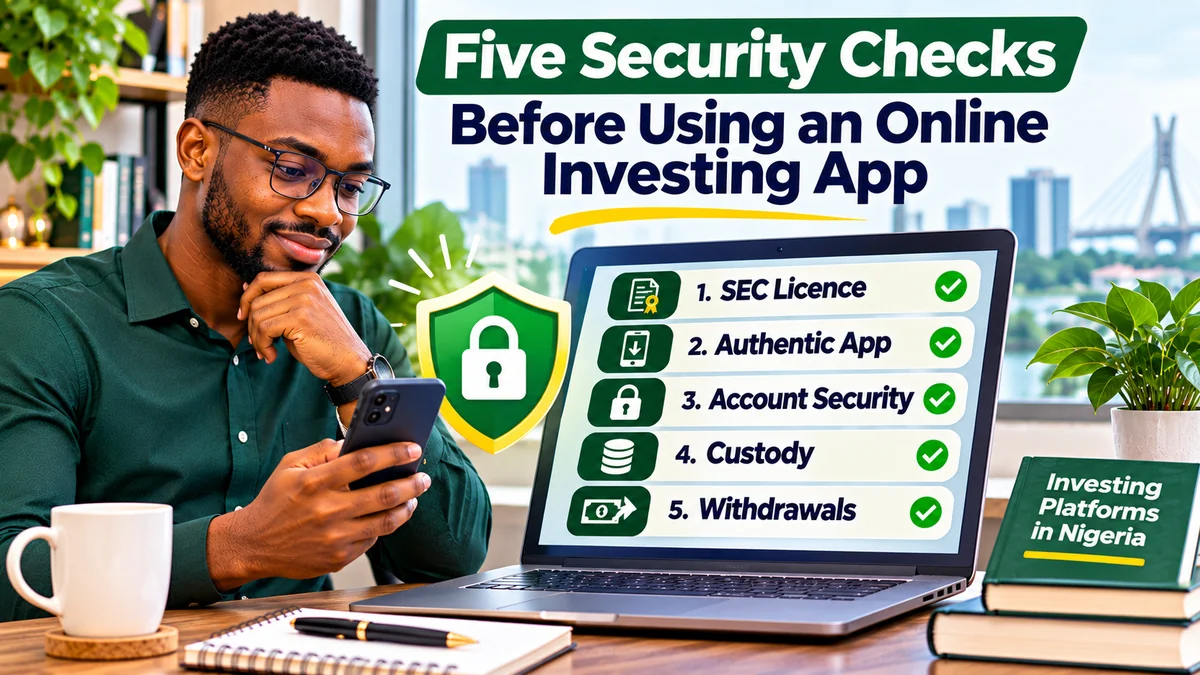
Before you transfer money to an online investing app in Nigeria, verify the operator's authorisation, confirm the app is genuine, secure your account, understand where your investments are held, and check how withdrawals actually work. Those five checks are more useful than trusting a polished interface, an influencer's testimonial or the promise of impressive monthly returns.
Many investing platforms give ordinary Nigerians easier access to shares, mutual funds, bonds and other financial products. But an app is only the interface. Its legal operator, permissions, custody partners, technical security and cash-handling procedures determine what happens when you invest—or when something goes wrong.
The Securities and Exchange Commission (SEC) warned in May 2026 that unregistered investment schemes were being promoted through WhatsApp, Telegram, Instagram, Facebook, TikTok and other digital channels. In October 2026 , the regulator also issued a notice about a specific unregistered platform. These are reminders that an online presence is not evidence of authorisation.
This is a practical five-step safety check for investing platforms, written for first-time and experienced Nigerian investors. It includes a 10-minute pre-deposit review, real-world warning signs and an action plan if your account or payment is compromised. Sources checked on 16 November 2026; status and terms can change.
The five checks at a glance
| Security check | Question to answer | Evidence that matters |
|---|---|---|
| 1. SEC authorisation | Which legal company may offer this exact investment service? | Matching company name, current activity and status on SEC records |
| 2. Authentic app and website | Am I dealing with the genuine platform rather than an impersonator? | Official site, developer/publisher identity, consistent domain and safe install source |
| 3. Account and device protection | Could a stolen phone, password or OTP expose my money? | Strong authentication, alerts, recovery controls, minimal permissions and updates |
| 4. Custody and ownership | Where is my asset recorded, and can I verify my claim independently? | NGX/CSCS evidence, fund trustee/custodian documents or relevant foreign custody agreements |
| 5. Funding and withdrawals | Can I trace payments and understand how to exit, including all costs? | Verified beneficiary, fee schedule, redemption rules, test transaction and complaint process |
A failed core check should stop your deposit. High reviews, low fees and attractive yields should not override an unresolved licensing or ownership concern.
Security check 1: Verify SEC registration and the exact permission
Nigerian investment businesses may operate as brokers, digital sub-brokers, fund managers, investment advisers, trustees, custodians, crowdfunding operators or other regulated intermediaries. The relevant authorisation depends on what the company actually does—not on whether it has an app or advertises itself as a fintech.
Start at the SEC's Find a Registered Operator directory. Use the registered legal entity name from the app's terms of service or account documents, not just a brand name. Check whether its recorded role corresponds to your proposed transaction. For example, investment advice, custody and dealing in listed securities are not automatically interchangeable permissions.
The SEC's fintech operators directory provides categories for digital sub-brokers, portfolio managers, robo-advisers and businesses operating through regulatory-incubation frameworks. That is useful for newer app-based services, but the status requires interpretation. In a 2 July 2026 announcement , the SEC explained that approval-in-principle under the Accelerated Regulatory Incubation Programme is conditional and not a final licence.
A four-step verification test
- Find the app's full company name, registration jurisdiction, address and statement of regulated services.
- Search the official SEC operator and fintech records independently, then confirm the correct firm and authorised function.
- If the platform executes Nigerian listed-share orders, also check the underlying dealer against the NGX trading licence-holder directory .
- Review the SEC's scam alerts for warnings. If details conflict, seek confirmation from SEC through contacts found on its official website before funding.
A CAC incorporation certificate is not an SEC investment licence. Neither are an app-store listing, an influencer's assurance, a photograph with a public official or a certificate that cannot be checked against a regulator's real records. A foreign brokerage arrangement calls for verifying the actual overseas broker or custodian and its relevant regulatory status as well; a foreign licence should not be treated as permission for every Nigerian capital-market service.
Red flag: the app refuses to identify the legal investment operator, cites an unrelated corporate-registration number or claims “fully SEC approved” while its record shows a different function or conditional incubation status.
Security check 2: Confirm the app, website and contact channels are genuine
Even when a legitimate financial institution exists, a fraudster can create a look-alike website, social-media account or mobile app that uses its name. This is different from investment-market risk: it is an impersonation and credential-theft problem.
Start at the financial company's independently verified website. If it links to an app-store listing, open that listing directly and compare the publisher, spelling, product description and privacy information. A search result or sponsored advertisement alone is not proof that you have reached the correct business. On Android, Google Play Protect can scan for potentially harmful software and flag applications that misuse sensitive permissions, but this does not establish a company's SEC authorisation or guarantee that every app is safe.
Avoid APK installation packages sent through WhatsApp, Telegram or unsolicited text messages, particularly when the sender insists you disable security warnings. Review requests for SMS access, accessibility services, notification reading, contacts and device-administration privileges. An investing application may legitimately need limited information for identity verification or account access, but a request to read every text message or remotely control the phone deserves serious scrutiny.
Spot phishing, smishing and fake support agents
Phishing uses deceptive email or websites; smishing uses text messages; and vishing uses phone calls. In its April 2026 investor alert , the US SEC described how attackers impersonate financial firms to obtain passwords, authentication codes and other financial information. Its safeguards are useful to investors worldwide, though its legal complaint and compensation systems are US-specific.
If someone says your account must be verified urgently using a link, do not click reflexively. Instead, open the official app yourself or type the company's verified domain manually. Call a number obtained from the legitimate website rather than a number included in the suspicious message. Check the entire domain: a familiar name in the middle of a long address does not establish ownership. HTTPS is necessary for secure transport, but it does not prove the site belongs to the genuine operator.
Red flag: a support agent demands a password, bank PIN, one-time password (OTP), remote-access installation or an immediate transfer to “reverify” your investing account.
Security check 3: Test account protection before adding money
A genuine, regulated investment platform can still become a target for credential theft, account takeover or unauthorised withdrawals. The question is whether you and the provider have practical defences.
Use a unique, strong password or passphrase not reused on your email, bank or social accounts. If the app supports passkeys, they may offer stronger protection against phishing by binding authentication to the legitimate service. Enable multifactor authentication (MFA), preferably an authenticator or passkey-based method where available. SMS codes are better than relying solely on a password, but they can be affected by phone loss, number recycling, phishing or unauthorised SIM swaps.
The US SEC's April 2026 online-account protection bulletin recommends account alerts for logins, password changes, changed contact details, trades and transfers, as well as regular review of statements. These are sensible checks for Nigerian investors too, regardless of the country's separate regulatory framework.
Security features worth checking
- MFA and recovery: Can you enable a second authentication factor? How is a lost device recovered, and what stops a stranger from resetting the account?
- Withdrawal protection: Does adding a new bank account trigger extra verification and an alert? Can suspicious cash-outs be paused?
- Session management: Can you review signed-in devices and end unfamiliar sessions?
- Activity alerts: Are trades, withdrawals, password changes and new-device logins visible promptly?
- Device hygiene: Does the app run on a supported, updated operating system? Can you protect the phone with an effective screen lock?
- Privacy: Does the app explain why it collects identifiers such as NIN or BVN, how it stores them and which partners receive them?
Do not publish screenshots containing your complete account number, BVN, NIN, CHN, email security codes or bank details to troubleshoot a problem publicly. Keep copies of account statements in secure storage and use the app's formal support process.
Red flag: a provider allows password resets or bank-beneficiary changes using only information an attacker could easily obtain, and offers no meaningful alerts or user-controlled recovery options.
Security check 4: Verify custody, asset ownership and independent records
A dashboard showing ₦250,000 in “portfolio value” is a screen display. It does not by itself explain what legal asset you own, who holds it or what happens if the platform closes. This is the most important structural check many first-time users skip.
For NGX-listed Nigerian shares, ask for the name of the executing broker and your relevant depository records. The NGX directory lets investors check trading licence holders, while CSCS's Online Portfolio View offers eligible investors independent access to holdings and transaction information linked to a registered Clearing House Number (CHN). A broker confirmation and independent records should reconcile; a difference needs explanation, not another deposit.
For mutual funds, identify the exact fund, the manager, trustee, custodian and unit-holder record system. Ask for the offer documents and redemption procedures. The custodian and trustee perform distinct functions; their existence helps structure oversight but cannot guarantee a positive investment return or immediate liquidity.
For foreign shares, the platform may rely on a separate foreign broker, clearing firm or nominee. Request the legal name and jurisdiction of these entities, the nature of your beneficial interest, whether fractional shares are transferable, and the protection or insolvency rules applicable to your actual account. A screenshot of “US stock ownership” is not the same as a direct entry on the US issuer's register.
For crypto or tokenised assets, find out whether assets are held by the platform or a third-party custodian, who controls the relevant keys, whether customer assets are segregated and what loss-recovery provisions exist. The regulated status of one digital-asset provider does not make all tokens safe or guarantee recovery from hacks.
Questions to ask the platform
- Which entity legally holds my money and underlying investments?
- Can I download an official contract note, unit statement or custodian/depository confirmation?
- Are customer assets segregated from the operator's own assets, and how is this documented?
- Can my holding be transferred out to another eligible broker or custodian?
- What happens to my assets if the app, broker or custodian ceases operations?
Red flag: the company says “your funds are fully secured” but will not name its broker, fund, custodian or asset register, or explain what rights an investor would have after the service stops working.
For a practical example of how investing can be distributed through familiar mobile channels, FlyingEze previously reported on mobile access to mutual funds through FCMB . That news does not substitute for reviewing any particular fund's current documents.
Security check 5: Verify the payment destination, costs and withdrawal route
The final check is operational: where does the money go, what will it cost, and how do you get it back when you are entitled to withdraw? An app can pass superficial identity checks while its funding and exit arrangements remain unclear.
Do not pay a personal bank account or cryptocurrency wallet merely because a recruiter or social-media “account manager” provides it. Verify the beneficiary named in the app's legitimate funding instructions and how it relates to the authorised operator or payments partner. Name mismatches should be explained in writing through the provider's official support channel before you send funds.
Read the fee schedule before making your first investment. Fees can include brokerage, market and settlement charges, fund expenses, currency conversion, deposit costs, withdrawal charges, penalties for early redemption, and applicable taxes. For cross-border products, an advertised zero commission can coexist with an FX spread. For funds, a redemption date is not necessarily a same-day cash payment.
Where feasible and permitted, start with a modest amount appropriate for your circumstances and verify that transaction receipts, account records and the published withdrawal process function as described. A small test withdrawal does not prove a platform is legitimate: some fraud schemes deliberately permit early payments to build trust. It is an operational check, not a replacement for licensing or independent custody verification.
Ask what happens if a transaction fails, if an instrument is illiquid or if the platform is unavailable during trading hours. Look for written complaint procedures, timeframes and contract terms. Avoid promises that all investors can withdraw instantly regardless of the underlying asset.
Red flag: a representative asks for unexpected “tax clearance”, “profit release”, “account upgrade” or “verification” payments to a separate personal account before allowing you to withdraw an apparently earned balance. The SEC's January 2026 warning about an unregistered scheme specifically describes misleading regulatory claims and withdrawal problems.
What these five checks look like in real-life situations
Scenario 1: An investment link arrives in a WhatsApp group
You see an app promising 8% returns every week and a referral bonus when friends register. The promoter sends a short payment deadline and calls the company “SEC certified”. Do not transfer money. Check the exact legal entity against SEC records, identify the investment being offered and verify where assets would be held. Unrealistically steady gains and recruitment pressure are major warning signs; the SEC's 2026 notice specifically targets unregistered social-media schemes.
Scenario 2: A legitimate broker's name appears on a fake login page
A message says you must confirm your account with an OTP. The displayed sender resembles an authentic broker, but the link opens a different domain. Close it without entering details, navigate through the company's verified website and contact support through the official number if needed. A real company can have fake impersonators.
Scenario 3: A stock-investing app will not show any independent holding record
You made a purchase of Nigerian listed shares, but the provider refuses to name the executing broker or explain why a relevant CHN or CSCS record is unavailable. Pause further funding and obtain an explanation and supporting trade documents. Some products may be held through different structures, but the operator should be able to identify the one you actually purchased.
Scenario 4: A new phone suddenly loses network service
You can no longer receive SMS codes and see an unrequested password-reset notification. It may be a telecom fault, but a SIM-swap attempt is also a possibility. Contact the mobile network and the investment provider promptly using verified channels, secure the linked email account, and consider temporarily restricting withdrawals if the provider offers that option. Do not share verification codes with a caller who claims to fix the signal.
Scenario 5: You can buy easily but cannot understand the exit
An app advertises a fund with high returns but provides no redemption timetable or information about penalties. Ask for the fund's full name, governing documents, valuation method, custodian and applicable charges before subscribing. Ease of purchase is not evidence of liquidity or capital protection.
Security versus investment risk: know the difference
An app can be technically well protected and correctly regulated while an investment still loses value. Conversely, a fraudulent service might show fake account gains without ever purchasing an investment.
| Risk | Example | What helps |
|---|---|---|
| Fraud and impersonation | Fake platform, cloned website or unauthorised investment solicitation | SEC verification, authentic domain and payment-recipient checks |
| Account takeover | Stolen login, phishing or SIM-swap-related recovery | Unique password, stronger MFA, alerts and rapid reporting |
| Custody and record risk | Operator fails to hold or evidence customer assets as represented | Independent broker, depository, fund and custody records |
| Market risk | A stock, fund or bond loses value despite proper custody | Product research, diversification, suitable time horizon and risk awareness |
| Liquidity risk | No timely buyer or a fund delays permitted redemption | Understand terms, settlement, lock-ups and underlying assets |
Neither a SEC-regulated platform nor two-factor authentication guarantees a profit. Likewise, a Nigerian stock or ordinary fund holding should not be described as an insured bank deposit. Evaluate both the safety of the intermediary and the inherent risk of the product.
A 10-minute pre-deposit review you can repeat
Use this as a short practical workflow—not an assurance that due diligence always takes only 10 minutes. If questions remain unresolved, take as much time as necessary and do not send funds.
- Minutes 1–2: write down the product, exact operator legal name and the web domain you intend to use.
- Minutes 3–4: check SEC registration, authorised role and relevant NGX or foreign broker information. Save the verification source.
- Minutes 5–6: reach the app from its verified official website; inspect publisher, login and account-protection options.
- Minutes 7–8: locate investor documents, custody details, fees, asset records and redemption rules.
- Minutes 9–10: verify the payment beneficiary, complaint contacts and how to get evidence of a trade or withdrawal.
If one of these five checks fails, the outcome is “pause and verify”, not “invest a smaller amount and hope”. For context about wider capital-market and app-operational risks, FlyingEze has reported on the infrastructure pressures surrounding a major Nigerian IPO . Operational capacity is a separate issue from an investor's legal ownership and account security.
What to do if you have already deposited into a suspicious app
- Stop sending additional funds. Do not pay extra fees demanded by a stranger to release a balance or investigate a supposed frozen account.
- Preserve evidence. Keep the company and domain details, payment receipts, transaction IDs, chat histories, account statements and advertisements, without posting sensitive identifiers publicly.
- Secure linked accounts. Change passwords on trusted devices, revoke suspicious sessions, enable MFA and contact your bank quickly if payments or credentials may have been compromised.
- Contact the genuine operator. Use verified support contact information; request a written explanation and reference for the complaint.
- Report suspected capital-market misconduct. Follow the SEC's information for harmed investors , which recommends collecting records and submitting a complaint through official channels.
- Consider appropriate legal or law-enforcement help. Especially where theft, identity abuse or substantial financial loss is suspected.
Acting quickly can improve your ability to document and report the incident, but no regulator, recovery service or private agent can guarantee that lost money will be returned. Beware of secondary “recovery scams” in which someone demands a fee to trace or release investments.
FlyingEze has reported on EFCC enforcement developments involving a Ponzi scheme and official warnings about investment scams . These reports illustrate why an investor should investigate the legal operator and underlying asset before paying, not after withdrawals fail.
Frequently asked questions
How do I know whether an investment app is safe in Nigeria?
Check the exact legal operator and its authorisation on SEC records; confirm the app's authenticity; review MFA, device and account safeguards; independently verify custody and ownership; and examine payments, fees, redemption rules and complaints. No single feature guarantees safety.
Does an SEC licence mean my investment is guaranteed?
No. Regulation can provide supervisory protections and recourse processes, but it does not prevent market losses, issuer defaults or all operational failures. Verify the actual product and risks.
Can a fake investment app appear in an official app store?
App stores use security checks, but no store listing is a guarantee of regulatory authorisation or freedom from impersonation. Compare the developer and listing with links from the real operator's independently verified website.
Why should I use two-factor authentication?
MFA can make it harder for someone with only your password to enter your account. Where supported, passkeys or authenticator-based methods may help reduce dependence on SMS. Maintain secure recovery methods as well.
Should an investing app ask for BVN or NIN?
A regulated financial provider may need identity information for appropriate know-your-customer checks, but confirm the legal operator, privacy notice and authenticated collection channel first. Never send those details to informal recruiters or an unverified WhatsApp account.
What is a CHN in Nigerian investing?
A Clearing House Number is an identifier associated with relevant securities depository records. CSCS provides eligible investors with ways to review shareholdings and account information. Whether it applies depends on the investment product and custody structure.
Is a test withdrawal enough to prove a platform is legitimate?
No. A successful small withdrawal may confirm some operational functionality, but a fraudulent scheme can deliberately process early payments. It cannot replace regulator verification, legal-product documents or independent custody evidence.
What if the platform is registered abroad?
Verify the exact foreign brokerage or custodian, its regulator and the legal terms of your account. A foreign licence should not be interpreted as a universal Nigerian approval or a guarantee that foreign compensation schemes cover your particular investment.
Are guaranteed daily or weekly returns a warning sign?
Yes. Implausibly high or fixed returns without a credible underlying product and risk explanation are major warning signs, especially when referrals or urgent deposits are emphasised. SEC Nigeria issued broad warnings about unregistered online schemes in May 2026.
How do I report suspicious investment activity?
Preserve records, contact the operator through verified channels, notify your bank if payment security is involved, and use the SEC's official complaint or harmed-investor guidance for issues within its jurisdiction. Consider law-enforcement or legal assistance as warranted.
Conclusion: do not let convenience replace verification
The best online investing experience combines convenience with real legal and technical safeguards. Before using an app, verify the SEC-authorised entity, confirm the software and domain are genuine, protect your login, establish who holds the assets, and understand exactly how money enters and leaves the system.
If those details cannot be verified, delay the transaction. Legitimate investing platforms should be able to explain their legal identity, product, risks, custody, costs and complaint procedures without pressuring you to decide immediately. A colourful dashboard is useful; independent evidence is more important.
Editorial note: This guide was researched on 16 November 2026 using SEC Nigeria, NGX, CSCS, Google Play and US SEC investor-protection materials. US cybersecurity guidance is cited for general safety practices, not as Nigerian law. None of the hypothetical examples endorses or certifies a particular app. This article provides general consumer education, not personalised financial, legal or tax advice.



