How to Write a Strong Industrial Training Application and Technical CV
A strong industrial training application tells an employer four things quickly: who you are, the attachment you need, when you can participate and what practical skills you can contribute while learning. Your technical CV then proves those claims through coursework, projects, tools and verifiable results. For students searching for a NITDA internship in Nigeria or a placement at another technology organisation, a clear application and credible portfolio are more useful than an exaggerated list of programming languages.
First, understand the status of the opportunity. The Industrial Training Fund's official SIWES portal describes the Students Industrial Work Experience Scheme as a structured programme for students to gain practical workplace experience. NITDA's Idea to Impact platform acknowledges industrial training students and NYSC corps members in its activities. That does not establish that NITDA has a general internship application open today. Its careers page displayed no employment vacancies when checked; employment recruitment and academic industrial attachment are different processes.
This guide explains how to prepare a credible industrial attachment letter, write a student-friendly technical CV, select project evidence, avoid unsafe applications and handle institutional paperwork. Information verified 4 November 2026.
Understand the placement before writing anything
Ask your department's SIWES coordinator which organisations are suitable, what introduction letter is required and the dates approved for your course. The ITF student guidance tells students to attend their institution's orientation, follow attachment rules and complete the Student Commencement Attachment Form (SCAF), logbook and ITF Form 8 where applicable. The institution guidance gives universities, polytechnics and other institutions responsibility for coordinating placements and supervision.
The placement process differs from a casual vacation internship or an NYSC place of primary assignment. Before you draft, check:
- Whether the organisation actually accepts students for industrial attachment and through which verified channel;
- Whether the placement is part of SIWES, another departmental requirement or a separate internship;
- Your programme, level, permitted attachment period and exact available dates;
- Whether the school needs to approve the host and issue an introduction letter;
- Whether the host requests a CV, academic transcript, portfolio or other documents; and
- Whether attendance is physical, hybrid or remote, and what supervision is provided.
Do not submit an application based only on an old news story or social-media flyer. Where no open intake is published, a polite enquiry about eligibility is appropriate, but it should not be presented as an official application.
What should an industrial training application letter contain?
Keep the letter concise and tailored to the organisation. A one-page letter is a useful default for a student, although a host's own format takes precedence. The purpose is not to repeat every line of your CV; it is to make a specific, supportable case for the attachment.
| Part | What to include | Common mistake |
|---|---|---|
| Contact and subject | Your name, reachable email, telephone, date and specific attachment request | Sending to an unverified address or writing “Job needed urgently” |
| Opening | Institution, course, level and exact proposed period | Forgetting dates or assuming the reader knows your programme |
| Relevant skills | Two or three truthful capabilities tied to the organisation's work | Claiming expert knowledge of tools you have never used |
| Evidence | One or two projects with your contribution and outcome | Listing technologies without showing anything built |
| Learning interest | What you hope to practise and how you can assist under supervision | Demanding a particular department or promising unrealistic results |
| Close | Polite request, attachments and contact availability | Pressuring the employer or treating silence as acceptance |
Address a named official if the organisation supplies one. Otherwise, use an appropriate neutral designation, such as “The Industrial Training Coordinator” or “The Human Resources Team”. Do not invent the name of a department or a staff member.
Sample industrial training application letter for a technology student
This illustrative template is adaptable for a software company, IT department or verified NITDA-related opportunity. Replace every bracketed field and remove any skills or project claims that are not true. It is not an official NITDA form.
Subject: Request for SIWES Industrial Attachment — [Course], [Start Month–End Month]
Dear [Verified recipient or Industrial Training Coordinator],
I am [Full Name], a [Level] student of [Course] at [Institution]. I am writing to request consideration for an industrial training placement with [Organisation] from [Start Date] to [End Date], subject to my institution's SIWES requirements and your placement availability.
My studies and practical projects have introduced me to [two relevant skills or tools]. In a recent [project name], I [specific task you personally completed], which helped me develop [relevant technical skill]. I have included a short project description and a link to supporting work in my CV.
I am particularly interested in learning how your team approaches [specific, verified work area]. I would welcome the opportunity to assist with suitable tasks, learn from assigned supervisors and maintain the records required by my institution.
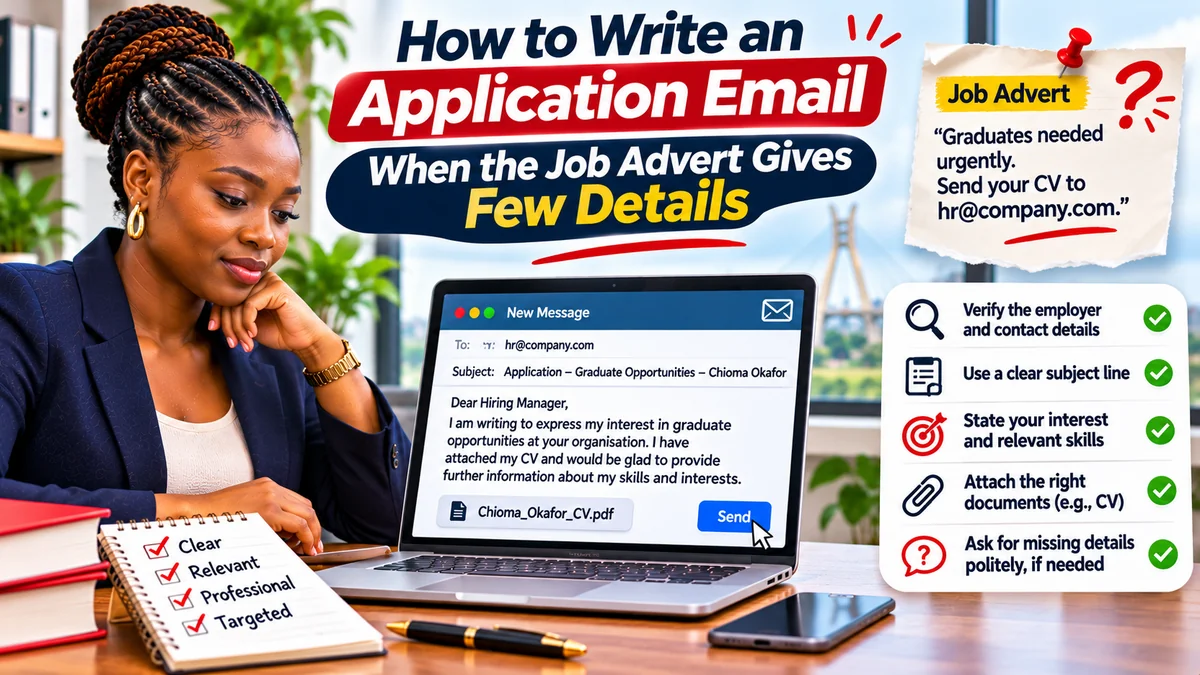
My CV is attached. I can also provide an institutional introduction letter and other approved documents if requested. Thank you for considering my enquiry. I would appreciate information about whether placements are available and the appropriate next steps.
Yours faithfully,
[Full Name]
[Telephone]
[Professional email]
Personalise the central paragraph. For a company building web applications, mention a small tested web project. For an analytics team, explain the dataset, cleaning steps and what your analysis actually found. For embedded systems, describe a low-voltage prototype or simulation. Do not claim to have worked at NITDA, NCAIR or any organisation unless you genuinely did.
How to build a strong technical CV without previous employment
A student can have a credible technical CV without holding a formal job. Academic projects, practical assignments, supervised volunteering, open-source contributions and demonstrable personal work may all show relevant capability.
Harvard's career guidance recommends tailoring a CV or résumé to the role, using clear section headings, action verbs, consistent formatting and honest evidence of outcomes. Its 2026 industry résumé advice explains a useful project–action–result framework for describing work. A clean one-page CV is often enough for an early-stage applicant; use more space only when the material genuinely warrants it or the organisation asks.
A practical CV section order
- Name and contact: full name, professional email, reachable telephone, city/state and relevant working portfolio link.
- Profile: two or three lines stating your discipline, level, interests and truthful strengths.
- Education: institution, programme, expected completion date and highly relevant courses.
- Technical skills: programming, frameworks, data tools, design or hardware you can demonstrate.
- Selected projects: the problem, your role, tools and outcome; include accessible links where useful.
- Experience or activities: volunteering, school tech teams, hackathons or prior authorised placements.
- Training or awards: relevant courses or recognitions you have actually completed or earned.
Move the most relevant evidence towards the top. A data-analysis applicant might show an SQL or Python project before unrelated part-time experience; someone seeking network support training might highlight basic troubleshooting and supervised lab practice. Your CV should reflect the placement, not a generic list designed for every job.
Copy-ready technical CV example
The following is an invented example for a student. Do not copy the fictional achievements as personal facts; replace them with your own experience and remove unsubstantiated measures.
[FULL NAME]
[City, State, Nigeria] | [Phone] | [Professional Email]
GitHub: [Verified Portfolio URL] | LinkedIn: [Optional URL]
PROFILE
[Level] [Discipline] student at [Institution] seeking a
supervised industrial attachment from [Start] to [End].
Interested in [specialisation]. Built and documented
beginner projects using [tools you genuinely know].
EDUCATION
[Qualification in progress], [Institution]
Expected completion: [Month Year]
Relevant coursework: [2–4 applicable subjects]
TECHNICAL SKILLS
Languages: [Python, JavaScript, etc. if genuinely used]
Tools: [Git, SQL, Figma, Linux, etc. if genuinely used]
Concepts: [Testing, data cleaning, APIs, networking, etc.]
SELECTED PROJECTS
[Project title] — [Month Year]
- Built [what you made] to solve [defined problem].
- Used [your actual tools] to implement [specific feature].
- Tested [specific behaviour] and documented [result].
- Evidence: [Safe public repository or demonstration URL]
[Second project title] — [Month Year]
- Analysed/designed/configured [specific task].
- Explained [real output or learning] in documentation.
ACTIVITIES / EXPERIENCE
[Student developer, volunteer, team role if applicable]
- Supported [actual task] and contributed [actual result].
RELEVANT TRAINING
[Completed course or certificate, issuer, date]
AVAILABILITY
Industrial attachment: [Verified start and end dates]
Do not include a passport photo, date of birth, religion, marital status, identity numbers or bank details in a general technical CV unless a legitimate organisation specifically requires relevant information at an appropriate stage. The ITF's official instruction to submit certain bank details through school SIWES coordinators applies to SIWES administration, not to unsolicited CVs.
Write project bullets that prove skills instead of just naming them
The difference between a weak CV and a persuasive one is often the evidence attached to each claim. Begin with an accurate action verb, identify the problem or task, explain your contribution and record a verifiable result.
| Weak or vague | Stronger, if true |
|---|---|
| “I know Python.” | “Built a Python script to validate and summarise a sample student-results dataset; documented the input checks.” |
| “Experienced with websites.” | “Created a responsive three-page site using HTML, CSS and JavaScript and tested the mobile layout.” |
| “Worked on a group project.” | “Implemented the search interface for a four-person school project and presented the testing results.” |
| “Expert in data analysis.” | “Cleaned a public dataset with Python and produced charts explaining two observed trends and their limitations.” |
Use numbers when they are measured and meaningful: dataset size, number of completed test cases, pages designed or response-time improvement based on an actual benchmark. Never invent “40% faster” or “500 users” to make a student project appear professional. Explain if a project used sample data rather than live customer records.
For public code portfolios, provide a working README, setup requirements, sample screenshots where permitted, test instructions and a clear note about your contribution. Remove API keys, customer records, secrets and private institutional materials. A broken link or private repository that reviewers cannot open adds little value.
Tailor your CV to the technical learning area
NITDA's capacity-building guidance lists software development, data analysis, quality assurance, UI/UX, cybersecurity, cloud computing, AI and related skills under broader digital talent initiatives. These are useful examples of the skills a tech applicant might develop, not a confirmed list of available departments for an internship.
| Target learning area | Useful evidence | What not to claim |
|---|---|---|
| Software development | Functional app, Git history, README, tests | Production expertise from an untested tutorial |
| Data analysis | Cleaned dataset, SQL queries, notebook or dashboard | Unverifiable predictions or invented datasets |
| Cybersecurity | Authorised lab exercises, secure configurations, safe write-ups | Unauthorised testing of live systems |
| UI/UX | Problem statement, wireframes, prototypes, user feedback | Claimed user research that was never conducted |
| Networking or IT support | Basic network lab, troubleshooting record, diagrams | Administrator access you have never held |
| Embedded systems | Low-voltage sensor or microcontroller prototype | Advanced laboratory access without evidence |
Choose quality over quantity. Two well-documented projects closely matched to the opportunity can be more persuasive than a long skills list that cannot survive a short technical discussion.
How to submit the application professionally
Follow the host organisation's actual procedure. If it asks for a portal application, do not assume an email is an acceptable substitute. If an administrator confirms that enquiries are welcome, an appropriately brief email can introduce your interest and request guidance.
A clear email subject might be “SIWES Placement Enquiry — Computer Science Student — May–August 2027”, but use your real dates. Attach only the requested files and use descriptive filenames such as firstname-lastname-technical-cv.pdf and firstname-lastname-siwes-letter.pdf.
PDF is often convenient for preserving formatting, but use DOCX or another format if expressly requested. Keep layout simple enough for human readers and applicant-tracking systems: consistent headings, selectable text and standard fonts; avoid scanned images of the whole CV, excessive graphics or difficult multi-column tables. No formatting trick guarantees automated shortlisting.
Check the destination, attachments, phone number and links before pressing send. Keep a respectful record of submission and follow up once after a reasonable period if the organisation has not specified a response timeline. Avoid repeated daily messages or contacting staff through personal accounts without invitation.
What documents are genuinely required for SIWES?
Separate application preparation from formal attachment administration. A potential host may ask for a CV and school introduction letter to assess a request, while the ITF's documented forms are used for approved SIWES placement and assessment.
According to the ITF student page , students should attend orientation, have the SCAF endorsed as required, complete a logbook and use ITF Form 8 for assessment. The ITF resources page provides the relevant forms and logbook sample. The precise order and institutional instructions should be confirmed with your SIWES coordinator.
Protect personal information: although the ITF mentions providing bank information through school coordinators for official SIWES procedures, that is not a reason to attach your bank statements, BVN, PIN, password or unrelated identity documents to a speculative internship enquiry.
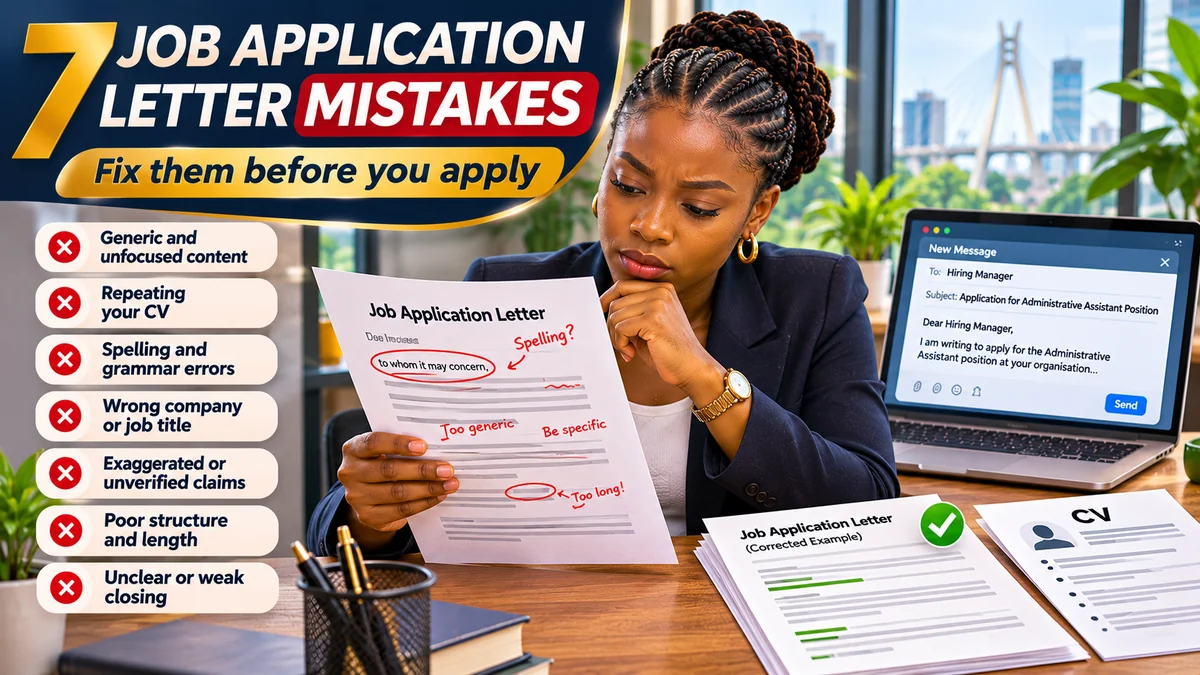
Seven mistakes that weaken an industrial training application
- Using the same letter for every organisation: the reader should understand why your skills and interests relate to the actual host.
- Leaving out availability: without accurate attachment dates and institutional status, a host cannot judge practical fit.
- Claiming skills you cannot demonstrate: use truthful beginner descriptions and link to relevant work.
- Sending an overloaded CV: focus on education, projects and applicable activities rather than unrelated personal details.
- Including insecure portfolio content: remove secrets, client data and private files before sharing a repository.
- Ignoring your institution's process: a host's informal willingness does not necessarily satisfy SIWES approval and supervision requirements.
- Trusting fake recruitment notices: verify the opportunity rather than paying a supposed agent for guaranteed placement.
NITDA has previously warned about fraudulent recruitment websites . That historical warning is especially relevant to students searching generic terms such as “NITDA internship application form”. Do not infer a new recruitment process from an imitation domain, an unofficial form or a recycled advert.
A final application quality checklist
| Check | What passing looks like |
|---|---|
| Eligibility | Institution confirms the attachment requirement and proposed dates |
| Opportunity | Host and submission channel verified from credible sources |
| Letter | Specific purpose, course, dates, learning fit and polite request |
| CV | Readable contact details, education, relevant skills and projects |
| Evidence | Portfolio links work; contributions and outcomes are honest |
| Documents | Only requested attachments, correct filenames and safe personal data |
| Review | Spelling, dates, name, links and attachments checked |
| Follow-up | Submission record retained; coordinator informed where required |
Ask a trusted lecturer, SIWES coordinator or experienced developer to review the application. A short review for factual accuracy, clarity and broken links is often more useful than adding fashionable keywords.
Frequently asked questions
Can I apply for SIWES without previous work experience?
Yes. SIWES is designed to expose students to practical work, so relevant coursework, lab exercises, honest beginner projects and a willingness to learn can form the core of a student CV. Follow your institution's approval process.
How many pages should a technical CV for industrial training have?
One concise page is a reasonable starting point for a student with limited experience. A second page can be justified by substantial relevant projects or host requirements. Clarity matters more than a rigid universal page count.
Should I address my letter to the NITDA Director-General?
Not automatically. Follow the official opportunity's instructions or use the department or coordinator specified by the institution or host. Do not invent a named recipient or assume NITDA is accepting general internship letters.
Do I need a GitHub account?
Not universally. GitHub can help demonstrate coding projects, but a suitable accessible portfolio, project documentation or supervised assignment may work for non-coding disciplines. Follow the host's stated requirements.
Is there an official NITDA internship application deadline?
No currently open general-public deadline was established by the sources reviewed on 4 November 2026. NITDA's public careers page is not an SIWES intake announcement. Verify any specific placement through the institution and official host channels.
Can AI write my application?
AI can help organise and proofread a draft, but verify every statement, adapt it to your actual work and remove invented achievements. Do not share private credentials or other people's personal data with an application-writing tool.
Conclusion: demonstrate potential without exaggeration
A successful industrial training application does not need to make a beginner sound like a senior engineer. The value of practical digital competence also comes through in FlyingEze's report on why Nigerians need digital skills for economic growth . It needs to make the student's availability, interests, skills and evidence easy to understand. Pair a clear one-page application letter with a readable technical CV, two or three honest projects and the correct institutional paperwork.
For a NITDA internship enquiry or any Nigerian SIWES placement, confirm the host's real process first, tailor the documents second, and submit only through an authorised channel. That approach protects applicants from avoidable mistakes and helps a prospective supervisor see what the student can learn and contribute.