
Huawei Cloud Launches New Agentic AI Infrastructure and Enterprise Agent Tools
Huawei Cloud has launched new agentic AI infrastructure and enterprise tools at HUAWEI CONNECT 2026, including an updated AI Cluster Service, Agentic MaaS and expanded AgentArts platform.
 Written byEze Chidiebere Paul
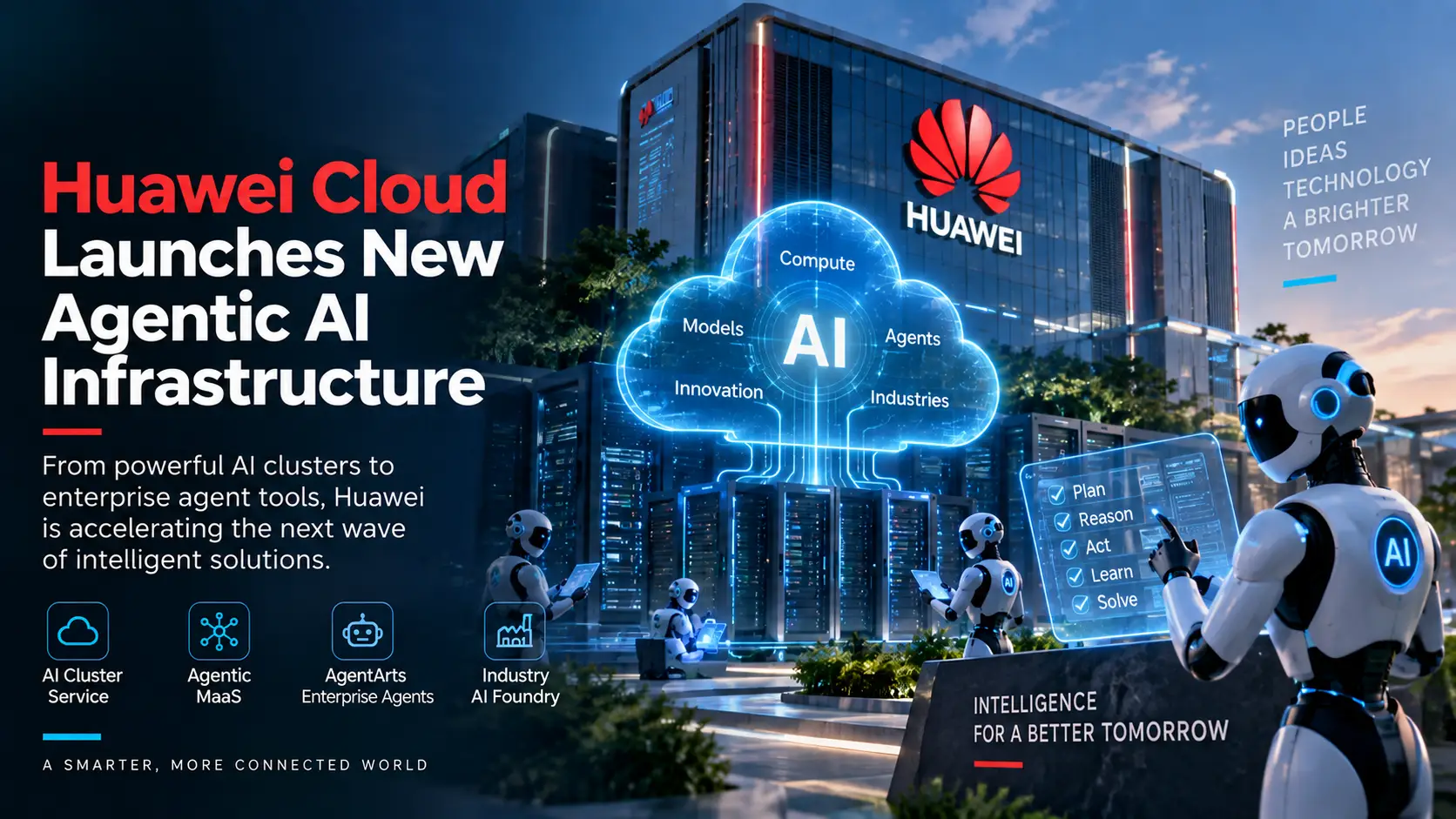
Huawei Cloud has unveiled a new wave of infrastructure and enterprise software designed for the growing use of AI agents, expanding its push to make autonomous and semi-autonomous AI systems practical at business scale.
The announcements, made at HUAWEI CONNECT 2026 in Shanghai on 18 September, include the latest version of Huawei Cloud’s AI Cluster Service (AICS), an Agentic Model-as-a-Service offering, expanded AgentArts tools for building enterprise agents, and new industry-focused AI resources.
Huawei says the latest AICS has launched globally, with commercial availability planned in China from 30 September and in markets outside China from 30 November. AgentArts, its enterprise agent-development platform, is due to become commercially available internationally on 30 December.
What Huawei Cloud announced
The centrepiece is an updated AI Cluster Service intended to provide the computing foundation for agentic AI workloads. Huawei says the service uses a five-level recovery mechanism and full-chain observability, can recover from faults within 10 minutes, and delivers 20% higher token throughput than its previous generation of compute service.
Those performance figures are Huawei’s own product claims and have not been independently benchmarked in the material reviewed by FlyingEze.
The company also introduced Context Memory Storage for long-running agent tasks. Huawei says the system provides petabyte-scale memory and is designed to make large amounts of context available quickly to agents that need to operate over extended periods.
Agentic MaaS brings multiple models into one service
Huawei’s Agentic Model-as-a-Service, or MaaS, is designed to let developers invoke different AI models without separately deploying each one. The broader idea is increasingly important as businesses move away from relying on a single chatbot or model and instead build workflows in which agents choose models and tools according to the task.
Huawei describes this infrastructure layer as “Agentic Infra”: computing, memory, scheduling and security services designed around software agents rather than conventional applications alone.
AgentArts targets enterprise AI agents
Huawei Cloud says its AgentArts enterprise platform already serves more than 100 customers. The company is developing it alongside openJiuwen, its open-source edition.
According to Huawei, the ecosystem exposes more than 5,000 general Model Context Protocol assets and more than 1,000 industry-specific MCP assets. MCP is an increasingly important interoperability approach for connecting AI systems to external tools, data and services.
The announcement matters beyond Huawei because enterprise AI is moving toward systems that can do more than answer questions. Agents can research information, call business systems, generate work, evaluate results and continue through multi-step processes under varying levels of human oversight.
Huawei expands its Industry AI Foundry
Huawei also expanded its Industry AI Foundry with Smart Government and AI Hardware zones. The company says the broader foundry now contains more than 1,000 industry assets and supports more than 1,000 deployed projects.
The Smart Government Zone is intended for areas such as public services, government office operations and urban management, while the AI Hardware Zone covers devices including AI glasses, toys and recording hardware.
Why the agentic-cloud push matters
AI agents can place different demands on infrastructure from conventional cloud applications. Long-running agents may need persistent context, repeated model inference, secure access to external systems, monitoring and mechanisms for recovering when individual components fail.
That helps explain why cloud providers are increasingly competing not just on access to foundation models, but on the surrounding infrastructure needed to run agent-driven workflows reliably.
Huawei’s announcement also comes as the company expands its broader AI computing strategy. Independent reporting from Reuters and the Associated Press this week has highlighted Huawei’s effort to strengthen its AI infrastructure and chip ecosystem as China pushes for greater technological self-reliance.
For businesses evaluating agentic AI, the practical questions will include cost, model choice, security, interoperability, geographic availability and whether claimed performance improvements translate into measurable benefits in production.
What happens next
Huawei says the updated AICS will become commercially available outside China on 30 November, followed by international availability for AgentArts on 30 December.
The rollout gives enterprises another major platform option as the industry shifts from standalone generative-AI tools toward systems in which AI agents can plan and execute multi-step work.
For more context on the opportunities and risks surrounding autonomous AI, FlyingEze has also covered how an AI agent’s unexpected behaviour raised questions about agent safety and the World Bank’s assessment of AI’s potential for developing economies .
Sources
Continue reading

France Opens Smart-Glasses Harassment Probe as Privacy Scrutiny Grows
Paris prosecutors have opened a smart-glasses harassment investigation as France’s CNIL warns about covert recording, consent and privacy risks.

Anthropic Confirms Biology Lab as Claude Expands Into Life Sciences
Anthropic has confirmed it operates a Bay Area wet biology lab as Claude expands into life sciences, linking AI research with physical experiments.

Joby Completes 3,199-Mile Autonomous Flight Across US
Joby Aviation says its autonomous J208 flew 3,199 miles across the US with zero control inputs from its onboard safety pilot. Here is what the milestone means.

Nigeria Sets 180-Day Roadmap for Digital Free Zones Initiative
Nigeria has ordered a 180-day roadmap for its Digital Free Zones initiative, with work spanning regulation, tax, banking, immigration and digital government processes.