
France Opens Smart-Glasses Harassment Probe as Privacy Scrutiny Grows
Paris prosecutors have opened a smart-glasses harassment investigation as France’s CNIL warns about covert recording, consent and privacy risks.
 Written byEze Chidiebere Paul
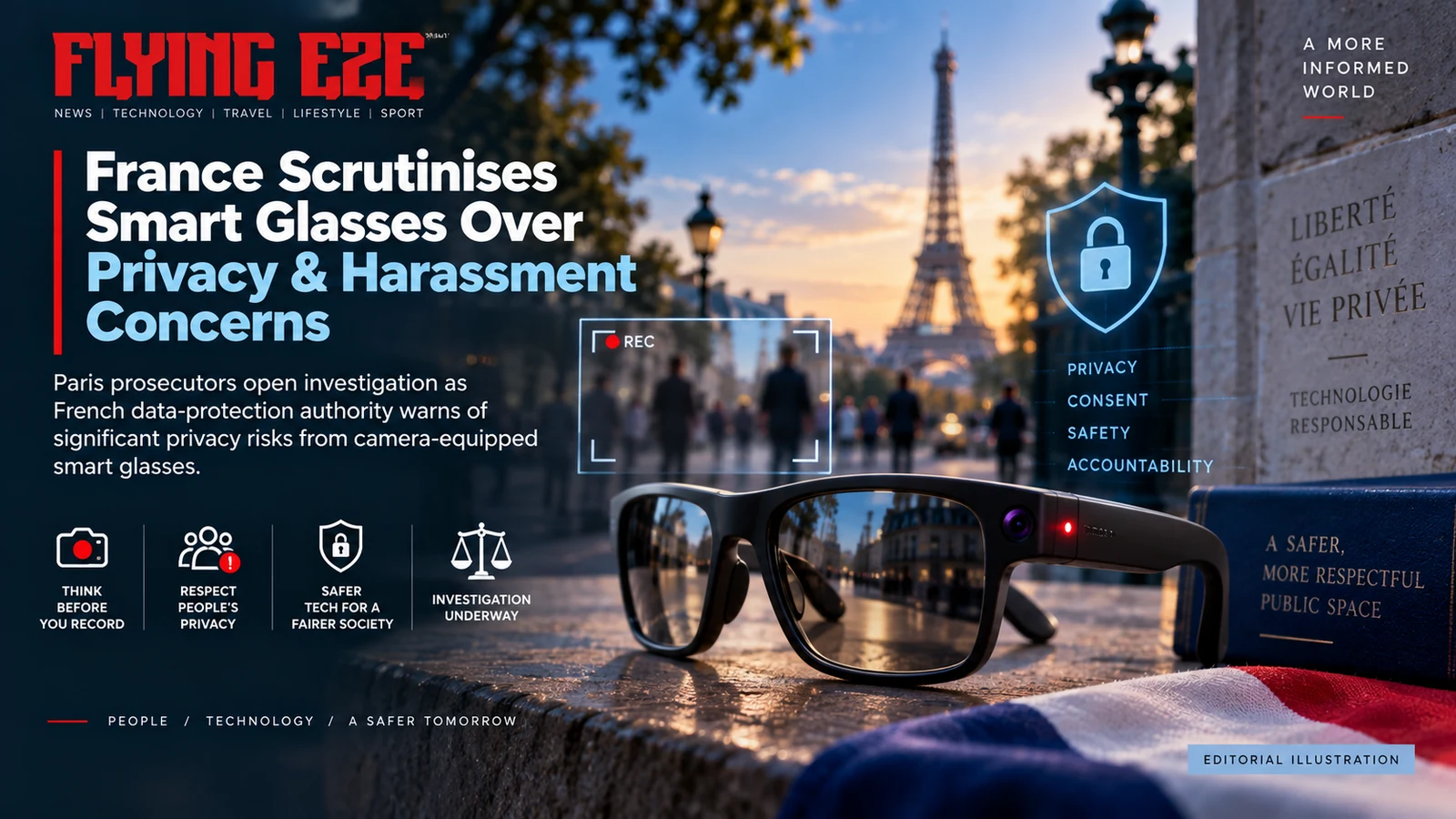
French prosecutors have opened a criminal investigation into suspected sexual harassment involving smart glasses, as France’s data-protection regulator intensifies scrutiny of camera- and microphone-equipped wearables that can record people with little visible warning.
The Paris prosecutor’s office told Reuters on 18 September that it had recently opened at least one criminal probe after complaints linked to a social-media trend in which women were filmed on the street without their consent and the footage was posted online. Prosecutors did not identify the brand of smart glasses allegedly used.
The case comes as France’s data-protection authority, the CNIL, warns that smart glasses create significant privacy risks because their cameras and microphones can capture people nearby without them fully realising that recording is taking place.
Key takeaways
- Paris prosecutors have opened at least one criminal investigation into suspected sexual harassment involving smart glasses.
- The complaints concern women allegedly being filmed in public without consent and the footage being posted on social media.
- Prosecutors have not identified the brand of smart glasses involved in the alleged incidents.
- France’s CNIL says smart glasses can capture images, video and audio in ways that are difficult for bystanders to detect.
- The regulator recommends that users inform people nearby, obtain consent where appropriate and avoid recording in places where people do not expect it.
What French prosecutors are investigating
According to Reuters , the Paris prosecutor’s office said the investigation followed sexual-harassment complaints connected with a trend of using smart glasses to record women in public without their consent and then publishing the videos online.
The office said its cybercrime unit had also tested smart glasses to better understand the types of offences the devices could potentially facilitate.
The investigation remains at an early stage. Opening a criminal probe does not establish wrongdoing, and any allegations must be assessed through the French legal process.
Why smart glasses create a different privacy problem
Traditional cameras and smartphones are usually obvious when somebody raises them to record. Smart glasses can be much harder to distinguish from ordinary eyewear.
Many models contain small cameras and microphones and can activate recording through a button, touch control or voice command. Some also connect to artificial-intelligence systems that can process images, sound or information from the wearer’s surroundings.
That creates a practical consent problem: somebody standing nearby may not know whether the person looking at them is simply wearing glasses or actively recording.
The CNIL warned in June that the technology raises significant questions around image rights, personal data and broader social expectations of privacy.
CNIL says most surveyed French adults see a privacy risk
Earlier in 2026, the CNIL surveyed 2,128 adults representative of the French population. It reported that 67% considered smart glasses a risk to people’s privacy.
The regulator said respondents expressed concerns about consent, misuse of images, AI-assisted manipulation such as deepfakes and what happens to data collected by the devices.
The authority has since launched an action plan to examine the legal and technical implications of smart glasses and says it intends to work with other European data-protection authorities.
What CNIL recommends to smart-glasses users
The French regulator says people using smart glasses should inform those around them when the devices are active and disable functions that are not needed.
It also advises users to avoid using the glasses in places where people would not reasonably expect to be recorded and to obtain consent before using or publishing images and videos in which other people appear.
Those recommendations are especially relevant when content is intended for social media. Once footage is published, it can be copied, redistributed or combined with other data in ways that are difficult to reverse.
Workplaces are also asking questions
Reuters reported that the CNIL has received fewer than 10 complaints concerning smart glasses in workplaces and is increasingly being contacted by businesses asking whether the devices can be restricted or prohibited at work.
For employers, the issue can extend beyond individual privacy. Camera-equipped glasses may expose confidential documents, computer screens, conversations or commercially sensitive information that was never intended to be recorded.
That makes smart glasses a data-governance and cybersecurity question as well as a consumer-privacy issue.
The investigation is not limited to one manufacturer
Meta’s AI-enabled glasses, produced with EssilorLuxottica, are the best-known products in the category, and Reuters reports that they account for a large share of the global market.
However, the Paris prosecutor’s office did not say which brand was used in the incidents under investigation. It would therefore be misleading to attribute the alleged harassment cases to any particular manufacturer without further evidence.
The broader issue concerns the capabilities common to many camera-equipped wearable devices: discreet recording, always-available sensors and increasingly powerful AI features.
How existing privacy law applies
Smart glasses do not operate outside existing European privacy rules. The CNIL says their use can fall within the General Data Protection Regulation and France’s data-protection law when personal information is processed.
French law also provides protections against certain forms of non-consensual recording, although the exact legal consequences depend on where recording occurs, what is captured, how the material is used and the circumstances of each case.
The current investigation will therefore be closely watched as prosecutors test how existing harassment and privacy rules apply to a rapidly growing category of wearable technology.
Why the issue is likely to grow
Smart glasses are moving from niche gadgets towards mainstream consumer products. As the technology becomes lighter, more fashionable and more tightly integrated with AI assistants, the devices may become less noticeable while their recording and processing capabilities become stronger.
That creates a difficult policy balance. Smart glasses can provide useful accessibility, translation, navigation and hands-free communication features. The same sensors can also be used in ways that undermine privacy or facilitate harassment.
The challenge for regulators and manufacturers is to preserve legitimate uses while making recording understandable to people nearby and creating meaningful safeguards against abuse.
What happens next
Paris prosecutors have released limited details about the criminal investigation, so the next significant developments are likely to come from the progress of that case and from CNIL’s wider regulatory work.
For users, the immediate lesson is simpler: wearable cameras do not remove ordinary responsibilities around consent, privacy and respectful behaviour. The fact that recording technology is embedded in glasses rather than held in a hand does not make its impact on other people disappear.
Sources
Continue reading

Huawei Cloud Launches New Agentic AI Infrastructure and Enterprise Agent Tools
Huawei Cloud has launched new agentic AI infrastructure and enterprise tools at HUAWEI CONNECT 2026, including an updated AI Cluster Service, Agentic MaaS and expanded AgentArts platform.

Anthropic Confirms Biology Lab as Claude Expands Into Life Sciences
Anthropic has confirmed it operates a Bay Area wet biology lab as Claude expands into life sciences, linking AI research with physical experiments.
Joby Completes 3,199-Mile Autonomous Flight Across US
Joby Aviation says its autonomous J208 flew 3,199 miles across the US with zero control inputs from its onboard safety pilot. Here is what the milestone means.

Nigeria Sets 180-Day Roadmap for Digital Free Zones Initiative
Nigeria has ordered a 180-day roadmap for its Digital Free Zones initiative, with work spanning regulation, tax, banking, immigration and digital government processes.