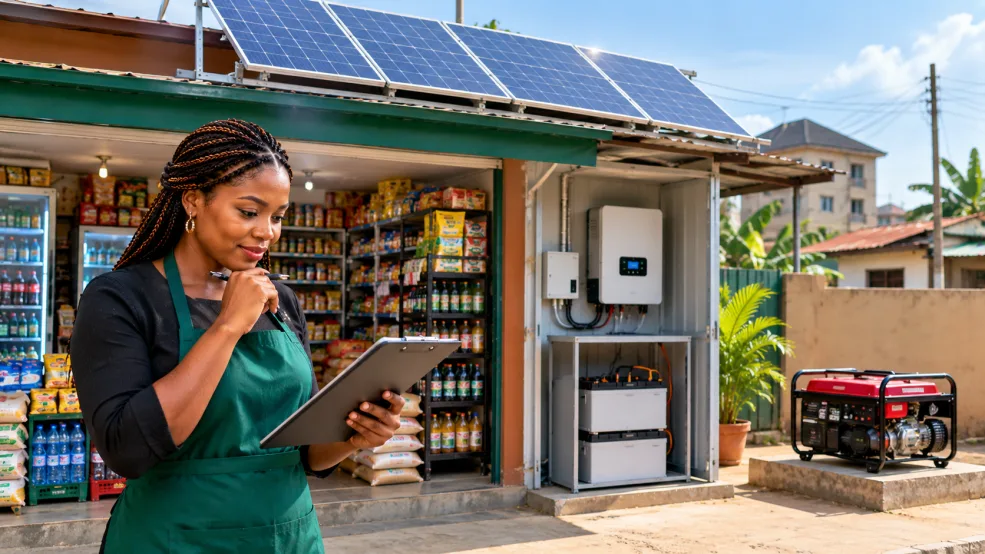
For a Nigerian salon, shop, clinic or small office, unreliable electricity can interrupt sales, refrigeration and customer service. A petrol or diesel generator is often cheaper to buy, while solar power for small businesses requires panels, an inverter, batteries and professional installation. Yet the generator needs repeated fuel purchases and servicing. Solar has lower routine energy costs but can involve repairs, battery replacement and finance charges.
Which option is cheaper over five years? There is no universal answer: it depends on actual electricity demand, generator runtime, fuel prices, available grid supply and equipment specifications. This 2026 guide uses verified Nigerian sources and an explicitly fictional cost model to show how business owners can calculate their own result.
Solar vs generator at a glance
| Factor | Generator | Solar and battery |
|---|---|---|
| Upfront purchase | Usually lower for smaller loads | Higher, including installation and storage |
| Ongoing energy cost | Petrol or diesel during use | No fuel for sunshine; may need grid or generator backup |
| Maintenance | Oil, filters, engine service and repairs | Inspection, cleaning, electrical repairs and replacements |
| Night operation | While fuel is supplied | Depends on usable battery capacity |
| Motor starting | Requires adequate surge capacity | Inverter and battery must support surge |
| Local exhaust | Noise, fumes and carbon-monoxide risk | No on-site combustion during solar operation |
Neither technology is automatically sufficient for every business. A hybrid solution that retains the grid and a generator for emergencies can sometimes be the most reliable choice.
1. Measure your electricity load before requesting quotes
List every appliance, its rated power in watts, quantity and hours of use. Estimate daily energy with watts × operating hours ÷ 1,000 = kilowatt-hours (kWh). A 200-watt device running five hours consumes approximately 1 kWh.
kVA, kW and kWh are different measurements. A 5 kVA generator does not necessarily supply 5 kW continuously; a nominal 10 kWh battery does not provide all 10 kWh as usable AC electricity after conversion losses and safety reserves. Pumps, freezers and air conditioners can draw substantial starting current. Measure simultaneous loads, not only daily consumption.
Record whether backup is needed at night, through frequent outages or primarily during sunny daytime hours. Businesses using uninterrupted refrigeration or sensitive medical equipment should prioritise reliable service over headline system size.
2. How much does business solar cost in Nigeria?
Installed solar quotes differ by battery capacity, panels, brand, location and workmanship. Kara's 2026 SME guide estimates a small-office 3–5 kW package at roughly ₦3 million–₦6 million. Eneronix cites approximately ₦3.6 million–₦5.7 million for a 5 kVA hybrid setup. These are indicative vendor figures, not verified quotes for your premises or universal national price averages.
A proper proposal must itemise PV panel capacity, inverter continuous and surge output, usable battery storage, mounting, wiring, surge and circuit protection, earthing, warranties and installation. Be wary of adverts that quote only an inverter but imply a complete system.
Get three comparable quotes after a site survey. Ask about roof strength, shading, installation schedule and local technical support.
3. How much does a generator cost to operate?
Generator cost includes purchase, fuel, engine oil, filters, routine service, repairs and sometimes transport or safe fuel storage. Consumption depends on engine type, age and electrical loading, so obtain manufacturer data and measure actual litres burned during normal business hours.
A Reuters report of 21 September 2026 described petrol near ₦1,400/litre in Lagos and Abuja and diesel exceeding ₦2,000. These are reported September prices, not verified prices for every state on 31 October. The NBS petrol price survey provides historical government data.
Keep receipts and record generator hours for at least one working week. Your own data is more dependable than assuming all generators of a particular kVA rating use identical fuel.
4. Five-year comparison: a fictional Nigerian shop
Imagine a shop requiring approximately 2 kW of average backup power for four hours on 26 working days per month, about 8 kWh daily. The solar option is assumed to serve this load using daytime production and stored electricity, with a small additional allowance for grid or backup energy. This is not an engineered design; an installer must confirm adequate battery autonomy, peak power and motor-starting capability.
| Assumption | Illustrative amount |
|---|---|
| New generator and connection | ₦650,000 |
| Petrol burn | 1.2 litres per hour |
| Petrol price held constant | ₦1,400 per litre |
| Generator maintenance | ₦180,000 annually |
| Hybrid solar purchase and installation | ₦5,500,000 |
| Solar maintenance | ₦150,000 annually |
| Residual grid or backup purchases for solar | ₦120,000 annually |
| Period | Five years, unchanged nominal prices |
These are hypothetical planning values, not current supplier quotations. The model excludes grid energy purchased equally under both options, finance interest, inflation, tax, resale value and major component replacement within five years.
5. Calculate generator fuel and total ownership costs
The generator runs 4 × 26 = 104 hours monthly. At 1.2 litres per hour, consumption is 124.8 litres, costing ₦174,720 monthly or ₦2,096,640 annually.
| Five-year cost item | Generator | Solar |
|---|---|---|
| Initial capital | ₦650,000 | ₦5,500,000 |
| Fuel purchases | ₦10,483,200 | ₦0 for normal solar production |
| Maintenance | ₦900,000 | ₦750,000 |
| Extra grid or backup energy | Included in fuel cost | ₦600,000 |
| Five-year total | ₦12,033,200 | ₦6,850,000 |
Solar is ₦5,183,200 cheaper over five years in this specific scenario. Its extra initial capital is ₦4,850,000. Annual running-cost savings are ₦2,006,640, giving an approximate 2.4-year simple payback. This is not a discounted financial valuation and assumes equivalent delivered service.
Major battery or inverter failure, financing, generator replacement and changing fuel prices could materially change the conclusion.
6. What if outages are less frequent?
At only two hours of generator use daily over the same 26 days, fuel cost becomes ₦1,048,320 annually. With the other assumptions unchanged, the generator's five-year total falls to ₦6,791,600, slightly below the solar case of ₦6,850,000. Solar might be oversized for that lighter workload, but the result illustrates why actual usage matters.
Longer outages and rising petrol prices make fuel-backed power costlier. Reliable grid supply or low generator usage can make a large battery investment harder to recover. Calculate low, expected and high runtime cases before purchasing.
7. Understand solar sizing and storage limitations
A hypothetical 4–5 kWp PV array, suitably rated inverter and 10 kWh nominal lithium battery might be explored for the example, but actual sizing depends on site-specific sunshine, shade, temperature, battery discharge limits and night-time demand. Solar panels cannot supply electricity after sunset without storage or another energy source.
The US Department of Energy notes that real PV performance differs from laboratory nameplate ratings because of sunlight and temperature. Ask an installer for monthly production estimates, expected usable battery hours and a list of appliances that cannot run together.
If a cold store or workshop cannot tolerate interruptions, consider a hybrid configuration with grid and generator fallback.
8. Maintenance and replacement risk
The US Department of Energy's operations guidance describes the importance of inspections, monitoring and timely repairs. PV arrays can operate for decades, but batteries and inverters may need replacement sooner depending on heat, cycling and warranty terms.
Generators need servicing according to running hours and manufacturer specifications. Obtain written estimates for expensive future repairs and assess local technician availability. For a ten-year business decision, add realistic battery and inverter replacement provisions, equipment resale and the true cost of financing instead of extrapolating the five-year model unchanged.
9. Compare grid tariffs, not just backup equipment
The Nigerian Electricity Regulatory Commission explains the country's service-based tariff bands, while distribution-company orders specify approved charges. A shop's current electricity rate should come from its own meter receipt or bill, not a single national “Band A” figure.
For each scenario, include actual grid kilowatt-hours multiplied by the applicable tariff and the cost of backup during shortages. If grid supply is good for most working hours, switching some load to daytime solar may save money without the largest battery package.
See NERC's tariff-order listings for official regulatory documents.
10. Financing and REA support
Even a financially attractive solar system can be unaffordable upfront. Nigeria's Rural Electrification Agency DARES Standalone Solar programme includes Solar for Business, with energy-as-a-service and lease-to-own approaches aimed at MSME clusters and productive economic activities.
The REA's December 2025 announcement described businesses such as salons, tailors, ICT shops and agricultural processors as intended beneficiaries. Neither page guarantees a particular shop immediate funding or an open application window. FlyingEze's coverage of Nigeria's renewable-energy financing initiative provides additional context.
Compare total lease payments, interest, installation charges, maintenance responsibilities, penalties and ownership at the end of any contract.
11. Safety and installer selection
Petrol and diesel generators emit carbon monoxide. The US Centers for Disease Control and Prevention recommends operating portable generators outdoors more than 20 feet (about six metres) from doors, windows and vents, never indoors or in a garage. Install appropriate detectors and use properly designed electrical changeover equipment.
Solar has different hazards, including poor earthing, unsafe cabling, battery protection failures and overloaded roofs. Insist on competent installers, suitable protection devices, documented commissioning and after-sales support. Improvised backfeeding is unsafe regardless of power source.
Frequently asked questions
Is solar cheaper than a generator in Nigeria?
Often over time when fuel-backed electricity is used heavily, but not always. Actual backup hours, capital costs, equipment replacements and financing determine the result.
Can solar run a freezer, pump or air conditioner?
It can when correctly designed for running load, surge current, usage hours and battery autonomy. An installer must assess the equipment.
Will I still need my generator?
Some businesses can operate without one; others retain backup for extended low-sunlight periods or high-priority loads.
How do I calculate my actual payback period?
Measure fuel use and grid bills, obtain comparable solar quotes, include maintenance and replacement risks, then test multiple outage and fuel-price scenarios.
Internal Linking Recommendations
Explore FlyingEze's renewable-energy finance report for policy context. Its generator-pollution coverage discusses reported health concerns; treat quoted mortality figures as attributed claims, not an independently verified estimate. Its electricity tariff debate article explains why owners should check their actual local tariff.
Verdict: compare five-year ownership, not the sticker price
Generators frequently offer the lowest upfront cost, while well-sized hybrid solar can reduce long-term energy spending where outages are common and fuel use is high. A reliable grid, modest operating hours or expensive financing can reverse the result.
For owners assessing solar power for small businesses, begin by measuring seven to fourteen days of electricity demand and generator consumption, then request three written quotations and compare realistic five- and ten-year costs. That evidence is stronger than any universal claim of a two-year payback.
Research checked 31 October 2026. All model calculations are hypothetical and assume unchanged nominal prices; actual fuel, grid, equipment and financing terms require fresh quotes.