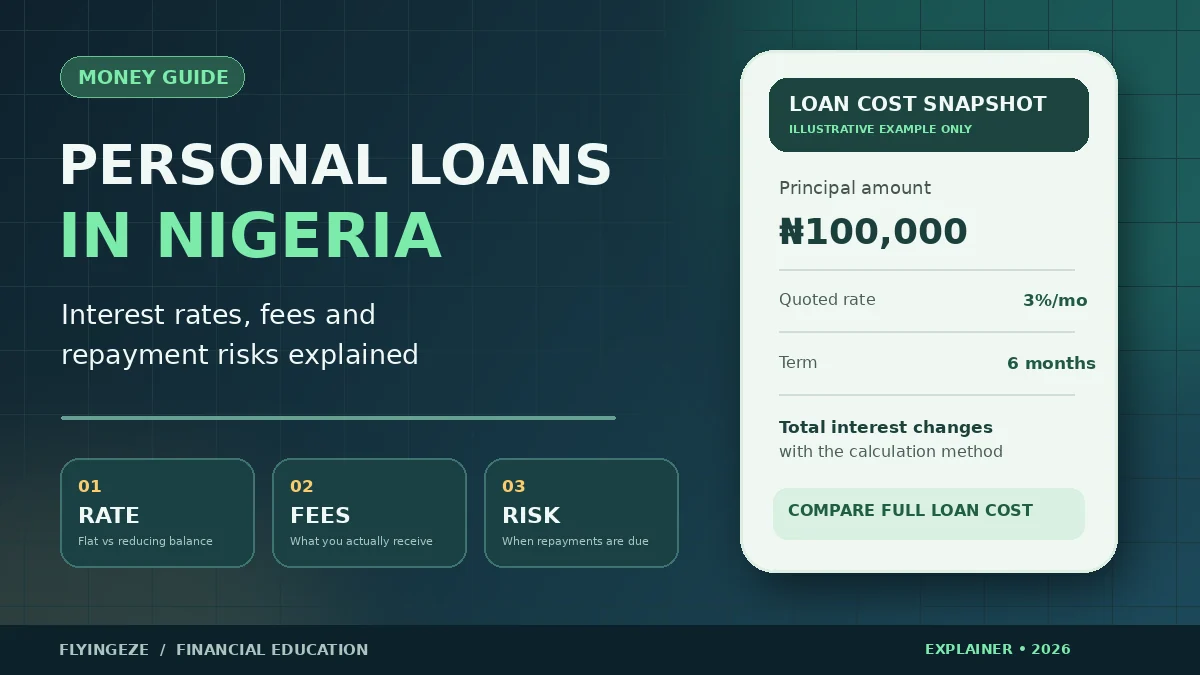
A personal loan in Nigeria is money borrowed from a bank, microfinance bank, finance company or eligible lender under an agreement to repay the amount borrowed plus interest and any applicable charges. The most important number is not the advertised interest rate alone: it is the total cost of credit, including fees, the timing of repayments, how interest is calculated and what happens if you miss a due date.
If you are considering a loan for medical expenses, household needs, education, a salary gap or another personal purpose, compare the actual amount you will receive with the full schedule of payments. A lender advertising “3% per month” may calculate interest on the original principal or on the declining balance, producing different costs. A short repayment period can also make an apparently modest loan difficult to service.
This Nigerian guide explains how personal loans work, uses independently calculated naira examples, and outlines consumer protections from the Central Bank of Nigeria (CBN) Consumer Protection Regulations and the Federal Competition and Consumer Protection Commission (FCCPC) . Research verified 13 November 2026. This is financial education, not a specific lender recommendation or personalised borrowing advice. Rates and eligibility change; the signed offer and applicable rules govern your loan.
Personal loan basics: seven figures you must understand
| Term | Meaning | Why it matters |
|---|---|---|
| Principal | Amount on which the loan is based | It may differ from cash actually received after fees |
| Disbursement | Money paid into your account | An upfront deduction may leave less than the stated principal |
| Interest rate | Cost of borrowing expressed per period | Check whether it is monthly or annual, flat or reducing-balance |
| APR | Annual percentage rate under the relevant disclosure method | Helps assess borrowing cost beyond a headline rate |
| Fees | Disclosed loan administration and other applicable costs | Can increase the cost even when the interest rate looks attractive |
| Tenor | How long you have to repay | Changes instalment size and often total interest |
| Repayment schedule | Amounts and dates you owe | Determines whether the loan fits your cash flow |
For a CBN-regulated consumer loan, the CBN regulations require disclosure of loan costs, repayment terms, and an applicable APR, as well as a Key Facts Statement (KFS) summarising the proposed credit. Do not rely solely on a lending app's front-page advertisement.
Who provides personal loans in Nigeria?
Personal credit can come from several types of institutions. Commercial banks may offer salary loans, unsecured personal loans or overdrafts. Microfinance banks often serve borrowers and businesses with smaller financing needs. Finance companies can provide credit within their applicable licence. Digital lenders can offer application, assessment and disbursement through apps and websites. Employer-backed schemes and cooperatives may also provide loans under their own rules.
The category matters because the appropriate regulator, product terms and complaint path may differ. The CBN supervises institutions within its remit, while the FCCPC operates a consumer-protection and registration framework for relevant digital and non-traditional lenders. A mobile app is a distribution channel, not proof that the company behind it is authorised or trustworthy.
Some loans are unsecured, meaning the borrower does not pledge a specific asset as collateral. Others may require a guarantee, salary deduction arrangement, vehicle or another asset. “No collateral” never means “no repayment obligation”: the signed agreement can still specify recovery rights and lawful consequences for default.
How a personal loan normally works: from application to final repayment
- Choose the amount and purpose. Work out the smallest sum that meets the real need.
- Review eligibility. The lender may request identification, proof of income, account history, employment details, contact information and consent for credit checks.
- Receive an offer. Examine the principal, cash disbursed, rate and calculation method, fees, APR, tenor, repayment timetable and late-payment rules.
- Accept only after checking the contract. Read and retain the Key Facts Statement where required; do not rely on an agent's verbal assurance.
- Receive funds. Confirm the amount credited and reconcile any deductions against disclosed charges.
- Repay according to schedule. Payments may be monthly, weekly or on another agreed timetable, sometimes collected by direct debit or an authorised payment mandate.
- Obtain closure confirmation. Once repaid, request a statement or confirmation showing no remaining obligation and verify that any repayment mandate is handled as agreed.
Approval is never guaranteed. A lender may assess cash flow, credit records, existing debts and other factors. Check whether a proposed loan is genuinely affordable before providing a repayment mandate.
Flat interest versus reducing-balance interest: an example
Two loans can advertise the same monthly percentage yet have different repayment costs. Under a flat-rate calculation, interest may be calculated for the entire tenor on the original principal. Under a reducing-balance calculation, interest is charged on the unpaid balance as principal is repaid.
Consider a fictional ₦100,000 loan over six months at a quoted 3% per month. Assume equal monthly payments, no missed instalments and, for this comparison alone, no additional fees.
| Illustrative cost | 3% monthly flat rate | 3% monthly reducing balance |
|---|---|---|
| Original principal | ₦100,000 | ₦100,000 |
| Interest calculation | ₦100,000 × 3% × 6 months | 3% of unpaid balance each month, with equal instalments |
| Total interest | ₦18,000 | Approximately ₦10,758.50 |
| Total repaid | ₦118,000 | Approximately ₦110,758.50 |
| Approximate monthly payment | ₦19,666.67 | ₦18,459.75 |
The flat example costs about ₦7,241.50 more in interest than the reducing-balance example. The figures are mathematical teaching examples, not current rates quoted by a Nigerian lender. Actual schedules can vary due to fees, compounding conventions, rounding, repayment dates and interest methods.
Why does it happen? A flat calculation keeps using the original ₦100,000 to calculate each month's interest even after some principal has been repaid. A reducing-balance calculation ordinarily charges interest on the smaller outstanding amount. Before accepting a loan, ask the provider to show the full repayment schedule rather than treating “3% monthly” as a complete description of cost.
What does APR mean, and why is it useful?
The annual percentage rate (APR) expresses borrowing cost over an annual basis using the relevant calculation and disclosures. For consumer loans covered by the CBN regulations, the loan contract is expected to state the applicable APR and explain the nature and calculation of interest, fees and other charges. The CBN's rules include prescribed APR calculation annexures.
A loan quoted at 3% flat per month is not equivalent to a loan charged at 3% per month on a reducing balance. Multiplying 3% by 12 to obtain “36% a year” is not enough to compare a six-month flat-rate instalment loan with an amortising loan: the borrower is repaying principal throughout the term, and upfront fees may reduce the usable cash.
Ask for the lender's disclosed APR, total repayment and exact payment dates for a like-for-like comparison. A true comparison should consider the same amount received and the same duration. The effective rate implied by your cash flows can differ from a simple annualised headline percentage.
Do not assume every online lender uses identical rate terminology or an identical disclosure format. If the provider cannot explain the rate basis in plain language, consider that a warning sign.
Upfront fees: why ₦100,000 approved may not mean ₦100,000 received
Lending costs can include a disclosed management or processing charge, insurance where applicable, legal or documentation costs, collateral-related expenses, taxes or other charges allowed under the applicable rules. Some fees may be deducted before disbursement; others may be paid separately or included in the repayment amount.
For illustration, suppose a ₦100,000 loan carries a ₦1,000 upfront charge deducted when it is paid out. The borrower may receive ₦99,000 in cash while still owing repayments calculated on the ₦100,000 contractual principal. If the loan also uses the six-month flat-rate example above, the scheduled payments total ₦118,000. Compared with the ₦99,000 received, the total difference is ₦19,000, before any other applicable charges. The ₦1,000 is a hypothetical fee, not an endorsement of a particular lender's charge.
The CBN's published Guide to Charges includes rules for certain regulated loan fees, but what is permitted depends on institution and facility type. Do not apply a quoted fee ceiling universally to every digital loan or treat an unexplained deduction as automatically legitimate.
Demand an itemised disclosure showing each charge, the amount, who receives it, and whether it reduces the disbursed funds. Compare cash received with every repayment required, not merely the headline principal.
Loan tenor and repayment frequency can change the risk
A shorter term generally produces larger instalments but may reduce interest paid over time, depending on how the lender calculates interest and fees. A longer term may lower the immediate monthly burden while increasing total interest. These are tendencies, not guarantees for every product.
Also check the timing. A borrower paid once per month may struggle with weekly deductions even if the total interest seems affordable. A daily-collection loan can be especially risky where income arrives irregularly. Align the repayment calendar with reliable cash flow rather than expected commissions or a salary increase that has not happened.
Ask whether repayments are fixed or can vary, what happens on public holidays or failed bank transfers, and whether partial payments reduce principal immediately. An instalment labelled “small” is not small if it leaves too little for rent, food, medical needs and emergencies.
How to test whether a loan fits your budget
Start with your reliable net income, not the highest amount you earned in an unusually good month. Subtract essential living costs, existing loan payments, important obligations and a realistic emergency buffer. Only the remaining amount can safely support a new instalment.
For example, suppose a person receives ₦300,000 in reliable monthly take-home pay, spends ₦215,000 on essential commitments, pays ₦25,000 toward existing debt and sets aside ₦20,000 as a basic buffer. That leaves ₦40,000 before any new loan repayment. A proposed ₦35,000 monthly instalment would leave only ₦5,000 of that margin. Even though the payment is technically lower than the available amount, the arrangement may be fragile if food, electricity or transport prices rise.
This is an illustrative household budget, not a CBN-approved debt-to-income threshold. There is no single safe percentage that suits every borrower. Stress-test the loan against late salary, lower sales, illness or an unexpected household expense. If one small disruption would make repayment impossible, borrowing less—or not borrowing—may be the safer decision.
A simple monthly spending record can reveal whether the payment fits. Existing FlyingEze coverage of open banking, personal-finance data and account verification in Nigeria explains how financial information may be used to assess credit and organise finances.
What lenders may check before approving a personal loan
Depending on the lender, requirements may include a minimum age, acceptable identification, Nigerian bank account, employment or income evidence, salary records, account statements, existing liabilities and a credit check. Digital lenders may use automated eligibility checks; banks may apply more detailed documentation and internal credit policies.
Some personal loans use salary domiciliation, employer relationships or agreed direct debit mandates. Others may require collateral, a guarantor or security arrangements. You should know exactly what you are authorising, including whether a lender can attempt payment from an account or use an agreed lawful recovery mechanism.
Your past repayment history can affect future borrowing. The CBN's consumer FAQs describe credit-information systems used to help lenders evaluate a borrower's repayment capacity. Before applying repeatedly to multiple providers, check whether your existing debts and missed payments could affect approval or the rate offered.
Never falsify income documents or permit an agent to invent employment details. That may create legal and financial problems beyond an ordinary loan rejection.
How to verify whether a Nigerian personal-loan provider is legitimate
For a bank or microfinance bank: confirm its current regulated status using the CBN's official information and the institution's independently located website or branch. A provider's name on a historical list is not conclusive evidence that its authorisation remains current; licensing decisions can change.
For a digital lender: inspect the company's real legal name, its loan contract and the FCCPC's registration and approval resources . Check the specific lender and app, not merely a similar trading name. FCCPC lists approvals as well as conditional approvals, watchlists and delistings. Inclusion in a register does not guarantee that a loan is cheap, suitable or risk-free.
Be cautious when the only “support” offered is a private WhatsApp number or a person demanding an upfront payment before you can see a contract. Verify whether the application publisher, company website, loan documents and recipient account match. Do not treat an app-store listing, social-media badge or celebrity advert as regulatory authorisation.
The FCCPC's digital-lending FAQs say consumers should verify listed lenders, read the full terms and understand how their data is used before borrowing.
What changed in Nigeria's digital-loan regulation by November 2026?
In 2025, the FCCPC introduced the Digital, Electronic, Online or Non-Traditional Consumer Lending Regulations (DEON) to improve transparency, responsible lending, fair recovery practices and data privacy. Implementation was temporarily suspended following an interim court order in April 2026. On 20 July 2026, the FCCPC announced that the Federal High Court had upheld the regulations and vacated the restraining order; the Commission said implementation had resumed and the rules were enforceable again.
This sequence matters because older online guides may incorrectly claim the 2025 digital-lending rules are suspended. The current regulatory position was confirmed in the FCCPC's 20 July 2026 announcement . The framework is intended to address unclear terms, exploitative practices, abusive collections, privacy violations and other conduct in relevant digital lending.
Regulation does not remove borrowing risk. A provider operating within a compliance framework can still offer a costly product, and a loan that is lawful for one borrower may be unaffordable for another.
Repayment risks: what happens when you miss a personal-loan instalment?
Late repayment may trigger contractually applicable default fees or interest, debt-collection contact, negative credit records, agreed recovery procedures or legal action. The actual consequences depend on the contract, lender type and applicable laws. It is misleading to say that every missed repayment automatically leads to arrest, or that no consequences exist because a loan has no collateral.
The CBN's regulations require regulated institutions to disclose relevant default charges and collection conditions. They also set standards for fair treatment and prohibit intimidation and abusive recovery conduct. For digital and non-traditional lenders, the FCCPC's DEON framework addresses unethical collection practices, including harassment and unlawful use of personal data.
The financial risk can become a debt cycle: a borrower takes a second expensive short-term loan to meet the first loan's due date, then must service two payments and new fees. This can escalate quickly. Before using fresh credit to pay old debt, seek the existing lender's written options for restructuring or a realistic payment arrangement.
Debt-collection calls, contact shaming and data privacy
Some loan-app complaints in Nigeria involve threatening messages, public shaming, unauthorised disclosure of a debt to contacts or excessive access to personal information. The FCCPC's digital-lending regulations and CBN consumer protections address transparency, data privacy and fair recovery.
Read permission requests before installing an app. A lender may need information to assess credit and verify identity, but that does not mean unlimited contact-list, photo or message access is acceptable. Review the privacy notice, collection purposes and who receives information. Do not provide passwords or one-time banking codes to anyone claiming to be a recovery officer.
If you experience threats or contact shaming, keep screenshots, records of calls, the contract and payment history. Report the behaviour through the appropriate lender complaint process and relevant regulators. Do not respond by sharing other people's private information publicly.
Can you repay a personal loan early?
Some loans permit early settlement, but the financial effect depends on the agreement. You may save future interest under some reducing-balance arrangements, while certain facilities have early-liquidation fees, minimum charges or different interest calculations. Do not assume that making a single large payment automatically closes the loan.
Request an early-settlement quotation showing remaining principal, accrued interest, any permitted fee and the exact settlement deadline. After payment, request confirmation that the account is closed or the balance is zero. The CBN consumer regulations require disclosures of early-liquidation terms for covered credit facilities.
Also ask whether a partial early payment reduces the future instalment, shortens the tenor or simply counts as an advance payment. Those outcomes are not identical.
How to compare two Nigerian loan offers fairly
Put both offers into one table before choosing. Use the same planned borrowing amount and, if practical, the same repayment horizon.
| Question | Offer A | Offer B |
|---|---|---|
| How much cash will I actually receive? | Read disbursement after deductions | Read disbursement after deductions |
| How is interest calculated? | Flat, reducing or other specified method | Flat, reducing or other specified method |
| What APR and total cost are disclosed? | Use contractual figures | Use contractual figures |
| How much is each instalment and when due? | Check exact schedule | Check exact schedule |
| What fees or insurance apply? | Itemise separately | Itemise separately |
| What happens if I pay early or late? | Read settlement/default terms | Read settlement/default terms |
| Who is the regulated provider? | Verify legal entity and status | Verify legal entity and status |
A higher monthly instalment can sometimes accompany a lower total cost because the loan is repaid faster. Conversely, a small instalment can conceal a long and expensive tenor. Choose only after comparing money received, total money paid, timing and contractual risks.
What to do if you cannot meet the next repayment
- Contact the lender before the due date. Explain the realistic change in income or expenses and request available hardship or restructuring options.
- Ask for an updated written schedule. Understand any new interest, extension charges or fees before agreeing.
- Do not hide from legitimate correspondence. Respond through verified channels, without sharing banking passwords or sensitive details with impostors.
- Prioritise essentials and avoid another costly emergency loan. Borrowing more to cover old instalments may worsen the problem.
- Keep payment and complaint evidence. Save receipts, statements, messages and case numbers if the balance is disputed.
- Escalate abusive conduct or unresolved errors. Use the regulator relevant to the actual provider.
A lender may reject a proposed payment plan, so do not assume a request for more time automatically suspends penalties. Get any accepted variation in writing and confirm that the repayment records match it.
Where can Nigerians complain about loan fees or harassment?
For a CBN-regulated bank or institution, start with the lender's formal complaints channel and keep a reference number. The CBN's complaint lodgement guidance says general complaints may follow a two-week resolution route, while complaints about excess charges and loans can have a 30-day resolution period before escalation to the CBN's Consumer Protection Department, depending on the category.
For conduct involving a digital money lender under FCCPC's framework, first engage the provider when appropriate and preserve the evidence. The FCCPC offers a consumer complaint portal and also publishes the digital-lending complaint address lenderstaskforce@fccpc.gov.ng. The correct handling route can depend on the legal identity and regulatory category of the lender.
If a stranger threatens arrest, demands a bank PIN or asks you to pay a “clearance officer” rather than the verified lender, independently check the demand before responding. Formal complaint mechanisms do not guarantee reimbursement or cancellation of a legitimate debt, but they provide channels to challenge errors or unlawful practices.
When may an alternative be safer than a personal loan?
If a planned expense can be postponed, saving toward it may avoid interest and default risk. A negotiated payment plan with a hospital, school or service provider can sometimes spread the cost without the same borrowing structure. A carefully documented, affordable arrangement with a cooperative or employer may be worth comparing, subject to its own terms and deductions.
For education, a government-backed student financing programme is different from an ordinary commercial consumer loan. FlyingEze's NELFUND institutional charges versus upkeep-loan guide explains that separate programme. For a business need, evaluate whether the funds are actually for business use and compare the alternatives in FlyingEze's grants versus loans versus equity-funding explainer .
No alternative is automatically free of obligations. The safest choice is the one whose terms and payment schedule you understand and can realistically fulfil.
Frequently asked questions about personal loans in Nigeria
What is a personal loan?
It is credit given to an individual under agreed terms requiring repayment of principal, interest and applicable fees. It may be unsecured or subject to salary, guarantee or collateral arrangements.
What interest rate do personal loans have in Nigeria in 2026?
There is no single verified rate for every lender or customer. Offers vary by provider, borrower profile, tenor, security, promotions and calculation method. Ask for the current contractual rate, APR and total amount repayable rather than relying on an outdated market average.
Is 3% monthly interest cheap?
Not enough information is available from that phrase alone. A 3% monthly flat-rate loan and a 3% monthly reducing-balance loan have very different costs, and additional fees can raise the true borrowing cost.
Can I get a personal loan without collateral?
Some lenders offer unsecured personal credit, subject to eligibility and other conditions. No collateral does not remove the duty to repay or prevent lawful collection and credit reporting.
Can a loan app contact or shame my friends if I default?
Lenders must comply with applicable privacy and fair debt-collection rules. Unauthorised contact shaming, abusive threats or unlawful disclosure can be reported to the relevant regulator, including the FCCPC for covered digital-lending conduct.
What happens if I miss a payment?
Depending on the agreement, you may face disclosed default costs, collection activity or adverse credit records. Speak to the lender early and seek a written repayment arrangement rather than assuming the obligation disappears.
Can I repay a loan early without a penalty?
It depends on the contract and applicable rules. Ask for the early-liquidation terms and a written settlement figure before paying ahead of schedule.
How do I check if a loan app is approved?
Check the exact legal provider and app against the FCCPC's current digital-lender resources , and verify any CBN-regulated institution separately. Registration is not a guarantee of a good price or suitable loan.
Should I borrow to repay another loan?
Doing so can create a costly debt cycle, especially when the new loan has higher fees or a shorter term. Explore written restructuring with the existing lender and compare the full cost before taking replacement credit.
Final checklist before accepting a personal loan
- Verify the provider's legal identity and relevant regulatory status.
- Know the principal and the exact cash you will receive.
- Confirm whether the rate is flat or reducing-balance and whether quoted per month or year.
- Request the applicable APR, Key Facts Statement and complete repayment schedule where required.
- Itemise every upfront, recurring, late and early-settlement charge.
- Make sure instalments fit essential living costs and an emergency buffer.
- Read account-debit mandates, security terms, privacy permissions and the consequences of default.
- Keep the signed offer, receipts, messages and closure documents.
The bottom line: a personal loan can provide useful temporary funding, but its real price is the total amount of money and risk committed—not the interest-rate headline. In Nigeria, compare the rate calculation, fees, cash actually received, repayment schedule and provider's authorisation before borrowing. If the terms are unclear or a missed instalment is likely, do not treat rapid approval as a reason to accept an unaffordable loan.