The most useful open banking opportunities in Nigeria are practical: helping a lender understand a borrower's finances, giving a customer a clearer view of money held across accounts, and helping a service verify that a customer controls a bank account. Each relies on appropriately authorised access to financial information through application programming interfaces (APIs). None guarantees a loan, proves legal identity by itself, or permits unlimited account access.
The Central Bank of Nigeria (CBN) issued its operational guidelines on 7 March 2023 , specifying API participants, information-sharing safeguards, authentication and customer consent. In 2026, the benefits are easy to imagine, but nationwide availability should not be overstated: the original August 2025 go-live target was missed, and no subsequently confirmed universal rollout was established in the sources reviewed by 3 November 2026. Private banking integrations and supervised tests are not proof that all banks share identical production APIs.
Rather than repeat the general regulatory framework, this guide works through three specific uses—lending, personal finance and account verification—and shows what data each needs, how a legitimate customer journey might work, and where the risks lie.
How does open banking work in a real service?
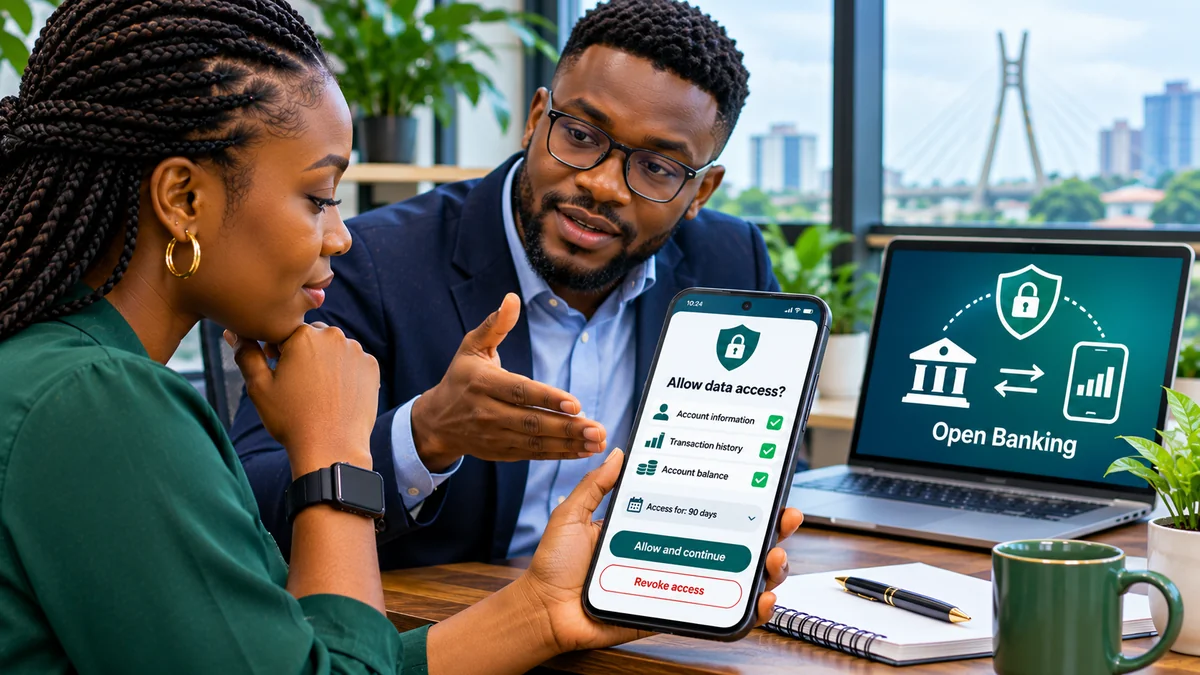
At its simplest, a customer wants another financial service to access specific information from a bank. The bank or eligible data holder acts as an API provider; the app requesting the information acts as an API consumer. The customer gives authenticated permission for a described purpose, scope and period. The provider releases only information covered by that permission.
For example, permission to inspect recent incoming payments does not inherently include authority to withdraw money, inspect an unrelated account or keep retrieving information forever. The CBN guidelines require the API provider to validate that permission comes from its customer. The rules distinguish financial-data categories and specify security and participant responsibilities.
The following comparison captures the three uses without implying that every relevant API is currently offered nationwide:
| Use case | Data that may be relevant | Practical result | Important limitation |
|---|---|---|---|
| Lending | Permitted transaction history, balances and cash-flow patterns | More evidence for affordability and income assessment | Approval, pricing and fairness still require independent checks |
| Personal finance | Balances, transactions, account identifiers and recurring payments | Combined spending overview, budgets and alerts | Incomplete connections and classification errors can mislead |
| Account verification | Relevant account details and authenticated proof of account access | Evidence linking a customer to an account | Account control is not comprehensive KYC or proof of identity |
The industry organisation Open Banking Nigeria identifies lending and personal financial management as major potential uses. Its earlier annual report also discusses account ownership verification and affordability checks. These are use-case descriptions, not verified results for every Nigerian financial institution.
Use case 1: Better lending and income verification
Many borrowers can document their income poorly even when they regularly earn money. Consider a freelance designer paid by several clients into two different bank accounts. A lender looking only at one salary slip—or a few screenshots—might miss recurring receipts, irregular periods, transfers between the person's own accounts and existing payment obligations.
With a suitable consented connection, a lender could request transaction information from the accounts the applicant has chosen to share, identify likely customer payments, look at volatility and compare inflows with regular obligations. That might support a more informed affordability assessment for a freelancer, employee, trader or small-business operator.
What an illustrative lending journey could look like
- The applicant selects a financial product from an appropriately authorised lender and receives clear information about its charges and credit assessment.
- The lender requests access to relevant account data for a specified period, explaining the purpose and how long permission lasts.
- The customer authenticates and approves the requested access through the legitimate bank or approved system.
- Permitted records are retrieved and categorised; the lender checks income consistency, obligations and available cash flow.
- The lender applies its own underwriting rules, verifies other information and makes a decision it can explain through appropriate channels.
- The customer receives an outcome and information about the treatment of shared records and applicable review or correction routes.
This is a hypothetical process, not a guaranteed workflow offered by every Nigerian digital lender today. Open Banking Nigeria's consumer credit use-case paper outlines a similar motivation for customer-permissioned financial-data access.
What a lender should not assume from transaction data
A deposit is not necessarily business revenue, and a transfer from another account may not be new income. A short data history might miss seasonal trading, cash sales or informal obligations. Expenses may be misclassified and some financial accounts may be unconnected.
Lenders must also consider applicable credit information, financial-service regulation and consumer protection. Open banking does not create a lending licence, guarantee cheaper credit, replace responsible underwriting or make an automated risk score inherently fair. Financial-data accuracy and meaningful human review are important when decisions may significantly affect applicants.
The CBN's Fintech Report highlights fragmented APIs and missing or delayed credit-related data as practical barriers to reliable risk decisions. A future system would need to solve those problems, not merely make more information available.
Use case 2: Personal finance dashboards and more useful budgets
A person with a salary account, a savings account and a second account used for everyday expenses may struggle to understand total spending. Balances visible in different apps do not by themselves reveal recurring charges, transfers between personal accounts or progress against savings goals.
With appropriate access, an independent personal-finance service could bring authorised account information into one view and help the customer:
- Compare income and spending trends across connected accounts.
- Identify recurring subscriptions, rent, bills and other regular commitments.
- Set a savings target and see how actual cash flow affects it.
- Spot duplicate charges or transactions needing review.
- Receive a warning when spending is approaching a user-set budget.
- Track whether money reserved for an upcoming expense remains available.
Illustrative example: A Nigerian worker notices that a family-support transfer and a rent payment have both been categorised as discretionary spending. The app allows manual correction, after which the monthly report becomes more useful. That illustrates why a good product needs editable categories, not just automated analysis.
The biggest limitation is completeness. A dashboard combining two linked accounts cannot accurately describe someone's total finances if a third account, cash transactions or a business wallet is missing. Transfers between your own accounts must not be double-counted as income and expenses.
Some tools can already use uploaded statements, manual entries or individually negotiated provider connections. That is not identical to accessing all Nigerian bank data through a nationwide, common CBN-standard open banking service. For background on the category, FlyingEze's published guide to budget apps compares consumer money-management tools; readers should verify each product's current integrations independently.
Use case 3: Account verification, onboarding and safer payouts
Account verification can sound simple, but several different questions are often confused:
- Does the account number correspond to a real account? A name-enquiry or account-validation service may help establish that.
- Does the customer control that account? A properly authenticated, customer-authorised connection may provide additional evidence.
- Does the customer have the identity they claim? This requires appropriate identity checks and customer due diligence; an account connection alone is insufficient.
- Is a payment actually settled? That needs transaction evidence and payment-system confirmation, not merely account verification.
Consider a payroll provider preparing to pay a contractor. A basic beneficiary-name check might help reduce mistyped payment details. In a suitable open banking implementation, the provider could ask the contractor to authorise verification of a particular bank account and compare the evidence with its onboarding records. Any unresolved name mismatch would go for further review rather than immediate rejection or unverified payout.
For a lending or marketplace service, authenticated account linking could help reduce manual statement collection or support account-change checks. But a fraudulent actor might control an account opened under false pretences; a joint account, virtual account or business account can also make a simple personal-name match misleading. The CBN's operational guidelines require authenticated consent and appropriate participant verification, not a blanket assumption that access to an account proves every identity claim.
The distinction matters particularly for Nigerian businesses sending refunds, salaries, supplier payments or customer disbursements. Use verification alongside appropriate KYC, anti-fraud and reconciliation controls—not as a substitute for them.
What is already possible, and what depends on a wider rollout?
Nigeria's 2021 framework and 2023 operational guidelines establish the policy basis. However, Open Banking Nigeria's July 2026 update says the original August 2025 nationwide target was missed and describes continuing implementation coordination. The CBN's fintech report also records persistent interoperability gaps.
| Capability | What can be said in 2026 |
|---|---|
| Bank transfers and beneficiary name enquiry | Existing banking/payment features; not proof of a fully launched open banking network |
| Fintech apps using proprietary bank-data integrations | Possible through specific providers and agreements; coverage varies |
| Consent-based data access under the CBN framework | Regulatory design established; universal production availability not independently confirmed |
| Regulatory sandbox experiments | Supervised testing opportunities, not an unrestricted national rollout |
| Seamless aggregation from every Nigerian bank | Should not be promised without verified participant and endpoint availability |
The CBN's second Regulatory Sandbox programme lists account aggregation, open banking data exchange, and credit decisioning among eligible innovation activities. Sandbox scope is not proof that an applicant was admitted or that its product is generally licensed for production.
What data should each service request?
Different problems justify different datasets. A budgeting app may need transaction amounts, dates and merchant descriptions, while a one-off account check may need only a limited confirmation. A lender might seek a longer history for a disclosed affordability assessment. Collecting everything “just in case” is not a sound default.
| Purpose | Reasonable data to assess | Data to avoid unless genuinely necessary |
|---|---|---|
| Affordability review | Relevant balances, transaction history and regular obligations | Unrelated account history, contacts, messages and device photo libraries |
| Spending dashboard | Transaction dates, amounts and categories on selected accounts | Payment-initiation authority when only reading is required |
| Ownership/control check | Selected account identifiers and authenticated confirmation evidence | Years of transactions when a limited verification would suffice |
The Nigeria Data Protection Act 2023 requires personal data to be processed lawfully and for specified purposes. It also deals with transparency, retention and rights affecting certain automated decisions. Open banking's customer-permission rules operate alongside these wider legal duties; withdrawing API consent does not necessarily erase every record that was previously collected lawfully.
Technical and commercial challenges for Nigerian businesses
Even when APIs are available, a product needs more than a successful demo. Account connections can expire, banks can experience outages, response formats can differ, and duplicate transactions or reversals can confuse analytics. Providers should plan for consent expiry, secure token storage, retries, audit logs, reconciliation and clear disclosures.
A responsible product team should also check whether the contemplated activity is regulated, how customer data will be protected, and what it will cost to serve users. Data-access fees, provider coverage, customer support and compliance work may determine whether the commercial model is sustainable.
For a Nigerian small business, the useful question is not “Can we add open banking to our marketing website?” It is “Which manual process becomes measurably more accurate or easier without exposing customers to unnecessary data risk?”
FlyingEze's published guide on Nigerian business obligations under the NDPC provides related context for teams handling personal information.
Six questions customers should ask before linking a bank account
- Who is the actual requesting business? Identify its legal and brand names and verify the real website or app.
- What permission am I granting? Distinguish read-only information access from any payment-related functionality.
- How much data will it retrieve? Look for an understandable scope and period tied to the service.
- Can I withdraw permission? Find out how to see, expire or revoke consent and what happens to information already collected.
- How will the data affect a decision? For lending, ask what factors matter and how inaccurate information can be corrected or disputed.
- Who handles complaints? Save the provider's support details and use official banking and data-protection complaint routes where appropriate.
Do not give a supposed bank integration officer your PIN, banking password or one-time code through a chat. A credible open banking process does not require handing secrets to an unknown person.
FAQs about open banking use cases in Nigeria
Can open banking make it easier to get a loan?
Potentially. Consented transaction data can help an appropriately authorised lender assess cash flow and affordability. It does not guarantee acceptance, lower interest rates or a fair result without proper underwriting and data-quality checks.
Can one personal finance app show every Nigerian bank account?
Not automatically. Coverage depends on live integrations, participating providers, customer permissions and data availability. A dashboard should disclose which accounts and periods are included.
Can open banking prove that a customer owns an account?
An authenticated connection may help demonstrate control of a specified account, but ownership and identity require careful interpretation and sometimes separate KYC evidence. Name enquiry and account control are not equivalent to full identity verification.
Does consent for account verification let an app send money?
No such authority should be inferred. Read-only verification and payment-related permissions are distinct functions. Review the actual request carefully.
Is nationwide open banking fully available in November 2026?
The sources verified on 3 November 2026 did not establish a confirmed universal go-live. Private integrations and sandbox activities must be distinguished from a fully operational CBN-standard nationwide scheme.
What if my financial data is wrong or used without permission?
Contact the provider and relevant financial institution through their official channels, keep evidence, and exercise applicable correction or complaint rights. The CBN and Nigeria Data Protection Commission have different oversight roles depending on the issue.
Conclusion: Useful data, but only with useful safeguards
Open banking's strongest Nigerian use cases solve identifiable problems: lenders can assess relevant cash-flow evidence, consumers can understand finances across accounts, and businesses can gain better evidence about account access during onboarding or payouts. These are potential improvements, not guaranteed outcomes.
The test of a trustworthy service is whether it requests only necessary information, obtains genuine customer permission, explains its limits and handles errors fairly. As Nigeria works towards broader standardisation, financial providers should validate real API availability and compliance before promising seamless connections; customers should insist on transparency and control before linking accounts.