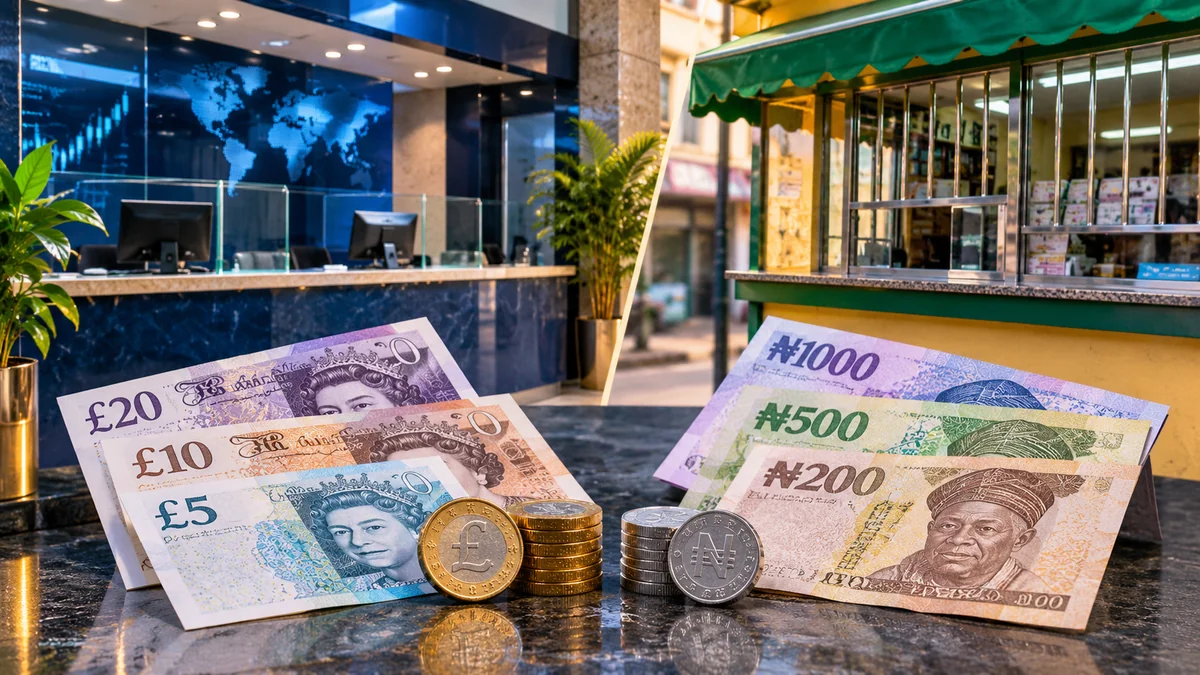
Why does a bank show one pound-to-naira exchange rate while a bureau de change (BDC) offers another? The short answer is that an exchange-rate reference is not the same as the price a customer is offered. Banks and licensed BDCs operate through different retail channels, with different funding costs, transaction sizes, operating expenses, and services. Their buying and selling rates can therefore differ, even at the same moment.
For anyone converting British pounds (GBP) to Nigerian naira (NGN), the useful question is not simply “What is the sterling to naira rate?” It is “How many naira will I actually receive—or how many pounds can I obtain—after the rate, spread and fees are applied?” This guide explains how to answer that question, without mistaking an indicative online quote for a guaranteed deal.
What is the difference between the bank rate and the bureau de change rate?
A bank exchange rate is the rate an authorised bank offers for a particular foreign-exchange transaction. Its price may depend on whether the customer is buying or selling GBP, whether the funds are cash or account balances, the transaction purpose, the currency route, and applicable charges. Not every bank handles every transaction type, and a displayed quote is not necessarily available for an immediate trade.
A bureau de change rate is a retail rate offered by a licensed BDC for a transaction within its permitted activities. BDCs typically serve customers seeking currency exchange rather than the full banking, payment and trade services available through authorised dealer banks. Their rates may reflect the cost of sourcing currency, cash handling, inventory and prevailing local demand.
A licensed BDC is not automatically the same thing as an unregulated street trader or the parallel market. Nigeria’s CBN-approved BDC guidelines set out licensing, permitted activities, customer identification, rate display and recordkeeping obligations. The CBN also requires authorised dealers to apply transparent pricing principles under its revised Nigerian Foreign Exchange Market guidelines .
Why pound-to-naira quotes differ: seven practical reasons
1. The official benchmark is not the retail price
The Central Bank of Nigeria publishes rates and market statistics for the Nigerian Foreign Exchange Market (NFEM). Its exchange-rate page describes the NFEM rate as a volume-weighted average and shows market data primarily in naira per US dollar. That is useful reference information, but it is not a promise that a customer can buy or sell physical pounds at that precise rate.
For GBP/NGN, a cross-currency reference may also depend on the GBP/USD relationship. For example, an illustrative GBP/USD rate of 1.30 and USD/NGN rate of ₦1,400 would imply ₦1,820 per pound (1.30 × 1,400) before retail spreads and fees. This calculation is not a live quotation, and two reference prices observed at different times cannot be treated as a firm executable GBP/NGN rate.
2. Buying and selling are opposite sides of the quote
Every customer should ask which side of the exchange is being quoted. A provider's GBP buying rate usually means the naira it will pay when the customer sells pounds to it. Its GBP selling rate means the naira it will charge when the customer buys pounds from it. The selling rate is normally higher than the buying rate; the difference is the bid–ask spread.
For example, if a provider quotes ₦1,825 to buy £1 and ₦1,900 to sell £1, its quoted spread is ₦75 per pound. Comparing the bank's buying rate with a BDC's selling rate would give a misleading impression, because they represent different transactions.
3. Each provider prices costs, risks and margins
Foreign-exchange providers incur costs in obtaining funds, settling transactions and managing currency positions. Cash-based exchanges may involve security, transport and verification costs, while account transfers may attract payment or correspondent-banking charges. Providers also account for the risk that the market price moves before an offsetting transaction is completed.
The Nigeria FX Code recognises that client prices may include markups to cover costs, services and risk. It calls for fair, reasonable pricing and appropriate disclosure. This does not mean every different rate is justified; it means customers should examine both the quoted rate and the explanation of any additional charges.
4. Cash exchange and bank transfers are different products
Exchanging physical £20 notes for naira cash is not identical to receiving a £500 transfer into an account and converting it electronically. A bank's GBP account-conversion price may differ from its cash-handling price, international remittance price or card conversion rate. A BDC may be able to exchange permitted cash amounts but may not offer the particular international payment service needed for an overseas invoice.
Before comparing prices, make sure both quotes refer to the same amount, direction, payment method, delivery method and settlement time. If one quote includes the money reaching a UK beneficiary and the other merely supplies pounds locally, they are not like-for-like alternatives.
5. Transaction size and availability matter
A small, immediately available amount of GBP can cost a provider proportionately more to process than a larger transaction. Conversely, limited pound-note availability may make a particular retail quote less competitive. A posted rate should never be taken as proof that the provider has sufficient funds available or that the transaction is eligible under current regulations.
6. Prices change during the day
GBP/USD and USD/NGN market conditions, provider inventory, liquidity and order flows can change. A quote captured in the morning may no longer be actionable later in the afternoon, even if it appears on a search-results page or social media post. Always request the rate's timestamp and how long the provider will honour it. On weekends and public holidays, the last displayed market reference may be older than the rate a retail provider is prepared to execute.
7. Documentation and eligibility affect the available channel
Nigerian foreign-exchange rules require appropriate identification and transaction records. The CBN's approved BDC guidelines specify customer-identification procedures, permitted transaction types and receipts; the CBN's published reforms also describe measures to improve licensed BDC access to FX supply. The availability of a bank or BDC service depends on the transaction and the rules applying at the time, not just the exchange rate someone advertises.
Bank vs BDC vs online converter: what each quote actually tells you
| Quote source | What it commonly represents | What to verify |
|---|---|---|
| CBN/NFEM data | Official market benchmark or statistical rate | Currency pair, date, calculation and whether it is a benchmark, not a retail offer |
| Authorised bank | Bank's customer buy/sell quote for a specified service | Transaction purpose, buy/sell side, fees, eligibility, settlement time |
| Licensed BDC | Retail buy/sell quote for an eligible transaction | Licence, applicable rate, available amount, payment and receipt |
| Currency converter | Typically an indicative market or mid-market rate | Timestamp and whether the provider will actually execute that rate |
| Social-media or informal quote | Unverified advertised or reported price | Source, date, licence, actual executable rate and safety |
An online mid-market figure is commonly the midpoint between buy and sell prices, not a consumer offer. Wise's explanation of the mid-market rate recommends comparing both rates and fees before exchanging. It can be a useful sense-check, but it is not proof of the best obtainable price in a specific Nigerian transaction.
Worked example: how much does a £500 exchange really deliver?
Imagine you want to sell £500 and receive naira. These figures are entirely hypothetical; they are not current offers from a Nigerian bank or a BDC.
| Item | Bank | Licensed BDC |
|---|---|---|
| Provider's GBP buying rate | ₦1,825/£ | ₦1,835/£ |
| Gross value of £500 | ₦912,500 | ₦917,500 |
| Illustrative additional charge | ₦2,500 | ₦0 |
| Net naira received | ₦910,000 | ₦917,500 |
Under these assumptions the BDC would pay ₦7,500 more, provided both transactions were available, lawful and equivalent. The conclusion could reverse if the prices or fees changed.
Now reverse the question: you have ₦950,000 and want to buy pounds. At the bank's hypothetical selling price of ₦1,900/£ with a ₦7,500 transaction charge, you could receive about £496.05. At a hypothetical BDC selling price of ₦1,920/£ with no extra charge, the same budget would buy about £494.79. In this example the bank delivers more pounds despite its fee. Check rounding, minimum charges and any restrictions before treating a calculation as a final quote.
How to compare sterling-to-naira quotes before exchanging
- Specify the direction. Say “I am selling £500 for naira” or “I am buying £500 with naira”. Avoid the ambiguous question “What is today's pound rate?”
- Identify the transaction. State whether you have physical notes, a domiciliary-account balance, an incoming transfer, or a tuition or travel payment.
- Check a dated reference. Review the CBN's market information and, when useful, a current GBP/NGN mid-market indicator. Neither substitutes for an executable offer.
- Request comparable quotes. Ask at least two suitable licensed providers for their specific buy or sell rate, currency amount and quotation time.
- Get every charge in writing. Include service, transfer, cash-handling and intermediary fees where applicable. Ask whether any recipient-side deduction is possible.
- Calculate the delivered amount. For selling GBP, use GBP amount × GBP buying rate − fees. For buying GBP with a fixed naira budget, use (NGN budget − NGN charges) ÷ GBP selling rate.
- Confirm availability and compliance. Check identification requirements, any transaction limits and whether the provider can complete your specific payment method.
- Keep the evidence. Request the transaction receipt, rate, amount and settlement confirmation before assuming the conversion is complete.
Can a bank rate be lower than a BDC rate—and still be the better deal?
Yes. If you are selling pounds, a higher buying rate generally puts more naira in your hands, other things equal. If you are buying pounds, a lower selling rate generally costs you less naira, other things equal. But fees, timing and the exact service can outweigh a difference in headline rates.
There is no universal rule that banks always offer the cheaper GBP/NGN conversion or that BDCs always pay more for pounds. The sensible choice depends on a real, comparable offer from an eligible, licensed provider at the time you transact.
For background on recent efforts to improve supply to licensed dealers, read FlyingEze's coverage of CBN approval for licensed BDC participation in FX sales . For wider context on the relationship between market segments, see its report on the reported narrowing of the official–parallel-market gap for the US dollar . Neither story establishes a live pound quote or guarantees an individual customer price.
How to avoid misleading or unsafe foreign-exchange offers
Use banks authorised for the relevant FX service or BDCs with a valid CBN licence. The 2024 BDC rules require a BDC to display buying and selling rates, avoid misleading price indications and issue transaction records. The CBN has also advised the public to avoid unlicensed FX operators. Do not send funds to a personal account merely because somebody advertises a strikingly good “bank rate”.
Warning signs include an offer that will not specify whether it is buying or selling GBP, unexplained charges added after payment, refusal to issue a receipt, pressure to transfer immediately, and an advertised rate that is far better than comparable quotes without any credible explanation. Verify the operator independently; a familiar logo or social-media profile is not proof of authorisation.
For overseas fees or business payments, confirm that the provider can pay the intended beneficiary through an eligible channel. The cheapest cash rate is of little use if the transaction requires a documented international bank transfer.
Frequently asked questions
Is the CBN pound-to-naira rate the same as a bank's customer rate?
Not necessarily. Official market figures are reference information; a bank's customer quote depends on the specific transaction, its pricing and applicable fees. Confirm the currency pair and whether a published number is directly quoted or derived from another pair.
Are all bureau de change operators illegal or part of the black market?
No. Licensed BDCs are recognised retail foreign-exchange operators regulated by the CBN. Unlicensed individuals and businesses should not be treated as equivalent to properly authorised BDCs.
Which rate matters when I have pounds and want naira?
The provider's GBP buying rate, followed by deductions for any fees. If you instead want to purchase pounds using naira, compare providers' GBP selling rates.
Why might a Google or converter result differ from my final bank credit?
The online figure may be a market midpoint or reference snapshot. Your transaction can include a spread, processing charge, conversion at a later time or recipient-side deductions. Compare the actual amount delivered rather than the headline number.
Should I wait for the pound-to-naira rate to improve?
Exchange rates can move in either direction. If the payment has a deadline, assess the financial consequences of delay and the cost of a known quote. No source can reliably guarantee the next market movement.
The bottom line
Different sterling-to-naira quotes do not automatically mean someone has published the wrong exchange rate. They may refer to different sides of the market, different services or different moments in time. The CBN's market data supplies important context, while a bank or licensed BDC supplies the executable retail offer.
Before exchanging pounds, compare like-for-like buying or selling rates, insist on full fee disclosure, confirm that the provider is licensed and calculate the actual naira received or pounds delivered. That is more reliable than choosing a provider solely because its displayed exchange rate looks better.