Quick answer: The real cost of converting pounds into naira is not just the displayed GBP/NGN exchange rate. It can include the exchange-rate margin, transfer or conversion fees, charges for how you fund the transaction, intermediary or receiving-bank deductions, and any clearly disclosed, applicable taxes or cash-handling costs. To compare offers fairly, fix the total amount of pounds you are willing to spend and compare the final amount of naira the recipient gets.
People searching for sterling to naira often see a rate on a search engine and assume they can multiply their pounds by that number. That provides a useful gross estimate, but it is not necessarily what a bank, transfer app or licensed exchange provider will pay. The World Bank's Remittance Prices Worldwide methodology identifies the transaction fee and foreign-exchange margin as distinct components of a transfer's total cost, and warns that the final price depends on the product and time of quotation.
Important: This guide, fact-checked on 13 November 2026, does not claim there is one live “pounds to naira” rate or universal transfer fee today. All rates, providers and charges in the worked examples below are fictional educational figures, not bank offers. For a real transaction, obtain a dated, valid quote from an authorised provider and verify the final payout before paying.
What does it really cost to convert GBP to NGN?
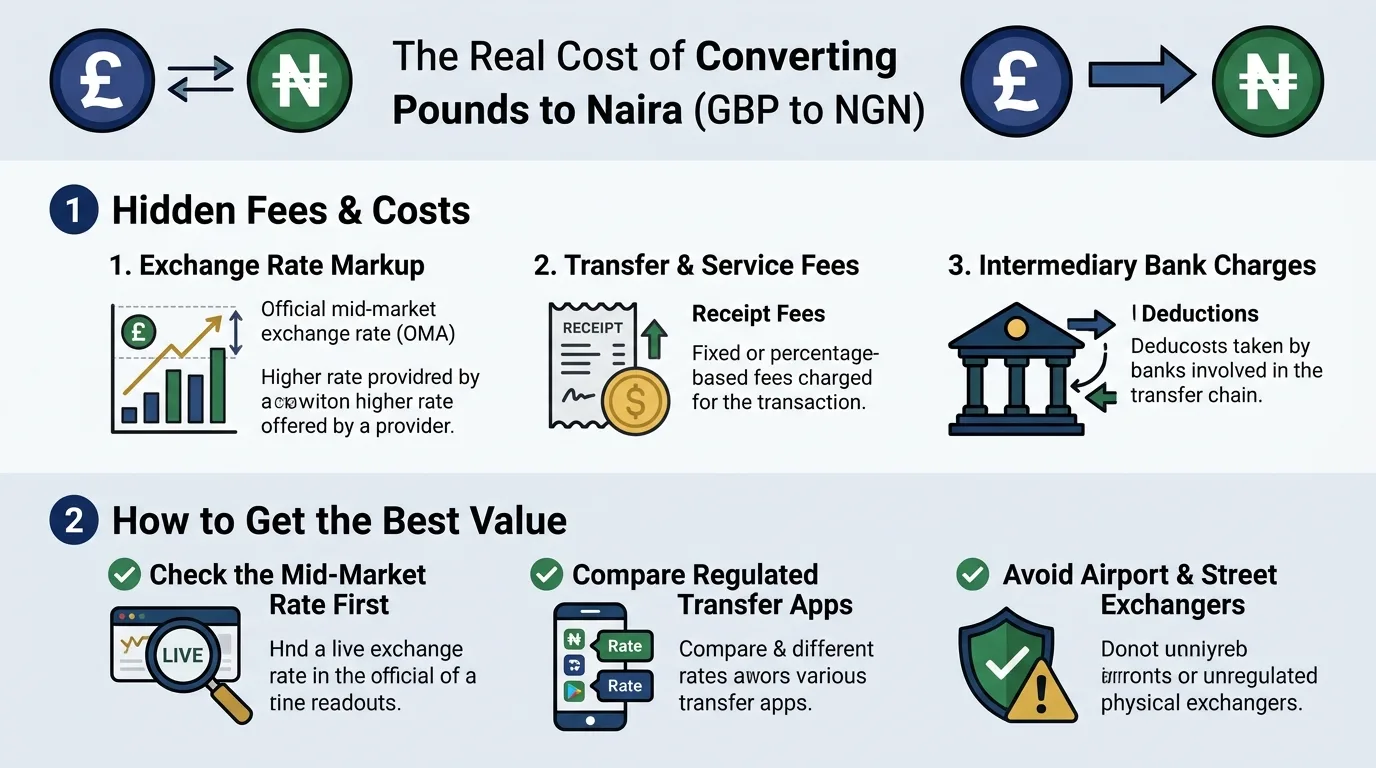
The total cost depends on what you are converting, how you pay, which service you use and where the naira is delivered. Here are the charges to identify before accepting an exchange.
| Cost component | What it means | What to ask the provider |
|---|---|---|
| Exchange-rate margin | Difference between the rate used for your transfer and a comparable market-reference rate | What precise GBP/NGN rate will you apply, and what is its validity period? |
| Transfer or conversion fee | Fixed or percentage charge by the provider | Is the charge deducted from the pounds sent or added to my payment? |
| Funding-method charge | Additional price for paying by card, bank account or another method | Does changing the payment method change the fee or FX rate? |
| Intermediary/correspondent fee | Possible deduction in some bank or international transfer chains | Will any bank deduct money before the recipient receives it? |
| Receiving/payout charge | Possible amount charged at the destination | Is the quoted “recipient gets” figure net of all known deductions? |
| Cash handling/other permitted charges | Charges applicable to particular delivery or service arrangements | Are there any other fees or taxes, and when do they arise? |
The World Bank says remittance prices are frequently made up of a sending fee, exchange-rate margin and sometimes a fee at the receiving end. Its research also distinguishes bank-account, card, cash and mobile payment methods. These costs can vary substantially between providers and transfer sizes. See the World Bank's explanation and methodology .
1. The exchange-rate margin: a cost you may not see as a fee
The exchange-rate margin, sometimes called an FX spread or markup, is the difference between a comparable benchmark and the provider's transaction rate. For example, suppose the indicative market reference is ₦1,800 per £1 but a service converts your pounds at ₦1,770 per £1. The 30-naira difference may represent some of the cost of the service, even if the provider advertises a transfer fee of £0.
At those fictional figures, converting £200 at ₦1,770 rather than ₦1,800 would produce ₦6,000 less before any explicit charge. That comparison is meaningful only if the two rates are measured at the same time, in the same direction and for a comparable payment route.
A mid-market or published reference rate is not automatically an executable customer quote. The Bank of England says its published sterling spot rates are not official tradeable prices. Nigeria's CBN market-rates page publishes official Nigerian market data, with its prominent NFEM table expressed in naira per US dollar; do not label a USD/NGN benchmark as GBP/NGN.
The real question is whether the quote is fair and usable for your specific transaction. One provider can show a lower exchange rate with no separately listed fee; another may show a stronger rate and deduct an explicit charge. Compare the entire outcome, not the marketing wording.
2. Fixed fees, percentage fees and minimum charges
Some money-transfer services charge a fixed fee, such as £5. Others charge a percentage of the transfer, a fixed amount plus a percentage, or a minimum fee for small transfers. The method matters because fixed fees make a greater percentage impact on smaller amounts.
Consider a purely illustrative £5 flat fee:
| Total GBP budget | Fee as share of the budget |
|---|---|
| £50 | 10% |
| £100 | 5% |
| £500 | 1% |
| £1,000 | 0.5% |
This table shows why a service that looks affordable for a large transfer may be disproportionately expensive for a small allowance or gift. Equally, it does not mean larger payments are automatically cheaper: provider-specific volume fees, caps, pricing tiers and extra checks can change the calculation.
For consumer transfers, the price may also depend on how you fund the payment. Wise's fee explanation describes transfer amount, payment method and exchange rate as relevant pricing variables; its product description is an example of fee mechanics, not confirmation that any particular GBP-to-NGN route is currently supported. Always check a provider's actual quote for your destination and funding method.
3. Worked example: three providers, one £200 budget
Let's compare three entirely fictional providers on the same assumption: the sender has exactly £200 in total, which must cover the foreign-exchange conversion and any deducted sending fee. Use an illustrative reference rate of ₦1,800 per pound to show the differences. No receiving-bank charges apply in this example.
| Line item | Provider A | Provider B | Provider C |
|---|---|---|---|
| Total sender pays | £200 | £200 | £200 |
| Published conversion rate | ₦1,770/£1 | ₦1,800/£1 | ₦1,790/£1 |
| Explicit fee deducted | £2 | £6 | £0 |
| GBP actually exchanged | £198 | £194 | £200 |
| Naira recipient receives | ₦350,460 | ₦349,200 | ₦358,000 |
| Effective rate per £1 paid | ₦1,752.30 | ₦1,746.00 | ₦1,790.00 |
| Gap versus ₦360,000 reference outcome | ₦9,540 | ₦10,800 | ₦2,000 |
| Indicative total-cost percentage | 2.65% | 3.00% | 0.56% |
Provider A: (£200 − £2) × ₦1,770 = ₦350,460. Compared with the hypothetical ₦360,000 no-cost reference outcome, its ₦9,540 gap includes the £2 fee valued at the reference rate (₦3,600) and a 30-naira rate difference on £198 (₦5,940).
Provider B: (£200 − £6) × ₦1,800 = ₦349,200. Its rate matches the reference but the fee lowers the payout by ₦10,800.
Provider C: £200 × ₦1,790 = ₦358,000. It advertises no separate sending fee but pays ₦2,000 less than the hypothetical reference, equivalent to a 0.56% indicative gap.
Provider C delivers ₦8,800 more than Provider B for the same £200 spent. This is why choosing the provider with the highest advertised exchange rate, or the provider advertising zero fees, is not enough. The provider that sends the most naira within an agreed budget may be different.
Calculation note: the cost percentages above use a fixed illustrative reference rate, not a rate consumers are guaranteed to obtain. They measure an indicative gap, not a statutory fee or audited statement of any real company's charges.
4. How to calculate the real cost of sterling-to-naira conversion
There are two useful calculations. The first tells you the amount your recipient gets. The second puts the result into one effective rate so you can compare providers.
When a fee is deducted from the pounds before conversion
Net naira received = (Total GBP paid − GBP fee) × provider GBP/NGN rate − any NGN receiving charge.
For example, if the £200 budget includes a £2 fee and the rate is ₦1,770, the result is ₦350,460, assuming no destination deductions. If a recipient charge of ₦1,000 then applies, the final payout would instead be ₦349,460.
When the sender pays the fee on top
Some quotes instead describe £200 being converted plus a £5 transfer fee. In that case the sender spends £205, and the correct effective rate is calculated using £205, not £200. Comparing that offer with a quote that costs only £200 without adjusting the total budget would be misleading.
Calculate the effective exchange rate
Effective NGN per GBP spent = final naira received ÷ total pounds actually paid.
If a customer pays £205 all-in and the beneficiary receives ₦360,000, the effective rate is approximately ₦1,756.10 per pound paid. The number is lower than the hypothetical ₦1,800 transaction rate precisely because the fee is part of the sender's cost.
For a simple benchmark-based illustration, calculate the naira that your total GBP spend would equal at a contemporaneous, comparable reference rate; subtract the real payout; then divide that gap by the hypothetical no-cost reference amount. This gives an indicative percentage gap. It is not a universal measure of bank profit, because spreads can reflect multiple factors and the benchmark may not be executable.
5. The funding method can change the price
When comparing offers, make sure each one uses the same GBP funding method. A bank-funded transfer, debit-card payment, credit-card payment and cash-funded transaction may produce different costs. Some card issuers can also apply their own charges, particularly if a transaction is treated as a cash advance or processed in a different currency.
The World Bank's methodology explicitly tracks the payment instrument used at the sending end and the receiving method at the destination. An online quote for funding from a UK bank account should not automatically be treated as the price of paying with a credit card.
Before approving, look for both the transfer service's charges and the possible charges from the account or card used to fund it. If the provider doesn't know how the issuing bank will categorise a card transaction, confirm with the card issuer. Do not assume that a “free” deposit or transfer means every third-party charge has disappeared.
6. Bank wires, intermediaries and deductions at the receiving end
Not every pounds-to-naira conversion is a standard consumer remittance. A business might use an international bank transfer; a customer might convert GBP through a multicurrency account; or a foreign-currency payment may pass through correspondent banks before a final conversion.
For some international bank-transfer routes, the bank or an intermediary can charge a handling or routing fee. The recipient bank may also apply a permitted charge or currency conversion. The charges and which party pays them depend on the transfer arrangement and provider terms. They should not be assumed to apply to every IMTO remittance.
Ask the sending institution which charges are known, whether any may be deducted during transit, who bears them and how the beneficiary's final payout is confirmed. For a supplier invoice requiring an exact amount, an unexpected deduction can create a payment shortfall even when the sender has paid the bank's initial fee.
For personal transfers to Nigeria, the CBN's 2024 revised IMTO guidelines describe the permitted inward-transfer arrangements, including naira payouts and operator disclosure obligations. Its March 2026 update adds requirements around designated naira settlement accounts and traceability. Do not rely on old online claims about mandatory foreign-currency payouts or an outdated exchange window without checking the applicable current rules.
7. What Nigerian regulations say about disclosed conversion costs
The CBN's Guidelines on International Money Transfer Services in Nigeria , section 4.1, provide for disclosure to customers of the applicable exchange rate, commissions, fees and other amounts charged by operators or their agents. The guidelines also cover transfer records, receipts and dispute handling.
This is significant because a customer should not have to guess whether an operator's advertised exchange rate is accompanied by a separate transfer charge. However, it would be incorrect to conclude from the rules that every transfer is free, that every company must offer a particular identical GBP/NGN retail rate or that a listed market benchmark is guaranteed to be the exact sum paid to every beneficiary.
The CBN's official licensed IMTO listing is a starting point for confirming the legal identity of Nigeria-facing operators. A name appearing on a regulatory list does not establish that a particular app, website, advertised discount or UK-to-Nigeria route is available at a given moment. Check the provider's legal entity and transaction terms directly.
8. How much do small and large GBP-to-NGN transfers cost?
The total pounds you send can significantly change the percentage cost. If a provider charges a small fixed amount, it weighs heavily on a £50 gift. If the main cost is an exchange-rate margin, the naira difference can become much larger as the transaction grows.
As a simple hypothetical, a ₦20-per-pound difference between two otherwise identical rates creates the following gross differences before other charges:
| GBP converted | Difference at ₦20 per pound |
|---|---|
| £50 | ₦1,000 |
| £100 | ₦2,000 |
| £250 | ₦5,000 |
| £500 | ₦10,000 |
| £1,000 | ₦20,000 |
The figures explain why evaluating a real exchange-rate margin matters for tuition, regular family support and high-value payments. But it is also essential to consider transfer limits, verification requirements and rate validity rather than assuming that splitting a large transfer into smaller ones will lower fees. Splitting can increase repeated fixed charges and should never be used to evade lawful checks.
9. Comparing bank, remittance-app and cash-conversion options
There is no single channel that is always cheapest for every customer. Evaluate the transaction you actually need:
| Option | Best question to ask | Watch for |
|---|---|---|
| Licensed international transfer operator | How many naira will the named recipient receive for my fixed GBP payment? | Transfer fee, FX margin, quote expiry, delivery method |
| Commercial bank international transfer | What is the all-in cost, including correspondents and destination charges? | Wire fees, charge allocation, conversion timing |
| Multicurrency account | When exactly is GBP converted, and what fee or spread applies? | Separate conversion and withdrawal/payout charges |
| Licensed cash-exchange service | What GBP buying rate applies to my amount, and will I get a receipt? | Buy/sell spread, cash handling and legitimacy |
| Card or ATM abroad | What is my issuer's FX margin and withdrawal/transaction fee? | Card-issuer charges and dynamic currency conversion |
For a UK-to-Nigeria family payment, compare the exact same GBP budget, recipient account, payment method, date and delivery conditions. A cash quotation in Lagos is not directly comparable to a British bank's international-wire quote without adjusting for what the sender is buying and receiving.
FlyingEze's reporting on diaspora remittance inflows to Nigeria provides background on why transparent pricing matters to families and businesses. But a report on remittance volumes cannot substitute for current service quotes.
10. GBP/NGN rate movements and quote expiration can affect final cost
Currency markets move, and the date on a website matters. A rate on a financial-news page may be a historical reference, a mid-market indicator or a previous business-day fixing. A commercial transaction can use a different rate at the time the funds are received or converted.
Some providers give a guaranteed price for a defined period; others use a floating price. For the latter, the final naira amount can differ from the initial estimate. Read the conditions on the quote, including how long it stays valid and which event fixes the rate.
The Bank of England's exchange-rate page explicitly says its daily rates are not official transaction rates. Nigeria's CBN rates page is useful for market context, but its publicly displayed NFEM USD/NGN series must not be mislabelled as a direct GBP/NGN retail quote.
Readers who need help finding a credible GBP benchmark can consult FlyingEze's separately scheduled article, Pounds to Naira: How to Check Reliable GBP/NGN Exchange Rates, once published. This article instead focuses on the total conversion cost, including fees and effective prices.
11. Avoid common hidden-cost and foreign-exchange scams
Some misleading offers use a high headline rate to attract customers, then reveal an additional fee late in the process. Others promote “zero commission” but pay a materially weaker exchange rate. Neither slogan alone proves that an offer is good or bad; you need the actual payout and provider documentation.
Before sending money, verify a Nigeria-facing operator against the CBN's licensed IMTO list . For a UK-based service, use the Financial Conduct Authority's Firm Checker to review the firm's identity and relevant permissions. The FCA warns about clone firms that mimic genuine licensed businesses while using different contact numbers, accounts or websites.
Be wary of an individual who promises a guaranteed better-than-market rate and demands a transfer to an unrelated personal bank account. Never provide banking PINs, one-time codes or remote-access permission to someone offering to “unlock” a currency conversion. If you already suspect a fraudulent payment, FlyingEze's published guide on what to do after sending money to a suspected fraudulent bank account in Nigeria explains steps for preserving evidence and reporting the incident promptly.
12. A practical five-minute checklist before converting pounds
- Fix the total sender budget: decide whether you will spend exactly £100, £200 or another amount including all fees.
- Specify the receiving method: Nigerian bank account, supported cash collection or another available lawful method.
- Collect comparable quotes: obtain the GBP/NGN transaction rate, sending fee, funding method and exact net naira received.
- Inspect charges: ask about receiving deductions, correspondent fees and whether taxes or card charges apply.
- Check quote timing: note the time, expiration and whether the rate is fixed or floating.
- Verify the operator: confirm the legal firm and relevant UK or Nigerian authorisation, not just an app's marketing name.
- Confirm beneficiary data: check the account name, bank and destination details before authorising.
- Keep records: save the receipt, applied rate, charged fee, payment reference and recipient confirmation.
If a provider does not clearly show how much naira will be delivered, ask for clarification before paying. The CBN's IMTO guidelines set out disclosure requirements for applicable rates, commissions and fees; the World Bank's comparative approach likewise looks beyond a single headline figure.
Frequently asked questions about the cost of converting pounds to naira
How much does it cost to convert £100 to Nigerian naira?
There is no universal cost. It depends on the GBP/NGN rate, whether fees are fixed or percentage-based, the funding route and any receiving deductions. Obtain a current quote that states your total pounds paid and the naira the recipient receives.
Is sterling-to-naira conversion free if an app says “zero fees”?
Not necessarily. Zero explicit transfer fees can still accompany a margin within the exchange rate. Compare the net naira received with other verified provider quotes for the same GBP budget.
What is an exchange-rate markup?
It is the difference between a provider's applied rate and a comparable market reference. Because references may not be executable, describe the comparison carefully rather than assuming the entire difference is profit or a disclosed commission.
How do I calculate the effective GBP-to-NGN rate?
Divide the final naira received by the total pounds actually paid, including sending fees. A transfer delivering ₦360,000 for a total £205 spend has an effective rate of about ₦1,756.10/£1.
Why can a higher advertised rate leave me with less money?
A fee may be deducted before conversion, or the recipient may incur a charge. Always compare the complete payout, not just the number displayed next to GBP/NGN.
Do debit cards and bank transfers cost the same for GBP-to-NGN payments?
Not always. Payment-method fees can differ, and the card issuer may add its own charges. Compare quotes using the same funding method, and verify with your bank if a card payment may be treated as a cash advance.
Can I use the CBN's exchange rate to calculate what my bank must pay?
A published benchmark helps with context, but it is not automatically an executable retail quote. Check the currency pair, publication date and current bank or provider terms.
Are intermediary bank charges always deducted on transfers to Nigeria?
No. They depend on the transfer route and product. Do not assume every licensed remittance service uses a correspondent-chain deduction. Ask what fees are included and whether the recipient amount is guaranteed.
How can I check whether a transfer service is licensed?
Check the relevant legal entity on the CBN's IMTO list and, for UK-based regulated services, the FCA Firm Checker . Verify the domain and payment instructions separately to avoid clone firms.
Does a £5 transfer fee have the same percentage impact on £50 and £1,000?
No. A flat £5 fee consumes 10% of a £50 budget but only 0.5% of £1,000. Rate margins and other charges may still change the overall calculation.
What is the cheapest way to send pounds to Nigeria?
There is no universally cheapest provider for every amount, customer and route. Compare multiple authorised providers using the same total spend, funding method, timing and destination; choose on net naira received and acceptable service terms.
What if the quote changes after I start the transfer?
Check whether the price was guaranteed, what event locks it and whether it has expired. If the service is quoting a floating exchange rate, review the updated payout before proceeding where the product allows.
Conclusion: the real price of pounds-to-naira conversion is the money you do not receive
When converting sterling to naira, the most useful number is not the advertised GBP/NGN rate or a “zero-fee” badge. It is the final naira amount delivered for a known total pound cost. Foreign-exchange margins, sending charges, payment-method fees and possible receiving deductions can all affect that figure.
A fair comparison requires up-to-date quotes on the same terms, transparent fee information and a properly verified provider. Before pressing “send”, confirm the exchange rate, exact GBP spend, recipient payout and delivery conditions. Taking those steps can help Nigerian families, students and businesses avoid unexpected conversion losses and make safer international payments.
Editorial verification: 13 November 2026. The example rates, providers and prices are fictional and used solely to explain cost calculations; this article does not supply a current tradeable GBP/NGN rate or product recommendation. Primary sources include the World Bank's Remittance Prices Worldwide methodology, the CBN's international transfer and disclosure requirements, the Bank of England's exchange-rate disclaimer and the FCA's firm-verification guidance.