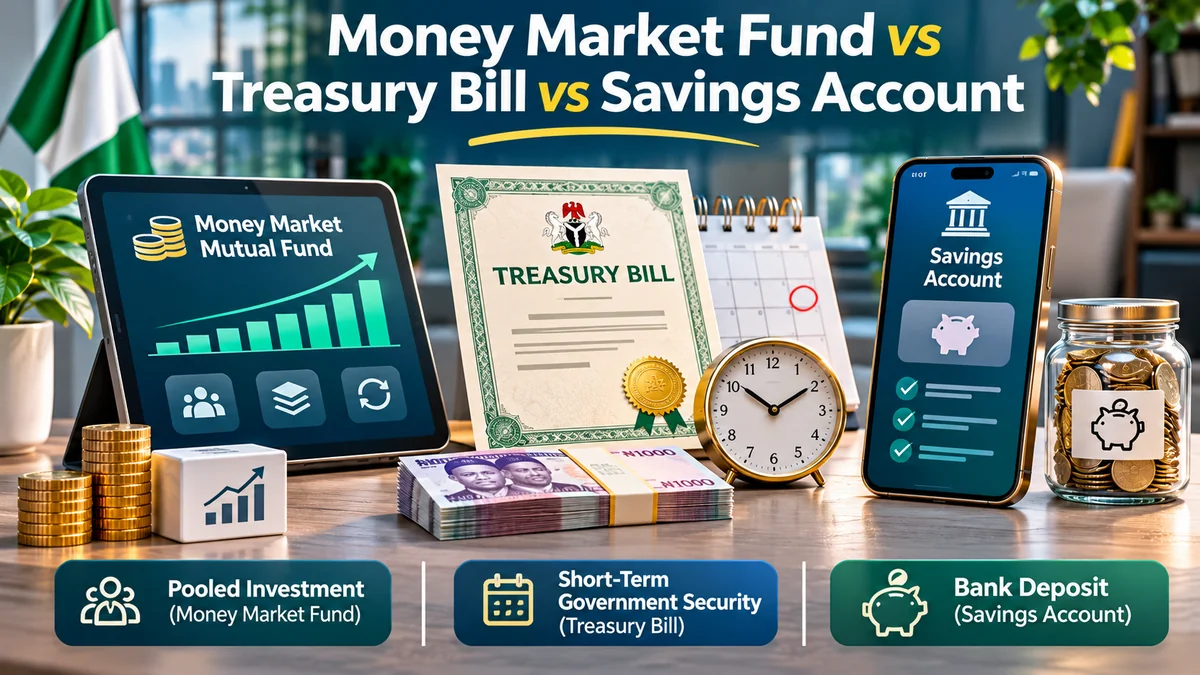
A money market mutual fund, a Nigerian Treasury bill and a bank savings account can all hold money for relatively short periods, but they are not interchangeable. A savings account is a bank deposit designed for access and payments; a Treasury bill is a short-term Federal Government debt security with a maturity date; a money market fund pools investors' money in a managed portfolio of short-term instruments. The differences show up in access to cash, risk, returns, fees, tax and deposit insurance.
For Nigerians comparing these options, the best question is not simply which one advertises the highest rate? It is when will I need the money, what can I afford to risk, and how much will I receive after charges and applicable tax? The right choice for an emergency reserve may differ from the right choice for money set aside until a known date.
Research verified 14 November 2026. This article is general education, not personalised financial advice. Quoted yields change; no live investment return is promised.
At a glance: the three-way comparison
| Question | Money market mutual fund | Nigerian Treasury bill | Bank savings account |
|---|---|---|---|
| What is it? | A pooled investment in short-term securities | A short-term Federal Government security | A deposit at a licensed bank |
| Who manages or owes the money? | SEC-regulated fund structure and underlying issuers | Federal Government as issuer | The deposit-taking bank |
| Return | Variable fund income or yield, not guaranteed | Purchase price and maturity payment determine return when held to maturity | Interest set under the bank's current product terms |
| Access | Redeem units subject to fund dealing and settlement rules | Normally hold to maturity; early sale depends on market access and price | Usually accessible through banking channels, subject to restrictions or outages |
| Principal risk | Underlying credit, market and liquidity risks | Sovereign credit, inflation and early-sale price risks | Bank failure risk, mitigated by NDIC cover within limits |
| NDIC deposit protection? | No | No | Yes, for eligible deposits at insured institutions, within applicable limits |
| Costs to check | Fund fees, exit conditions, tax | Dealer spread, custody or service fees, tax | Bank charges, account conditions, tax |
| Often useful for | Short-term funds not required instantly | Money needed on a known future date | Daily balances and immediately accessible reserves |
These are general features, not a product guarantee. Always read a specific fund's prospectus, the terms of a Treasury bill transaction and the chosen bank account's disclosures.
What is a money market mutual fund?
A money market mutual fund is a collective investment scheme that pools money from multiple investors and places it in short-term financial instruments. A professional manager selects investments within the fund's approved mandate. Depending on its rules, these can include Treasury bills, high-quality bank placements and other eligible short-term securities.
Nigeria's Securities and Exchange Commission (SEC) guidance on collective investment schemes explains how unit trusts pool investor funds and issue units representing a share of a managed portfolio. Investors hold fund units, not a savings balance owed by a bank.
How returns work: the portfolio earns income from its holdings, and the benefit reaches investors through distributions, unit valuation or the mechanism specified by the fund. A quoted annualised yield is generally a snapshot or historical measure, not a promise that the same rate will continue for twelve months. The actual amount received depends on the fund's performance, fee treatment, timing and distribution method.
How withdrawals work: an open-ended fund generally permits redemptions, but payment may require processing on business days and is subject to the prospectus. “You can redeem” is not the same as “cash arrives instantly”. Check cutoff times, minimum holdings, possible exit charges and the number of business days to receive money.
What can go wrong? Even when a fund targets capital preservation, investments can face credit or liquidity problems and changing market conditions. SEC oversight is important, but it is not government insurance or a guaranteed return. The SEC's NAV guidance explains how a collective investment scheme's net asset value and unit price are calculated.
For additional context on access to regulated investment products, FlyingEze previously reported on mutual-fund access through FCMB's mobile app . Availability through a familiar app does not change the underlying fund's investment risk or turn it into an insured bank deposit.
What is a Nigerian Treasury bill?
A Nigerian Treasury bill (NTB) is a short-term debt security issued by the Federal Government through arrangements involving the Debt Management Office and the Central Bank of Nigeria (CBN). The CBN's investor FAQ describes Treasury bills as securities sold at a discount with terms ranging from 91 to 364 days. Common tenors are 91, 182 and 364 days, subject to the official issuance calendar.
When a bill is issued at a discount, an investor pays less than its stated face value and, if the security is held to maturity and the issuer pays as promised, receives the face value. The difference is the gross investment income before applicable tax and transaction charges.
Why a 12% discount rate is not automatically a 12% investment yield
Suppose a hypothetical 182-day bill has a face value of ₦1,000,000 and a 12% annual discount quotation using an illustrative 364-day basis. Half a year of discount is ₦60,000, so the illustrative purchase price is ₦940,000. At maturity, the gross amount due is ₦1,000,000.
The gross gain is ₦60,000, or approximately 6.38% of the ₦940,000 actually invested over those 182 days—not 6% of the purchase price. An annualised investment yield calculated from the purchase price is therefore different from the discount quotation. Actual market calculations depend on the quoted convention, exact tenor, taxes and transaction fees.
Do not use this 12% figure as a current CBN rate. It is an arithmetic teaching example.
Can you withdraw a Treasury bill before maturity?
A Treasury bill is not a demand deposit. It may be possible to sell it before maturity through an intermediary or secondary-market arrangement, but the price is not necessarily the amount originally paid plus accrued income. If market yields have risen, a sale may produce a lower price than expected. Liquidity and dealing charges can also affect the result.
Ask the dealer which tenor you are buying, whether the quoted rate is a discount rate or yield, the actual cash purchase amount, custody arrangements, fees, maturity value, tax treatment and the price you might receive if selling early. Minimum transaction sizes and access requirements vary by distribution channel; do not rely on an old generic minimum.
What is a bank savings account?
A savings account is a deposit account at a licensed bank. It typically supports deposits, transfers and withdrawals using the bank's approved channels. Some savings products impose minimum balances, withdrawal conditions or other restrictions affecting interest. Rates and fees can change with the bank's terms and applicable regulation.
The essential difference is that the customer has a deposit claim on the bank, rather than fund units or a government security. A bank may pay relatively modest interest for this accessibility, but there is no universal rule that every savings account always earns less than every fund or Treasury bill.
What does NDIC protection cover?
The Nigeria Deposit Insurance Corporation (NDIC) states that the maximum insured limit for eligible depositors at Deposit Money Banks is ₦5 million per depositor per bank. The limit for microfinance banks, primary mortgage banks and payment service banks is ₦2 million. Eligibility and aggregation rules apply; separate branches of the same bank do not automatically create separate coverage limits.
That protection matters if an insured institution fails, but NDIC insurance is not an unlimited government guarantee for every financial product. A money market mutual fund or a Treasury bill does not become an insured bank deposit merely because it was bought through a bank or app.
FlyingEze has previously covered NDIC intervention following the revocation of microfinance bank licences , illustrating why investors should distinguish deposit insurance from other forms of financial regulation.
Before opening an account, verify the exact licensed institution, product category, fee schedule and withdrawal terms. The phrase “savings” in a fintech app is not itself proof that the user's money is held in an eligible insured bank deposit.
Which option is safer?
Safety has several meanings. If the priority is protecting an eligible deposit against a covered bank failure, NDIC insurance offers a defined protection up to the applicable limit. If the priority is the credit of the issuer, a Treasury bill is a Federal Government obligation rather than a bank deposit. A money market fund spreads exposure across securities in a portfolio, but that does not eliminate losses.
All three remain exposed to inflation risk: purchasing power can fall when the return on money is below price inflation. Treasury bills also carry a risk of an unfavourable price if sold early, while mutual funds face portfolio and redemption risks. A savings account can suffer low or negative inflation-adjusted returns even if the nominal balance is stable.
It is more accurate to ask, “Safe against which event?” than to rank the three products using a single risk score.
Liquidity: how quickly can you get your money?
Savings account: generally the most convenient for payments and urgent withdrawals, subject to bank operating rules, transaction limits and outages.
Money market fund: generally offers redemption opportunities, but settlement may take one or more business days under the specific fund's terms. Confirm timing before treating it as emergency cash.
Treasury bill: provides a defined maturity date, while earlier access depends on the ability to sell and the market price. For money required to pay a fixed bill next week, an instrument maturing months later may be a poor match.
A useful approach is to align each financial goal with the cash-access deadline. Money for tomorrow's transport, rent or emergency repairs should not be locked into an investment you cannot reliably convert to spendable cash by then.
Returns: compare like with like, not just headline rates
Three rates that all say “per annum” may measure different things. A savings account might quote a nominal annual interest rate; a money market fund might publish a trailing annualised yield; a Treasury bill might be quoted on a discount-rate basis. The tax and fee treatment may differ too.
Compare the net money actually expected to be available on the same future date after taking account of the amount invested, holding period, costs and any withholding. For a fund, clearly label a projection as uncertain. For a Treasury bill held to maturity, distinguish the contractual payment from a hypothetical early-sale price.
A simple comparison checklist for ₦500,000
| Item to compare | Question to ask |
|---|---|
| Starting amount | How much of ₦500,000 is actually invested after charges? |
| Time horizon | Will I need the money in seven days, three months or a year? |
| Quoted return | Is the rate fixed, variable, historical, projected or a discount quotation? |
| After-tax proceeds | How much is likely to arrive in my account after applicable withholding? |
| Exit | Can I withdraw or sell early, and at what price or charge? |
| Risk protection | What legal claim or insurance exists if the bank, fund or issuer fails? |
This avoids inventing a current “best-performing” product. Compare real, dated quotes from authorised providers using precisely the same assumptions.
Fees and taxes that can change the result
Money market funds may have management and operating expenses, with costs reflected in the fund's reported performance or charged as described in its documentation. The correct comparison needs the fund's official factsheet, current prospectus, fee disclosures and redemption rules. The SEC maintains weekly net asset value data for collective investment schemes, useful for independent context.
Treasury bill investments can involve intermediary spreads, custody or service charges depending on how they are purchased. A bank savings account may impose account-related charges or interest conditions. Comparing only the advertised rate can therefore misrepresent net outcomes.
Do not assume Treasury bill interest is always tax-free in Nigeria. The SEC's July 2025 circular addressed the expiration of an earlier tax exemption for some short-term government securities, and the subsequent tax guidance and enforcement changes brought withholding on interest from short-term securities into focus. Savings interest and fund distributions can have their own tax treatment. Tax rules depend on the instrument, investor and prevailing law.
Ask the bank, fund manager or dealer for the current gross-to-net calculation and any tax documentation. A headline yield should never be represented as a guaranteed take-home percentage.
Which should you choose for an emergency fund, tuition or business expenses?
Emergency fund: prioritise immediate access
For money needed without warning, an eligible bank savings account may be the simplest primary reserve. Some people keep an additional portion in a redeemable money market fund after verifying redemption speed. A Treasury bill with an inconvenient maturity date is not a substitute for instantly accessible emergency cash.
Known future payment: match the maturity
If a school fee or planned purchase is due on a particular date, a Treasury bill maturing beforehand may be considered, provided the investor accepts its risks and can access the appropriate security. A money market fund offers flexibility without a fixed maturity of the investor's units, but its future returns are not locked in.
Business working capital: avoid liquidity surprises
A business needs to pay salaries, suppliers and unexpected expenses on time. Keeping all operating cash in assets requiring redemption or secondary-market sales can create a cash-flow problem. Segment funds into immediate operating needs, short-term reserves and longer-dated commitments. Do not expose payroll or tax obligations to investment risks simply to earn a higher headline yield.
How to check a money market fund or investment offer before paying
- Verify the operator. Use the SEC's capital market operator register to check the manager or intermediary, and confirm the exact scheme's status and documentation.
- Read the fund documents. Look for the asset mix, risks, fees, trustee, custodian, dealing days and redemption procedure.
- Check recent information. Compare the factsheet's date, reported yield convention and audited information rather than trusting a screenshot circulated on social media.
- Confirm Treasury bill dealing details. Ask about the approved intermediary, tenor, price, effective yield, maturity payment and potential early-sale treatment.
- Confirm deposit-insurance eligibility. Check whether a “savings” service is actually an eligible deposit at a licensed insured institution.
- Keep a record. Save official statements, transaction confirmations and documentation of charges and taxes.
- Reject unrealistic guarantees. The SEC has warned against unregistered platforms promising unrealistic or guaranteed returns . Do not transfer investment money to a random personal account because of a social-media recommendation.
Frequently asked questions
Can a money market mutual fund lose money?
Yes. Its objective may be to preserve capital and earn income, but it is still an investment with portfolio and liquidity risks. SEC registration does not guarantee the principal or a particular yield.
Are Treasury bills covered by NDIC?
No. NDIC deposit insurance is for eligible deposits at insured institutions, not for directly held Treasury bill investments. Treasury bills are obligations of their government issuer.
Is a money market fund the same as a savings account?
No. A fund investor holds units of a collective investment scheme. A savings-account customer holds an eligible deposit claim against a bank. Their rules, risks and protections differ.
Can I sell a Treasury bill before maturity?
It may be possible through an intermediary, but the sale price depends on market conditions, available buyers and dealing costs. It should not be assumed that early sale always returns the original amount plus the expected interest.
Which one pays the highest return in Nigeria?
No single choice wins all the time. Returns vary with CBN auctions, interest-rate conditions, fund portfolios, bank pricing, taxes and fees. Compare current, dated, after-cost figures for the same time horizon instead of relying on a general ranking.
The bottom line
For everyday access and covered deposit protection, a suitable bank savings account has an important role. For money that can stay invested to a specified date, a Treasury bill offers a defined maturity structure. For a managed, generally redeemable short-term investment, a regulated money market mutual fund offers a different balance of flexibility and risk.
None is automatically best for everyone, and none is a perfect defence against inflation. Start with when you need the cash, verify the issuer or provider, understand the exact product and calculate what you may receive after costs and applicable taxes.