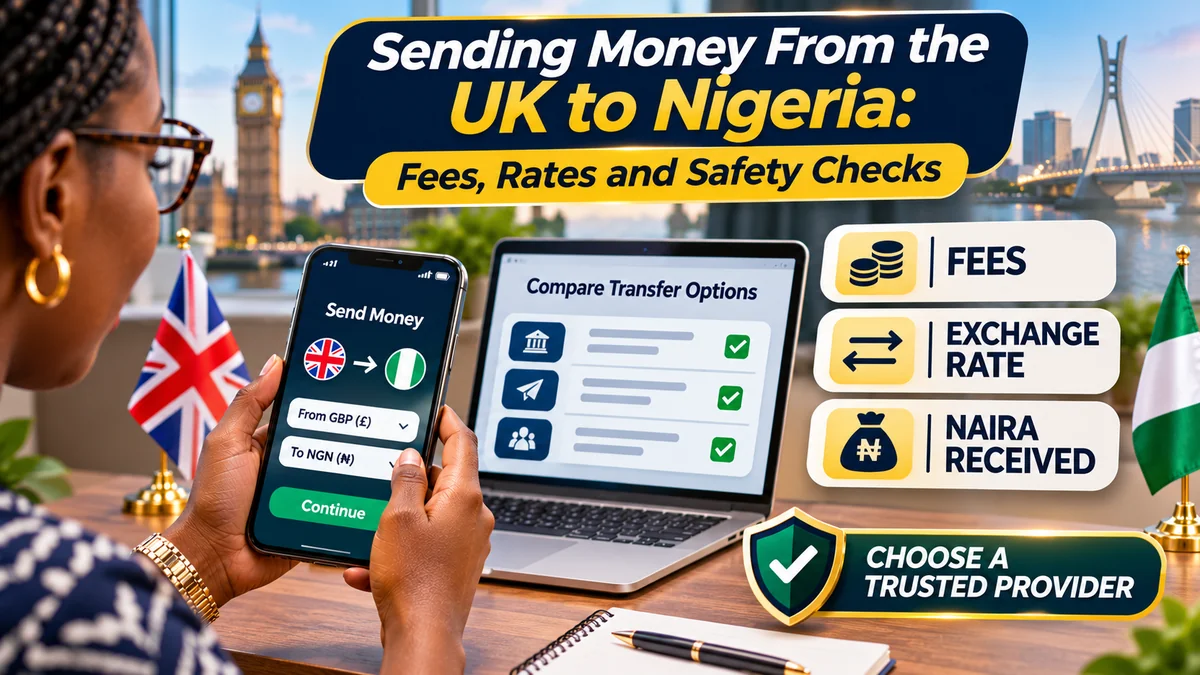
Quick answer: To send money from the UK to Nigeria safely, choose a legitimate transfer service, confirm it supports your GBP-to-NGN route, verify the recipient’s Nigerian bank details and compare the total pounds paid with the naira actually received. Check the sender fee, exchange-rate margin, any additional charges, delivery estimate and provider’s regulatory status before authorising payment. Keep the transaction reference and contact the provider promptly if anything goes wrong.
For people searching sterling to naira, an advertised GBP/NGN number is only part of the answer. The exchange rate, fixed fee, payment method, payout method and rate-lock conditions can all change the recipient’s final amount. A transfer promoted as “zero fee” may still use an exchange rate below a comparable market benchmark.
This independent guide explains how UK-to-Nigeria transfers work in 2026, how to check firms in both countries, what information to prepare, how to compare real quotes and how to recognise fraud. It is not a ranking or endorsement of individual providers, and all numerical transfer examples are hypothetical, not live exchange-rate quotes.
Research and policy verification: 13 November 2026. Primary sources include the UK Financial Conduct Authority (FCA), Central Bank of Nigeria (CBN), World Bank, UK Report Fraud service and Financial Ombudsman Service.
How to send money from the UK to Nigeria: the steps at a glance
| Step | What to do | Why it matters |
|---|---|---|
| 1. Choose a route | Decide on Nigerian bank-account payout or another currently supported lawful method | Delivery conditions, eligibility and cost vary |
| 2. Check the company | Verify the UK legal entity and relevant permissions with the FCA, and Nigeria-facing IMTO status with the CBN | Reduces the chance of using an impersonator or unlicensed operator |
| 3. Compare real quotes | Enter the same GBP budget and payout method with each provider | Reveals the impact of rates and fees |
| 4. Verify the recipient | Check full legal name, bank, account number and any requested identifier | Helps avoid misdirected funds |
| 5. Complete verification | Follow lawful identity and source-of-funds checks on the provider’s authentic site or app | Required checks may affect the transfer timeline |
| 6. Fund and approve | Read the final screen, confirm total GBP charged and NGN payout, then authorise once | Prevents price surprises and repeat payments |
| 7. Track and confirm | Save the transfer reference, monitor status and confirm receipt through the recipient’s bank records | Creates a useful trail for complaints or investigation |
1. Decide how the recipient will receive money in Nigeria
For an ordinary family payment, the most straightforward option may be a transfer to a Nigerian bank account. The service requests the beneficiary’s correct name, bank and account number, then arranges payout in naira according to the quoted terms. Some services may also support cash collection or other channels, but availability can depend on the transfer provider, transaction size, identity verification and current regulations.
The CBN’s January 2024 revised international money-transfer guidelines describe inbound remittance payouts in naira through a bank account or cash, with transfers above the equivalent of US$200 directed through an account and acceptable identification required for cash collection. That rule does not mean every provider offers both methods; check the particular service and current regulatory instructions.
In March 2026, the CBN issued additional settlement measures requiring IMTOs to route remittance settlements and disbursements through designated naira settlement accounts at authorised Nigerian dealer banks. These are operator-level requirements and do not mean a sender should transfer money directly to an arbitrary personal account advertised as an “IMTO settlement account”.
Choose the receiving method before comparing prices. A cash-pickup quote is not directly comparable with a bank deposit if access, identification, fees or delivery dates differ.
2. Check that the money-transfer provider is legitimate
Start by identifying the legal company operating the transfer—not simply its app name or advertisement. For a UK-based provider, use the FCA Firm Checker or FCA guidance on authorised firms to look up the firm and the relevant permission or registration status.
Check the exact legal name, financial-services permission, official domain and customer-service information. The FCA warns that clone firms can copy the name, reference number or website design of a genuine company while providing different telephone numbers or bank details. Verify contact information independently using the FCA’s clone-firm warning guidance .
For the Nigerian side of a formal inbound money-transfer arrangement, check the CBN’s published International Money Transfer Operators list . A firm may use overseas and Nigerian partners, so establish which legal entities are actually serving you. A company’s appearance on a list does not prove a specific website, social-media account, transfer offer or route is legitimate or currently active.
UK regulation, Nigerian licensing and the precise services provided are separate questions. Do not assume that a business registered at Companies House is therefore authorised to provide regulated payments, or that a regulatory registration guarantees every transfer will succeed.
3. Compare the true GBP-to-NGN cost, not the headline rate
The key comparison is simple: how many naira will the recipient receive for exactly the same amount of pounds spent? Compare the exchange-rate quote, explicit sending fee, funding-method charge, any destination deductions, transfer expiry and rate-guarantee conditions.
The World Bank’s Remittance Prices Worldwide methodology combines fees and exchange-rate margins when comparing remittance costs. Its UK-to-Nigeria corridor data covers different providers and methods, but the page checked for this guide was collected in August 2025. It is historical comparison research, not a live November 2026 price list and not proof that a provider’s earlier rate is available today.
Here is a fully hypothetical example based on an all-inclusive £200 sender budget:
| Comparison | Example A | Example B | Example C |
|---|---|---|---|
| Total pounds paid | £200 | £200 | £200 |
| Published exchange rate | ₦1,830/£1 | ₦1,790/£1 | ₦1,800/£1 |
| Sending fee deducted | £6 | £0 | £2 |
| Pounds actually converted | £194 | £200 | £198 |
| Naira received | ₦355,020 | ₦358,000 | ₦356,400 |
| Effective naira per total pound spent | ₦1,775.10 | ₦1,790.00 | ₦1,782.00 |
Although Example A advertises the highest rate, the £6 fee lowers the payout. Example B delivers ₦2,980 more than A for the same £200 paid. The figures are educational assumptions with no receiving-bank fee; actual providers can structure charges differently.
To calculate your own comparison, use: Effective GBP/NGN rate = final NGN received ÷ total GBP paid. If a provider charges its fee on top of the conversion amount, include the extra pounds in the denominator. This prevents comparing a £200 all-in quote with a £200 transfer that actually costs £206.
4. Understand the fees that can increase the cost
The exchange-rate margin is the gap between a transaction rate and a comparable reference rate at approximately the same moment. This margin is different from an explicitly listed transfer fee. A service advertising “no fees” may still apply an FX spread; another may offer a better rate but charge for funding or cash collection.
Charges may include a flat transfer fee, a percentage-based charge, a fee for paying with a credit or debit card, and—in some traditional bank-transfer routes—correspondent or receiving charges. These are possibilities, not charges that necessarily apply to every Nigerian remittance.
The CBN’s 2024 IMTO guidelines, section 4.1 , require disclosure of the applicable exchange rate, commissions, fees and other charges. They do not establish one universal retail GBP/NGN price offered to every sender. The sender should read the provider’s final transaction quote and obtain confirmation of the net payout.
For reference-rate context, the CBN exchange-rate resources show official Nigerian FX-market data; their prominent NFEM series is in USD/NGN, not a direct GBP/NGN consumer quote. A dated reference rate should not be mistaken for the amount the recipient will get on a transfer.
5. Gather the details you need before sending
Identity checks differ between institutions and depend on the amount, service and risk factors. A typical sender may need a legal name, UK contact details, acceptable identity document, address information and a valid funding account. The provider can request additional verification or information about the source and purpose of funds when appropriate.
For a Nigerian bank-account payment, prepare the recipient’s full name as registered with their bank, bank name and correct account number. Some providers also require a bank code, phone number, recipient address or transfer purpose. The service should tell you exactly what it needs; do not enter made-up identifiers to get past a validation prompt.
Before submitting, ask the recipient to confirm the information through a channel you already trust. A mistyped digit or wrong bank can create a delay or a misdirected payment. Do not simply trust bank details forwarded by an unknown caller or inserted into a last-minute social-media message.
Important: Do not send copies of your passport, bank statements or other sensitive documents to a WhatsApp account merely because someone claims to represent a transfer service. Upload documents only through the genuine provider’s protected verification process.
6. Choose the funding and payout methods carefully
When a provider accepts both bank transfer and card payment, compare the two actual final quotes. A card may be more convenient, but it can have different fees or issuer treatment. A bank transfer may require different funding instructions or processing time. Do not assume either method is always cheaper or always faster.
Make sure the bank account you pay belongs to the genuine service, and follow only instructions displayed inside its verified transaction flow. For a business or tuition payment, check whether the recipient needs a specific GBP amount or an NGN payout. Those are different payment objectives, and the quote must match the intended obligation.
If you are using a bank’s international transfer rather than an IMTO product, clarify the applicable currency conversion, intermediary charges and recipient-bank fees. Do not assume the rules for a specialist remittance app are identical to those for a bank-to-bank international wire.
7. Review the rate lock, delivery estimate and limits
A quoted exchange rate may be guaranteed for a stated window or floating until the money is received or converted. Check when the rate becomes binding, what happens if funding arrives late, and whether fees are refundable if a transfer cannot proceed. This matters particularly when a sender is waiting for a UK bank payment to reach the remittance service.
Transfer speed depends on identification checks, funding method, banking days, provider cut-off times, beneficiary details and the receiving institution. Do not rely on an unqualified “instant” promise. The actual provider should show an estimated arrival date and tell you how the transfer status can be tracked.
Providers may also apply minimum amounts, transaction limits or enhanced checks. Avoid splitting a large transfer merely to evade anti-money-laundering or identity rules. The CBN’s IMTO guidelines specifically prohibit apparent deliberate splitting to circumvent relevant reporting requirements.
8. Complete the transfer safely, step by step
- Go directly to the real provider. Type its known web address or open a previously verified app; do not follow a sponsored or forwarded impersonation link without checking it.
- Select United Kingdom as the sending country and Nigeria as the receiving country, where those selections are required. Set GBP as the payment currency and confirm the intended NGN payout.
- Enter your fixed total GBP budget and check the complete breakdown: fee, conversion rate and final recipient payout.
- Confirm recipient identity and account details through a trusted communication channel, particularly for a first transfer.
- Complete the provider’s identity checks through its genuine secure channel.
- Fund using an accepted method, confirming the payee details and any separate card or bank charges.
- Review the final authorisation screen, including the exact pounds to be charged and the expected naira payout, before pressing send once.
- Save the receipt and tracking reference. Ask the recipient to verify arrival using actual bank records, not an edited or forwarded screenshot.
If the payment screen times out after you have authorised the transfer, check whether the transaction was accepted before sending it again. A technical timeout does not necessarily mean no instruction reached the bank or provider.
9. What UK consumers should know about regulatory protections
The FCA distinguishes a bank deposit from money held with a non-bank payment institution or electronic-money institution. Its consumer explanation of payment-service providers says funds at non-bank payment and e-money firms generally do not have Financial Services Compensation Scheme (FSCS) coverage. Authorised payment institutions and relevant e-money institutions instead operate under safeguarding requirements; small payment institutions can be treated differently.
Safeguarding is intended to protect relevant customer funds if the firm fails, but it is not identical to FSCS deposit protection, and recovery may be delayed or reduced by insolvency costs. Never assume that using an FCA-listed service guarantees a refund of a failed payment or protects against every scam. Check what type of firm you are dealing with and its complaints arrangements.
The FCA’s complaints guidance says firms should handle complaints fairly; payment-service providers and e-money issuers normally must respond to certain complaints within 15 business days, subject to applicable exceptions. Unresolved eligible complaints may be referred to the UK Financial Ombudsman Service .
10. How Nigeria regulates inbound money-transfer payouts
The CBN’s revised January 2024 guidelines describe licence requirements, accepted payout forms, customer disclosure, records and complaint handling. They direct inbound IMTO transfers to be paid in naira, require disclosure of relevant charges and provide for customer receipts and dispute procedures.
The 24 March 2026 circular adds designated naira settlement-account routing and reporting measures for licensed IMTOs and authorised dealer banks. Because Nigeria’s remittance rules have changed over the years, old advice saying every remittance must be paid in US dollars is not a dependable description of the current rules.
For consumers, the practical questions are whether the operator supports the transfer, which payout channels it legitimately offers, what rate and charges it discloses, and how a missing payment can be traced. Neither the CBN’s 2024 rules nor its 2026 settlement circular means any random online seller is authorised to receive GBP for conversion.
11. Common UK-to-Nigeria money-transfer scams
Clone-firm fraud: Someone copies a genuine remittance provider’s logo, website appearance or FCA reference number and supplies a different bank account. Verify the real legal entity and contact details on the FCA register, not merely the branding. The FCA’s clone-firm advice documents this tactic.
Payment diversion: A criminal impersonates a recipient, relative, landlord, supplier or school and asks you to use a replacement account. In September 2026, the UK Report Fraud service warned that payment-diversion cases had caused major reported losses during 2025–26. Independently confirm any change of beneficiary details.
Fake exchange-rate deals: A social-media user promises a rate substantially more attractive than documented quotes but insists on payment to a personal or unrelated account. Do not treat an attractive sterling-to-naira figure as proof that a transfer is legitimate.
OTP and screen-sharing theft: Scammers request banking passwords, one-time codes, card PINs or remote-control access under the pretence of “verifying” your transfer. A genuine provider may require identity checks, but you should not disclose secret authentication credentials to a person over chat or phone.
Money-mule offers: The FCA warns against schemes in which strangers pay you to receive money and forward it elsewhere. Such activity can involve money laundering, even when presented as a simple transfer job. See the FCA’s money-transfer scam guidance .
FlyingEze has a published guide on what to do after transferring money to a suspected fraudulent bank account in Nigeria . The steps in that article support the general principle of reporting promptly and preserving evidence rather than relying on a “recovery agent”.
12. What to do if the money is delayed, missing or sent to the wrong account
First, check the transaction receipt, funding debit and status inside the real provider’s app or website. Confirm whether the instruction is pending, processing, completed, reversed or cancelled. Ask the recipient to check the destination account statement rather than relying only on a text-message alert.
If the transfer is unresolved, contact the sending provider first and give it the amount, date, recipient details and transaction reference. Ask for a trace and an explanation of the rate, fee, delivery status or attempted cancellation. Keep a complaint number and copies of the provider’s written response.
If you suspect fraud, contact your funding bank immediately to explain what happened and ask whether recall or protective steps are possible. Neither a payment recall nor a refund is guaranteed after funds have reached another account.
For a UK-based eligible complaint, follow the provider’s complaints procedure and then the Financial Ombudsman Service if appropriate. If fraud occurred in England, Wales or Northern Ireland, the UK’s Report Fraud reporting portal explains how to report it; Scotland uses Police Scotland reporting arrangements.
For a dispute involving a Nigerian IMTO, the CBN’s 2024 guidelines provide complaint-handling and escalation mechanisms; the CBN consumer complaints guide sets out processes for complaints about institutions within its regulatory remit. Do not send banking PINs or passwords with a complaint.
13. Checklist for repeat transfers, school fees and business payments
For monthly support to family, keep the recipient details saved in a secure account and compare the provider’s current GBP-to-NGN quote each time. Rates and fees can change; a service that was favourable last month may no longer offer the best payout. Check changes to terms, limits and identification requirements.
For UK tuition or supplier invoices, identify the required settlement currency. If an institution must receive £1,000, paying the naira equivalent into a Nigerian account may not fulfil that bill. Obtain the legitimate recipient account and transfer instructions directly from the institution or supplier and clarify whether intermediary fees will be deducted.
FlyingEze’s published reporting on diaspora remittance inflows offers context for why transparent transfers matter to households. Its coverage of Nigeria’s 2026 current-account balance and remittances provides a broader economic angle, but these articles do not replace a current, individual transfer quote.
Frequently asked questions about sending money from the UK to Nigeria
What is the safest way to send pounds from the UK to Nigeria?
Use a verified bank or money-transfer provider with the relevant authorisation, confirm the Nigerian payout route, independently check the beneficiary’s details, review the total cost and keep the transaction reference. There is no universal safest app for every user.
How do I check a UK money-transfer company?
Use the FCA Firm Checker to confirm the legal entity and permissions and compare the listed contact details with the provider’s own site. Watch for cloned names or altered URLs.
Where can I check Nigeria-facing international transfer operators?
Check the CBN’s licensed IMTO list . Verify the exact company and the current availability of your UK-to-Nigeria service.
Can the recipient receive naira directly into a Nigerian bank account?
Yes, eligible inbound money transfers can use naira bank-account payout under the CBN’s revised IMTO rules. The provider must support that route, and correct bank and account details are essential.
Can a person collect cash instead?
The 2024 CBN guidelines describe cash payout under applicable identification and amount requirements, including routing transfers above the equivalent of US$200 through an account. Individual providers may not offer cash collection and current rules should be confirmed before sending.
What is the GBP-to-NGN exchange rate today?
There is no single rate guaranteed for every consumer transaction. Obtain a time-stamped, executable quote from the provider; a central-bank or currency-data reference may differ from the actual payout rate.
Are UK-to-Nigeria transfers free if the provider advertises zero fees?
Not necessarily. Some providers earn an exchange-rate margin or impose different funding charges. Compare the final naira received for the same total GBP paid.
How long does a transfer to Nigeria take?
It depends on the provider, funding and payout methods, identity verification, banking hours and receiving bank. Use the provider’s actual estimate and transaction tracking instead of assuming every transfer is instant.
Do I need the recipient’s BVN?
Requirements depend on the provider and regulatory context. For ordinary bank-account payout, the recipient’s legal name, bank and account number are central; additional information should only be supplied through the verified provider’s secure process when genuinely required. Never disclose private banking PINs or OTPs.
Is the money protected by FSCS when using a remittance app?
Not automatically. The FCA distinguishes bank deposits from funds at non-bank payment and e-money firms, which generally rely on safeguarding rather than FSCS deposit protection. Understand the firm type and the protections that apply.
What if I paid but the recipient has not received the money?
Check the transaction status and proof of debit, obtain the reference and ask the provider for a trace. Do not automatically send the same transfer again if the first payment may still be processing.
Can I recover money sent to a scammer?
Recovery is not guaranteed. Immediately notify your funding bank and the real transfer provider, preserve evidence and report suspected fraud through the relevant UK or Nigerian channels.
Conclusion: a reliable UK-to-Nigeria transfer needs price transparency and verification
Sending money from the UK to Nigeria should start with the right provider, the correct recipient and a transparent GBP-to-NGN quote. Know how much you are paying in pounds, how much will arrive in naira, what fees or FX margins apply and how long the quote remains valid.
Then verify the company using the FCA and CBN resources, confirm bank details independently and keep a proper record of the transaction. These steps make it easier to compare costs and reduce avoidable risks, whether the transfer supports family expenses, school fees or a legitimate business obligation.
Editorial verification: 13 November 2026. Source references include FCA consumer guidance and firm verification, CBN 2024 IMTO rules and March 2026 settlement measures, World Bank remittance pricing data and methodology, the UK Report Fraud service and the Financial Ombudsman Service. All numerical price comparisons in this guide are illustrative, not live quotes or endorsements.