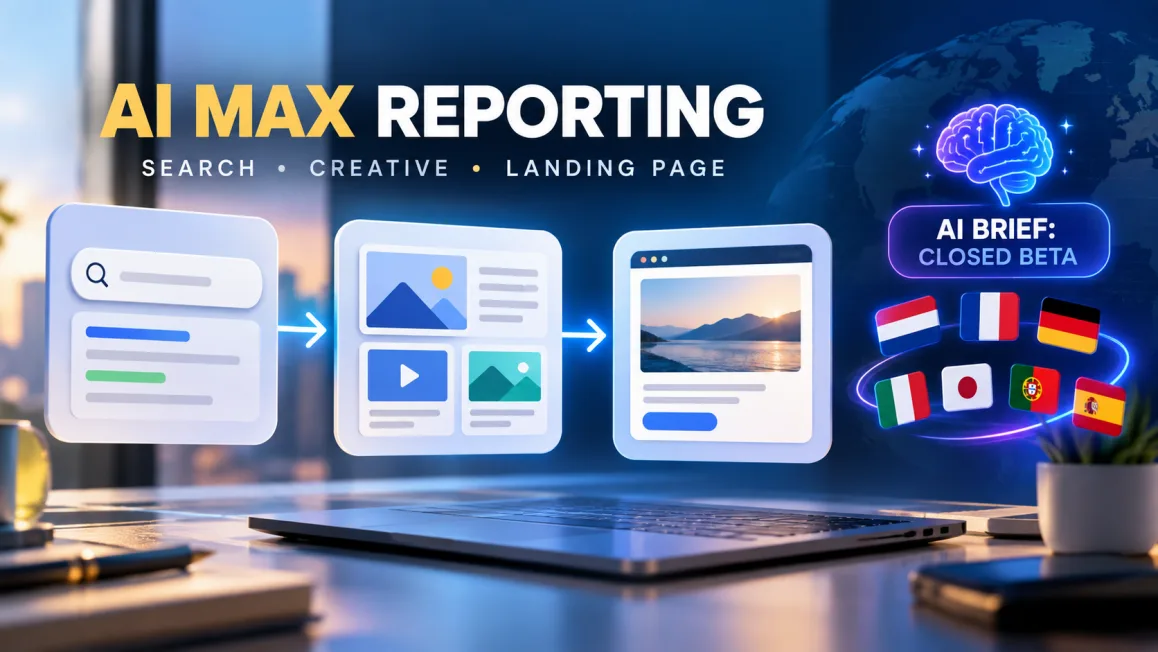
Google is adding a new AI Max reporting view designed to show advertisers the path from the search term that triggered an ad to the creative a user saw and the landing page they ultimately visited.
The company announced the feature on 23 September 2026 alongside an expansion of AI Brief's closed beta to Dutch, French, German, Italian, Japanese, Portuguese and Spanish.
Google has not said the new reporting interface is universally available today. It says additional details and availability information will be shared later in 2026. AI Brief also remains a closed beta, so advertisers should not assume it is enabled on every eligible account.
Key takeaways
- AI Max is getting a unified Search ads journey reporting view.
- The report will connect triggering search terms, served creative assets and landing-page destinations.
- AI Brief's closed beta is expanding to seven additional languages.
- Google says more details and availability information for the reporting feature will come later in 2026.
- The changes are intended to give advertisers more visibility into AI-driven Search campaigns, but they do not guarantee improved campaign performance.
What the new AI Max report is designed to show
Google says the new report will provide a single view of the Search advertising journey. Advertisers will be able to see which search terms triggered their ads, which creative assets were shown to the user and exactly where that user landed on the advertiser's website.
That matters because AI-driven campaign systems can make it harder to understand how individual inputs combine to produce a particular ad experience. Bringing query, creative and landing-page information together could reduce the amount of cross-referencing advertisers need when diagnosing campaign behaviour.
It may also make it easier to identify mismatches. For example, an advertiser could inspect whether a query with one intent was paired with a creative asset and landing page that addressed a different need. The report itself does not prove that AI Max improved results; it provides additional evidence advertisers can use when evaluating performance.
AI Brief expands to more languages
Google is also expanding the closed beta of AI Brief to Dutch, French, German, Italian, Japanese, Portuguese and Spanish.
AI Brief lets advertisers describe their business, audience and key messaging in natural language to provide AI Max with additional context. The expansion makes that briefing process available in more languages for advertisers included in the beta.
The closed-beta label is important. This is not a general-availability announcement, and access may depend on account eligibility and Google's testing programme.
Why advertisers want more AI transparency
Automation can reduce the manual work involved in campaign creation and optimisation, but it also changes what marketers need from reporting. When systems dynamically combine targeting signals, queries, creative assets and destinations, advertisers need enough visibility to understand why a campaign produced a particular user journey.
A unified report can help teams answer practical questions: Which query triggered this ad? Which asset did the user actually see? Which page received the click? Are the creative message and landing page aligned with the search intent?
Those questions are particularly important for businesses with large asset libraries or multiple landing pages. They are also useful for compliance and brand-review workflows where marketers need to know which combinations were presented to users.
What advertisers should do now
Advertisers using AI Max should first avoid assuming the new reporting interface is already available in every account. Google says it will provide more details and availability information later this year.
When the report becomes available, teams can use it as an audit layer rather than treating it simply as another performance dashboard. Reviewing search terms, creative assets and landing pages together can reveal whether automated campaign decisions remain consistent with user intent and business messaging.
Advertisers invited to the AI Brief beta can also assess whether providing richer business and audience context improves the relevance of the system's decisions. Because it remains a beta, teams should document changes and evaluate results rather than assuming benefits.
Availability and limitations
Google's announcement describes the reporting feature as being introduced, but says more details and availability information will be shared later in 2026. FlyingEze therefore does not treat it as universally available at publication time.
AI Brief is explicitly described as a closed beta. Its additional language support expands the test but does not convert it into a generally available product.
Sources
Google's 23 September 2026 Ads & Commerce announcement was used as the primary source, with specialist advertising and search-industry coverage checked for context.