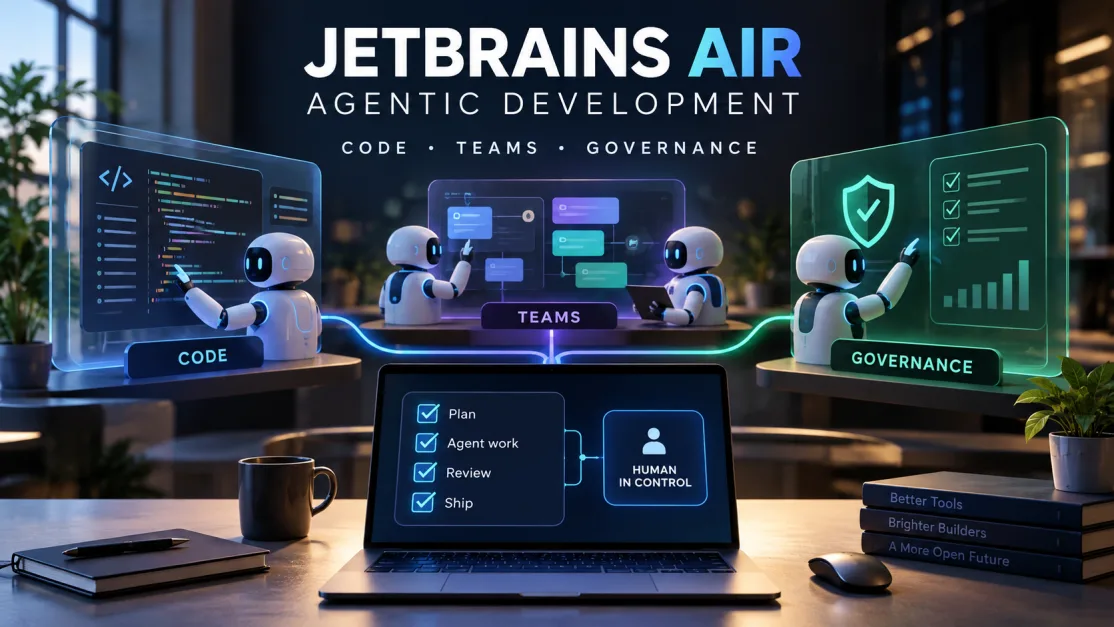
JetBrains is expanding Air from an agentic development environment into a broader system of products designed to help developers, teams and organisations direct, coordinate and govern AI agents throughout software delivery.
The company announced the strategy on 22 September 2026, bringing together work previously spread across its IDEs and JetBrains Central. The resulting JetBrains Air system is intended to cover individual coding work, team-level delivery workflows and organisation-wide controls.
JetBrains is also making an important availability distinction: Air includes products that can be used today alongside others that will arrive through a rolling series of releases. That means the announcement should be read as both a product consolidation and a roadmap, not as a claim that every Air component is generally available immediately.
Key takeaways
- JetBrains Air now describes a wider agentic-development system rather than a single coding environment.
- Air in JetBrains IDEs focuses on directing agents and verifying their work.
- Air Teams is designed to coordinate software-delivery workflows involving developers and autonomous agents.
- Air Governance, formerly JetBrains Central, targets policy, visibility, auditability and AI cost management.
- JetBrains says the system is multi-vendor and supports third-party agents through the Agent Client Protocol.
What JetBrains Air now includes
At the developer level, Air in JetBrains IDEs is intended to let programmers direct and orchestrate agents while using JetBrains' code intelligence to inspect and verify their output. The company says its Junie coding agent will work across Air surfaces, but its broader strategy does not depend on customers using only JetBrains' own agent.
Air Teams moves up a level. It is designed around coordinated software-delivery workflows in which developers and autonomous agents can share work. Rather than treating each agent session as an isolated coding task, the aim is to connect agent activity with team processes and delivery controls.
Air Governance addresses the organisational layer. JetBrains says it will provide policy controls, visibility, auditability, cost management and accountability for AI-assisted and agent-driven development. It is the evolution of what the company previously called JetBrains Central.
Why JetBrains is emphasising an open system
JetBrains argues that agentic software development will remain multi-vendor. Different models and agents may suit different tasks, and engineering teams may not want to standardise on a single provider while the market is changing quickly.
The company's answer is the Agent Client Protocol, or ACP, which standardises the connection between an IDE and an agent's wider harness, including planning, tools, model routing and observability. Through the ACP Registry, developers can discover compatible agents while continuing to work inside JetBrains IDEs.
That openness matters because adding more AI tools can create governance problems. Context can become fragmented, spending can be harder to attribute, and policies may have to be rebuilt across services. Air Governance is intended to give organisations a common layer of visibility and control even when developers choose different agents or models.
Verification becomes a bigger part of development
JetBrains' announcement repeatedly focuses on verification rather than simply generating more code. As agents handle more implementation work, the company argues that the bottleneck shifts towards understanding, reviewing and taking responsibility for what those agents produce.
For engineering leaders, this makes questions about provenance, permissions, review and accountability increasingly important. Teams need to know which agents can access repositories, where data can travel, which changes require human approval and how remote agent activity can be audited.
Those concerns are especially relevant when autonomous systems move beyond code suggestions into multi-step actions across repositories, build systems and delivery pipelines.
What is available now and what comes later
JetBrains says Air combines products available today with products that will be introduced as the system develops. The company plans a rolling series of releases and says it will distinguish between functionality customers can use immediately, preview capabilities and longer-term direction.
Future work includes extending Air into mobile and remote experiences, bringing richer code and organisational context into agent workflows, and allowing more work to be triggered by repository events, schedules and delivery processes.
That staged approach means developers should check the availability of the specific Air component they want rather than assuming every capability described in the announcement has reached general availability.
What developers and engineering teams should watch
The practical test for JetBrains Air will be whether its different layers can make multi-agent development easier to control without forcing teams into one AI vendor. Integration quality, auditability, cost visibility and the reliability of agent hand-offs will matter as much as raw code-generation capability.
For existing JetBrains customers, the most immediate significance is that agentic development is moving deeper into the company's core IDE strategy while simultaneously extending beyond the IDE. For larger organisations, Air Governance and Air Teams show where JetBrains believes the next bottleneck lies: coordinating and controlling agent-driven work at scale.
Sources
JetBrains' 22 September 2026 Air announcement was used as the primary source, with InfoWorld reporting used for independent context on the product strategy.