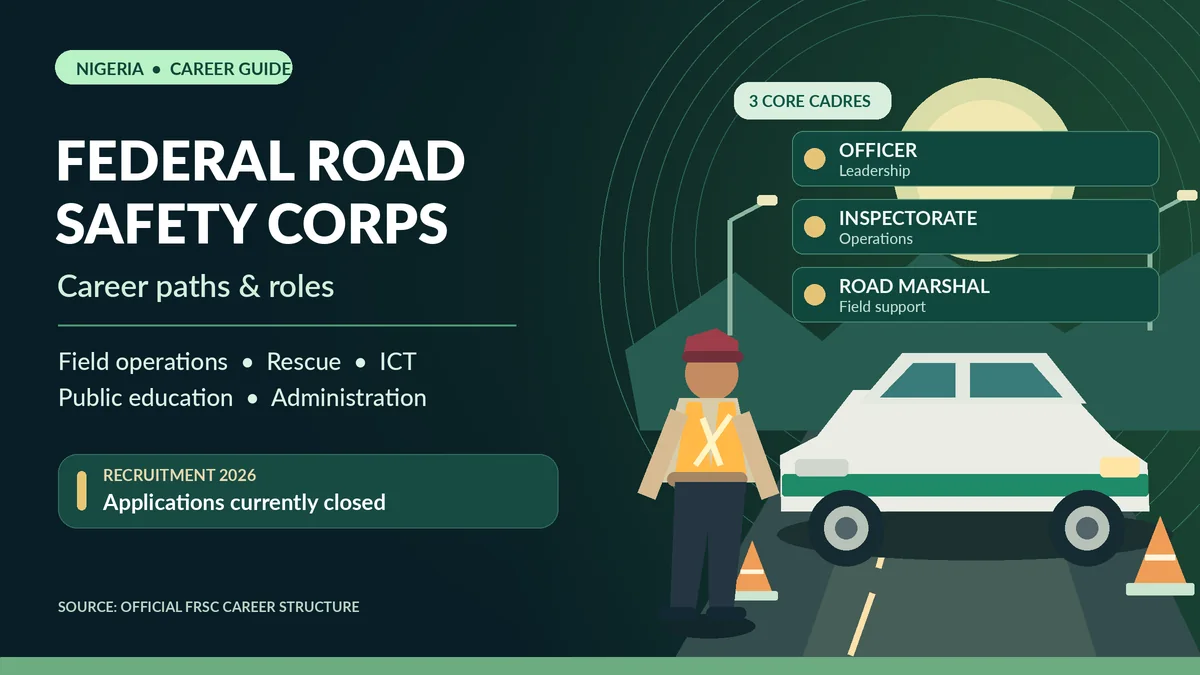
The Federal Road Safety Corps (FRSC) offers several career routes in Nigeria, including officer positions, marshal inspectorate roles and road marshal assistant positions. Its work goes beyond stopping vehicles: personnel support highway patrols, crash rescue, road-user education, vehicle administration, information technology, engineering, research, medical services and organisational management. The appropriate route depends on an applicant's qualifications, the vacancies advertised and the recruitment rules for the particular exercise.
For people searching recruitment of FRSC, the most important current fact is that the official FRSC recruitment portal says applications are closed and existing applicants will be contacted about subsequent steps. The 2026 exercise opened on 3 July 2026; it must not be described as a recruitment window that is still accepting new applications.
This guide explains what the Corps does, the differences among career cadres and ranks, specialist roles, the qualifications illustrated by the 2026 recruitment, and how to prepare for a legitimate future opportunity. It also distinguishes salaried regular marshals from voluntary special marshals. Fact-checked on 13 November 2026. Future openings, qualifications and salaries must be verified from the latest official FRSC notice.
What is the Federal Road Safety Corps?
The Federal Road Safety Corps is Nigeria's federal road-safety agency. It was created in 1988, with its legal framework subsequently established under the Federal Road Safety Commission (Establishment) Act 2007. The official FRSC About Us page describes its mission in terms of preventing crashes, improving safe road use, enforcing applicable road-traffic requirements and helping crash victims.
The FRSC's responsibilities include road-user education, clearing dangerous highway obstructions, crash response, traffic safety research, speed-limit enforcement, driver's-licence administration and vehicle number-plate functions. It also cooperates with other public agencies and transport stakeholders. A career here can therefore involve public-facing operational duties, technical systems, administrative work or specialist professional practice.
FRSC is not the same organisation as the Nigeria Police Force, the Nigeria Security and Civil Defence Corps or a state traffic-management agency. Responsibilities may overlap in traffic safety and emergency coordination, but their legal mandates, recruitment portals and career structures are not interchangeable.
FRSC recruitment status in November 2026: is the portal open?
No new application is currently being accepted through the official portal. At the time of this review, recruitment.frsc.gov.ng displayed an applications-closed notice and said existing applicants would be contacted for further steps.
The 2026 recruitment was formally advertised to open on Friday, 3 July 2026 for a four-week application period. Its three major categories were the Officer Cadre, Marshal Inspectorate Cadre and Road Marshal Assistant Cadre. The announcement said applications were free. FlyingEze's contemporaneous report, FRSC Opens 2026 Recruitment and Invites Qualified Nigerians to Apply , documented the launch; that news report should now be read as a historical announcement, not an invitation to apply in November.
In September, FRSC also disowned a viral instruction telling candidates who were not shortlisted to report to a camp for verification. According to its warning reported on 20 September 2026 , candidates should not act on unofficial messages or pay someone for shortlisting. Check the status directly before taking any action.
The three main FRSC career cadres explained
The recruitment cadre is the broad employment category through which a candidate enters or is appointed. A rank is the position held within the Corps hierarchy. A department or posting describes the kind of work or location assigned. These three concepts are related but are not the same.
| Cadre | Examples from the 2026 exercise | Broad qualification routes | Typical nature of work |
|---|---|---|---|
| Officer Cadre | Assistant Route Commander; Deputy/Route Commander; Superintendent Route Commander | Recognised degree or HND for some posts; specialist degrees and professional qualifications for others | Operations, command, professional services, planning and leadership |
| Marshal Inspectorate Cadre | Marshal Inspector II and III | Relevant ND/NCE or specified nursing, midwifery and community-health qualifications | Enforcement support, technical assistance, operational supervision and specialist assignments |
| Road Marshal Assistant Cadre | Road Marshal Assistant II and III; some driver, rider and artisan roles | Specified SSCE credits or relevant trade competence, certificates and licences | Frontline assistance, patrol support, driving, maintenance and other operational tasks |
These are simplified summaries of the 2026 recruitment notice . They do not imply that every HND, ND or SSCE holder qualifies for every position in that cadre. Exact academic subjects, age ranges, experience, professional licences and other conditions must be checked against the relevant official advert.
1. Officer Cadre: command, planning and professional leadership
The Officer Cadre is one of the most visible routes into senior operational and specialist responsibilities. FRSC's official regular-marshals rank structure describes an officer hierarchy beginning with Assistant Route Commander (ARC) and progressing through Deputy Route Commander (DRC), Route Commander (RC), Superintendent Route Commander (SRC), Chief Route Commander (CRC) and higher command ranks.
A newly appointed officer may contribute to patrol operations, incident reporting, public education, personnel management, safety compliance and planning, depending on assignment and training. More senior officers supervise operations, manage resources, coordinate teams and implement strategic road-safety priorities.
Importantly, an officer's entry rank is not always ARC. The 2026 exercise separately advertised Superintendent Route Commander positions for medical doctors and Route Commander/Deputy Route Commander posts for specified professions. Those openings reflected professional qualifications and recruitment needs rather than a promise that every graduate starts or advances at the same level.
Examples of professional backgrounds relevant to officer roles
Depending on the advertisement, officer-category recruitment may recognise degrees or professional credentials in medicine, pharmacy, nursing, engineering, law, health sciences, administration, and other disciplines. The 2026 notice also provided routes for eligible general graduates. A professional qualification is relevant only if the specific vacancy lists it and all registration or licensing conditions are satisfied.
2. Marshal Inspectorate Cadre: operational supervision and specialist support
Marshal inspectors sit within the Corps' non-commissioned ranks. FRSC's rank framework includes Marshal Inspector III, II and I, followed by senior inspector ranks such as Senior Marshal Inspector and Principal Marshal Inspector.
This work can include supervising small operational tasks, helping administer compliance activities, documenting incidents, supporting technical services and engaging road users. Inspectorate duties can vary significantly by unit: a medically qualified inspector may support a different function from one deployed to field operations or administrative work.
In the 2026 notice, qualifications for advertised Marshal Inspector II/III posts included specified ND/OND, NCE, registered nursing or midwifery and community health extension worker credentials. These are historical examples of entry eligibility, not a standing guarantee of recruitment for every holder of those awards.
3. Road Marshal Assistant Cadre: frontline and trade-based roles
Road Marshal Assistants are part of the Corps' junior uniformed ranks. FRSC lists RMA III, RMA II and RMA I, followed by Senior Road Marshal Assistant, Deputy Chief Road Marshal Assistant and Chief Road Marshal Assistant within the junior marshal sequence.
Personnel may help with route patrol support, road-user direction, documentation, traffic-safety activities, vehicle or equipment support and other tasks allocated by command. The work can involve outdoor duty, long periods on one's feet and travel to different operational locations.
The 2026 recruitment included positions for candidates with at least three relevant SSCE credit passes, including English Language and Mathematics, as well as certain artisans, drivers and riders. Trade roles referred to mechanics, electricians, plumbers, computer operators, tailors and relevant drivers. These positions require the particular skills or licences stated in the notice; a trade skill does not automatically substitute for every other admission condition.
Specialised FRSC career paths beyond highway patrols
FRSC's official headquarters structure identifies Operations, Administration and Human Resources, Training, Finance and Accounts, Motor Vehicle Administration, Policy Research and Statistics, and Technical Services. It also lists corps offices covering medical and rescue work, legal advice, public education, safety engineering, transport standardisation, intelligence, procurement and information technology.
| Career area | Examples of responsibilities | Useful skills or qualifications |
|---|---|---|
| Highway patrol and enforcement | Observe traffic conditions, enforce applicable safety requirements, coordinate patrol and document incidents | Road-safety law, communication, sound judgement, incident reporting |
| Emergency rescue and medical services | Crash-scene assistance, first aid, emergency coordination and clinical support within professional scope | First aid, emergency response, nursing, medicine or relevant healthcare training |
| Driver's licensing and vehicle administration | Support licence administration, motor-vehicle records and related verification systems | Records management, computer proficiency, process integrity |
| Road-safety education and communication | Teach safer road use, run community campaigns and communicate safety guidance | Teaching, public speaking, content development, stakeholder engagement |
| Research and data analysis | Study crash trends, compile statistics and support prevention planning | Statistics, data quality, GIS or research methods |
| Engineering and technical services | Road-safety engineering support, fleet or equipment maintenance and technical assessments | Engineering, mechanical or other relevant technical competence |
| ICT and digital operations | Support information systems, user services, technical infrastructure and data protection practices | Software, networking, cybersecurity and IT support skills |
| Finance, legal and administration | Budget support, accounting, procurement, legal services and personnel administration | Accounting, law, administration, audit or procurement competence |
This table describes possible functional specialisations within the organisation, not separate advertised vacancies available now. A graduate with an ICT or engineering background is not guaranteed an IT or engineering posting. Recruitment needs, formal qualifications, service rules and management deployment decisions determine assignments.
What does an FRSC officer or marshal actually do each day?
Daily work depends heavily on posting. A patrol officer may attend briefings, inspect operational equipment, join designated patrols, enforce road-safety laws and prepare incident reports. A rescue specialist may respond to a crash, coordinate with medical or other emergency personnel and assist injured people within the limits of training. An administrative professional may work on schedules, driver records, communications or budgets.
Some roles involve shifts, urgent incidents and roadside hazards. A career in enforcement can demand physical stamina, patience with the public and readiness to manage conflict lawfully. Rescue duties can be emotionally challenging. Office-based assignments require accuracy, confidentiality and integrity, particularly when handling licence records or public funds.
For a real example of the safety dimension, FlyingEze has reported on FRSC's road-transport safety compliance work with commercial fleet operators in Abia . Such assignments show that road safety includes regulatory inspection and engagement with transport companies, not only routine vehicle stops.
Regular marshals versus special marshals: paid service or volunteering?
One of the most important distinctions for prospective applicants is between regular marshals and special marshals. FRSC's official pages state that regular marshals are paid, career personnel in a pensionable service structure, whereas special marshals participate on a voluntary basis.
Special marshals may join group highway patrols, support public-enlightenment campaigns, encourage road safety clubs and assist road-safety research. FRSC's Special Marshals page lists requirements including having a serviceable vehicle, holding a driving licence, having a visible livelihood and having no criminal record. It directs interested people to enquire at the nearest FRSC command's Special Marshal Unit.
That volunteer route is not a substitute for entering the salaried officer or marshal recruitment process, nor should someone assume voluntary service automatically converts into government employment. FlyingEze's coverage of FRSC's safety guidance to special marshals offers further context about this distinct form of service.
How FRSC ranks and career progression work
FRSC's published structure includes separate officer and junior/inspector rank sequences. In the officer hierarchy, titles progress from Assistant Route Commander through route-command ranks toward Corps Commander, Assistant Corps Marshal, Deputy Corps Marshal and Corps Marshal. Within the junior marshal and inspector structure, ranks progress from RMA levels into higher assistant and inspector positions.
These sequences show hierarchy, not an automatic promotion timetable. Advancement is subject to service regulations, vacancies, performance, discipline, training, examinations and any other applicable rules. Different entry cadres may have different career progression procedures. Do not treat a private website's claim about “promotion every two years” as official without verifying the actual FRSC policy.
FRSC personnel can also develop specialised skills or move between functions when authorised. FlyingEze's report on FRSC promoting thousands of personnel in August 2026 provides a dated example that promotion exercises occur, not a guarantee of when or whether a particular recruit will be promoted.
FRSC recruitment qualifications: what the 2026 exercise required
The 2026 advert was specific about entry category. It should be used as a preparation reference, not as a permanent eligibility rule for all future exercises. The conditions summarised below were reported from FRSC's recruitment notice in July 2026.
| Category | 2026 qualification examples | 2026 age guidance |
|---|---|---|
| Officer positions | Relevant B.Sc., BA, HND or regulated professional degrees as specified by vacancy; NYSC discharge/exemption where required | Generally 18–35 years for the advertised officer posts |
| Marshal Inspector II/III | ND/OND, NCE or designated health-profession qualifications, depending on position | 18–30 years for the reported inspectorate posts |
| Road Marshal Assistant II/III | At least three SSCE credits including English Language and Mathematics for applicable posts | Generally 18–30 years for these positions |
| Drivers, riders and artisans | Relevant trade skills and certificates; proper class of driving licence where applicable | Position-specific; some specialised articulated/tow-truck roles had a different age bracket |
The published 2026 requirements also discussed Nigerian citizenship, fitness, character, documentation, computer literacy and physical standards. Some conditions were stated specifically for that exercise. Prospective applicants should check their exact category and obtain any professional registrations or licences required rather than relying only on this table.
For example, the 2026 notice reported a minimum height of 1.65 metres for men and 1.58 metres for women under its recruitment conditions. These are historical figures from that notice, not a prediction about the next recruitment. The exact official advert controls. Likewise, a degree in a preferred field is not a guarantee of selection.
Skills that can strengthen an FRSC career application
Technical credentials matter, but public service also depends on behaviour. The strongest candidates are likely to demonstrate sound communication, respect for procedure, reliable record-keeping, teamwork and the ability to respond calmly under pressure. Knowledge of Nigerian road signs, road-user obligations and basic first aid is relevant to many operational duties.
Computer literacy can be useful for documentation, licensing systems, research, scheduling and reporting. FRSC's 2026 advert listed computer literacy among general expectations. Applicants aiming for technical functions can build skills in networking, data analysis, equipment maintenance, information security or professional engineering, while medical applicants should keep their licensing requirements current.
These are preparation suggestions, not a promise that completing a private online course guarantees preference at recruitment. Avoid paying a third party for a supposed “official FRSC training certificate” unless the qualification is genuinely required and its provider is independently verified.
How FRSC recruitment and screening normally work
The 2026 recruitment was conducted through the official online portal. Applicants selected the category and specialisation for which they were eligible, entered their personal details and followed confirmation instructions. The published notice required truthful declaration of qualifications and said shortlisted candidates would present printed application forms during screening.
Recruitment may involve application review, identity and credential verification, medical or physical assessment, screening and further instructions. The number, order and details of stages can change and must come from the actual recruitment announcement and authenticated applicant communications. This is particularly important when an exercise has closed and only existing applicants are awaiting further steps.
Keep records of any legitimate application, including the confirmation email, form and the portal address. Do not submit multiple contradictory applications or change your qualifications to match a different advertised category. The 2026 exercise said applicants should use their own contact details and declare certificates accurately.
How to prepare while applications are closed
- Decide which cadre fits your qualifications. Compare your highest award and any professional licence with the actual examples from the previous advert.
- Review your documents. Ensure your personal details and educational records are accurate, legible and consistent.
- Keep professional licences current. Where applicable, check a driving, healthcare or other regulated licence through its legitimate issuing authority.
- Strengthen relevant skills. Develop practical road-safety awareness, first aid, communication, computer literacy or discipline-specific expertise.
- Follow official FRSC communications. Bookmark frsc.gov.ng and the genuine recruitment portal ; do not assume a new exercise has started without an announcement.
- Avoid speculative payments. The 2026 recruitment was free, and an agent cannot lawfully sell a guaranteed appointment or shortcut.
- Stay ready for a future notice. New eligibility requirements and deadlines must be read afresh rather than copied from 2026.
Anyone who submitted a valid 2026 application should follow the instructions sent through genuine channels, rather than submitting a new application to an unrelated website while the official portal is closed.
FRSC salaries, allowances and working conditions: what can be verified?
Regular FRSC positions are paid career roles, while special marshal service is voluntary. However, there is no verified, universal current salary amount for every rank in the official pages reviewed here. Many websites circulate precise monthly salary tables without identifying the applicable pay scale, effective date, deductions or allowances.
Pay can depend on rank, grade, approved allowances, deductions and the rules governing the appointment. Employment-related benefits, stationing, promotion and pension arrangements should be confirmed from the formal appointment letter or authorised FRSC human-resources information. Applicants should not make financial plans on the assumption that an unsourced salary figure is guaranteed.
Working conditions vary too. Patrol, rescue and field-enforcement roles can involve deployments and risk exposure; specialised office and technical roles may have different schedules and responsibilities. The Corps' operational needs and formal posting decisions determine the actual work of an employee.
How to spot fake FRSC recruitment links and appointment offers
FRSC's September 2026 warning about an invented camp-verification directive illustrates why candidates must verify messages. A fraudster may copy the agency's identity, claim an unofficial shortlist, offer a preferred posting or demand money for an interview, medical screening or appointment letter.
Check the full domain name rather than trusting a page design, social-media badge or forwarded PDF. The official recruitment site is recruitment.frsc.gov.ng , but a genuine-looking URL in a message should still be checked by typing it independently. No current open application should be inferred from a website that merely discusses 2026 recruitment.
Do not provide banking passwords, one-time codes or sensitive documents to an unverified contact. If a suspicious communication claims immediate action is necessary, independently confirm it from FRSC's published contact channels before travelling or making any payment. FlyingEze has also published guidance for identifying fake job offers and recruitment scams in Nigeria .
Who should consider a career in the FRSC?
An FRSC career may appeal to someone interested in public safety, structured government service, emergency response, transport administration or technical support. Graduates may be attracted to command, professional or research functions; diploma holders may investigate applicable inspectorate opportunities; and people with suitable school qualifications or trade competence may look at road marshal assistant positions when advertised.
The decision should also reflect the realities of a uniformed service. You may need to follow strict rules, wear prescribed attire, accept postings, work outdoors and interact with motorists under difficult conditions. Service can involve accountability for public records and decisions affecting safety. Those responsibilities should be considered alongside job security or progression possibilities.
For individuals who already have established employment and want to contribute voluntarily to road safety, the special marshal programme may be more appropriate than applying for a salaried position—provided they meet its separate criteria.
Frequently asked questions about FRSC careers and recruitment
Is FRSC recruiting in November 2026?
The official FRSC recruitment portal states that applications are closed and existing applicants will be contacted. No fresh application should be assumed available without a subsequent authentic announcement.
What are the main FRSC recruitment cadres?
The 2026 exercise advertised the Officer, Marshal Inspectorate and Road Marshal Assistant cadres. Individual vacancies within those cadres had different educational and professional requirements.
Can an SSCE holder join FRSC?
The 2026 Road Marshal Assistant recruitment included certain posts requiring at least three relevant SSCE credits, including English Language and Mathematics. Meeting the minimum certificate requirement did not remove age, fitness, character and other conditions.
Can graduates or HND holders work in FRSC?
Yes, some officer-category vacancies have accepted eligible degree or HND holders, depending on the post. Professional positions may require additional licences, training or qualifications.
Do FRSC employees only work on highways?
No. The Corps also has medical, ICT, engineering, research, public education, driver-licensing, finance, legal and administrative functions. The actual posting depends on organisational requirements.
What is the difference between a regular marshal and a special marshal?
Regular marshals are paid career personnel. Special marshals serve voluntarily and have separate eligibility and operational arrangements.
How much does FRSC recruitment cost?
The 2026 application exercise was officially advertised as free. Do not pay an intermediary for a form, shortlisting or a guaranteed appointment. Future adverts should be checked for their own authentic instructions.
Are promotions automatic after a certain number of years?
No automatic timetable can be promised from the general rank list. Advancement depends on the relevant service and promotion rules, qualifications, performance and other applicable conditions.
Where can I ask an FRSC recruitment question?
Start at the official FRSC website and its contact page , which lists 122 as a toll-free number and publishes official contact details. Emergency line availability or suitability for recruitment enquiries should be confirmed from the site; avoid tying up emergency services for routine enquiries where other contact options exist.
Conclusion: choose a suitable FRSC career route, not an unofficial shortcut
Understanding the recruitment of FRSC begins with recognising the difference between the officer, inspectorate and road marshal assistant cadres—and between the rank an employee holds and the department where they work. The Federal Road Safety Corps offers opportunities across highway safety, rescue, public education, administration, technology and other professional functions, but entry and posting depend on actual vacancies and qualifications.
As of 13 November 2026, the 2026 application portal is closed . Prospective candidates can use this period to verify documents, develop relevant skills and learn about the Corps' career structure. For any later recruitment exercise, rely on FRSC's official website and authentic instructions—never a paid agent promising placement.