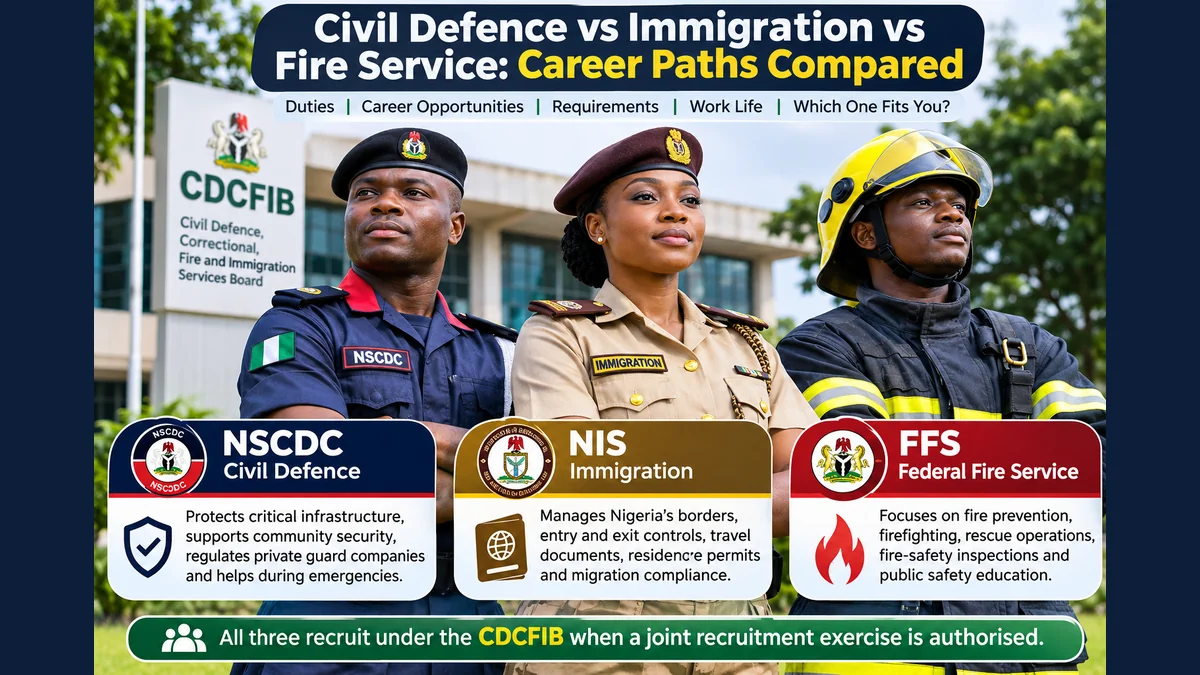
Choosing between the Nigeria Security and Civil Defence Corps (NSCDC), Nigeria Immigration Service (NIS) and Federal Fire Service (FFS) means choosing three different kinds of public-service careers. Civil Defence focuses on protecting critical infrastructure, community security and emergency support. Immigration manages borders, travel documents and migration rules. The Fire Service specialises in preventing fires, rescuing people and responding to emergencies. All three recruit under the Civil Defence, Correctional, Fire and Immigration Services Board (CDCFIB) when a joint recruitment exercise is authorised.
The best choice is not automatically the agency with the most recognisable uniform or an attractive salary claim on social media. It depends on the work you want to do, the qualifications you hold, the physical and operational demands you can meet, and the exact role advertised. Each service also has administrative, planning or technical functions beyond its most visible front-line duties.
Recruitment update, 11 November 2026: The official CDCFIB recruitment notice describes the 2024/2025 exercise as concluded. The separate 28 October 2026 final-stage announcement concerns existing eligible applicants and a 28 October–14 November portal window; it is not a new application opening. Anyone planning for a future vacancy should monitor the official Board recruitment portal , rather than pay for a supposed 2026/27 form.
This career comparison uses the agencies' own published mandates and organisational structures, the last official recruitment notice and government pay-information sources. Where a career fit, working-condition or development pathway is an informed interpretation rather than a formal promise, it is identified as such. Fact-checked: 11 November 2026.
Civil Defence vs Immigration vs Fire Service: comparison at a glance
| Career factor | NSCDC (Civil Defence) | NIS (Immigration) | FFS (Fire Service) |
|---|---|---|---|
| Core mission | Critical-infrastructure protection, civil security and disaster support | Border management, travel documents, residency and migration compliance | Fire prevention, firefighting, rescue and safety enforcement |
| Examples of work | Infrastructure patrols, intelligence, protection of schools, guard-company regulation | Border checks, passport administration, permits, investigations and migration records | Incident response, inspections, rescue, fire investigations, public safety education |
| Possible specialist functions | Technical services, investigations, training, disaster management | ICT and cybersecurity, border systems, migration, statistics and finance | Fire-risk inspection, safety standards, research, training, ICT and administration |
| Work environments | Community or field deployments; government facilities; offices | Border posts, airports, passport offices and headquarters | Fire stations, incident locations, inspections and offices |
| Physical demands | Potentially high in field operations | Vary substantially by posting | Potentially very high in rescue and operational firefighting |
| Good starting interest | Security, public protection and community resilience | Border management, travel systems, law, public service and data | Emergency response, practical teamwork, safety and engineering |
The final two rows are general career-guidance comparisons, not official recruitment classifications. Actual duties, schedules and postings depend on the appointment and operational needs of the employing service.
What does a career in the NSCDC look like?
The NSCDC's official mandate covers safeguarding critical national assets, helping prevent crimes, regulating private guard companies and assisting with emergencies. Examples of infrastructure it may protect include power installations, oil and gas pipelines, telecommunications networks, water resources and railway facilities.
A person entering Civil Defence should therefore expect a security-oriented public service, not simply a conventional office job. Depending on the assignment, work may involve observations, patrols, investigations, documentation, community relations or coordination with other authorities. Its responsibilities overlap with public safety but are not identical to those of the Nigeria Police Force or the Armed Forces.
Potential NSCDC career directions
The Corps' published directorate structure identifies operations; critical national assets and infrastructure; intelligence and investigation; disaster and crisis management; technical services; training and manpower development; private guard companies; and administration. These divisions demonstrate that career development can involve specialised work in addition to general operational service.
For someone interested in cybersecurity or engineering, the existence of technical and infrastructure-protection functions may be relevant. But it does not mean that applying to the NSCDC guarantees a cybersecurity appointment or a particular state posting. The actual vacancy and later service assignment control the possibilities.
Potential benefits: exposure to a broad range of public-protection operations and opportunities to develop operational, investigative, supervisory and emergency-management skills. Potential difficulties: uncertain deployments, demanding security environments, emergency call-outs and the discipline required in a chain-of-command organisation.
What does a career in the Nigeria Immigration Service look like?
The NIS's official core mandate covers people entering or leaving Nigeria, issuing Nigerian travel documents, residence permits for eligible foreign nationals, border surveillance and patrol, and enforcement of immigration laws. That makes the service a strong fit for candidates interested in mobility, identity systems, border security and public administration.
Its jobs are broader than issuing passports. Officers may work in the processing or review of travel documents, operational border controls, immigration compliance, migration administration or supporting functions. The service uses digital passport and biometric systems, so accurate records, secure handling of personal data and reliable technology matter.
Potential NIS career directions
NIS's official directorate information identifies border management, ICT and cybersecurity, finance and accounts, planning, research and statistics, alongside other operational and management work. For graduates interested in data, information systems, languages or public administration, this suggests specialist areas worth studying—not guaranteed entry placements.
Immigration work may involve dealing with travellers, checking documents, applying legal rules, protecting personal data and making accurate records. Border operations may involve irregular hours or remote environments; a back-office passport or planning role may have a different pattern. Candidates should not assume the entire service is comfortable desk work or that an overseas posting is automatic.
Potential benefits: experience in regulated public service, migration systems, border operations and digital administration. Potential difficulties: dealing with sensitive identity information, demanding customer interactions, compliance responsibilities and deployment conditions that can vary considerably.
What does a career in the Federal Fire Service look like?
The Federal Fire Service's mandate includes fire prevention, firefighting, rescue, fire-risk assessment, public education, regulation of fire-safety standards and emergency coordination. It also has duties relating to the inspection of public buildings and the preparation of fire reports.
Firefighting is a physically demanding profession when assigned to incident response. Operational personnel may face smoke, heat, hazardous environments and time-sensitive rescue decisions. The work depends heavily on teamwork, discipline, situational awareness and appropriate training and equipment. An administrative appointment has different daily demands, but every candidate should understand the mission of the service.
Potential FFS career directions
The FFS department list identifies operations; investigation, inspectorate and enforcement; planning, research and statistics; the National Fire Academy; administration and supply; and finance and accounts. It explicitly includes ICT within planning and research. These are examples of functions where experience and professional specialisation may develop.
The National Fire Academy supports firefighter education and fire-safety curricula. Career progression may involve additional training, supervision or specialist responsibilities, but exact training access and promotion depend on applicable service rules and selection—not simply the number of years served.
Potential benefits: highly practical public-safety work, teamwork, prevention education, rescue and fire-investigation skills. Potential difficulties: physically demanding incidents, emergency shifts, exposure to hazards and pressure to act quickly while following safety procedures.
Which service fits your interests and qualifications?
A useful way to choose is to ask what type of problem you would want to solve at work, rather than which organisation sounds more prestigious. The following is a career-fit guide, not an official recruitment scoring system:
| Your main interest | Service worth examining first | Reason |
|---|---|---|
| Protecting strategic installations and helping with community safety | NSCDC | Core civil-protection and infrastructure-security mandate |
| Travel documents, legal entry and exit, migration rules | NIS | Statutory responsibility for border and immigration processes |
| Fire prevention, rescue and emergency response | FFS | Core firefighting, inspection and rescue mandate |
| Investigations and enforcement | NSCDC, NIS or FFS | All have relevant work, but different subject-matter powers and duties |
| ICT, cybersecurity or data management | Research vacancies across all three | Technical and planning functions exist, but vacancies vary |
| Training and administration | Research vacancies across all three | All operate training, management or support functions |
A degree in computer science, for example, may be relevant to a properly advertised technical post, but it does not automatically qualify someone for every operational or specialist vacancy. Similarly, a background in engineering, health or public administration is useful only where the vacancy requirements and selection process recognise it.
Physical fitness and working conditions: which job is harder?
It would be misleading to rank all three organisations from “easiest” to “hardest”. Difficulty depends on the appointment. A firefighter responding to an industrial incident and an Immigration officer patrolling a remote border both face potential physical and safety demands. An NSCDC officer assigned to infrastructure security may work in challenging terrain or under changing threat conditions, while administrative staff in any service may spend more time on documentation and management.
Applicants should be realistic about the possibility of duty outside ordinary office hours. Fire and rescue work may require immediate mobilisation; security and border duties may require shifts and field assignments. Public-facing roles can also involve stressful interactions, rigorous documentation and the responsibility to follow lawful procedures.
Ask about the role's training, medical standards, protective equipment, mobility requirements, posting arrangements and workplace supervision when that information is made available officially. Avoid assuming that the uniforms alone predict daily responsibilities.
Training, professional development and promotion
All three are structured paramilitary services with formal leadership and reporting arrangements. The NSCDC describes its headquarters, zonal, state and area commands . The NIS lists professional directorates and management functions. The FFS identifies the National Fire Academy as a training institution.
Possible long-term development areas include leadership and supervision, specialist operations, administration, investigations, compliance, ICT or public education. But the route from a new recruit's original cadre to a senior position is not automatic. It depends on qualifications, service conditions, training, available roles, performance, promotion rules and decisions by the authorised bodies.
FlyingEze has previously covered promotion of Federal Fire Service officers in Kebbi , illustrating that promotions can occur through formal service decisions. That report is an example of a specific event, not proof that every recruit will progress at the same pace.
Civil Defence vs Immigration vs Fire Service salaries: what can be verified?
Salary is a reasonable factor in a career choice. However, online posts routinely publish detailed naira salary tables without linking to a current, authoritative government circular covering every agency, rank, allowance and step. Those figures often differ substantially.
For that reason, this comparison does not invent a 2026 monthly salary for an NSCDC, NIS or FFS recruit. The exact entitlement depends on the approved pay framework, position, cadre, grade or rank, deductions and any applicable allowances. Government pay information should be confirmed through the National Salaries, Incomes and Wages Commission's circulars , the authorised recruitment documentation and the eventual formal appointment terms.
Do not infer that Immigration always pays more because it processes passports, or that firefighters automatically receive a particular hazard allowance amount. If pay is the deciding factor, request verifiable current information for the specific advertised grade and compare total remuneration and working conditions—not a viral screenshot.
What are the CDCFIB eligibility rules for these services?
The official 2025 CDCFIB recruitment announcement published by the Nigerian Correctional Service applied to the four Board-supervised services and provides a historical reference. It listed:
- Nigerian citizenship by birth.
- General age range of 18–35 years.
- Minimum height of 1.65 metres for men and 1.60 metres for women.
- Physical and mental fitness, and good character.
- Qualifications appropriate to the advertised vacancy.
- An instruction to apply to only one participating agency; multiple applications risked disqualification.
These were requirements for the previous advertised exercise, not a promise that a future intake will use exactly the same figures or processes. Educational requirements also varied by cadre—some posts involved O-level or trade qualifications, while others required diplomas, degrees or professional credentials. Applicants should examine the next official vacancy for exact grade, subjects, age cut-off, professional registration and any medical or physical standards.
For the wider four-agency context, see FlyingEze's CDCFIB recruitment explainer covering agencies, eligibility and official channels . The Nigerian Correctional Service (NCoS) also belongs to CDCFIB, but is outside this article's three-service career comparison.
Is recruitment open for NSCDC, NIS or FFS in November 2026?
No new CDCFIB application intake was verified as open on 11 November 2026. The Board's official recruitment notice states that the 2024/2025 exercise has concluded. The NSCDC's careers page also states that the Corps is not currently recruiting.
A separate Board statement, published on 28 October 2026, offered a 28 October–14 November 2026 window for eligible candidates already progressing through final checks in the existing recruitment. It was not an invitation for new first-time applications.
For some existing candidates, the final stages included document checks, selection of a screening location and a mandatory Drug Integrity Test (DIT). On 30 October 2026, the National Drug Law Enforcement Agency confirmed that the DIT requires no payment from candidates , because the Ministry of Interior had arranged bulk payment. Follow only the designated link supplied through the relevant official portal.
Because this information changes with recruitment announcements, readers should check the current government recruitment portal before taking action. If this article is published after 14 November, the status section and screening deadline must be checked again rather than presenting an expired window as active.
How to choose one CDCFIB service before applying
Previous joint recruitment instructions restricted candidates to one of the four agencies. A future application should therefore be a considered choice, not repeated trial submissions. Use this short decision process:
- Read the official mandates. Decide whether you are most drawn to infrastructure protection, immigration and border administration, or fire prevention and rescue.
- Compare specific jobs, not just agency names. A technical support position can be quite different from a front-line operational role within the same service.
- Check eligibility objectively. Match age, qualifications, registration, physical requirements and any other vacancy conditions before starting an application.
- Consider work environments. Think about emergency response, shift duties, interaction with the public, operational risk and possible location assignments.
- Check formal remuneration and progression information. Distinguish confirmed terms from speculation about ranks, allowances and overseas postings.
- Submit only through the officially announced process. Keep your acknowledgement and personal records secure.
This method cannot guarantee selection or a preferred deployment, but it can prevent common errors such as choosing a service based on a friend’s application or an unverified salary infographic.
How to avoid fake CDCFIB application and job offers
Fraudsters can exploit applicants' uncertainty by advertising paid shortcuts, leaked shortlists or special recruitment forms. The safest starting points are the government-managed CDCFIB portal and the relevant agency's own website. Do not trust a link simply because a message includes a Nigerian coat of arms or an official-looking logo.
Be cautious of demands for money to obtain an application form, confirm a shortlist, select a centre or complete a drug screening. Do not send an NIN, password, one-time code or bank information to an unverified third-party “status checker”. The Board's official notices should override dated social-media posts or screenshots.
For background, FlyingEze has reported the Board's warning about fake recruitment portals . That historical report reinforces the need to authenticate an announcement before acting, but it is not a substitute for the current recruitment notice.
Frequently asked questions
Which is better: Civil Defence, Immigration or Fire Service?
There is no universally better service. NSCDC may suit an interest in community and infrastructure security; NIS may appeal to those drawn to borders, migration and travel-document systems; FFS may suit people interested in fire prevention, rescue and practical emergency response. The specific vacancy and your qualifications should determine the choice.
Is Immigration a desk job?
Not necessarily. The NIS carries out both public-facing administrative services and operational duties such as border surveillance, patrol and immigration enforcement. Work conditions depend on the posting.
Do all Federal Fire Service staff fight fires?
No. The FFS also has fire-safety inspectors, investigations, training, planning, research, administration, finance and other support functions. The appointed position determines the duties.
Can a computer science graduate apply for CDCFIB jobs?
Potentially, if a specific advertised role recognises the degree and the applicant meets all other conditions. The NIS has an ICT and cybersecurity directorate; NSCDC and FFS also have technical or ICT-related functions. Their existence does not guarantee an available vacancy or particular posting.
Does NSCDC only protect pipelines?
No. Its mandate extends to other critical infrastructure, civil protection, disaster support, private guard regulation, crime-prevention work and collaboration with public authorities.
Which of these services pays the highest salary?
A reliable general winner cannot be established from the official sources used here. Pay varies by grade or rank, appointment terms and applicable allowances. Applicants should verify current remuneration for the specific role rather than rely on unsupported online salary tables.
Can I apply to NSCDC and Immigration in the same exercise?
The 2025 CDCFIB recruitment announcement prohibited applying to more than one of the four services and warned of disqualification. Follow the rules stated in any future official advertisement.
What were the age and height limits in the last CDCFIB exercise?
The official 2025 notice stated generally 18–35 years, with minimum heights of 1.65m for men and 1.60m for women. These figures must be rechecked against a new vacancy notice before anyone applies.
Is a fresh CDCFIB application open in November 2026?
No new application round was verified on 11 November 2026. Notices about the final stage of the 2024/2025 exercise concern existing candidates. Check the official Board recruitment portal for changes.
Does CDCFIB also recruit for Correctional Service?
Yes. The Nigerian Correctional Service (NCoS) is the fourth CDCFIB-supervised service; this article compares only NSCDC, NIS and FFS, as stated in its title.
Conclusion: choose the work, not the rumour
Civil Defence, Immigration and the Federal Fire Service each offer a distinct route into Nigerian public service. NSCDC centres on protecting infrastructure and supporting civil security. NIS manages migration, borders and travel-document processes. FFS focuses on fire prevention, rescue, safety enforcement and emergency response. All three also have less-visible technical, administrative and supervisory functions.
The right career path depends on the specific job requirements, your interests and readiness for its working conditions. Do not assume one service guarantees higher pay, quicker promotion, an overseas assignment or a safer work schedule. Use the published mandates to decide what kind of service appeals to you, then rely on the next official CDCFIB recruitment notice to determine the actual opportunities.