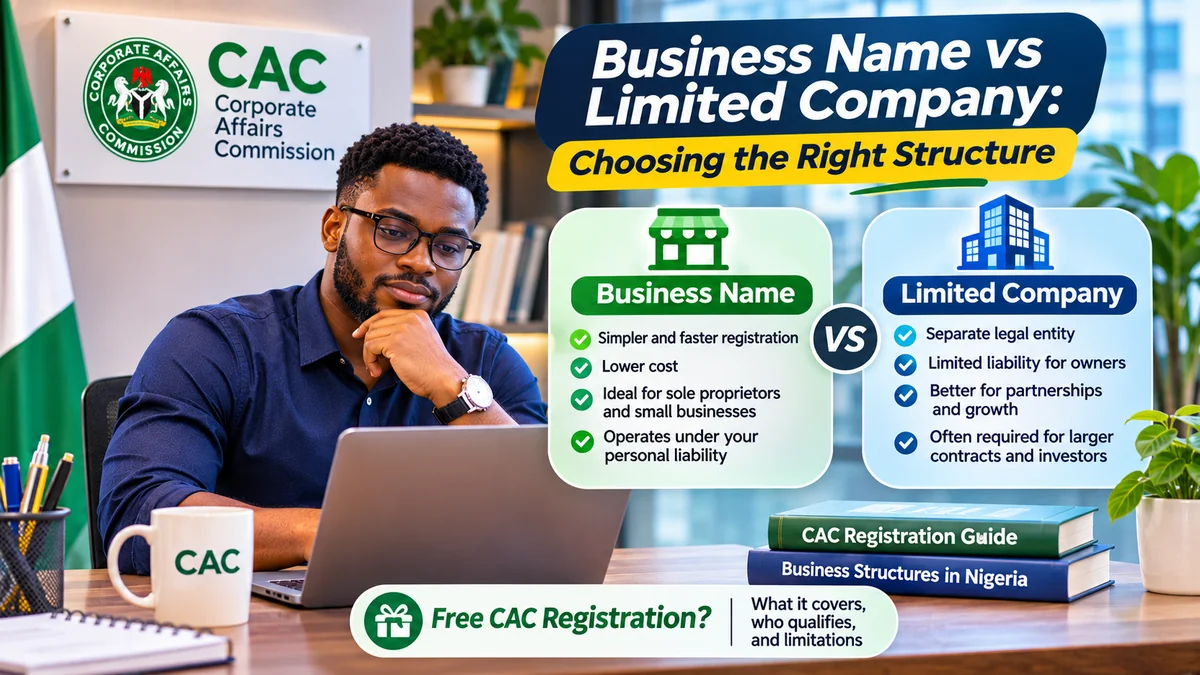
A free CAC registration offer can save a Nigerian entrepreneur an upfront fee, but it cannot decide which legal structure is right for the business. An ordinary registered business name is usually a trading identity for an individual or partnership. A private limited company is a separate incorporated legal person that can hold assets and issue shares, with generally limited shareholder liability. These differences can matter far more than the initial registration bill when a venture borrows money, hires staff, accepts investors or signs risky contracts.
The decision is particularly timely because the Small and Medium Enterprises Development Agency of Nigeria (SMEDAN) and the Corporate Affairs Commission (CAC) announced a programme sponsoring business-name registration for up to 250,000 eligible MSMEs. The keyword Free CAC Registration can lead founders to believe that every kind of business can be incorporated for nothing. It cannot: the documented programme concerns eligible business names, not a free limited-company incorporation scheme.
This guide is for people making a real decision: solo traders, online sellers, founders with partners, people preparing to pitch investors and owners who already registered a business name but now need a company. It includes a cost breakdown, six founder scenarios, practical risk questions and a plan for moving to a company if growth demands it. Research checked on 16 November 2026. Programme places, laws and charges may change.
Business name or limited company: the quick decision
| Your situation | Usually worth evaluating first | Main reason |
|---|---|---|
| One owner, low-risk service or small retail trade, no outside shareholders planned | Business name | Straightforward ownership and administration; may qualify for sponsored registration |
| Two founders expecting to own equity and admit investors | Private limited company | Formal shareholding and separate legal identity |
| Large customer deposits, credit, employees or significant contractual exposure | Private limited company | Separate company can be helpful, though it does not remove every personal risk |
| Temporary experiment with modest exposure | Business name or other lawful approach | Avoid unnecessary complexity, provided registration obligations are met |
| Existing business-name proprietor preparing to raise equity investment | Plan a new company structure | A business name cannot issue company shares |
| Non-profit charitable activity | Seek advice on an appropriate non-profit structure | Neither an ordinary trading name nor an investor-owned Ltd is automatically the right solution |
This is decision guidance, not a binding legal test. Professional services, foreign participation, finance, healthcare, education and other regulated operations may have special licensing or structural requirements. If material debts, substantial investment or ownership disputes are involved, get qualified legal and tax advice before applying.
1. What actually changes when you register a business name?
A business name allows an individual, partnership or qualifying business to trade using a registered name rather than only the proprietor's personal name. CAC's official business-name registration page describes a digital process: check availability, complete the form, supply the required documents, pay applicable fees and receive electronic registration documents. It also says an individual proprietor can register without necessarily hiring a lawyer, chartered accountant or chartered secretary.
Consider a fictional tailor, Ada, selling under “Ada Thread Studio”. Registration helps her use a recorded trading name and demonstrate that the business is formally recognised. It does not turn the shop into a separate limited-liability company. In an ordinary sole proprietorship, the individual remains legally responsible for business obligations, subject to the applicable law and circumstances.
That is why a business name can be sensible for a modest, owner-operated service but less attractive when the business starts taking large advance payments, importing equipment on credit or entering contracts with significant potential claims.
2. What changes when you incorporate a private limited company?
Under the Companies and Allied Matters Act (CAMA) 2020 , section 42 provides that an incorporated company becomes a body corporate capable of exercising company powers and having perpetual succession. A private company limited by shares can contract, hold assets and have shareholders in its own name. Its shareholders' ordinary liability is generally limited in the manner defined by their unpaid shares, rather than all company debts automatically becoming personal liabilities.
One person can incorporate a private company. Section 18(2) of CAMA 2020 allows a single individual to form a private company; it is not necessary to invent a second shareholder simply to establish an Ltd. The company's registration requires more formal corporate particulars than an ordinary business name, including information about shares, members and directors.
A limited company is not a guarantee that founders can never be personally liable. Personal guarantees, fraud, particular statutory obligations and unlawful conduct can expose directors or owners to liability. Keeping company books, contracts, bank accounts and decisions genuinely separate helps support the integrity of the corporate structure.
3. The free CAC registration question: which structure is actually covered?
SMEDAN's official announcement of 27 September 2025 states that the agency partnered with CAC to sponsor registration for up to 250,000 micro, small and medium businesses. Reporting dated 12 November 2026 describes renewed registration access after earlier portal problems, focusing on unregistered nano, micro and small businesses.
The reported free-registration route is for eligible business names. It does not establish a nationwide waiver of filing fees for private companies, NGOs, incorporated trustees, LLPs or all CAC categories. A SMEDAN account or identification number is also not itself a CAC registration certificate.
Applicants should start from SMEDAN's official portal , follow the instructions actually visible in their accounts and confirm eligibility. Neither the 250,000 programme target nor a newly accessible login page proves that a particular applicant has been selected or that slots remain. Do not send an agent a personal transfer in exchange for a promised “guaranteed free slot”.
Critical decision point: if a limited company would be appropriate because your business needs equity ownership, separation of obligations or investor documentation, registering a business name for free does not deliver those features. A sponsored business-name certificate can be useful, but choosing the wrong legal form solely to save filing fees may produce later transfer and compliance costs.
For a broader explanation of the legal differences between the two structures, read FlyingEze's existing guide to business names and limited liability companies . This article goes further by examining how the free-registration scheme affects the decision in practice. Always use official SMEDAN and CAC notices to establish the live status of any offer.
4. The surprising CAC fee comparison: “business name” is not always cheaper
The federal gazette of 29 May 2025 publishes CAC's revised service fees. The standard figures are important because some online comparisons still quote older charges or combine government fees and optional agent fees without explanation.
| Service | Published CAC filing fee |
|---|---|
| Ordinary business-name reservation | ₦1,000 |
| Business-name registration and listed certified documents | ₦20,000 |
| Business-name base total | ₦21,000 |
| Ordinary private-company name reservation | ₦1,000 |
| Private-company incorporation with issued share capital | ₦10,000 for each ₦1 million of issued capital, or part thereof, for listed private-company categories |
| Illustrative private-company base, ₦1 million issued capital | ₦11,000 in those two CAC fee lines |
| Business-name annual return | ₦5,000 |
| Company annual return within the ₦100,000–₦100 million capital band | ₦5,000 |
The ₦11,000 company example is not an all-in incorporation quotation. Stamp duties, relevant additional filings, transaction charges, optional professional services, higher issued capital and sector-specific approvals can increase the final cost. The business-name ₦21,000 is likewise a base of two published CAC charges, not necessarily every expense an entrepreneur will incur.
A selected beneficiary of the sponsored SMEDAN scheme may avoid the covered business-name filing cost. Nevertheless, free entry does not cancel future annual returns, penalties or other statutory obligations. For a fuller fee-by-fee guide, see FlyingEze's 2026 CAC registration costs explainer .
5. Personal liability: what happens when something goes wrong?
Imagine two fictional food businesses, each accepting advance orders for an event worth ₦2 million. A serious supplier problem leaves customers seeking refunds. The two founders may face different legal relationships depending on their contracts, representations, financing and corporate structure.
In an ordinary sole proprietorship using a business name, the proprietor is generally responsible for the enterprise's obligations; the registration certificate does not create a separate person to absorb all liabilities. A properly operated company normally contracts and incurs debts as its own legal entity, although a founder who personally guarantees an obligation or commits wrongful acts may still face personal exposure.
The example is not a prediction of how a court would decide a particular dispute. Contract terms, insurance, consumer protection, employment rules, insolvency and other factors matter. A company structure may help manage some risks, but it does not eliminate the need for financial discipline, appropriate cover and lawful operations.
**Practical question:** if a product fails, a customer sues or a large buyer delays payment, how much of your personal financial position could be exposed? That question is often more important than comparing the initial CAC bill.
6. Ownership and investors: do you need actual shares?
When two people start a business-name partnership, they should still agree in writing how profits, responsibilities, contributions, losses and exits will be handled. However, a registered business name cannot issue shares in a separate incorporated company. A cofounder cannot simply be promised “20% of the company's shares” if no company exists.
A private company offers a recognised shareholding framework. Founders can define initial ownership, contributions, directorship, voting, transfer restrictions and what happens when someone leaves, subject to CAMA and the company's documents. Investors may prefer this structure because the entity can admit shareholders and document equity interests.
This does not mean every investor accepts every Ltd or that incorporation guarantees funding. Due diligence, cap-table accuracy, tax compliance, contracts, licences and business traction still matter. A company registered with incorrect ownership details can be more problematic than a carefully documented small business.
Practical question: do you intend to sell an ownership stake, issue employee equity, bring in cofounders under a formal share structure or hold intellectual property for outside investment? If yes, investigate incorporation before agreeing to those transactions.
7. Tax in 2026: why there is no one-word answer
A common myth is that “business names pay no tax” or “every Ltd pays 30% tax”. Both are misleading. A sole proprietor's business income is generally addressed within the rules for taxing individuals, while a separately incorporated company is subject to the relevant company tax regime, returns and any available exemptions.
The signed Nigeria Tax Act 2025 , relevant to the 2026 reform, includes a 0% company income-tax rate for qualifying small companies and a higher standard rate for other companies, subject to conditions and other tax obligations. Whether an entity qualifies depends on the current statutory definitions, its activity and its facts; it is not automatic just because the company is new, has “Ltd” in the name or has a modest issued share capital.
There have also been differences in threshold descriptions across reform materials and summaries. For example, KPMG's analysis of the signed Act stresses that the enacted text differs from some earlier draft summaries, including the meaning of a small company. Avoid building a business plan around an unverified social-media claim of a blanket tax holiday. Check the enacted legislation and any subsequent official amendments or guidance with a qualified adviser.
VAT, withholding, personal income tax, payroll and sector-specific obligations can also be relevant regardless of the CAC form. FlyingEze separately explains the differences in its freelancer-versus-company tax guide .
8. Registration and ongoing administration: where complexity increases
CAC's business-name instructions focus on the proprietor or partners, trading details, required documents and fees. Its company-registration instructions involve company particulars, proposed members and directors, constitutional documents and issued share capital. Both are handled through the official CAC registration portal .
A private company generally needs better-defined governance and record-keeping because it is a separate legal person. It must maintain proper company information and complete applicable statutory filings. A qualifying small company may receive certain simplified governance treatments under CAMA, but those depend on statutory conditions. A one-person company still needs accurate ownership and business records.
Business names also have ongoing duties. The iCRP's current notices address business-name annual returns and system upgrades. Incorporation should not be treated as a one-time purchase followed by permanent exemption from filings. Budget for compliance, accounting and possible licensing before choosing a structure.
9. Six realistic founder scenarios
Scenario A: A tailor or hairstylist with one shop and modest exposure
A sole proprietor provides services to local clients and does not plan to sell equity. A business name may be a practical first option because the operation is straightforward and the founder can manage the records personally. If the owner qualifies for a current SMEDAN–CAC offer, a sponsored business-name registration could reduce upfront cost.
Scenario B: A skincare producer supplying retailers
The business manufactures goods that may create product-quality, consumer or contractual risks, hires workers and intends to enter large supply agreements. A limited company is worth stronger consideration, together with product safety, licences, insurance, proper contracts and corporate governance. Incorporation alone does not eliminate manufacturer liability.
Scenario C: Two friends building a SaaS product
They will jointly own software, sign customer agreements and may seek investment. A private company can define share ownership and help hold intellectual property and contracts in an identifiable entity. Registering a trading name merely because a free slot is advertised could create avoidable restructuring later.
Scenario D: A freelance designer testing small assignments
A sole practitioner works on manageable projects for a few clients without outside investors. A business name may be sufficient initially, depending on client requirements and the risk of the work. The founder should still use written contracts, accurate invoicing and suitable professional protections.
Scenario E: An agricultural supplier using significant borrowed capital
The founder plans to lease assets, hire staff and borrow to purchase inputs. The legal structure and loan documentation should be reviewed together. An Ltd may provide a clearer contracting entity, but a lender may require a personal guarantee, which can expose the founder regardless of incorporation. Do not assume choosing Ltd automatically removes all borrowing risk.
Scenario F: A founder who wants to run a charity or NGO
Neither the ordinary SMEDAN business-name scheme nor a private company owned by equity investors automatically solves the requirements of a non-profit organisation. Depending on the objectives, the relevant CAC framework could involve incorporated trustees or another appropriate structure. Seek specific advice before registering the wrong entity.
10. A five-question framework before applying for free CAC registration
Write down answers to these questions before opening a registration form:
- What is the real activity? Small personal service, product manufacturing, regulated service, consulting, digital platform or charitable work?
- Who truly owns it? One proprietor, partners, proposed shareholders, cofounders or a non-profit body?
- What is the exposure? Customer deposits, borrowing, employment, intellectual property, personal guarantees or substantial contractual risk?
- What happens in 18 months? Will you still be a solo trader, or will you need equity investment, separate assets, a formal board or large contracts?
- What does the chosen structure cost over time? Include the real registration bill, annual filings, tax administration, licences and any future restructuring.
**A useful rule:** if a business-name registration meets your actual legal and commercial needs, a legitimate sponsored slot is worth investigating. If the structure itself is wrong for your plans, the saving should not override the reasons to incorporate a company.
11. Can a business name later become a limited company?
A successful trader can decide to operate through a new limited company later. But do not assume that adding “Ltd” to your business name, changing a logo or filing a name-change form automatically converts every existing contract and obligation into a new company.
A safer transition normally involves forming the appropriate new company, confirming the availability of its proposed name, deciding the shareholding arrangement, documenting any transfer of business assets or intellectual property, and addressing old contracts, debts, staff arrangements, bank accounts, tax records and licences. Some transfers require consent or have tax and regulatory consequences.
For example, if a shop held a lease in the proprietor's personal name, incorporation does not necessarily change the tenant under that lease. The landlord may have to agree to a new arrangement. If a freelancer sells software code or has long-running client subscriptions, rights and obligations should be reviewed before moving them to the company.
The point is not that restructuring is impossible—it is that it involves real legal and operational work. If rapid growth or an investment round is already expected, assess a company at the start instead of relying on an assumed automatic future conversion.
12. How to verify and complete the chosen registration
For an ordinary business name, follow CAC's business-name registration steps . For a company, follow CAC's company formation instructions and use the official iCRP portal for the relevant documents and payment assessment.
For a sponsored business-name opportunity, begin at the SMEDAN programme announcement and the portal it links to. Never pay someone for guaranteed selection. Confirm that an approval is actually a CAC-issued registration document, not merely a SMEDAN profile or name reservation.
Finally, use CAC's public search to check the registered name and identifier. FlyingEze's verification guide explains how to compare a certificate against registry records. After registration, keep the appropriate bank, tax, record-keeping and filing obligations in view; see the post-registration checklist .
Frequently asked questions
Does free CAC registration allow me to register an Ltd company?
The verified SMEDAN–CAC sponsored programme concerns eligible business-name registrations, not blanket free incorporation of private limited companies. Do not assume every CAC category is sponsored.
What is the main difference between a business name and limited company?
A business name is generally a registered trading name of a proprietor or partnership; an incorporated private limited company is a separate legal person with a shareholding framework and generally limited shareholder liability, subject to exceptions.
Can I register a limited company alone in Nigeria?
Yes. Section 18(2) of CAMA 2020 expressly allows one person to form a private company, subject to the other legal requirements.
Is a business name always cheaper to register than an Ltd?
No. The May 2025 CAC gazette gives a ₦21,000 ordinary business-name base from reservation plus registration, while a hypothetical private company with ₦1 million issued capital has ₦11,000 in the two listed CAC fee lines. Company stamp duties and other costs may make the overall company bill higher, so compare complete assessments.
Does a business name protect the proprietor's personal assets?
Not by creating a separate limited-liability company. An ordinary sole proprietor generally remains responsible for business obligations. Insurance, contracts and other risk-management steps may also be relevant.
Can an Ltd receive investors and issue shares?
A private company has a statutory shareholding structure, subject to its constitutional documents and applicable laws. Investment is not guaranteed; founders still need appropriate documents and regulatory compliance.
Does a one-person Ltd require a second shareholder?
No. One person can form a private company under CAMA 2020. Do not list a fabricated shareholder.
Can I move my business-name business into a company later?
Yes, a founder may establish a company and arrange a lawful transfer of business operations, assets and contracts, but it is not an automatic change of suffix or universal transfer of existing obligations. Seek advice where tax, liabilities, leases or partners are involved.
Do business names and companies both file annual returns?
Yes, subject to the applicable rules. CAC's gazette lists annual-return filing fees for both. Free sponsored business-name registration does not mean ongoing filings are permanently free.
Which structure pays less tax in Nigeria?
There is no universal answer. Proprietors are generally taxed under individual-income provisions while companies follow applicable corporate provisions and possible exemptions. The result depends on income, the current rules, entity type and actual activities. Seek specific advice rather than choosing solely for a presumed tax rate.
Is a limited company required to open a business bank account?
Not universally. Banks may offer accounts for registered business names and companies with different documentation requirements. A bank's eligibility or KYC process does not turn one form into another.
Where can I confirm whether the free SMEDAN offer still has places?
Check official SMEDAN announcements and your account at portal.smedan.gov.ng . The 250,000 figure is a programme target, not proof of remaining vacancies or guaranteed acceptance.
Final verdict: choose the structure before chasing the discount
A business name can be appropriate for a straightforward, modest-risk, owner-managed enterprise; a private limited company is often more suitable when separate corporate identity, formal share ownership or larger commitments matter. Neither choice guarantees funding, avoids all taxes or makes legal and financial risks disappear.
The SMEDAN–CAC free-registration initiative can lower an eligible entrepreneur's cost of formalising a business name. But the structure it sponsors must still fit the actual business. Consider your ownership, potential liabilities, customers, intended growth and long-term compliance—not just what is free this month.
Editorial note: This guide was researched on 16 November 2026 using CAMA 2020, CAC's May 2025 fee gazette, SMEDAN announcements, current CAC guidance and 2026 tax-law materials. The founder scenarios and numerical examples are fictional. Exact SMEDAN availability and a specific company's all-in filing, legal or tax liability have not been independently assessed. Obtain professional advice for significant legal, tax or financing decisions.