
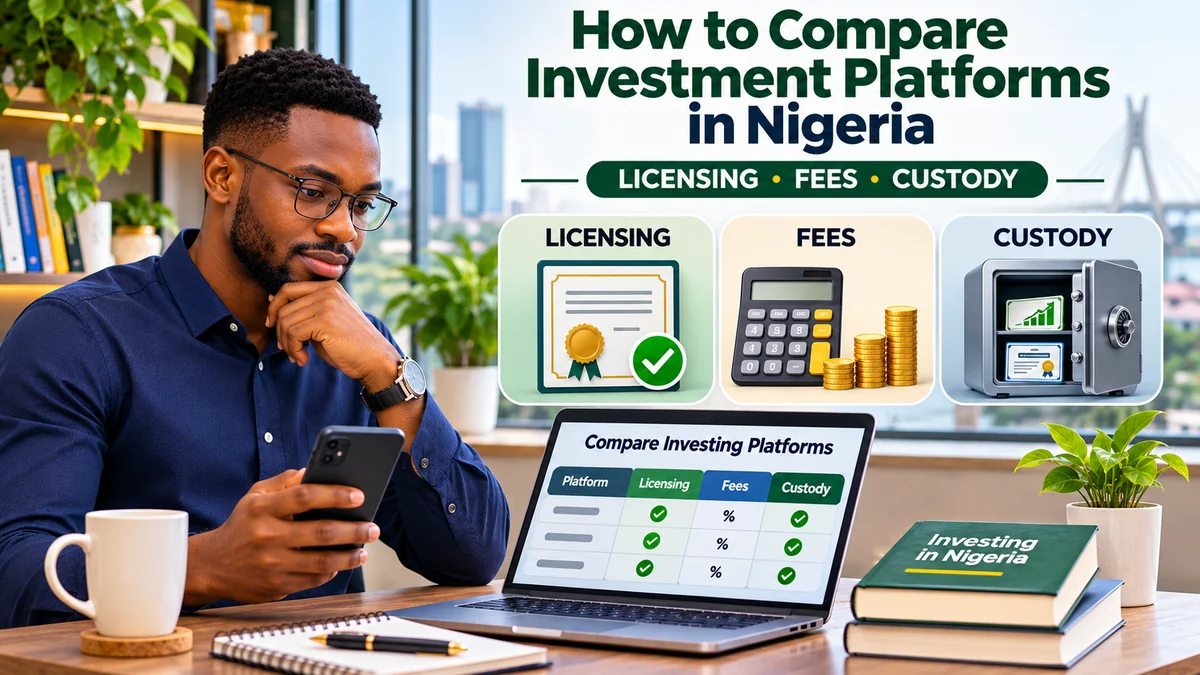
The safest way to compare investing platforms in Nigeria is to ask three questions before looking at advertised returns: who is authorised to provide the investment service, what will it cost you in total, and who legally holds the money or securities? An attractive interface, low minimum deposit and thousands of app downloads cannot answer those questions. They matter whether you want Nigerian shares, money market funds, bonds, foreign stocks or newer digital investments.
In May 2026, the Securities and Exchange Commission (SEC) warned against online investment schemes promoting unrealistic or guaranteed returns through social media. The Commission specifically encouraged the public to verify operators against its own directories. In October 2026, it issued another warning about a named unregistered platform . Both notices underline why verification should precede funding.
This guide shows Nigerian investors how to assess licensing, broker relationships, CSCS records, fund custodians, explicit and hidden fees, withdrawal restrictions, cross-border structures and investor protections. It includes a practical comparison worksheet and a worked fee example. It is educational, not personalised investment advice or a ranking of specific apps. Sources reviewed on 16 November 2026; licences, terms and tariffs can change.
Quick comparison: three checks every investment platform must pass
| Check | Ask this before investing | Evidence to request |
|---|---|---|
| 1. Licensing and scope | Which legal company operates the service, and is it authorised for this exact activity? | SEC operator directory entry and role; NGX dealing-member record for Nigerian listed-share trading; relevant foreign regulator details if applicable |
| 2. Full fees | What is the total cost of funding, buying, holding, converting currencies, selling and withdrawing? | Current fee schedule, example contract note, fund documents, FX conversion terms, withdrawal and tax disclosures |
| 3. Custody and ownership | Where are the underlying assets recorded, and how can I verify them independently? | CSCS/CHN or custodial statements, fund trustee and custodian details, foreign custody agreements, redemption and failure procedures |
Do not compensate for a failed licensing or custody check by awarding extra points for a low fee or high projected yield. If a platform cannot identify its regulated operator, product and asset custody chain, stop and investigate before transferring money.
1. First identify what you are actually buying
“Investment app” is a distribution channel, not an asset class. Two apps may look similar while offering entirely different legal and financial arrangements.
| Product advertised | What may sit behind the app | Critical check |
|---|---|---|
| Nigerian listed shares or ETFs | A securities broker/dealing member, market infrastructure and depository/custody relationship | SEC-registered broker and relevant NGX status; CSCS holdings |
| Money market or other mutual funds | SEC-authorised collective investment scheme with fund manager, trustee and custodian | Actual fund registration, investment mandate, fees and redemption terms |
| Treasury bills or bonds | Government or corporate debt accessed through an eligible intermediary | Issuer, specific instrument, ownership evidence, price/yield and maturity |
| US or other foreign shares | Foreign execution, brokerage, custody or nominee arrangements | Legal entity, foreign oversight, beneficial ownership, FX and withdrawal terms |
| Real-estate, private credit or crowdfunding investments | Project-specific securities, loans, SPVs or crowdfunding structures | Issuer, operator permissions, investors' legal rights, lock-up and default risk |
| Cryptoassets or tokenised products | An exchange, custody wallet or token issuer with distinct regulatory and operational risks | Exact virtual-asset authorisation, safeguarding arrangement and loss/recovery risks |
The comparison should begin with your objective and time horizon. Money you need next month should not be assumed available from a product with a six-month lock-up, an illiquid private investment or a volatile share. Likewise, a money market fund is not automatically equivalent to cash in an insured bank account merely because a mobile app calls it “savings”.
2. How to verify an investment platform's SEC registration
The SEC provides a Find a Registered Operator directory showing capital-market operators and their authorised functions. Its records can distinguish a broker/dealer, fund or portfolio manager, trustee, investment adviser, custodian and other regulated categories. That distinction matters because authorisation for one role does not confer permission to perform every other activity.
- Identify the full legal name. Look in the terms of service, not only the app-store brand. Ask which company is responsible for execution, advice, managing assets and holding client money.
- Search the SEC operator register. Use the independent SEC website and compare the legal name, status and registered functions. Do not rely only on a PDF licence image supplied by an agent.
- Verify the scope. A licensed fund manager is not necessarily your Nigerian stockbroker; a payment-services licence does not by itself authorise discretionary securities portfolio management.
- Check separate fintech records. The SEC's Registered FinTech Operators page distinguishes categories such as digital sub-brokers, portfolio managers, robo-advisers and firms admitted to regulatory-incubation programmes.
- Check public warnings. Search the SEC's scam-alert information and enforcement notices for the exact legal entity and platform.
- Resolve discrepancies directly. If the brand and register do not match, request a written explanation and contact the regulator through details found independently.
Be precise about fintech status. The SEC's July 2026 ARIP announcement describes approvals-in-principle that allow firms to operate within a defined programme scope and conditions. Admission to an incubation scheme or an approval-in-principle should not be presented as unconditional, permanent authorisation for every investment product.
Similarly, a CAC business-registration certificate establishes a company's registration, not that it has SEC permission to solicit investments. Check both identity and capital-market authorisation where applicable. An unfamiliar foreign brokerage should be checked against its own claimed regulator as well; a Nigerian marketing representative is not proof of overseas investor protection.
3. Nigerian shares: verify the broker, the exchange and CSCS
The Nigerian Exchange (NGX) explains that investors trading securities on its exchange use registered trading licence holders. Its public broker directory lists dealing firms and their status. Check the actual executing broker, not merely the app displaying prices.
NGX also explains that listed securities can be held through the Central Securities Clearing System (CSCS), Nigeria's central securities depository, under a dealer or an appointed licensed custodian. A broker's app may display your holdings, but independent depository records can provide an important cross-check.
Ask the platform: Will I receive a Clearing House Number (CHN) or other appropriate account identifier, and can I verify eligible holdings and transactions directly? CSCS offers an Online Portfolio View with self-service access to shareholdings and authenticated statements linked to a registered CHN. This does not mean every fractional or foreign product is individually recorded in CSCS; it depends on what is being traded and how it is held.
For example, if a Nigerian-share platform says you bought 300 units of a listed stock, reconcile the contract note, trade price, charges and settlement with the relevant broker and available depository records. If you cannot obtain independent evidence, ask the broker and CSCS to resolve the issue before making further deposits.
4. Mutual funds: check the actual fund, not only the app
A money market or balanced fund can be offered through a familiar mobile interface, but you are normally buying units in a fund, not a guaranteed bank deposit or a specific share in your personal name. The SEC's collective investment scheme FAQ describes a unit trust as a pooled portfolio managed for unit holders, with fund-manager, trustee, custodian and registrar functions.
Before investing, identify the exact legal name of the fund, whether it is authorised, its asset allocation, who manages it, the trustee and custodian, and where unit-holder records are kept. Review the prospectus, trust deed or key-information documents, periodic reports and unit pricing policies.
Custody is especially important: a fund custodian holds scheme assets, while the trustee provides an oversight function. These arrangements are intended to separate important responsibilities; they do not remove credit risk, price changes, poor liquidity or every potential operational failure.
For an open-ended fund, ask how its net asset value (NAV) is calculated, which price applies to subscriptions or redemptions and when proceeds are normally paid. The SEC's NAV guidance explains that the unit price derives from assets less liabilities divided by units. Reported annualised yields, past distributions and money market labels should never be interpreted as a promise of future returns.
For an example of the distribution model—not a recommendation of a particular product—FlyingEze previously reported on mobile access to mutual funds through a Nigerian bank app . Always verify the underlying fund and current terms independently, whichever channel you use.
5. Fees: calculate the complete round trip, not the headline commission
A “zero commission” banner might still coexist with currency-conversion spreads, market charges or other costs. Start with the total amount of money that leaves your bank account and the value you could actually withdraw after buying, holding and selling an investment.
| Cost category | Where it may arise | What to request |
|---|---|---|
| Brokerage or dealing commission | Buying and selling listed securities | Buy-side and sell-side rate, minimum and VAT treatment |
| Exchange, settlement and statutory charges | Market transactions | Current contract-note breakdown, including NGX/CSCS and applicable SEC or stamp charges |
| Fund management and other scheme expenses | Mutual funds, managed portfolios | Annual fees, expense ratio, performance fee and how they affect NAV |
| FX rate and conversion spread | Funding or selling foreign investments | Actual executable NGN/USD rate, separate conversion fees and withdrawal conversion rate |
| Deposit, withdrawal and bank-transfer charges | Movement of cash | Rates, minimum amounts and supported bank routes |
| Inactivity, custody or data charges | Keeping an account or accessing records | Subscription, maintenance and custody-fee schedule |
| Early redemption or exit charges | Funds, bonds, structured or locked products | Notice period, penalties, secondary-market limits and exit calculation |
| Applicable taxes | Transactions, distributions and realised returns | Product- and investor-specific tax explanation under current law |
NGX's published equities trading structure lists a brokerage commission range of 0.75%–1.35% and separate exchange, CSCS, SEC, stamp and VAT-related fee lines. This is a public reference, not a verified personalised quote or guarantee that every platform uses identical current charges. Ask your broker for its current written tariff and a sample contract note.
A ₦100,000 example: how small percentages add up
Suppose two hypothetical investment platforms each accept a ₦100,000 deposit. Platform A charges a 1% purchase commission, while Platform B advertises zero dealing commission but applies a 1.5% currency-conversion fee. Using the same ₦100,000 base for illustration:
- Platform A's illustrated commission: ₦1,000. Other market and exit charges may still apply.
- Platform B's illustrated conversion fee: ₦1,500. Its actual FX spread and selling costs may add more.
Neither number establishes which platform is cheaper over an entire investment journey. For a meaningful comparison, model the same product, trade value, holding period, purchase, sale and cash withdrawal. These percentages are imaginary, not actual current platform tariffs.
6. What does custody really mean—and why is it not the same as an app balance?
Custody concerns the legal and operational arrangements for holding investments and protecting records of ownership or entitlement. It is not just the app's claim that your balance is “safe”.
For Nigerian listed securities: clarify the NGX dealing broker, depository/custodian structure, CHN and how to access an independent CSCS statement where relevant.
For mutual funds: identify the fund's trustee, regulated manager, custodian and registrar or unit-holder record arrangement, together with the documents determining your redemption rights.
For foreign shares: request the precise foreign executing broker or custodian, the jurisdiction, whether assets are held as individually registered shares or through a pooled nominee, and the legal treatment of fractional shares. A statement of “US stocks” alone does not answer these questions. Insurance and investor-compensation rules in another country may apply differently by account structure and customer eligibility.
For crypto or tokenised assets: determine whether the provider or user controls private keys, whether custody is pooled or segregated, what happens if access is lost and which current regulatory permissions cover the activity. The SEC's fintech directory distinguishes virtual-asset operators and firms in regulatory-incubation tracks; these statuses should not be flattened into the same meaning.
Finally ask: What happens if the app shuts down, the operator becomes insolvent, a custodian fails or I lose access to my phone? A clear answer should identify independent records, legal claims, transfer or redemption processes and relevant dispute channels.
7. SEC regulation does not mean your investment cannot lose money
Regulation provides important supervisory and legal protections, but investment losses from price movements, issuer default, foreign-exchange changes or unexpected liquidity conditions can still occur. It is a mistake to assume a company's SEC status guarantees the principal, a fixed return or immediate withdrawal.
Nigeria's Investments and Securities Act 2025 provides for investor-protection funds in defined circumstances, including certain losses connected with failed dealing members or misconduct. Such mechanisms are not general insurance against a falling share price or a badly performing fund. The NGX investor protection fund information similarly describes particular eligible types of operator-related loss.
Bank deposit insurance is different. The NDIC Act 2023 distinguishes insurable bank deposits from monies held for purchases of securities, shares and certain other investment purposes. A mutual fund or brokerage share portfolio does not become NDIC-insured simply because a bank transfers the money or the platform uses the word “savings”.
Ask exactly what protection applies, to which legal account, against what kind of failure, under which law and with what limitations. Do not accept blanket phrases such as “all investments fully guaranteed” without the underlying instrument and formal terms.
8. Comparing dollar-investment apps: include currency and legal jurisdiction
Foreign investing can introduce legitimate diversification, but Nigerian investors may face additional currency-conversion costs and legal complexity. A naira-funded investment in US shares can gain or lose value in dollars and change in naira value as exchange rates move. Neither a rising dollar nor a strong US stock is a predictable guaranteed outcome.
Before using a cross-border service, ask what you buy (direct share, beneficial entitlement, fractional economic interest or synthetic product), which company executes the trade, where the shares are held, how dividends are processed and which rules govern account protection. Check whether you can transfer whole shares to another broker, or whether you must sell and withdraw cash. Fractional interests often have different transfer restrictions.
Always compare the actual conversion rate with a credible independent benchmark at the same moment; a provider can label its conversion “free” while earning a spread between the buy and sell rates. Ask about conversion on both entry and exit, payment-processor fees, withholding on dividends, account statements and tax reporting. Do not assume foreign investor insurance applies to a Nigerian app user through every intermediary structure.
9. Red flags: investment platforms that should prompt extra caution
- Guaranteed high returns: especially daily or weekly payouts with little or no explanation of the underlying asset.
- No verifiable regulated entity: only a trade name, influencer or personal contact appears.
- Payment to a personal account: transfers are requested outside the platform's documented beneficiary and funding process.
- Referral recruitment dominates: new users' deposits seem necessary to pay earlier members.
- Unclear custody: the platform will not identify a broker, fund, custodian or investor record.
- No understandable fee schedule: withdrawals trigger unexpected “tax”, “verification” or “unlocking” fees.
- Fabricated regulator documents: a certificate image replaces an independently verifiable SEC register entry.
- No practical exit method: operators repeatedly block sales, redemptions or transfers without contractual justification.
- Pressure and secrecy: a salesperson insists you must fund immediately or avoid asking the regulator.
- Unsupported claims of insurance: the offer cannot state who insures exactly what and against which event.
These signs are warnings, not proof of fraud in every isolated case. The SEC's investor FAQ identifies unrealistic returns and recruitment-driven payments as common Ponzi characteristics. FlyingEze has also reported on enforcement developments related to the CBEX investment scheme , underscoring why investors should verify operators before sending funds.
10. A practical investment-platform comparison scorecard
Use this worksheet to compare two or three services offering a similar product. First apply a strict screening gate: if an operator's authority for the service, ownership of assets or identity cannot be independently established, do not mark it safe merely because it scores well on other features.
| Criterion | What strong evidence looks like | Your result |
|---|---|---|
| Regulatory identity | Exact legal entity and current role confirmed on regulator's official record | Verified / Unresolved |
| Product identity | Fund name, listed security, issuer or foreign instrument and legal claim explained | Clear / Unclear |
| Independent custody evidence | Appropriate CSCS, fund or external custodian documentation and rights | Verified / Unresolved |
| All-in costs | Fees for funding, holding, converting, trading and leaving disclosed | Known / Incomplete |
| Liquidity and exit | Written settlement, redemption or transfer rules and restrictions | Clear / Unclear |
| Risk documentation | Market, credit, FX and operational risks disclosed without guarantees | Clear / Unclear |
| Service and records | Documented support channels, contract notes, statements and complaint route | Verified / Unresolved |
| Security and data privacy | Appropriate sign-in protection, transparent KYC and safe account recovery | Clear / Unclear |
Then compare the platforms on a like-for-like basis: expected total cost for your intended amount and holding period, access to the specific asset, ease of independent verification, withdrawal service and quality of disclosures. A simpler but properly documented service may be preferable to a flashy app with an opaque investment structure.
11. Questions to ask before depositing your first ₦10,000
- What is the full company name responsible for my investment, and where can I verify its licence?
- Which security, fund, bond or legal entitlement do I actually acquire?
- Who executes the transaction, manages the asset and holds it in custody?
- Can I obtain an independent statement or confirmation of ownership?
- What will I pay to fund, buy, hold, sell, convert currency and withdraw?
- Can I move my shares or funds to another authorised provider if I leave?
- How do dividends, interest, redemptions and applicable taxes work?
- What happens if the operator is hacked, becomes insolvent or loses a partner?
- Are there minimum amounts, lock-ups, trading suspensions or withdrawal limits?
- How do I make a formal complaint and escalate it to the relevant regulator?
Keep the latest terms, an account-opening acknowledgement, payment records and contract notes in a safe place. Do not disclose passwords, one-time codes or full identity documents to someone contacting you on social media. Where an app requires NIN, BVN or other KYC information, verify the operator and the secure submission channel first.
12. What to do if a platform refuses to return your money
Begin by checking whether the transaction is subject to a stated settlement period, redemption notice or legitimate trading suspension. Record the dates, amounts, reference numbers, communications and account statements. Contact the legal operator through the independently verified support channel and request a written explanation and complaint reference.
If the issue appears to involve misconduct or an unauthorised investment service, use the SEC's guidance for harmed investors . It recommends preserving evidence, reporting alleged malpractice and seeking appropriate legal advice where necessary. If a Nigerian listed-share transaction is involved, the responsible broker, NGX and CSCS may have relevant records. For foreign products, the regulator and complaint mechanism depend on the actual custody and brokerage jurisdiction.
Do not pay a “release fee” to a private contact who promises to unlock an account or recover losses. Such a demand can compound an existing problem. Protect linked payment accounts promptly if credentials or personal data have been compromised.
Frequently asked questions
Which investment platform is the best in Nigeria?
There is no universal best app. Compare the actual product, regulated legal entity, custody arrangement, costs and ability to withdraw or transfer holdings. A stockbroker, money market fund distributor and foreign-share app offer different risks and services.
How can I check if an investment app is licensed by SEC Nigeria?
Search the SEC registered-operator directory for the exact legal entity and permitted functions. Check the fintech operator lists where relevant and confirm any remaining ambiguity directly with SEC.
Does a CBN licence mean an app can sell investments?
Not by itself. A payments or banking authorisation and a securities-market authorisation serve different purposes. Verify the particular activity and entity against the appropriate regulator.
What is CSCS and why do Nigerian share investors use it?
CSCS is a central securities depository and settlement institution for eligible Nigerian market securities. Its online portfolio service can help eligible investors independently see holdings and statements linked to their CHN.
Are money market funds guaranteed in Nigeria?
No general guarantee follows from the words “money market”. Check the specific authorised fund's prospectus, mandate, portfolio, custodian, NAV and redemption rules. Some funds pursue relatively low-volatility instruments, but credit, liquidity and other risks remain.
Are my stocks insured by NDIC?
Stocks and ordinary investment interests are not simply insured bank deposits. The NDIC Act distinguishes deposits from money received to buy securities. Certain capital-market investor protection funds may cover specified operator-related losses, not ordinary market declines.
Can I invest in US stocks from Nigeria?
Products may be offered through international brokerage or intermediary structures, subject to applicable laws and access. Verify the named foreign institution, what you legally own, its oversight, custody, currency-conversion and tax arrangements before funding.
Is a 0% trading-commission app always cheaper?
No. Compare foreign-exchange spreads, market charges, fund fees, deposit and withdrawal costs and the total expense of buying and exiting. “No commission” describes only one possible line item.
Is an SEC fintech incubation approval the same as full licensing?
Not necessarily. An approval-in-principle or regulatory-incubation status can be conditional and limited to a defined activity. Verify the precise current terms rather than assuming blanket permission.
What if an investment platform advertises guaranteed daily returns?
Treat that as a major warning, especially if the legal operator, product, custody and source of returns cannot be verified. SEC's 2026 public notices specifically warn against unregistered schemes promoting unrealistic or guaranteed returns.
Where should I report suspected investment fraud in Nigeria?
Preserve evidence and report suspected capital-market misconduct through the SEC's official investor-protection and complaint channels. Notify your bank promptly if there was unauthorised payment activity, and consider appropriate law-enforcement or legal assistance depending on the facts.
Conclusion: compare the investment, not just the app
The most reliable comparison of investing platforms in Nigeria starts with verifiable regulatory status, moves to a full round-trip cost calculation, and ends with a clear account of custody and legal ownership. A provider that cannot explain these basics is not made safer by a high advertised yield or a polished interface.
Before committing meaningful money, confirm the exact SEC-regulated function, the relevant NGX broker or fund structure, independent holding records where available, the cost of buying and leaving, and the risks you could bear. Regulation helps protect investors, but it does not turn investments into risk-free deposits or guarantee gains.
Editorial note: Researched on 16 November 2026 using the SEC, NGX, CSCS, NDIC and applicable Nigerian statutes. The example platform fees are hypothetical and no investment app is endorsed or individually certified by this article. Licence status, product terms, fees, tax and regulatory protections must be rechecked before acting. This is general education, not personal financial advice.



