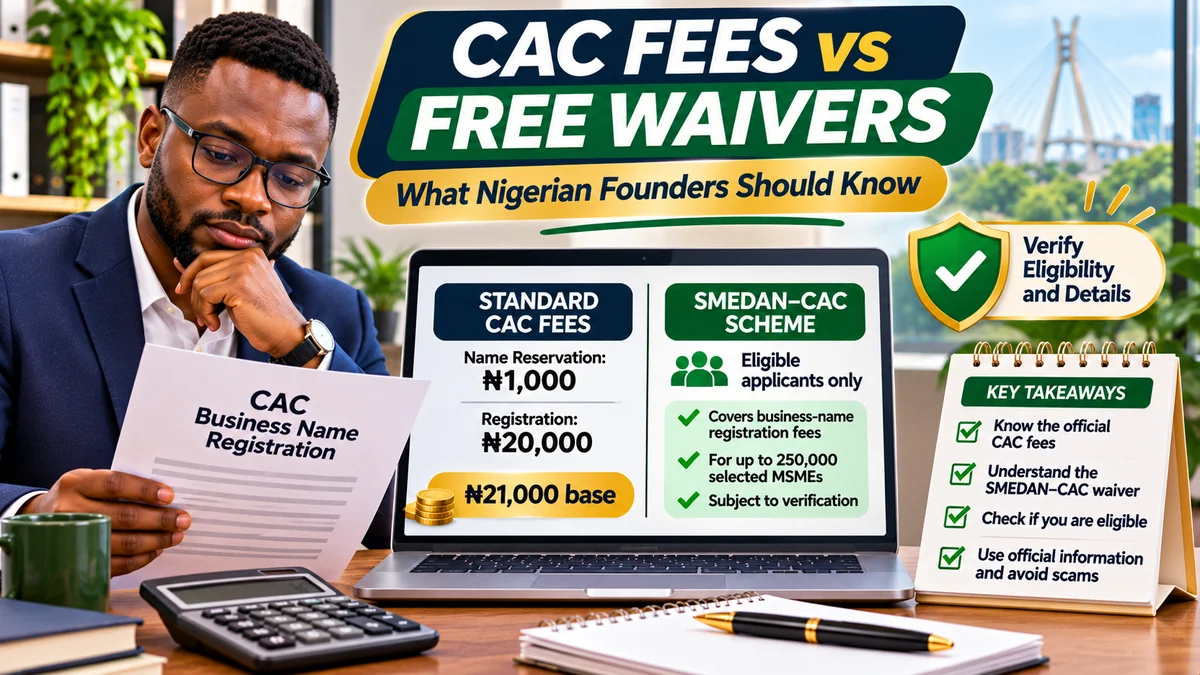
Free CAC Registration is a real opportunity for selected Nigerian micro and small businesses, but it is not the standard price of registering every business with the Corporate Affairs Commission (CAC). Under CAC's official fee schedule published in the Federal Gazette on 29 May 2025 , an ordinary business-name application has a ₦1,000 name-reservation fee and ₦20,000 registration fee: a ₦21,000 published base cost before any applicable extras. A separate SMEDAN–CAC initiative is designed to cover registration fees for up to 250,000 eligible MSMEs.
For a founder, these are two different financial situations. One is the ordinary published charge for a government service. The other is a time-limited or capacity-limited support arrangement for people who meet stated conditions. An agent advertising a “free CAC package” is yet another category: the offer might waive the agent's own service fee without changing what CAC charges.
This guide explains how to distinguish a genuine government waiver from a promotion, what an official fee may still cover, how much different business structures can cost, what to check before accepting an offer and which expenses remain after registration. It draws on the CAC fee gazette, CAC's current registration portal, SMEDAN's original programme announcement and reporting published in November 2026. Research checked: 16 November 2026.
Quick answer: CAC fees, fee waivers and promotions are not the same
| Term | What it means | What founders should verify |
|---|---|---|
| Official CAC fee | The published statutory charge for a specific filing or service | Entity type, fee schedule, current portal assessment and payment destination |
| Government-sponsored waiver | Some qualifying registration charges are covered or forgone under an authorised programme | Official agency announcement, eligibility, scope, allocation and approval |
| Private promotional discount | An agent or service provider reduces its own price or offers to fund some costs | Whether statutory CAC charges, professional fees and other expenses remain payable |
| Free SMEDAN profile | Registration on the SMEDAN MSME platform | It is not itself proof of CAC business-name registration |
| Free public search | Basic registry information made available without a charge | It is not the same as a paid filing or full registered-business certificate |
The most important question is “Which exact CAC service is free, for whom, and who is paying any costs that remain?” Do not assume “free CAC registration” means free incorporation of a limited company, free tax registration, free professional licences or permanent exemption from annual returns.
What are CAC's published business-name registration fees in 2026?
The official New Schedule of Fees includes a separate section for business names. The relevant ordinary amounts are:
| CAC business-name service | Published fee | What to know |
|---|---|---|
| Ordinary name reservation | ₦1,000 | Checks and reserves an acceptable proposed name |
| Reservation involving restricted words | ₦5,000 | May also require a separate consent or approval review |
| Registration and listed CTC documents | ₦20,000 | The standard business-name registration filing |
| Ordinary reservation plus registration | ₦21,000 base | ₦1,000 + ₦20,000, before any applicable additional charges |
| Annual return / specified post-registration filing | ₦5,000 each | Can arise after the business has been registered |
| Change of registered name | ₦10,000 | A later service, not included in the initial base example |
| Separate status report request | ₦5,000 | Do not confuse a separate paid request with initial documents supplied at approval |
These are published fees, not a quote for a specific applicant's entire transaction. A restricted name, optional professional help, payment-processing charges, other filings or a sector-specific approval can change the cost. CAC may update its schedule; therefore, the final amount payable should be checked in the authenticated iCRP portal immediately before making payment.
Older information can cause confusion. SMEDAN's September 2025 programme announcement described ordinary registration as costing “around ₦11,000”. That figure appeared in the announcement, but the relevant Federal Gazette lists ₦1,000 for ordinary name reservation and ₦20,000 for business-name registration. To compare fees accurately in November 2026, founders should give priority to the gazetted schedule and the live CAC assessment rather than repeat an older promotional estimate. FlyingEze's published CAC registration cost guide provides a broader breakdown by entity type.
How much does it cost to incorporate a limited company instead?
A business name and a company limited by shares are not interchangeable products. The gazette lists ₦1,000 for ordinary company name reservation and, for small or other private share-capital companies, ₦10,000 for each ₦1 million of issued share capital or part thereof for incorporation. The schedule lists ₦20,000 per ₦1 million or part thereof for public companies. Other statutory charges, including applicable stamp duty, can arise.
For an illustrative private-company application with ₦1 million in issued share capital, the cited incorporation-rate component is ₦10,000, with an ordinary ₦1,000 name reservation, before other charges. For ₦5 million of issued share capital, that rate component is ₦50,000, again before other charges. These are rate illustrations, not complete incorporation quotations. The filing type, issued capital and other legal requirements affect the total.
A founder seeking shareholder investment, a shareholding structure or separation between personal and company obligations should choose the appropriate entity type on legal and commercial grounds, not solely because a free business-name programme is available. FlyingEze's business name versus limited liability company comparison explains this decision. The SMEDAN–CAC free-registration initiative described in this article does not establish a general waiver of incorporation costs for limited companies.
What is the SMEDAN–CAC free registration programme?
On 27 September 2025, the Small and Medium Enterprises Development Agency of Nigeria (SMEDAN) announced a partnership with CAC intended to provide free business registration to 250,000 micro, small and medium enterprises. Contemporary reporting from the News Agency of Nigeria and The Guardian described the project as a government-backed waiver, with CAC expected to forgo approximately ₦3 billion in registration fees.
In June 2026, Voice of Nigeria reported that SMEDAN was continuing its free formalisation effort. More recently, news outlets on 12 November 2026 reported renewed access through SMEDAN's online portal following earlier application difficulties. Those reports help explain why searches for “Free CAC Registration” have resurfaced.
However, the publicly accessible SMEDAN account-creation form does not show how many programme places remain, prove that an applicant qualifies, or constitute a CAC certificate. This article cannot independently confirm that a particular place is still open on 16 November 2026. A programme may be genuine while its remaining availability and each applicant's eligibility still require confirmation.
Who may qualify for a government waiver?
The scheme is aimed at smaller Nigerian enterprises that have not yet obtained the relevant CAC business-name registration. Reports in November 2026 describe likely applicant groups including traders, artisans, retail operators, online sellers and other nano or small-business owners. Businesses already registered with SMEDAN but not with CAC may also be considered under the programme's rules.
Founders should examine four questions before depending on free registration:
- Is the business unregistered with CAC? A company or business name already registered with CAC is not ordinarily the target of a new-business-name fee waiver.
- Is the intended filing a business name? Do not assume the programme will pay to form a limited company, incorporated trustee, LLP or LP.
- Does the business meet the actual programme criteria? Your location, business category, identity information and other details should match what the official portal requires.
- Has the agency confirmed selection and next steps? A SMEDAN profile or application acknowledgement is not an allocation notice, registered-business record or approved certificate.
If you do not meet the scheme's requirements, do not manipulate the business type, create duplicate accounts, falsely say you have no CAC registration or send another person's identity documents. Those actions can undermine an application and create later compliance problems.
How to check a legitimate free CAC registration offer
Use the agency's domain rather than a link forwarded by a purported agent. The primary sources are smedan.gov.ng , its official SMEDAN portal , and CAC's registration portal . Verify any programme-specific instruction against announcements from these organisations.
- Visit SMEDAN's website directly and locate the MSME registration or official programme information.
- Sign in to your existing SMEDAN account, or register once if you are a new user. Do not create repeated profiles merely because the page loads slowly.
- Provide truthful personal and business information, including whether your business already has a CAC number.
- Read the published eligibility and next-step information carefully. Where details are missing, contact the agency through official support channels rather than paying an informal intermediary.
- Save your application reference or acknowledgement where supplied. Monitor legitimate SMEDAN communications for any selection and CAC filing instructions.
- Only treat the business as registered after CAC has actually approved the filing and issued the corresponding certificate or verifiable registry record.
The CAC iCRP FAQ distinguishes name reservation, business registration, queries and approval. For an ordinary business name, the process involves a reservation Approval Validation (AV) code, proprietor details, an identification image, passport photograph, signature and final registration processing. Free-programme participants should follow the verified special route rather than assume the ordinary checkout will automatically remove charges.
What is actually waived—and what might still cost money?
A genuine government programme can remove registration charges covered by its agreement. But the scope matters. SMEDAN and CAC's initiative concerns the eligible registration of business names. It does not follow that every separate CAC service, bank product, tax obligation or sector-specific licence is included.
| Potential cost | Does a business-name waiver necessarily cover it? |
|---|---|
| Approved business-name registration under SMEDAN–CAC | The programme intends qualifying beneficiaries to receive this registration without paying the covered statutory fees |
| Limited-company incorporation or share-capital filing | No general coverage established by this programme |
| Future CAC annual returns | No general lifetime waiver established |
| Later name changes, status reports or extra copies | Not automatically included; check the separate fee schedule |
| Professional agent's service fee | Separate commercial charge; verify whether help is actually needed |
| Stamp duty or other taxes, where legally applicable | No general exemption arises merely because registration is subsidised |
| Sector permits, professional licences or local approvals | Separate obligations subject to the business activity |
| Business account charges or banking services | Separate provider terms; CAC registration does not make banking free |
For a specific programme, ask whether it covers name reservation as well as registration, and what happens if your name requires special consent. Do not assume an unlisted cost is covered or excluded without an official answer. The right evidence is a programme instruction or a CAC assessment identifying the charge and how it will be handled.
A government waiver is different from an agent's promotion
Private service providers can legitimately help applicants understand business structures, prepare filings or complete registration tasks. Some offer discounts or say that their own professional service is “free”. That does not mean the underlying statutory fees have been legally abolished. CAC expressly states on its business-name registration page that individuals may register business names themselves without using a lawyer, chartered accountant or chartered secretary.
Before paying an agent, request a written breakdown: the official CAC reservation charge; the applicable registration charge; other statutory or payment costs; the agent's professional fee; and exactly which component the promotion removes. An agent may choose to pay a customer's filing costs as a private incentive, but that is the agent funding a service—not proof that CAC has changed its published tariff.
A promotion can be legitimate if its terms are transparent. A suspicious offer demands an undisclosed “waiver activation fee”, refuses to identify the programme, uses a personal payment account while claiming to be CAC, or guarantees selection in a limited government initiative. If you suspect fraud, stop and verify through official CAC or SMEDAN channels before sharing money or documents.
Realistic budget examples for three Nigerian founders
Example A: a tailor opening a small fashion business
Suppose a sole proprietor wants to register an ordinary business name for a tailoring shop. Using the gazetted schedule, the published base for ordinary reservation plus registration is ₦21,000. If that same business is officially selected for a SMEDAN–CAC waiver that covers the relevant filing, the specified registration cost can be removed for that beneficiary. Either way, the founder may still need to budget for tools, record-keeping, relevant permits or later compliance.
Example B: a software venture planning to issue shares
Suppose two founders want a limited company with ₦5 million in issued share capital. The private-company incorporation fee component in the schedule is ₦50,000, plus ordinary name reservation of ₦1,000 and other applicable charges such as stamp duty. They should not budget ₦0 simply because a business-name registration campaign was announced. Choosing a business name solely to qualify for a promotion may be the wrong decision if the intended venture requires shareholders and an incorporated structure.
Example C: an existing registered retailer needing annual returns
A retailer with an existing CAC business name may see a free-registration advert and assume it will erase overdue filings. The published business-name annual-return fee is ₦5,000 for the applicable filing, and relevant penalties may also apply. The scheme for newly registering selected MSMEs is not a confirmed waiver of the retailer's existing annual-return responsibilities. Check the actual account record and current rules.
These examples explain cost categories; they are not personalised legal or tax quotations. Check the real filing before making a financial commitment.
Why “free” does not mean there are no obligations after registration
Once CAC has approved a business name, the proprietor must keep the business record accurate and comply with applicable law. The May 2025 fee schedule lists ₦5,000 for business-name annual returns and other specified post-registration filings. The current iCRP landing page also carries a notice about business-name annual returns while its system is being upgraded.
Separate responsibilities can include keeping financial records, meeting tax obligations, obtaining required sector approvals, updating registration particulars and ensuring that any claims about the business are truthful. The exact obligations vary by activity, location and entity type. Neither a CAC certificate nor a waived filing fee provides automatic access to a bank loan, government grant, tax holiday or public contract.
For a structured post-registration review, see FlyingEze's guide to what business owners should do after CAC registration . Founders should distinguish the one-time cost of formalising a business from the ongoing costs of operating and staying compliant.
How to compare two offers without being misled
Before choosing the standard route, a government-sponsored opportunity or professional assistance, use a simple four-column comparison:
| Question | Ordinary CAC route | Verified SMEDAN waiver | Private agent promotion |
|---|---|---|---|
| What entity is registered? | The entity you selected and paid to register | Qualifying business name under programme rules | Must be specified clearly in the agent's offer |
| Who is eligible? | Anyone meeting applicable CAC filing requirements | Selected MSMEs meeting programme conditions | Customers meeting the provider's commercial terms |
| Who pays official fees? | Applicant pays assessed fees | Covered or waived as authorised for successful beneficiaries | Applicant or provider, depending on written terms |
| Is the result guaranteed? | No; filing must pass CAC approval | No; selection and registration approval remain necessary | No private agent can legitimately guarantee government approval |
| What proof confirms completion? | CAC certificate and registry record | CAC certificate and registry record after actual registration | Same official CAC evidence, not an agent's receipt alone |
Keep the official source links, programme announcement, submission acknowledgements and any receipts. If an offer says “Free CAC Registration” in the headline but “pay a non-refundable processing charge to an individual bank account” in the small print, verify the beneficiary rules and provider before proceeding.
How to verify your CAC certificate after a free or paid application
Paying an official fee or receiving a waiver allocation does not establish that a business has already been registered. CAC's iCRP dashboard distinguishes Pending, Queried and Approved applications. For a queried submission, its FAQ explains how to open the query history, modify the application and resubmit. After approval, the portal provides access to the certificate and status report.
Confirm the entity's registered name, number and other details using authorised CAC records rather than trusting a screenshot sent by an agent. FlyingEze's guide to checking CAC registration records
Frequently asked questions
Is CAC registration free in Nigeria in 2026?
Ordinary CAC registration is not universally free. A government-backed SMEDAN–CAC initiative aims to provide free business-name registration to up to 250,000 qualifying MSMEs. You must meet the conditions, be selected where applicable and complete the actual CAC process.
What is the standard CAC fee for registering a business name?
The relevant May 2025 Federal Gazette lists ₦1,000 for ordinary name reservation and ₦20,000 for business-name registration and listed certified documents, giving a ₦21,000 published base. Confirm the current portal assessment and extras before payment.
Why does a SMEDAN announcement mention ₦11,000?
SMEDAN's September 2025 programme announcement referred to a typical registration cost of about ₦11,000. CAC's published Federal Gazette schedule lists the separate ₦1,000 and ₦20,000 charges. Use the official fee schedule and actual portal assessment for current cost comparisons rather than an old promotional summary.
Who can apply for the free SMEDAN–CAC registration?
The programme principally targets qualifying small or nano businesses not yet registered with CAC. Existing SMEDAN registrants without CAC business-name registration may also be considered, subject to the scheme's real eligibility rules and remaining capacity.
Where should I apply for free CAC registration?
Start from smedan.gov.ng and the official SMEDAN portal . The normal CAC application portal is icrp.cac.gov.ng . Do not rely on an unverified WhatsApp group, payment link or cloned site.
Does free CAC registration include a limited liability company?
The described SMEDAN–CAC programme covers eligible business-name registration; a general waiver for limited-company incorporation has not been established. A company has different filing and stamp-duty obligations.
Does getting a SMEDAN number mean my CAC registration is approved?
No. A SMEDAN account or identification number is separate from the CAC business registration. Wait for actual CAC approval and retrieve the relevant certificate and official record.
Can an accredited agent charge a service fee?
A professional provider may charge for agreed assistance. However, an agent's fee is separate from the official CAC tariff, and individual proprietors can complete ordinary business-name registrations directly. Request an itemised breakdown and do not pay someone for a supposedly guaranteed free programme slot.
Are annual returns free for beneficiaries of the waiver?
The programme announcement does not establish a lifetime exemption from CAC annual returns. The published business-name fee schedule lists ₦5,000 for applicable annual-return filings, and relevant penalties may apply if returns are overdue.
Can I get a grant or loan automatically after free CAC registration?
No. Registration may help a business meet eligibility criteria for future opportunities, but it does not itself award cash, credit or tax relief. Any grant, lending or banking programme has separate conditions.
How do I know whether free slots are still available?
Check SMEDAN's official portal and announcements. Reporting from 12 November 2026 described reopening, but the number of remaining slots was not independently confirmed in the publicly accessible sources reviewed on 16 November 2026. Do not treat any agent's claim about guaranteed selection as verified.
Final decision checklist for founders
- Choose the correct legal structure before considering any discount.
- Read CAC's current gazetted fees and the assessment shown on iCRP.
- Identify whether an offer is a government waiver or a private service promotion.
- Confirm eligibility, programme scope and whether slots remain officially available.
- Ask exactly which fees are covered, including any name-reservation or restricted-name charge.
- Keep NIN, portal credentials, identity documents and OTPs away from unverified third parties.
- Do not claim business registration is complete until CAC issues and verifies the records.
- Budget separately for ongoing filings, taxes and other applicable business obligations.
Conclusion: compare the cost you can verify, not the word “free”
The practical distinction is straightforward: CAC's fee schedule sets the ordinary charges for registration services; a verified government programme may waive or cover a defined charge for selected beneficiaries; an agent's promotion is a separate commercial offer. Those three things should never be collapsed into a single claim that “CAC registration is free in Nigeria”.
For an ordinary business name, the gazetted baseline is ₦21,000 for name reservation plus registration before applicable extras. Eligible MSMEs can investigate the separate SMEDAN–CAC initiative, but must verify availability and selection. Founders planning a limited company or facing complex ownership decisions should choose the right legal structure, not an unsuitable free product. The safest path is to verify the programme, understand the exact cost breakdown and confirm the final CAC registration record.