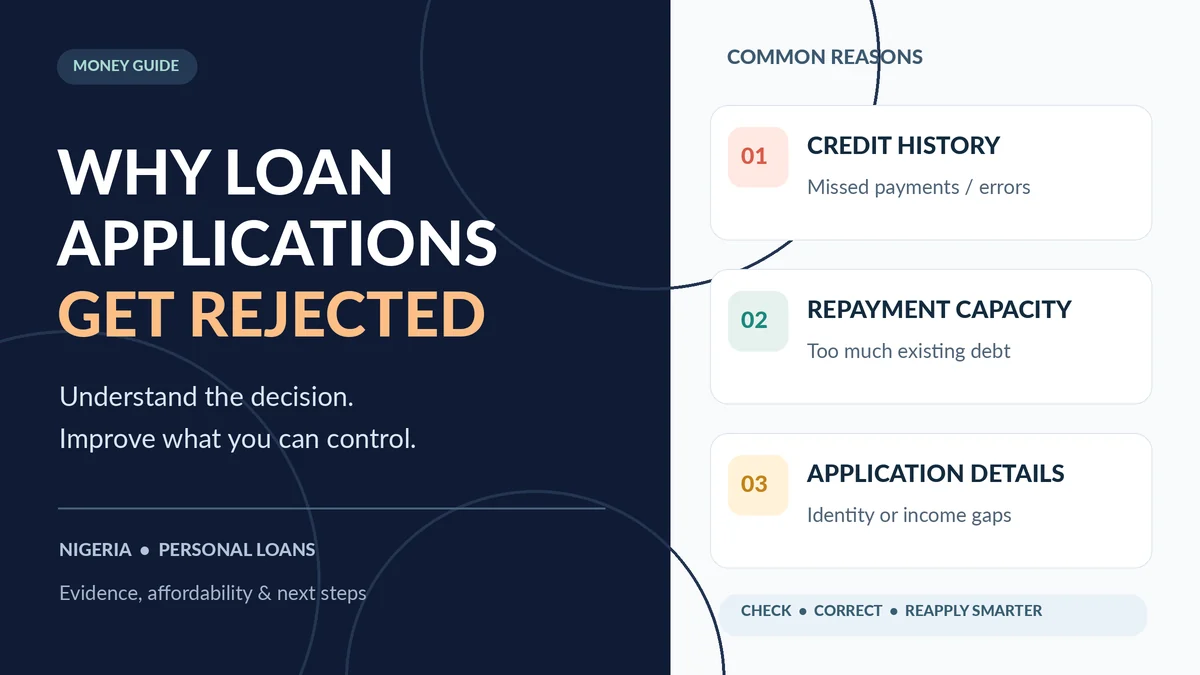
Loan applications in Nigeria are commonly rejected when a lender cannot verify the applicant's identity or income, considers existing debt too heavy, sees unresolved repayment problems, or finds that the applicant does not meet that particular product's requirements. A declined application does not automatically mean the borrower is on a government “blacklist,” and it does not prove the applicant can never obtain credit.
Whether you applied to a bank, microfinance bank or digital loan provider, the useful next step is to identify why the application failed before trying another lender. The Central Bank of Nigeria (CBN) Consumer Protection Regulations require institutions within the CBN's supervisory scope to assess whether customers can repay sustainably and to consider credit histories through relevant credit-information systems. Product eligibility, identity checks and the lender's own risk policies also matter.
This guide explains common rejection reasons, practical improvements Nigerian borrowers can make, how credit reports and the CBN Credit Risk Management System work, and when it may be wiser to postpone borrowing. It covers relevant 2026 digital-lending protections without suggesting that any tip guarantees approval. Fact-checked on 13 November 2026. This is general financial education, not an offer of credit or personalised financial advice.
Why do loan applications get rejected? A quick diagnosis
| Possible reason | What the lender may be checking | Practical next step |
|---|---|---|
| Repayment problems | Late payments, defaults or unresolved debt in relevant records | Obtain your credit information and correct inaccuracies or resolve arrears |
| Too much debt | Existing monthly obligations relative to reliable income | Review total repayments and reduce the amount requested where sensible |
| Unclear income | Salary, business receipts, income consistency and account statements | Prepare genuine evidence of stable cash flow |
| Identity mismatch | Name, date of birth, BVN, ID and bank-account details | Correct records through their legitimate issuers |
| Missing documents | Proof of employment, address, banking history or professional records | Request the lender's exact document checklist |
| Outside product criteria | Age, employment tenure, salary-account or location conditions | Check eligibility before a formal application |
| Requested amount is unsuitable | Whether the instalment fits disposable income and existing commitments | Consider a smaller loan or delaying the expense |
| Risk or verification flags | Contradictory information, suspected fraud or unsuccessful account checks | Ask which information needs verification, without sharing passwords or OTPs |
These are potential explanations, not the confirmed reason for any individual rejection. Banks and loan apps can use different models, product rules and verification procedures. Start with the actual decline message or an enquiry to the lender before treating any single factor as the answer.
1. Previous late payments or unpaid loans
A lender may review how you have handled existing and past borrowing. In the CBN's Credit Risk Management System (CRMS) explanation , participating institutions report information about loans, outstanding amounts and repayment status to help banks identify repayment difficulties and excessive exposure. Licensed private credit bureaus may also hold relevant credit information.
An unpaid balance, serious delinquency or repeated late payments can cause a lender to decline new credit. However, a refusal does not establish that every lender will automatically reject you or that a private service can sell a guaranteed “blacklist clearance.” Lenders make their own decisions, subject to applicable law and internal policies.
What to improve: identify legitimate outstanding obligations, request current statements, settle or restructure arrears where affordable, and retain proof of repayment. If an account was already settled but still appears as overdue, follow the reporting provider's correction procedure and ask the bureau to investigate. Do not pay an anonymous agent who claims to erase genuine debts instantly.
2. Existing loan payments leave too little income
Approval is not only about whether you earn a salary. Lenders need to consider what remains after existing loan repayments and necessary living costs. The CBN's responsible-lending provisions require regulated institutions to assess a consumer's capacity to repay in a sustainable manner before granting credit.
For an illustration, suppose your reliable monthly take-home income is ₦250,000. You already pay ₦60,000 monthly toward other loans. A new loan would require ₦80,000 monthly, bringing total scheduled debt payments to ₦140,000. The simplified debt-payment ratio would be:
₦140,000 ÷ ₦250,000 × 100 = 56% of monthly take-home income.
That calculation ignores rent, food, transport, dependants and emergencies, which could make the proposal even harder to sustain. It is a teaching example, not a CBN-mandated 56% rejection threshold. Lenders may apply different affordability approaches and policy limits.
What to improve: list every active repayment, reduce debt where feasible and calculate how much money remains after essentials. Avoid taking another costly loan simply to keep up with existing ones. A smaller request or postponing borrowing may improve both affordability and financial safety.
3. Your income cannot be verified consistently
Banks may ask for account statements, salary credits, employment information or other evidence that income is genuine and recurring. Digital lenders may use account data or alternative checks with appropriate customer permissions. A borrower who reports ₦400,000 in monthly earnings but has no consistent record supporting that figure may be harder to assess than someone with clear, traceable receipts.
For self-employed people, freelancers and traders, irregular cash flow is not necessarily a sign of dishonesty. It does mean that the evidence and repayment pattern may require more explanation. A lender may assess average income, seasonality, business continuity and the stability of deposits rather than one unusually strong month.
What to improve: keep accurate statements and invoices, separate business and household spending where practical, document genuine client payments, and show a realistic history rather than fabricating salary alerts. If income arrives irregularly, ask whether the lender supports an appropriate repayment schedule rather than committing to a payday-style instalment that you may not meet.
4. Incorrect or inconsistent identity information
Financial institutions carry out know-your-customer (KYC), identity and fraud-prevention checks. A mismatch between names on the loan form, bank account, identity document or Bank Verification Number (BVN) information can prevent successful verification. Other inconsistencies—including an incorrect birth date or an unverified phone number—may also need correction.
A failed identity check should not be interpreted automatically as evidence of fraud. Simple errors, outdated documentation or name changes may account for the problem. But a legitimate lender may be unable to proceed until it has accurate records.
What to improve: compare your details carefully, use the same legal identity across official documents and update inaccurate records through your bank or the relevant issuing authority. If you have changed your name, ask what supporting documents are required. Never submit another person's BVN, identity number or account information to get around a rejected application.
5. The application lacks a required document
Some loan products require valid identification, banking records, proof of income, a statement of account, a salary mandate, a guarantor or other supporting information. A secured facility can involve additional security documents or asset checks. A particular digital product may have fewer document requirements but stricter automated verification.
An official Stanbic IBTC unsecured-loan product page , for example, publishes applicant conditions relating to age, employment, account relationship, income and credit checks. These conditions illustrate that eligibility is product-specific; they are not universal requirements for all Nigerian personal loans.
What to improve: request the latest checklist for the exact product, submit legible and genuine records, and verify that uploaded files were received. Do not email identity documents to an address or WhatsApp contact that you have not independently confirmed belongs to the lender.
6. You do not meet the product's age, employment or account conditions
Some salary loans are designed for customers whose salaries are paid into a particular bank. Others target employees of approved organisations or require a minimum employment history. A product may also have age limits, residency conditions or a particular repayment tenor. A borrower who is otherwise financially responsible may still fall outside such criteria.
A lender's advertised “prequalified amount” is not necessarily final loan approval. The institution may still verify documentation, repayment capacity, employment status and credit information. Passing one automated screen does not guarantee the next stage will succeed.
What to improve: check the current eligibility page before applying. Ask whether a different legitimate product is intended for your income type or employment situation. Do not try to bypass an age or employment requirement by inventing details: that can create legal and account-security problems.
7. The loan amount or repayment period is unrealistic
Even when your history and documents are acceptable, a requested loan can exceed what the lender considers affordable. Larger principals generally mean larger required payments, while shorter tenors can put pressure on each due date. A longer tenor may reduce individual instalments but increase total borrowing cost under many interest structures.
The correct comparison is not just the headline rate. Examine the actual amount disbursed, interest calculation, upfront fees, repayment frequency and total amount repayable. CBN consumer regulations call for clear loan disclosures and a Key Facts Statement for covered consumer facilities.
What to improve: calculate the lowest genuinely necessary amount, compare lawful offers on the same basis, and test the instalment against income that is likely to arrive on time. If the payment would force you to miss rent or essential bills, borrowing less or delaying the purchase may be preferable even if a lender is willing to approve the full amount.
8. The lender sees an unfamiliar or incomplete credit history
Having little recorded borrowing history is different from having a poor record. A new borrower may not have a long history of instalments that demonstrates repayment behaviour. Certain lenders may respond cautiously to limited information, while others may accept additional evidence such as verified income, banking history or eligible guarantees.
What to improve: build a reliable financial record through regular income documentation and responsible use of any genuinely needed credit. Make agreed payments on time. Do not take out an expensive loan solely to create a credit history, and do not believe anyone promising that one small repayment will guarantee a particular credit score.
There is no single universal Nigerian “minimum credit score” that approves every personal loan. Scoring systems, data coverage and underwriting rules vary. A score can inform a decision without replacing the lender's assessment of affordability and eligibility.
9. Too many applications in a short period
After a rejection, it can be tempting to apply to multiple loan apps immediately. Doing so can create confusion about the amount of credit you are seeking, expose sensitive personal data to more providers and result in further enquiries on your credit file where applicable. Individual lenders decide whether and how recent applications or enquiries affect underwriting.
It would be misleading to claim that every credit enquiry in Nigeria lowers a credit score by a fixed number of points. There is no verified universal rule of that kind across all lenders and credit bureaus.
What to improve: stop repeating the same application while the underlying problem remains unresolved. Ask the original lender which requirements you failed, check your records, and compare relevant eligibility conditions before making another formal request.
10. The loan or account verification process triggers a risk check
Unusual account activity, inconsistent documents, duplicated identity details, unsupported financial information or an unsuccessful bank-account verification can trigger additional questions or a decline. Some systems may also reject an application because a service is temporarily unavailable or a technical check failed.
Do not assume that an automated “unable to process” message proves you were judged dishonest. It may describe a temporary issue or incomplete verification. Equally, repeated technical failures should not be solved by giving passwords, card PINs or one-time codes to an alleged agent.
What to improve: confirm the lender's official support channel, request clarification about any missing or conflicting information and try again only after an authentic issue is resolved. Provide only the data needed for the legitimate application under the lender's disclosed privacy terms.
How to check your credit report in Nigeria after a rejection
The CBN's CRMS overview explains how relevant bank-reported credit information helps lenders identify existing obligations and repayment problems. Separate credit bureaus can also provide reports on borrowing history. These systems are not the same as a permanent public list of “bad borrowers.”
- Find out which report the lender used. Ask whether the decision involved its own account records, a private credit bureau, the CRMS or another verification source.
- Request access through a legitimate channel. Contact the relevant licensed bureau or reporting institution and follow its identity-verification process. Available report products, fees and access routes may differ.
- Review the details. Check names, accounts you do not recognise, balances, payment statuses and the recorded settlement of old facilities.
- Dispute factual errors. Keep proof of settlement and ask the bureau and the lender that supplied the record to investigate and correct inaccurate information.
- Check for the outcome. Retain reference numbers and obtain an updated report or confirmation when the dispute is resolved.
Under the CBN's credit-bureau guidelines , a data subject can inspect credit information and request review of inaccuracies; the rules set out dispute-investigation and correction responsibilities. If the disputed information is in the CBN CRMS, the CRMS complaints procedure directs borrowers to the reporting bank first, then to the CBN if they remain dissatisfied.
An accurate record of a genuine late payment cannot simply be erased because it is inconvenient. Be cautious of services advertising instant guaranteed deletion or a paid “CBN clearance certificate.”
What does a rejected application mean for your credit score?
A rejection itself is not proof that your credit score has been reduced or that all future loans will fail. A lender may have declined the facility for product eligibility, income, risk or documentation reasons that are not captured by a simple score.
Some credit enquiries or new borrowings may appear in relevant credit information, depending on the reporting institution and system. Their effect on any particular score depends on the model being used. There is no reliable basis for promising an exact score change after one rejection.
The CBN clarifies in its banking FAQs that CRMS information helps banks appraise repayment capacity; the central bank is not itself deciding every loan application. If a lender declines you, ask the lender about its actual eligibility decision rather than assuming the CBN has forbidden your borrowing.
Improve your loan eligibility without taking unnecessary debt
The most useful improvements tend to be practical and verifiable. None can force a lender to approve an application, but they can reduce avoidable obstacles.
| Action | Why it may help | What not to assume |
|---|---|---|
| Make existing repayments on time | Prevents avoidable new delinquency | Old accurate defaults disappear immediately |
| Correct genuine report errors | Improves the accuracy of information assessed | Every rejection will be reversed |
| Document regular income | Helps establish actual repayment capacity | A high bank inflow always equals disposable income |
| Reduce existing debt obligations | May leave more money for the new instalment | All lenders use one fixed debt-ratio threshold |
| Update identity and contact records | Can resolve verification conflicts | Identity correction guarantees approval |
| Match a product's eligibility criteria | Avoids applying for an unsuitable loan | Prequalification equals final acceptance |
| Request less only when suitable | May make repayment more manageable | A smaller loan is automatically a cheap loan |
For a fuller explanation of interest, fees and the total cost of borrowing, FlyingEze's published introduction to personal loans provides general background. When evaluating account data, its guide to open banking in Nigeria discusses how authorised financial data can be relevant to lending and verification.
Should you apply again immediately after rejection?
Usually, the better first action is to understand the reason. If it is a minor documentation error, a corrected submission may be appropriate as soon as the provider confirms the issue is fixed. If repayment obligations are already too high, waiting while you reduce debts and strengthen income records may be safer.
Ask the lender whether it has a waiting period or whether you can appeal or resubmit. Some providers limit repeated applications; others allow a new eligibility check. Do not invent a universal “wait 30 days” rule or treat a lender-specific retry period as Nigerian law.
Think about why you need the funds. If the loan is for a non-urgent expense, saving over time may be cheaper than taking expensive short-term credit. If it is for a business, compare other suitable funding methods rather than using an unsuitable personal credit product; FlyingEze's grants, loans and equity-funding explainer discusses those distinctions.
A seven-day action plan after your loan application is declined
| When | What to do |
|---|---|
| Day 1 | Save the rejection notice and ask the lender for the relevant reason or eligibility condition |
| Day 2 | Write down existing loan balances, instalments, take-home income and essential expenses |
| Day 3 | Review credit records and request investigation of factual errors if found |
| Day 4 | Check identity documents, bank details, employment and income evidence |
| Day 5 | Calculate whether a smaller loan is affordable or whether borrowing should be delayed |
| Day 6 | Verify any lender you are considering using the relevant CBN or FCCPC resources |
| Day 7 | Choose whether to correct and reapply, pursue an appeal, save instead or seek an alternative |
This is an organising routine, not a promise that a credit-bureau dispute or repayment-history issue can be resolved in seven days. Some corrections and genuine financial changes take longer. There is no advantage in rushing a new application before essential facts are settled.
Loan apps, privacy and the 2026 digital-lending rules
A digital loan provider may offer very fast application decisions, but speed does not override fair treatment or privacy requirements. The FCCPC's Digital, Electronic, Online or Non-Traditional Consumer Lending Regulations, 2025 address transparency, responsible lending, data use and abusive recovery practices for covered digital and non-traditional lending.
There was a temporary interruption to enforcement in 2026. The FCCPC's 20 July 2026 announcement states that a Federal High Court judgment upheld the regulations and lifted the restraining order, allowing implementation and enforcement to resume. Older reports describing the rules as suspended should not be taken as the latest position.
Before uploading your BVN-related information, identification or bank statements to a loan app, verify the actual legal provider and check the FCCPC's current digital-lender register where applicable. The FCCPC distinguishes approved, conditionally approved, watchlisted and delisted entities. Registration alone is not a promise of an affordable loan or an approval decision.
Never pay a private “underwriting officer” to guarantee approval or disclose account passwords and OTPs to bypass verification. False guarantees and invasive data demands are warning signs, not shortcuts to responsible borrowing.
Can you challenge a rejected loan application?
You can ask a lender to clarify the decision and correct factual information. Whether it offers a formal appeal or reconsideration process depends on its product and procedures. A borrower generally cannot compel a lender to approve a loan merely because the applicant meets an advertised minimum requirement.
If the rejection rests on inaccurate credit information or there is a dispute about unfair charges, unauthorised data use or treatment, there may be a complaint route. For a CBN-regulated institution, first complain to the bank or regulated provider and keep the reference. The CBN complaint-lodgement guidance describes escalation after the institution has failed to resolve the matter in the applicable timeframe, generally two weeks or up to 30 days for relevant loan and excess-charge complaints.
For conduct involving a digital lender under the FCCPC framework, use the provider's appropriate complaints channel and the FCCPC's official digital-lending guidance ; the Commission also publishes lenderstaskforce@fccpc.gov.ng for reporting unlawful digital-lending practices. A complaint may address inaccurate data or improper conduct, but a regulator's review does not guarantee that an otherwise reasonable credit refusal will be overturned.
When might a loan rejection be a useful warning?
A rejection can be frustrating, especially when the expense is urgent. But taking on debt that you cannot reasonably repay can be more harmful than a delayed approval. If essential costs already exceed stable income, a new expensive loan may create more missed payments, fees and pressure on the household.
Where possible, investigate non-credit options: delaying a discretionary purchase, negotiating an instalment plan directly with a service provider, seeking genuine support from an employer or cooperative, or rebuilding an emergency buffer. Compare all conditions carefully; an informal arrangement can also create obligations.
For urgent expenses, prioritise safe, transparent and realistically affordable options. Approval is not the only goal; the ability to repay without sacrificing essential needs is just as important.
Frequently asked questions about rejected loans in Nigeria
Why was my loan rejected even though I receive a salary?
A salary alone does not establish eligibility. The lender may consider existing debts, the proposed instalment, employment tenure, account relationship, credit history, identity verification and the requirements of the particular product.
Does a rejected loan application mean I am blacklisted by the CBN?
No. The CBN's CRMS helps institutions assess credit exposure and repayment status; the central bank does not decide each lender's application. Request the lender's actual reason and review any inaccurate credit records.
Can I be rejected because I have never borrowed before?
Limited credit history can make some assessments harder, but it is not the same as defaulting. Lenders may use income and other legitimate evidence, depending on their policies.
How can I fix a wrong debt on my credit report?
Contact the reporting lender and relevant credit bureau with evidence, including settlement documents. Ask for an investigation and corrected information. If the disputed record is in CRMS, complain to the reporting bank before escalating through the CBN's stated process.
Is there a minimum credit score for all Nigerian loans?
No single universal approval score is established across all Nigerian lenders. Products, bureau data, scoring models and affordability rules differ.
Will applying to many loan apps increase my approval chances?
It can result in more declines, repeated disclosure of personal data and additional credit enquiries where applicable. Resolve the underlying eligibility issue before submitting more applications.
Can I use someone else's BVN if mine fails verification?
No. Provide your own accurate identification and correct any genuine mismatch through authorised channels. Using another person's identity can lead to serious problems.
How soon should I apply again after a rejected loan?
There is no one-size-fits-all waiting period. Correct the identified issue, confirm the lender's resubmission policy and make sure any new repayment would be affordable.
Can an agent guarantee that a bank or loan app will approve me?
No legitimate intermediary can reliably guarantee a lender's independent underwriting decision. Avoid paying for secret “approval codes,” fabricated statements or promised blacklist removal.
Final checklist: improve the facts, not just the application form
- Ask which product requirement or verification step contributed to the decline.
- Check your existing debts and realistic ability to make another repayment.
- Inspect your credit information and dispute inaccuracies through legitimate channels.
- Correct BVN, ID, contact and bank-account mismatches through their official issuers.
- Prepare true, consistent evidence of salary or other reliable income.
- Read the product's eligibility criteria and full cost before applying.
- Avoid repeated applications and unnecessary borrowing that could worsen your position.
- Verify lenders and report improper conduct to the relevant regulator.
The bottom line: a rejected loan application is a signal to investigate, not a command to keep trying more lenders. The most productive improvements are accurate records, manageable debt, verifiable income and a realistic repayment plan. If you identify the actual problem and correct what you can, you can make a better-informed borrowing decision—even if the safest decision for now is not to borrow.