
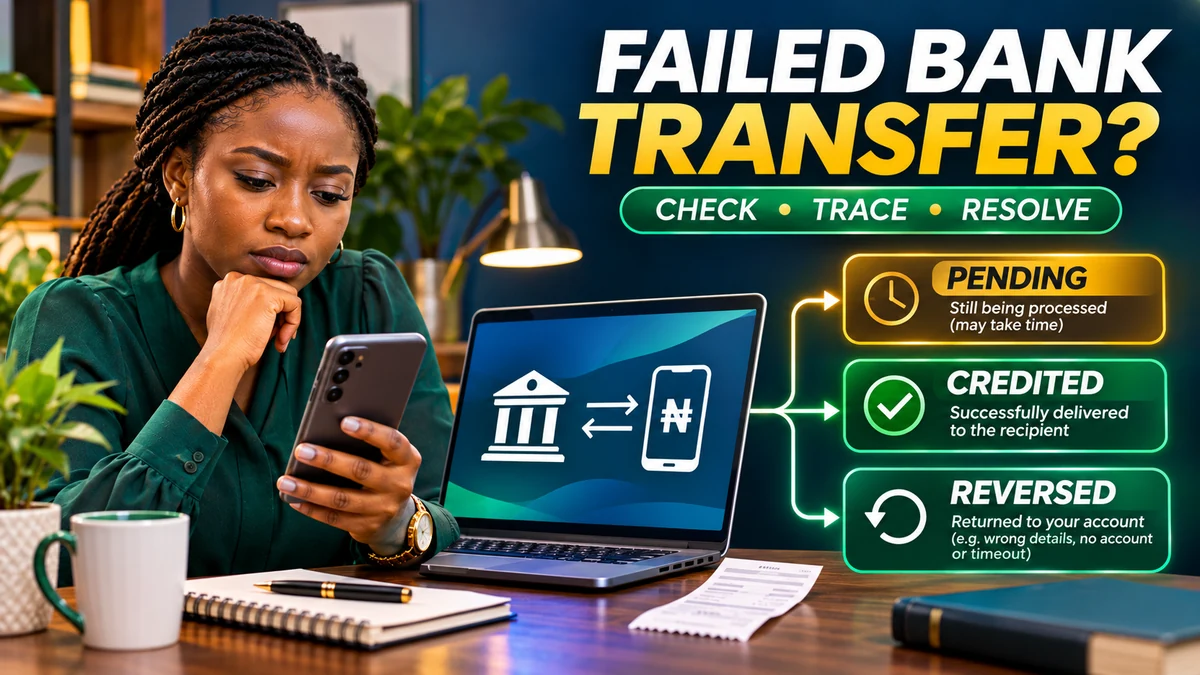
When a bank transfer fails in Nigeria, the money may be returned automatically, remain temporarily in processing, or require the sending and receiving banks to investigate. A reversed transfer means that money previously debited or credited has been returned or corrected under the relevant payment process. The first step is to establish which of those situations actually occurred—not to make another transfer immediately.
Suppose you send ₦75,000 to a supplier. Your banking app displays “processing”, the money leaves your available balance and the supplier says nothing has arrived. You may be dealing with a temporary delay, a failed payment awaiting reversal or a completed transfer that the recipient's bank has not properly reflected. Each has a different resolution path.
Another case is more serious: you enter the wrong account number and the payment successfully reaches a stranger. That is an erroneous transfer, not an unsuccessful transfer. A bank cannot always undo it automatically because the recipient may have been credited and different consent, dispute and recovery rules apply.
This guide explains how Nigeria's instant transfer system works, what CBN rules say about delayed credits and reversals, when to contact your bank, and how to recognise scams. It draws primarily on the CBN's Regulation on Instant (Inter-Bank) Electronic Funds Transfer , NIBSS's official transaction tracker , and the CBN consumer complaints process . Research checked: 12 November 2026.
Failed, pending, successful and reversed transfers: what the statuses mean
| Transfer status or situation | What it may mean | What to do |
|---|---|---|
| Failed / unsuccessful | The intended payment did not complete; the debit may still be visible | Check for an automatic return and contact the sending bank if it does not appear |
| Pending / processing | The final result is not yet confirmed | Check the transaction history; do not blindly send again |
| Successful, recipient not credited | A successful status is recorded, but the beneficiary cannot locate the credit | Ask the beneficiary to check their statement; request a bank-to-bank trace |
| Reversed / refunded | The money has been credited back or an earlier posting has been corrected | Check the actual account ledger and confirm the amount and reference |
| Wrong account credited | The transfer may be complete but went to an unintended beneficiary | Immediately request a formal transfer recall through your bank |
| Unauthorised transfer | A debit occurred without your valid authorisation | Report suspected fraud urgently and secure access to the account |
Do not rely only on the colour of an app's status badge. A merchant's payment screen, the sending bank's transaction record, the receiving bank's account statement and a payment-network status can reflect different points in the transaction journey. Any discrepancy needs investigation.
How Nigerian instant bank transfers normally work
Much of Nigeria's account-to-account instant payment activity uses NIBSS Instant Payment (NIP). The Nigeria Inter-Bank Settlement System (NIBSS) describes NIP as a real-time electronic funds transfer platform that routes payment messages between participating financial institutions.
In a standard transaction, the sending bank identifies the beneficiary, secures the sender's debit and transmits the transfer instruction. The payment service infrastructure forwards the message, while the receiving institution processes the credit and reports a result. The sender may see a receipt or in-app notification, and the beneficiary may receive an alert.
The CBN's 2018 instant-transfer regulation requires the receiving entity to apply an inward instant EFT to the customer's account within 60 seconds, with exceptional pending credits resolved as promptly as possible and within the specified 24-hour limit where security or system concerns prevent immediate credit. It also requires the receiving bank to confirm success only after crediting the beneficiary.
Those rules describe expected processing and accountability; they are not proof that an individual disputed payment has arrived. Always verify the specific transaction.
Why does a bank transfer fail or remain pending?
Several different problems can produce a failure message:
- Insufficient available funds: the account does not have enough money for the principal payment and relevant charges.
- Incorrect recipient details: an invalid account number, bank selection or beneficiary mismatch prevents processing or leads to a rejected instruction.
- Network or service interruption: the app, bank, mobile network, payment service or receiving institution does not respond as expected.
- Timeout or uncertain status: the sender's app times out even though the payment message may already have been processed.
- Security or compliance review: the institution restricts or delays a transaction while applying applicable checks.
- Transfer limit or account restriction: an account's transaction ceiling, risk restriction, authentication control or other valid condition prevents completion.
- Duplicate instruction: the same payment may be submitted twice after an apparent error, creating a separate dispute.
The cause determines the remedy. If no debit occurred and the app clearly reports failure, it may be appropriate to initiate a fresh transfer after checking the details. If your money was debited but the outcome is uncertain, stop and verify first.
The CBN's March 2026 instant-payment security reforms also introduced more customer controls and authentication requirements, with implementation standards taking effect from July 2026. Where a transfer is prevented by an account security setting or verification check, follow your institution's authorised procedure rather than trying to bypass the restriction.
How long should a failed NIP transfer take to reverse?
The CBN's published instant EFT regulation separates several situations. In particular, it requires the sending entity to refund failed proceeds returned by the receiving entity within 10 minutes. It also contains a provision for an unprocessed transaction to be refunded after the relevant settlement interval.
For a failed NIP transfer not reversed into the customer's account within 24 hours, the regulation lists a ₦10,000 sanction per item. That is a sanction assessed under the regulatory framework; it is not a guaranteed ₦10,000 payment to the affected customer. An account holder should not assume their refund must include that amount.
Another section sets a general requirement that instant EFT disputes be resolved within three working days. An investigation may still require documentation and bank-to-bank coordination. For a straightforward failed debit, the system's intended refund timetable should not be confused with the longer consumer-complaint escalation window.
| Rule in CBN's 2018 instant EFT regulation | Time stated | Important context |
|---|---|---|
| Apply ordinary inward instant credit | Within 60 seconds | Receiving institution's normal obligation |
| Refund failed proceeds returned by receiving institution | Within 10 minutes | Sending institution, after the return is received |
| Failed NIP transaction not reversed | 24-hour sanction threshold | Regulatory sanction, not automatic compensation |
| Instant EFT disputes | Three working days | Dispute-resolution provision |
| Ordinary customer complaint escalation to CBN | Generally two weeks after complaint to bank | Separate general consumer-complaint guidance; exceptions apply |
These are the published provisions cited for ordinary instant EFTs, not a promise that every type of card payment, POS dispute, international transfer or fraudulent debit follows exactly the same timetable. Later binding circulars and the specific payment channel may matter.
What to do immediately if you are debited but the receiver gets nothing
- Check your account ledger. Confirm whether the debit appears in the authenticated banking app or statement. An alert alone may not show the final position.
- Check the exact transaction status. Look for a pending, successful, failed or reversed entry and note the date, time and amount.
- Ask the beneficiary to check independently. They should review their own bank's transaction history, not merely wait for an SMS.
- Save evidence. Keep the transaction reference, sending institution, receiving institution, amount and any error message. Avoid sharing full card credentials or banking passwords.
- Avoid immediately repeating the transfer. If the first attempt ultimately succeeds, a second attempt could make you pay twice.
- Contact the sending bank using its official support channel. Request a transaction trace, reference or dispute ticket, describing exactly what the receiver has checked.
- Track the complaint and check for a reversal. A reversal should be visible as an actual credit or corrected balance, not just as a support agent's promise.
If the recipient has already received the payment, do not ask for an automatic refund as though the transfer failed. If a supplier needs to return money after a completed payment, that is a separate repayment or dispute situation.
How to check a NIP transfer through NIBSS
NIBSS publishes a NIP Transaction Tracker for recent instant-payment checks. Its official service page lists the USSD code *565*5#.
According to that page, the sender uses the mobile number registered to the sending bank account, supplies the requested account details and transaction amount, or checks a list of recent NIP transfers. The page says the tracker can confirm transactions from the preceding 48 hours and lists a service charge; confirm the present charge with your mobile or banking provider before using it.
NIBSS explains several possible outcomes: “No” for an unsuccessful transaction, where a reversal should be expected; “Yes” for a reported successful payment, where a beneficiary without a credit should contact their bank; and missing results where the payment may not yet have been processed by the sending bank.
The tracker helps identify what the payment infrastructure reports, but it is not a substitute for the bank's ledger or formal dispute investigation. A person receiving a payment should not be asked to expose someone else's account credentials to use it. For older transactions, refer to the bank's receipt and complaints process.
Who is responsible: the sending bank, receiving bank or NIBSS?
Customers should usually begin with the institution that debited them, because that institution can identify the original instruction and raise the appropriate query. Under the CBN regulation, the sending institution is responsible for customer status notifications, prescribed refunds and pursuing complaints to resolution.
The receiving institution is responsible for applying a valid inward credit, responding to exceptions and handling the recipient-side account record. If a transfer is reported successful but the beneficiary's account has no credit, the beneficiary should also contact the receiving bank with the details.
NIBSS provides payment infrastructure and dispute facilities to participating financial institutions. Its public e-BillsPay guidance directs a customer whose failed payment was debited to the initiating bank, which then engages NIBSS where necessary. It also describes a dispute-resolution system through which the sending and receiving banks exchange claims.
Do not treat an unfamiliar “NIBSS reversal officer” on WhatsApp as an authorised channel. Your bank should provide a verifiable complaint reference and clear next steps.
What happens if you transferred money to the wrong account?
A wrong-beneficiary transfer is not the same as a failed NIP transaction. If the amount reached a valid account, there may be no processing failure to reverse automatically. Recovery depends on whether the mistake was made by the customer or by the bank, whether funds remain and the applicable investigation procedure.
When the customer entered the wrong details
Section 10.4 of the CBN's 2018 instant EFT regulation addresses transfer recall due to customer error. If you know the recipient, the sending bank may encourage an amicable return. If the recipient is unknown or refuses to refund, the sending bank should consider a tenable claim and notify the receiving bank, which may place a lien on available funds and seek the recipient's consent for repayment.
Where consent is withheld, the regulation provides for bank internal auditors to mediate within two weeks of the complaint, with a related limit on the lien period. Where the recipient has spent the funds, recovery can be considerably more complicated and may involve further lawful steps. The mere fact that you made a mistake does not guarantee an instant refund.
When the bank made the error
Section 10.2 deals separately with a sending bank's mistake contrary to the customer's instructions—for example, an unintended account, amount or duplicated posting. It describes written reversal requests within 14 working days and a receiving-bank obligation to act within one business day where the required conditions, including available funds, are met. Those specific rules should not be confused with a customer typing the wrong account number.
In either situation, report immediately, give accurate evidence and ask your bank to classify the case correctly. Avoid circulating a recipient's personal details on social media or threatening them.
What if an unexpected transfer appears in your own account?
Do not assume you are entitled to keep or spend an unexplained credit. It could be a genuine customer payment, an internal bank error, a misdirected transfer or part of a fraud attempt.
The CBN framework requires customers who receive erroneous credits to notify the receiving institution and authorise the appropriate reversal. If someone contacts you directly and insists that you transfer the money to a different account, do not comply solely on their instructions. Ask your bank to confirm the original credit and arrange a properly documented return through its authorised process.
A scammer may create a fake alert, claim a mistaken transfer, or ask you to make a new payment before the initial credit is confirmed. The safest approach is to work through the bank with the real transaction reference rather than manually forwarding money to an unverified account.
What if the transfer was unauthorised or part of a scam?
If you did not approve the transaction—or you were tricked into sending money—act urgently. That is not simply an ordinary technical failure.
Contact the bank's verified emergency or fraud team immediately. Ask it to secure affected access, investigate the debit and, where appropriate, initiate a fraud report or recall with the receiving institution. Change passwords and revoke compromised sessions through official channels. Retain payment evidence, suspicious messages and the timing of the incident.
CBN's instant EFT regulation refers suspected fraudulent transfers to the specialised bank fraud-desk framework. Its 2026 instant-payment reforms require stronger real-time fraud monitoring and customer security controls. Recovery of money sent to a scammer is not guaranteed, particularly if it has already been moved or withdrawn.
For background on safe financial-data sharing and permissions, FlyingEze's guide to open banking, customer consent and rights explains why legitimate financial access should be verifiable and limited to authorised parties.
How to complain if your bank does not reverse the money
Start with an official complaint to the sending institution. Request the transaction reference, the complaint case number and a written explanation of the status. The CBN's public complaint guidance instructs customers to contact their institution first and generally allow two weeks before escalating ordinary unresolved complaints to the CBN Consumer Protection Department. It identifies 30 days for excess-charge and loan complaints.
Those are consumer-complaint escalation periods, not permission for a bank to ignore the shorter instant-transfer processing and dispute rules. Cite the issue accurately: a failed debit awaiting refund, a completed credit not found by the recipient, a customer-error recall or an unauthorised payment.
The CBN also provides a Consumer Complaints Management System portal , which instructs customers to lodge the issue with their financial institution, obtain its reference, allow for complaint information to be uploaded and then use that reference for portal tracking. Its complaint categories distinguish failed transfers, erroneous transfers and unauthorised charges.
For written escalation, CBN's consumer guidance lists cpd@cbn.gov.ng and the Consumer Protection Department at the CBN in Abuja. Check the current official website before sending sensitive supporting documents. Never send a PIN, password, OTP or complete card security code in a complaint.
Example complaint message for a failed bank transfer
Subject: Failed interbank transfer — request for trace and reversal
On [date] at approximately [time], I attempted to transfer ₦[amount] from my account with [sending bank] to [receiving bank]. My account was debited, but the beneficiary says the funds have not appeared.
Transaction reference: [reference]. The status shown in my app is [pending / failed / successful]. I have checked my statement and contacted the beneficiary.
Please trace the transaction, confirm whether the receiving bank applied the credit and arrange the appropriate reversal or correction if the payment failed. Kindly provide a complaint ticket and written update.
This is a suggested template, not an official form. Redact unnecessary information from screenshots and use the institution's approved complaint channel.
What businesses should do before releasing goods after a transfer
For merchants and service providers, payment verification should be a routine control rather than a judgement based on how convincing a receipt looks. A fake transfer alert can resemble a genuine one, while a genuine sender's app may display a successful transaction before a receiver locates it.
Use the business's own authenticated bank app, account statement or authorised merchant system to confirm the incoming credit. Match the payer, amount, reference, invoice and time to the relevant sale. If a payment is pending or disputed, place the order on a clearly documented hold until the institution confirms the outcome.
If a buyer mistakenly pays twice, reconcile both credits before arranging a refund. Use a properly authorised refund or transfer process and record it against the original sale. Do not assume that one of the credits can be ignored or that a duplicate screenshot proves duplicate payment.
Businesses that need better payment-data reconciliation can read FlyingEze's analysis of open-banking account verification and financial-data use cases . Any automated verification must operate through authorised access and must not expose bank credentials to third parties.
Quick decision guide: what should you do now?
| Your situation | First step | Next action if unresolved |
|---|---|---|
| Debit visible, app says failed | Check for the refund/reversal entry | Report to sending bank and request a trace |
| Debit visible, app says pending | Verify status before resending | Open a support ticket with the sending bank |
| App says successful, recipient sees nothing | Both parties check their own statements | Sender requests trace; recipient contacts receiving bank |
| Money went to a wrong valid account | Ask sending bank for a formal mistaken-transfer recall | Follow bank-to-bank consent and dispute process |
| Unexpected credit arrives | Notify receiving bank; do not spend it | Let bank verify and arrange lawful correction |
| Account debited without permission | Contact fraud desk and secure access immediately | Track investigation and escalate appropriately |
| Business customer shows only a screenshot | Check your own account or merchant statement | Do not release goods until payment is independently confirmed |
Frequently asked questions
How long does a failed bank transfer take to reverse in Nigeria?
CBN's 2018 NIP regulation provides for prompt refunds in defined circumstances and lists a regulatory sanction if a failed NIP transfer is not reversed within 24 hours. Actual troubleshooting depends on whether the transfer failed, remains indeterminate or was successfully credited. Contact the sending bank with the transaction reference if the return does not appear.
Will I automatically receive ₦10,000 compensation for a late reversal?
No. The ₦10,000 amount in the cited rule is a regulatory sanction per specified violation, not a guaranteed amount paid into a customer's account. Any compensation or other remedy would require its own applicable basis.
Can a successful bank transfer be reversed?
In certain circumstances, yes—for example, correction of a proven bank error or a properly handled erroneous-transfer recall. But a completed payment to a valid account is not necessarily reversible at the sender's request alone, and beneficiary consent or formal dispute procedures may be required.
Who should I contact when a transfer is debited but not received?
Usually the sending bank first. Ask for a trace and complaint reference. The beneficiary should also check their own account and contact the receiving bank if a successful transaction is reported without a visible credit.
What is NIBSS *565*5# used for?
NIBSS describes it as a transaction-status tracker for recent NIP payments. Its official page limits the check to the sender's registered phone number and transactions within 48 hours. Any current service charge should be confirmed before use.
Should I repeat a transfer that says pending?
Not without verifying the result first. The original payment might complete after the app displays a timeout. A second attempt could produce a duplicate debit.
Can I get money back if I sent it to the wrong account?
You can request a recall promptly through your bank. CBN's instant-transfer regulation describes recipient consent, liens on available funds and bank mediation for customer-error cases. Recovery is not guaranteed if the funds are unavailable or the case remains disputed.
Can a merchant trust a transfer receipt?
Not on its own. The merchant should check its own authenticated bank or payment-provider record and reconcile the credit against the sale before releasing goods or services.
What if my bank refuses to investigate?
Request a written complaint reference, keep supporting evidence and use the institution's formal escalation process. CBN provides general escalation guidance and a complaints portal for unresolved cases involving regulated financial institutions.
Conclusion: confirm the transaction before taking the next action
A failed bank transfer in Nigeria does not always mean money has disappeared. Many unsuccessful transfers are reversed, while some pending instructions need a status trace and some apparent successes require the receiving bank to locate the credit. Mistaken payments and unauthorised transfers demand different, often more urgent, procedures.
The safest process is to check your real statement, establish whether the transaction failed or succeeded, save the reference, contact the appropriate bank and track the complaint. Avoid sending the same payment twice, sharing banking credentials or accepting an unofficial “reversal agent”.
For official guidance, consult the CBN instant EFT regulation , NIBSS transfer tracker and CBN consumer complaints page . Those documents provide a stronger foundation than rumours about automatic reversals and compensation.



