
UK Air Traffic Control Outage Blamed on Software Defect
NATS says a software defect caused the 8 September UK air traffic control outage that disrupted thousands of flights. Here is what happened and what passengers should know.
 Written byEze Chidiebere Paul
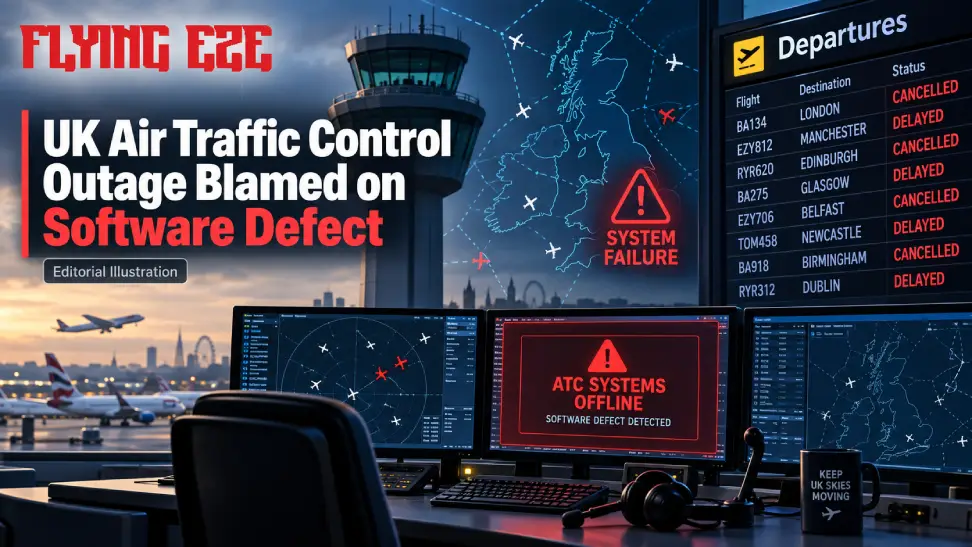
A previously unknown software defect caused the UK air traffic control outage that triggered widespread flight disruption on 8 September 2026, according to the preliminary findings of National Air Traffic Services (NATS).
The failure affected NATS’ flight data processing system and contributed to more than 2,000 flight cancellations, with disruption continuing after the core technical problem had been resolved as airlines worked to reposition aircraft and crews.
What NATS says went wrong
NATS says the fault was located in a software module within the National Airspace System that handles requests to allocate or reassign aircraft squawk codes. These codes help air traffic control identify and track aircraft alongside their flight plans.
According to the preliminary account reported on 18 September, a valid manual request for a squawk code was being processed when the system received a higher-priority task. Processing of the first request was paused, which is normal behaviour. But when the system returned to that request, the previously unknown defect caused it to resume incorrectly and produce corrupted output.
NATS chief executive Martin Rolfe said the issue had been traced to a small subsection of code. Mitigation is in place while a permanent fix undergoes safety testing. NATS has said flight safety was not compromised.
More than 2,000 flights cancelled
The outage hit major UK airports including Heathrow, Gatwick, Manchester and Stansted. Reuters reported that around 2,000 flights were cancelled, while hundreds of thousands of passengers were affected by cancellations, delays and the knock-on disruption that followed.
The incident occurred on Tuesday, 8 September. NATS restored its system later that day, but the effects continued into the following days because aircraft and crews were left out of position across the network.
What the finding rules out
The preliminary finding is important because it provides a technical explanation after several days of speculation about what triggered the failure.
NATS says the incident was unrelated to its major August 2023 outage. UK officials had also previously said there was no evidence that the September incident was caused by a cyberattack.
Reports had suggested that a military flight plan might have triggered the failure. The new explanation says the request being processed was valid and correctly made; the failure occurred because of the software defect when processing resumed after an interruption by a higher-priority system task.
CAA will independently review the outage
The UK government has asked the Civil Aviation Authority to carry out an independent review. The regulator will examine what happened, assess NATS’ resilience and consider its investment plans and regulatory accountability.
Transport Secretary Heidi Alexander described the disruption as unacceptable and said the government needed to understand why the defect had not been discovered before it caused such extensive disruption.
The review matters because this was another major failure of UK air traffic infrastructure following the August 2023 incident, which the CAA later estimated affected more than 700,000 passengers.
What affected passengers should know
The CAA has separately issued guidance on passenger rights following the 8 September disruption.
The regulator considers delays and cancellations directly caused by the NATS outage, including some knock-on effects, likely to constitute “extraordinary circumstances”. That means affected passengers are unlikely to qualify for the standard cash compensation that can apply when disruption is within an airline’s control.
However, airlines still have important duties of care. The CAA says passengers whose flights are cancelled should be offered a choice between a refund, rerouting at the earliest opportunity or rerouting at a later date.
Airlines must also provide appropriate care during lengthy delays, including meals and refreshments and, when necessary, hotel accommodation. Where an airline cannot provide suitable care directly, passengers may be able to recover reasonable costs, so keeping receipts is important.
Why the software explanation matters
Air traffic control systems are safety-critical infrastructure, so failures can rapidly reduce the number of aircraft permitted to move through controlled airspace even when aircraft themselves are operating normally.
The preliminary explanation suggests the September disruption did not result from invalid flight information or malicious interference. Instead, an unusual sequence of otherwise legitimate system events exposed a dormant software defect.
That distinction will shape the next stage of scrutiny: whether testing, software assurance and resilience arrangements should have identified the defect earlier, and whether NATS has sufficient safeguards to prevent a single software failure from producing disruption on this scale.
What happens next
NATS says mitigation is already in place while it safety-tests a permanent correction. The CAA’s independent review will provide a separate assessment of the operator’s findings and wider resilience.
For travellers, normal operations have resumed, but the investigation is likely to keep attention on the reliability of Britain’s air traffic infrastructure and the protections available when a system-wide failure disrupts flights.
Sources
Continue reading

Nigerian Airlines Challenge NCAA’s August Flight Delay Data
Air Peace, United Nigeria and ValueJet are challenging NCAA’s August 2026 flight-delay data, raising questions about flight counts, delay causes and passenger rights.

British Airways reveals new flights to bucket-list beach & safari spots – 14 years after they first launched
LOOKING for your next big holiday? Look no further as British Airways has revealed a major update to its summer 2027 schedule with flights to TWO East African d...

Best UK garden centres for family days out – with arcade games, FREE soft play, fairgrounds… and even a beach
FANCY a fun day out at the garden centre, but need something a little more exciting than just bulbs and shrubs to keep the kids occupied? These 10 garden centre...

The English holiday destinations set to be huge in 2027 – from new theme park lands to cool seaside towns
THERE’S lots of exciting things happening in 2027 across England, with plenty to interest all ages. From the opening of the world’s first Minecraft land to a b...