
Nigerian Airlines Challenge NCAA’s August Flight Delay Data
Air Peace, United Nigeria and ValueJet are challenging NCAA’s August 2026 flight-delay data, raising questions about flight counts, delay causes and passenger rights.
 Written byEze Chidiebere Paul
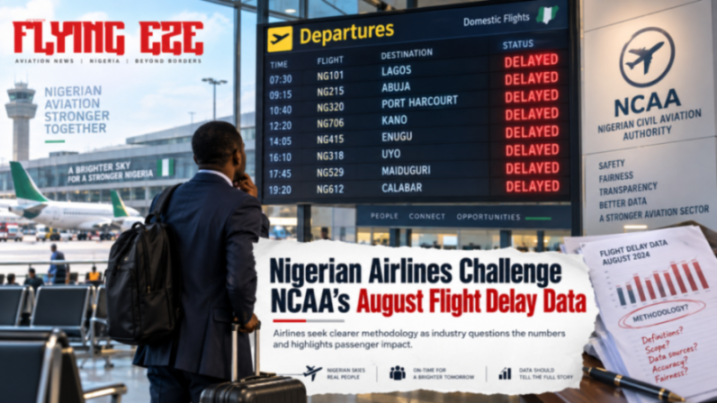
Nigerian airlines are challenging the Nigeria Civil Aviation Authority’s August 2026 flight-disruption figures, raising a wider question about how delays should be measured and who should be held responsible when airport congestion, weather, infrastructure or other external factors disrupt domestic flights.
The NCAA’s official August summary says Nigerian domestic airlines operated 7,961 flights during the month, with 4,765 delayed and 36 cancelled. That means roughly 59.9% of the flights recorded by the regulator were delayed.
Air Peace, United Nigeria Airlines and ValueJet have since pushed back against the way the figures were presented. Air Peace says the regulator undercounted the number of flights it operated, while airline executives have argued that published disruption data should distinguish delays within an airline’s control from delays caused by weather, airport congestion, infrastructure, security procedures and other external factors.
Key takeaways
- The NCAA’s August 2026 summary records 7,961 domestic flights, including 4,765 delays and 36 cancellations.
- Air Peace says it operated 2,564 flights in August rather than the 1,864 attributed to it in the NCAA summary.
- United Nigeria and ValueJet have also called for clearer separation between airline-controlled delays and disruptions caused by external conditions.
- The dispute does not erase the scale of disruption experienced by passengers, but it raises questions about how performance data should be interpreted.
- NCAA passenger-rights guidance says domestic passengers are entitled to refreshments after a two-hour delay and reimbursement of the full ticket value beyond three hours, subject to the applicable regulations and circumstances.
What the NCAA reported
The Nigeria Civil Aviation Authority published its August 2026 domestic airline disruption summary on 13 September.
According to the figures reported from the NCAA dataset, Nigerian carriers operated 7,961 domestic flights during August. Of those, 4,765 were recorded as delayed and 36 as cancelled.
Air Peace was listed with 1,864 flights, of which 1,330 were delayed. United Nigeria Airlines was listed with 1,231 flights and 943 delays, while ValueJet was listed with 767 flights and 435 delays.
The figures immediately attracted attention because they suggest widespread punctuality problems across the domestic market. But the airlines’ response has shifted the debate from the raw number of delays to the methodology behind the figures.
Air Peace disputes its flight count
Air Peace says the NCAA’s total for its August operations is wrong.
In a statement reported by Premium Times and Channels Television , the airline said it operated 2,564 flights during August rather than the 1,864 shown in the regulator’s summary.
If the airline’s figure is correct, the denominator used to calculate its delay rate would be materially different. Air Peace argues that omitting more than 700 flights makes its operational performance appear worse than it was.
The airline has also criticised the report for not showing the causes of individual delays.
Airlines want delays separated by cause
United Nigeria Airlines and ValueJet have made a related argument: a flight can leave late even when the airline itself is ready.
Airline representatives have pointed to airport congestion, bad weather, inadequate infrastructure, security procedures, presidential movements, technical safety checks and other operational constraints that can affect departure times.
That distinction matters because a simple delay percentage can tell passengers how often flights departed late, but not necessarily why they were late or which organisation had the ability to prevent the disruption.
For the regulator and passengers, however, the practical experience remains the same: a delayed flight can disrupt connections, business meetings, medical appointments and other time-sensitive plans.
The data dispute does not remove the passenger problem
Even if some of the airlines’ methodological objections are ultimately validated, the NCAA’s overall figures still point to significant disruption across Nigeria’s domestic aviation network during August.
The central policy question is therefore not simply whether one airline’s delay percentage should be higher or lower. It is whether Nigeria can develop a more transparent disruption-reporting system that shows both the extent of delays and their causes.
A more useful public dataset could, for example, separate delays linked to airline operations from those caused by weather, air-traffic restrictions, airport infrastructure, security, ground handling or other external events. That would give travellers a clearer picture of airline reliability while also helping regulators identify system-wide bottlenecks.
What Nigerian passengers are entitled to when flights are delayed
The NCAA’s own passenger-rights guidance says travellers have rights when flights are delayed or cancelled.
For domestic flights, the regulator says passengers are entitled to refreshments after a delay of two hours from the scheduled departure time. Beyond three hours, the guidance says the carrier should reimburse passengers the full value of their tickets.
For domestic cancellations, NCAA guidance also describes compensation and reimbursement rights, with exceptions depending on when passengers were informed and the circumstances of the disruption.
Passengers with unresolved complaints are advised by the NCAA to raise the matter with the airline first. If the airline does not resolve it, the regulator says passengers can use an NCAA Consumer Protection desk, its online complaint channel or the published consumer-protection contact process.
Why better disruption data matters
Reliable punctuality statistics can influence how travellers choose airlines, how regulators identify recurring problems and how airlines are held accountable for service quality.
But reliability data becomes less useful if airlines and regulators do not agree on the number of flights being measured or on how responsibility for delays should be classified.
That makes this dispute more than a disagreement over one month’s figures. It highlights the need for a consistent reporting standard that allows passengers to compare airlines fairly while distinguishing operational failures from wider infrastructure and weather-related disruption.
FlyingEze has previously covered Air Peace’s explanations for earlier flight cancellations , illustrating how weather, safety and operational conditions can complicate simple delay statistics.
What happens next
The NCAA has not withdrawn its August summary. Air Peace, United Nigeria and ValueJet are continuing to challenge how the information was compiled or interpreted.
The most useful next step would be clearer reconciliation between the regulator’s operational records and airlines’ own flight logs, alongside more detailed cause codes for disruptions.
Until that happens, passengers should treat the August figures as an important indicator of widespread delays, while also recognising that the current public data does not fully explain why each disruption occurred.
Sources
Continue reading
UK market towns could BAN drinking alcohol in public spaces as soon as October with £100 fines under new rules
A BAN on drinking alcohol in public places could be introduced in a number of popular UK market towns. It could come into force as soon as October, with anyone...

Indigeneship: Group defends Yayi, says Adebutu lacks moral standing to question his credentials
The Ogun Youth Vanguard (OYV), a pressure group, has hit back at attempts to question the indigeneship of the All Progressives Congress (APC) governorship candi...
ADC demands probe into deaths of 37 Nigerians in NSCDC custody
The African Democratic Congress (ADC) has called for an immediate, independent and transparent investigation into the deaths of 37 Nigerians who reportedly died...
Our UK nudist beach has been taken over by SWINGERS who have sex in broad daylight – creeps take photos & follow us home
NESTLED away behind a high 20ft sea wall in the heart of a suburb on the south coast is a secret “unofficial” nudist spot. The beach is a long stretch of pebble...